The Ponte Vecchio is one of the most photographed bridges in the world, and crossing it takes about 30 seconds if you move at a walking pace rather than stopping to photograph it from itself. The jewellers’ shops on either side are real and have been here in some form since the 16th century — gold and silver, rings and necklaces, set behind small shop fronts that have not changed their basic format in several hundred years. The tourists are dense, the view from the middle of the Arno is genuinely striking in both directions, and the bridge is worth crossing slowly once. And then you reach the other side, and that is where the more interesting part of the afternoon starts.
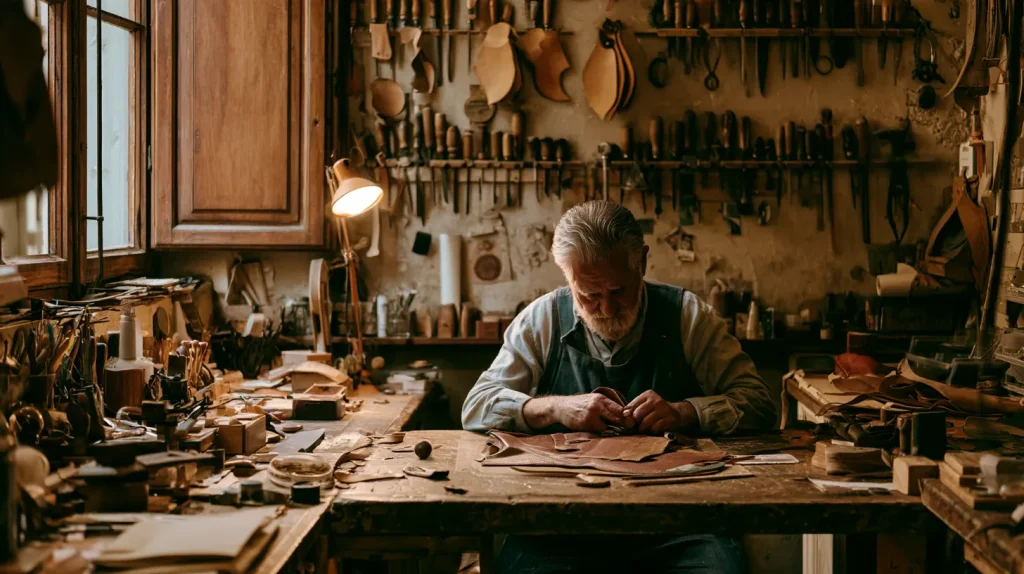
The Oltrarno — the name literally means “beyond the Arno” — is the neighbourhood south of the river, and it is the part of Florence that most visitors only glance at from the north bank while photographing the bridge. It is quieter, more residential, and maintains a tradition of artisan craft that has been disappearing from most European cities for decades. The streets between the Pitti Palace and Piazza Santo Spirito still contain functioning leather workshops, bookbinders, gilders, and furniture restorers in the ground floors of the same buildings they have occupied for generations.
Spend a morning or afternoon here and you see a different Florence from the museum circuit on the north bank — one that still has the texture of a working neighbourhood alongside its extraordinary density of art and architecture.
The Ponte Vecchio: What You’re Actually Looking At
The current bridge was built in 1345, replacing an earlier structure destroyed by flooding in 1333. It is the only bridge in central Florence that survived World War II — and the real story behind that is more interesting, and more specific, than the popular version.
In the summer of 1944, as German forces retreated up the Italian peninsula, Field Marshal Kesselring ordered every bridge over the Arno in Florence destroyed to slow the Allied advance — an operation codenamed Feuerzauber (“fire magic”). The Ponte Vecchio was the one exception. The popular legend credits Hitler personally, and there’s a real basis for that: Hitler had visited Florence in 1938, was reportedly charmed by the bridge and the view from the Vasari Corridor above it (Mussolini had the corridor’s central windows enlarged for the occasion), and is recorded as having told an ambassador that Florence was “too beautiful a city to destroy.” But the actual order sparing the bridge in 1944 came from Gerhard Wolf, the German consul in Florence, who lobbied Kesselring and the German ambassador directly against its destruction — and who separately used his position to help protect political prisoners and Jewish Florentines during the occupation. The Germans still destroyed the medieval buildings at both ends of the bridge to block Allied access, which is why the buildings flanking the Ponte Vecchio today look distinctly post-war while the bridge itself is medieval. Wolf has a memorial plaque on the bridge and was later made an honorary citizen of Florence.
The shops on the Ponte Vecchio are jewellers today, but they were not always. For much of the bridge’s medieval history it was home to butchers and tanners, whose waste went directly into the Arno below. According to the most commonly told account, Ferdinando I de’ Medici — who lived in the Pitti Palace and used the Vasari Corridor above the bridge to commute — issued a decree in the 1590s replacing the butchers and tanners with goldsmiths and jewellers, whose trade was considered more dignified for the corridor overhead (and more pleasant for the Grand Duke’s nose during his commute).
Today the shops sell gold and silver jewellery, with prices to match their location. Window shopping is free. The best views of the bridge are from the Ponte Santa Trinita to the west or the Ponte alle Grazie to the east — photographing the Ponte Vecchio from the Ponte Vecchio itself is difficult for obvious reasons.
Crowds peak between 10am and 5pm. Before 8am and after 7pm the bridge is a different experience — the shops are shuttered, the light is better, and you can actually stand still on it.
Santa Felicita: The Most Underrated Church in Florence
Cross the Ponte Vecchio into the Oltrarno and turn left immediately onto Via de’ Guicciardini. Within 50 metres you reach the small Piazza di Santa Felicita and the Church of Santa Felicita, which most visitors walk past without entering.
Do not walk past it.
The church contains Pontormo’s Deposition (also known as the Descent from the Cross), painted between 1526 and 1528 and hanging in the Capponi Chapel on the right side of the nave. It is one of the strangest, most beautiful paintings of the 16th century — the figures float in an impossible pile of bodies with colours (acid pink, sea green, orange) that have no precedent in Renaissance painting and no logical successor. Pontormo was working at the edge of what painting could do with anatomy and colour simultaneously. The result is disturbing and extraordinary in equal measure.
Also in the church: Pontormo’s Annunciation on the window wall of the same chapel, and a Vasari Corridor window above the main entrance where the Medici family could attend mass in private without being visible to the congregation.
Entry is free, as is standard for an active parish church, though a small donation is always appreciated. Allow 20-30 minutes minimum. If you can, spend time with the painting rather than glancing at it — the more you look at the Pontormo Deposition, the stranger and more compelling it becomes. The figures in the lower left appear to be floating rather than standing; the weight distribution makes no physical sense; the colours have no naturalistic justification. It is a painting made by someone who had absorbed everything the Renaissance had to teach and was working past it.
Via de’ Guicciardini to Pitti Palace
Continue south on Via de’ Guicciardini and you reach the Piazza de’ Pitti and the enormous facade of the Palazzo Pitti. Cosimo I de’ Medici’s family purchased the palace in the mid-16th century, and the Medici — and subsequently the Lorraine dynasty and the Savoy royal family — used it as the principal residence of Florentine rulers until Italian unification in the 19th century.
The Pitti Palace is now a complex of several museums under the same roof. The main collections:
Palatine Gallery: the art collection of the Medici and subsequent ruling families, covering Raphael, Titian, Rubens, Caravaggio, and others — a significant collection that receives far fewer visitors than the Uffizi.
Royal Apartments: the state rooms as furnished during the Savoy period.
Gallery of Modern Art: 19th and 20th century Italian painting — consistently undervisited and worth time if this period interests you.
Boboli Gardens: the formal gardens behind the palace, a large terraced hillside with grottos, fountains, and a citrus collection. The garden contains the Kaffeehaus pavilion with views over the city — a useful rest stop on a warm afternoon.
Ticket prices: as of 2026, a same-day combined Pitti Palace + Boboli/Bardini Gardens ticket costs €22 purchased on the day, or €25 booked in advance. If you also want the Uffizi, a 5-day combined ticket covering the Uffizi, Pitti Palace, and Boboli Gardens is available for €40, which is worth it if you’re planning to spread these visits across your stay rather than rushing them into one day — you visit the Uffizi first on a fixed slot, then have five days to use the rest. Pre-booking is generally less urgently required for Pitti than for the Uffizi — Pitti typically has available slots closer to your visit date.
Honest assessment: the Pitti Palace is a significant museum and deserves a proper visit. But it is also very large — the Palatine Gallery alone covers dozens of rooms — and attempting to combine it with the rest of an Oltrarno half-day makes neither experience satisfying. Give Pitti its own half-day if art is a primary interest of your Florence trip. For a neighbourhood walk focused on the Oltrarno’s character and atmosphere, you can see the palace’s exterior and proceed.
The Artisan Streets of San Frediano
The neighbourhood west of Pitti Palace — the sestiere of San Frediano — is where Oltrarno’s reputation as an artisan quarter is most visible. Dozens of traditional workshops operate in the ground floors of the buildings here, many with open doors that allow you to see the work in progress.
What you find here: leather workers shaping bags and belts by hand, bookbinders repairing antique volumes and making hand-marbled paper, picture framers gilding frames with gold leaf, furniture restorers working on 18th-century pieces. These are not tourist-facing demonstrations — they are functioning workshops that happen to be physically visible from the street.
Via Santo Spirito and the surrounding streets are the core of this district. Walking slowly through the area between the Pitti Palace and Piazza Santo Spirito takes 15-20 minutes and rewards looking into open doorways rather than moving at a tourist pace. Many workshops keep their doors or windows open during standard Italian working hours, with the traditional midday closure common to smaller Florentine businesses — hours vary shop to shop, so this is worth checking if a specific workshop is your destination. The leather school (Scuola del Cuoio), housed within the Santa Croce monastery complex on the other side of the centre, offers workshops for visitors who want to make their own leather item under guidance. Studios around Via del Parione and elsewhere in the Oltrarno offer paper marbling demonstrations and classes — the process of drawing patterns on water to transfer to paper is genuinely satisfying to watch. Many of the smaller workshops are simply open and visible without any organised visit, and the craftspeople are generally not bothered by people stopping to look through the window at work in progress.
Piazza Santo Spirito
Piazza Santo Spirito is the social heart of the Oltrarno — a wide, flat square with the plain, unfinished facade of Brunelleschi’s Basilica di Santo Spirito on the south side and a ring of bars and cafés around the perimeter.
Brunelleschi designed Santo Spirito starting in 1428 (construction began in 1436 and was completed after his death). The exterior gives nothing away — deliberately plain stone, no decoration. The interior is one of the purest Renaissance spaces in existence: a perfectly proportioned nave with semicircular chapels running the full length of both sides, each holding its own altarpiece. The mathematical logic of the space is visible and the effect is calming rather than overwhelming. In the sacristy: a wooden crucifix traditionally attributed to a young Michelangelo, though — as with much early attribution — the scholarly consensus has shifted over time and it’s worth checking current signage in the church rather than treating the attribution as settled fact. Entry to the church itself is generally free.
The piazza itself is used for a morning flea market on the second Sunday of each month and on most other mornings has a small daily market. In the evenings it fills with residents of the neighbourhood — aperitivo bars open their windows, students congregate on the church steps, and the square functions as a genuine neighbourhood gathering point rather than a tourist attraction.
Bardini Garden and Views
From Piazza Santo Spirito, walk east along Via dei Renai or Via dei Bardi toward the Giardino Bardini, a formal garden on the hillside above the Oltrarno. The garden is included in the same combined ticket as the Pitti Palace and Boboli Gardens (€22-25, as above) and is far less visited than Boboli itself, with views over Florence that are arguably better — looking north across the Arno to the Duomo and the city roofscape.
In April and May, the Bardini Garden’s wisteria tunnel is one of the most photographed sights in Florence — a long pergola of purple-flowered wisteria in full bloom, with the Duomo visible above the rooftops behind it. The wisteria blooms for roughly three to four weeks and the exact timing varies by year and temperature. Outside the wisteria season, the terraced garden and the viewpoints over the city are still worth the entrance fee and the short uphill walk — the perspective on Florence from this hillside is different from the more famous Piazzale Michelangelo and often has fewer people.
From the Bardini Garden you can continue uphill on foot to Piazzale Michelangelo and San Miniato al Monte — covered in the companion post on the Accademia and Piazzale Michelangelo — which turns the Oltrarno half-day into a longer full-day itinerary for those who have the energy and the right footwear. The walk from the Bardini Garden to Piazzale Michelangelo takes roughly 15-20 minutes uphill on good paths.
Timing and Practical Notes
The Oltrarno half-day works well in the afternoon when the Uffizi crowd and morning museum queues have thinned. Cross the Ponte Vecchio after 2pm, spend 20 minutes in Santa Felicita, decide whether Pitti Palace is on your agenda (it takes 2-3 hours for the Palatine Gallery alone), walk the artisan streets, reach Piazza Santo Spirito for aperitivo, and end at the Bardini Garden for the early evening view.
The neighbourhood has the best restaurant-to-tourist ratio in central Florence by a significant margin. Most of the trattorias and wine bars around Piazza Santo Spirito, along Via dei Serragli, and in the San Frediano streets are priced for residents rather than visitors — a meal that would cost considerably more in the area around the Duomo is meaningfully cheaper here for equivalent quality. If you are eating one dinner in Florence at a genuinely good value-for-quality trattoria, Oltrarno is the neighbourhood to look for it.
Getting to the Oltrarno: the Ponte Vecchio is the most central crossing point, but also the most crowded. The Ponte Santa Trinita (one bridge to the west) and the Ponte alle Grazie (one bridge to the east) give faster crossings with less foot traffic and better side views of the Ponte Vecchio itself.
suggested link — Accademia Gallery & Piazzale Michelangelo: Florence Art Guide
suggested link — 3 Days in Florence: First-Timer Itinerary & Top Highlights
Ponte Vecchio WWII history verified against multiple independent historical accounts, which broadly agree that Gerhard Wolf’s direct intervention with Field Marshal Kesselring was the operative cause of the bridge being spared, while acknowledging Hitler’s earlier fondness for the site as likely contributing context rather than a direct 1944 order. Pitti Palace, Boboli, and Bardini Garden ticket prices verified August 2026 against the official Uffizi Galleries ticketing site. The Michelangelo crucifix attribution at Santo Spirito is a long-contested piece of scholarship rather than settled fact — check current in-church signage for the museum’s present position.