Why Venice’s Seafood Is Different
Venice sits in a shallow tidal lagoon — the Laguna Veneta — that is one of the most biologically productive ecosystems on the northern Mediterranean coast. The lagoon’s mix of fresh and saltwater, tidal channels, and centuries of managed fishing grounds produces seafood that is genuinely different from what you eat in landlocked Italy or even in coastal cities with direct ocean access.
The fish and shellfish served in the best Venetian restaurants are often pulled from the lagoon or the northern Adriatic hours before they reach the plate. Venetian seafood cooking reflects this freshness — the preparations are typically simple, designed to highlight the ingredient rather than mask it with heavy sauces. A fritto misto cooked well in Venice is light, clean, and completely unlike the same dish done with frozen fish elsewhere.
Knowing which dishes are specifically Venetian — rather than broadly Italian seafood — helps you order with confidence and eat considerably better.
The Rialto fish market, which has operated on the same site since 1097, is the daily point of contact between the lagoon and the city’s kitchens. What arrives there in the morning shapes what appears on menus that afternoon. Visiting the market before a restaurant lunch is one of the best ways to understand what is actually in season.
Key Venetian Seafood Dishes to Know
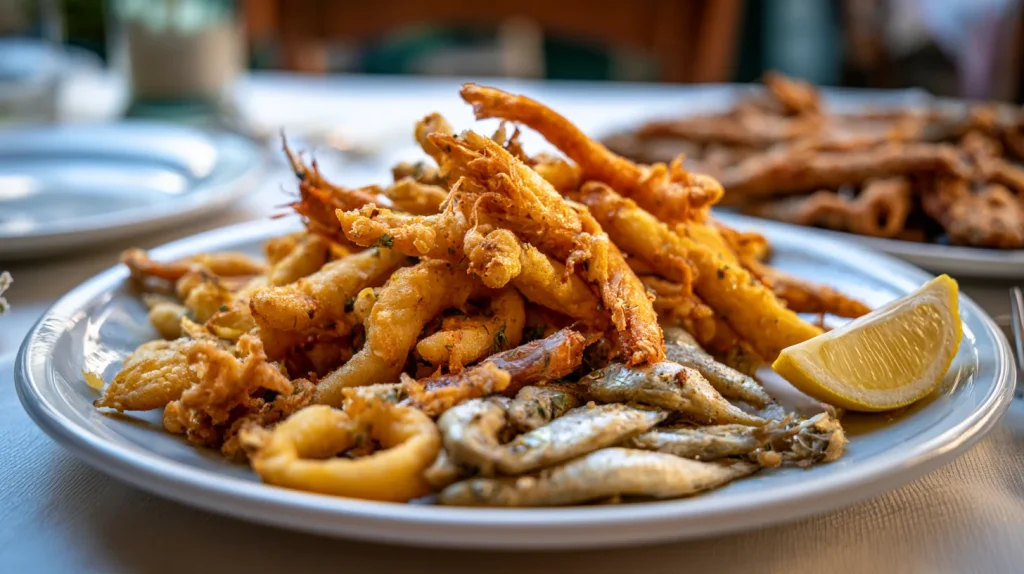
Fritto misto di mare (mixed fried seafood): The classic, and the one that varies most by season and catch. A proper Venetian fritto misto includes whatever came in from the lagoon and Adriatic that morning — baby shrimp, small squid, soft-shell moleche crabs when in season, tiny whole lagoon fish, sometimes scallops. Everything gets a light dusting of flour and a quick, hot fry — the result should be golden and grease-free, not heavy or oily. The version served with frozen fish from industrial suppliers is a different dish in almost every meaningful way. In the best restaurants, fritto misto is explicitly listed as using lagoon fish (pesce di laguna) or northern Adriatic fish (pesce dell’Adriatico) — this distinction matters and is worth asking about if the menu does not specify.
Sarde in saor (sweet-sour sardines): One of the oldest documented dishes in Venetian cuisine, with recipes recorded since the 14th century. Fresh sardines are fried, then marinated in a sweet-sour preparation of cooked onions, white wine vinegar, raisins, and pine nuts. The finished dish is served cold or at room temperature and improves with time — a sarde in saor made two days ago is better than one made this morning. It was originally developed as a preservation technique for fish on long sea voyages, and the same recipe that served the Republic’s galley crews is still served in bacari across the city. The pine nuts and raisins trace back to medieval trade routes through the Arab world — ingredients imported through Venice’s eastern Mediterranean connections that became embedded in the local cuisine so thoroughly that most Venetians no longer think of them as exotic.
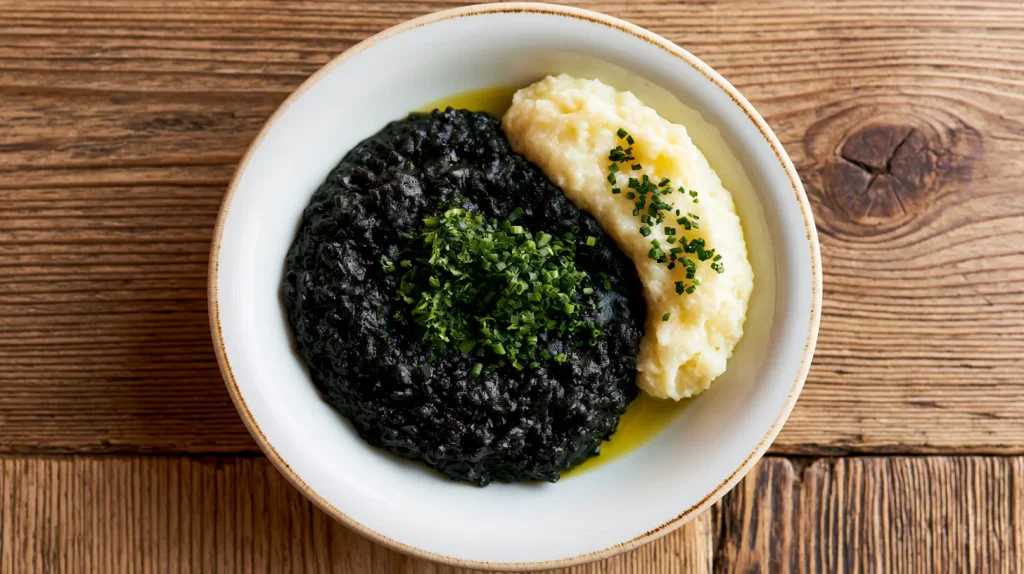
Risotto al nero di seppia (squid ink risotto): The most visually striking dish in Venice — rice cooked with cuttlefish and its ink, turning the entire dish a deep, glossy black. The flavour is intensely marine without being fishy, as the cuttlefish stock is absorbed into the rice while the ink adds depth rather than sharpness. The dish looks dramatic but eats surprisingly cleanly. The ink stains teeth temporarily — this is normal and not alarming. Served with a piece of grilled white polenta on the side in many restaurants, the polenta providing a neutral counterpoint to the intense marine flavour of the risotto.
Risotto di gò (goby fish risotto): The most Venetian of all risotti, made with goby — a small, bony lagoon fish that exists in enough quantity in the Laguna Veneta to be a staple ingredient but is virtually unknown outside the region. The goby are used to make a broth in which the rice is cooked; the fish themselves are too bony to eat whole but the flavour they contribute is intense and specific. This is not a dish you will find outside Venice and the surrounding lagoon communities. Finding it on a menu is generally a sign of a kitchen taking traditional cuisine seriously.
Moleche (soft-shell lagoon crabs): A seasonal dish available for a few weeks in spring and again in autumn, when the lagoon crabs shed their shells and are briefly soft-bodied. Moleche are fried whole — shell and all — and eaten entirely. The season is short, unpredictable, and now affects fewer restaurants each year as lagoon crab populations decline [VERIFY current availability]. Finding moleche on a menu when you are in Venice is worth treating as a priority. They are expensive — prices can run €25-35 for a plate [VERIFY current pricing at restaurants] — because the harvesting window is narrow and the crabs must be monitored constantly during their moulting process. The cost reflects genuine scarcity and skilled production, not tourist markup.
Bigoli in salsa: Thick whole-wheat pasta (bigoli) in a sauce of slow-cooked salted anchovies and onions. Simple and deep-flavoured, one of the oldest pasta dishes in the Venetian repertoire. The anchovy sauce dissolves almost completely during cooking, leaving a savoury, deeply umami coating on the pasta rather than identifiable anchovy pieces. Bigoli is a pasta shape unique to the Veneto region — thick, rough-surfaced, and made with whole wheat flour or sometimes duck eggs, which gives it a different texture from the smoother pasta of southern Italy. This dish is also a traditional Friday dish, reflecting the Catholic tradition of meatless Fridays that shaped Venetian cuisine for centuries.
Where to Eat Venetian Seafood
Antiche Carampane (Calle della Carampane, San Polo): Widely considered one of the best seafood restaurants in Venice. The location is deliberately difficult to find — down a series of narrow calli away from the tourist streets. The menu changes daily based on what arrived from the market that morning. Reservations are required [VERIFY current reservation requirements]. No tourist menu, no pasta for children listed at the bottom — this is a serious fish restaurant.
Trattoria alla Madonna (Calle della Madonna, San Polo): A large, busy, old-school Venetian trattoria near the Rialto. Not the most refined option but consistently good quality at reasonable prices for the location. The fritto misto and seafood pasta are reliable choices.
Trattoria Da Romano (Via Galuppi, Burano): On the island of Burano, running since 1947. A full sit-down restaurant with a classic Venetian seafood menu; the risotto de gò here is frequently cited as one of the best in the region. Worth combining with a day trip to Burano and the other islands [VERIFY current opening hours at trattoriadaromano.it].
The general rule for finding a good seafood restaurant in Venice: if the restaurant displays a tourist menu in multiple languages with photographs, it is not sourcing fresh local seafood. If the menu is handwritten or changes frequently, and the prices are slightly higher than the tourist strip, you are in the right direction. Venice has more bad restaurants than good ones in purely numerical terms — the sheer volume of day-tripper traffic has created an economic incentive to serve lower-quality food at high margins to people who will not return. The good restaurants exist and are not hard to find if you are willing to walk a few streets away from the main tourist corridors and look for the signs of a kitchen that cares.
The Venetian Spritz
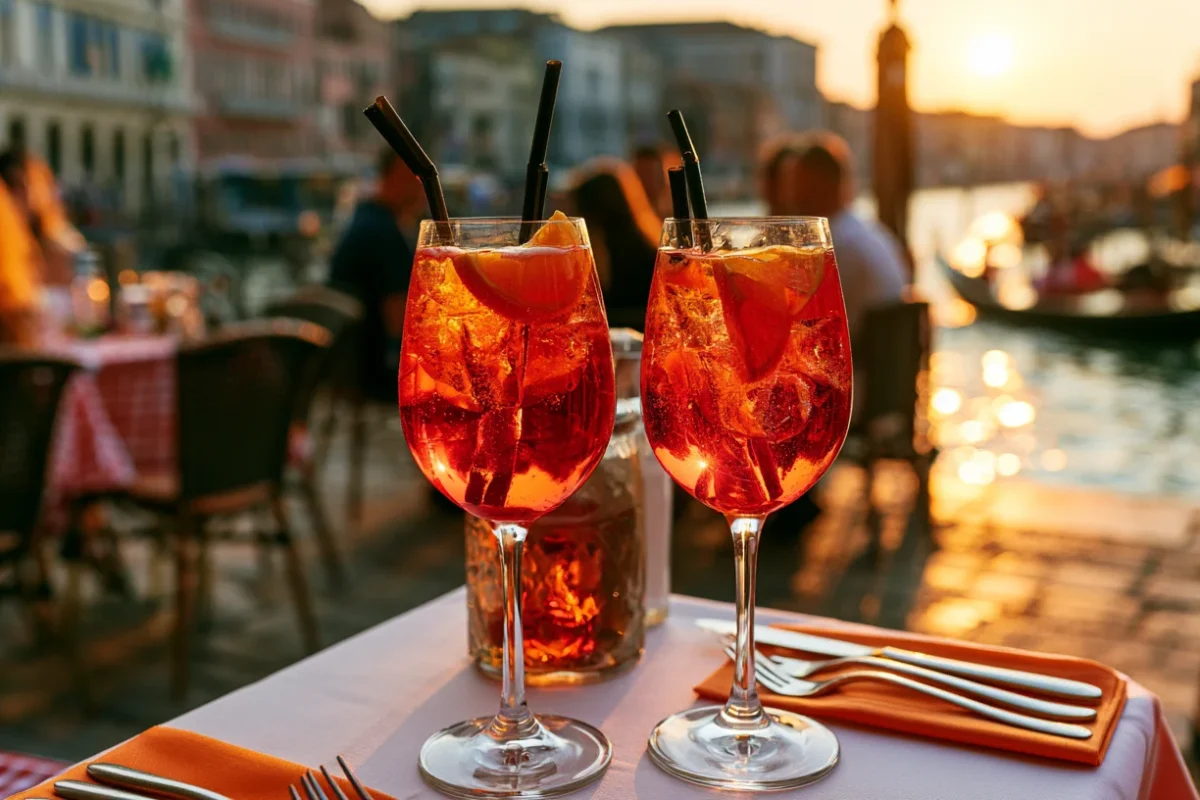
The spritz is Venice’s signature aperitivo drink, served in a large wine glass over ice with an orange slice. The traditional Venetian recipe uses Select — a locally produced bitter liqueur made in Venice since 1920, with notes of juniper, rhubarb, and citrus — combined with prosecco and a small splash of soda.
The more internationally known Aperol spritz uses Aperol instead of Select. Aperol is sweeter, lighter in bitterness, and orange-flavoured. It is not wrong to drink it in Venice, but Select is the local version and the one that pairs better with the salty, savoury cicchetti and seafood of Venetian aperitivo culture.
How to order: Ask for a “spritz con Select” to get the Venetian version. The bartender will know what you mean. In tourist-heavy bars, Aperol is often the default; in neighbourhood bacari, Select is standard.
The timing: Venetians drink spritz before meals — specifically between 11am and 1pm and again between 5pm and 8pm. Having a spritz outside these windows is not against any rule, but within them you are part of a citywide social ritual that includes most of the neighbourhood standing outside with the same red glass. This is aperitivo as lived culture rather than performance.
The spritz also comes in variations beyond Select and Aperol. Campari spritz is darker and more bitter. Some bars offer house versions with local amari. In the Ghetto neighbourhood, one bar serves a saffron spritz that reflects the area’s historic spice trade connections. Asking what the bar recommends or what is made in-house often turns up something interesting.
Where to drink it:
- Bacareto da Lele (Fondamenta dei Tolentini, Santa Croce): A long-standing local institution near Piazzale Roma, tiny and standing-room-only, frequented by local university students and neighbourhood residents. One of the cheapest spritzes available anywhere in Venice.
- Osteria Al Squero (Fondamenta Nani, Dorsoduro): Opposite the gondola boatyard, with canal-side outdoor space and sunset views toward the lagoon.
- Any neighbourhood bacaro away from the San Marco area — price drops significantly, quality stays consistent.
What to Drink With the Food
The natural wine pairing for Venetian seafood is the local white wine — Soave from the Veneto hills east of Verona, or Pinot Grigio delle Venezie from the northeastern Veneto. Both are dry, light, and crisp, with enough natural acidity to work alongside delicate seafood without overpowering it. In bacari, ordering the house white (bianco della casa) is usually the cheapest and perfectly adequate option.
For heavier dishes like bigoli in salsa or squid ink risotto, a light Venetian red — Bardolino from the shores of Lake Garda, or a simple Valpolicella — works better than a white. These are not powerful wines and do not compete with the food.
Prosecco is produced in the Veneto hills (the Conegliano-Valdobbiadene DOCG area) and is the local sparkling wine. Drinking it in Venice gives it a context that it entirely lacks when drunk elsewhere — this is specifically where it comes from, and the lighter, drier Brut style served in Venetian bars is noticeably different from the sweeter versions that dominate export markets.
Practical Notes
Avoid tourist restaurants near San Marco: The restaurants immediately on and around the piazza charge extremely high prices for food that is typically neither fresh nor specifically Venetian in preparation. Walking five to ten minutes away from the San Marco area, into the San Polo or Dorsoduro sestieri, drops prices and improves quality noticeably.
Rialto market: The fish market at the Rialto (Pescheria) operates Tuesday through Saturday mornings, closing around noon [VERIFY current market hours]. The market is architecturally beautiful — an open loggia on the Grand Canal built in 1907 in neo-Gothic style — and the display of lagoon seafood is as much a visual experience as a commercial one. Visiting before a restaurant lunch gives you a visual catalogue of what is actually seasonal and locally available — the same fish you see at the market stalls will be on the menus of good restaurants nearby that afternoon. The fruit and vegetable market (Erberia) immediately adjacent has a similar quality and range.
Seasonal eating: Venice’s best seafood dishes vary by month. Moleche (soft-shell crabs) appear in spring and again in autumn. Lagoon shrimp (schie) are at their best in cooler months. Fritto misto is available year-round but the composition of species changes with the season. Asking the server what is freshest or most seasonal today is not a silly question — in a good restaurant, it will get you the best answer on the menu, and the server will likely have an opinion. If the server does not know or does not care, that tells you something about the kitchen.
suggested topic — Cicchetti & Bacari Bars in Venice: What It Is and Where to Go
suggested topic — 3 Days in Venice: First-Timer Itinerary & Top Highlights