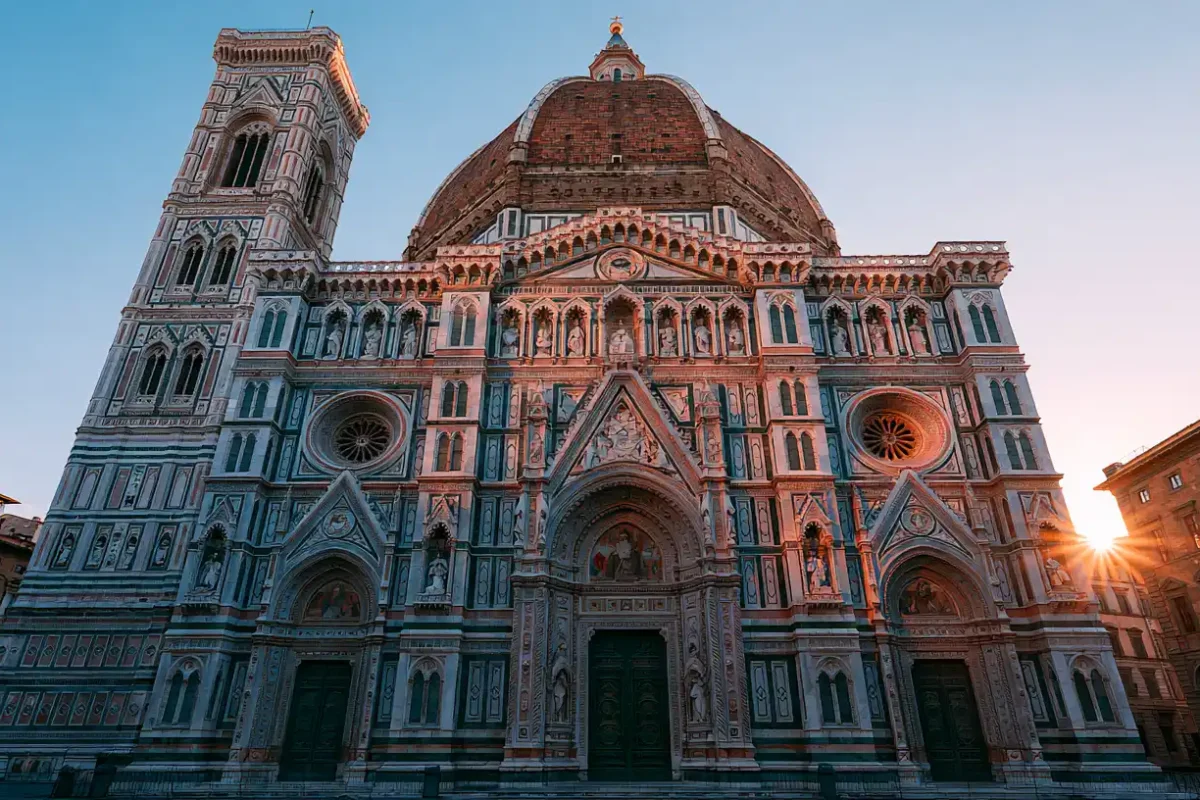
Brunelleschi built a dome in 1420 that no one alive at the time knew how to build and that no one has fully replicated since. The commission he won — after defeating Ghiberti in a public design competition — required spanning an octagonal drum 45 metres wide at a height of 52 metres above the cathedral floor. There was no scaffolding system in existence capable of bridging that gap in the conventional way. The problem had sat unsolved for over 100 years after the previous architects left the base of the drum incomplete, not knowing how to proceed.
Brunelleschi’s solutions were multiple and simultaneous. He invented a new herringbone bricklaying pattern that allowed each course of bricks to lock the ones below it into place without needing wooden centring to hold the arch while it cured. He built the dome as two concentric shells — one inside the other — with the space between them housing the staircases and access passages. The outer shell sheds rain; the inner shell carries the structural load. He invented new lifting machines to raise the materials. And he spent 16 years finishing it, dying in 1446, ten years after the lantern was completed.
That dome — the largest masonry dome ever constructed, a record it still holds — is what you see above Florence from almost every hill and rooftop. It is the visual anchor of the city in the way the Eiffel Tower is the anchor of Paris or St Paul’s is of London. But unlike those structures, you can climb inside it, through the gap between its two shells, and understand from the inside how it works.
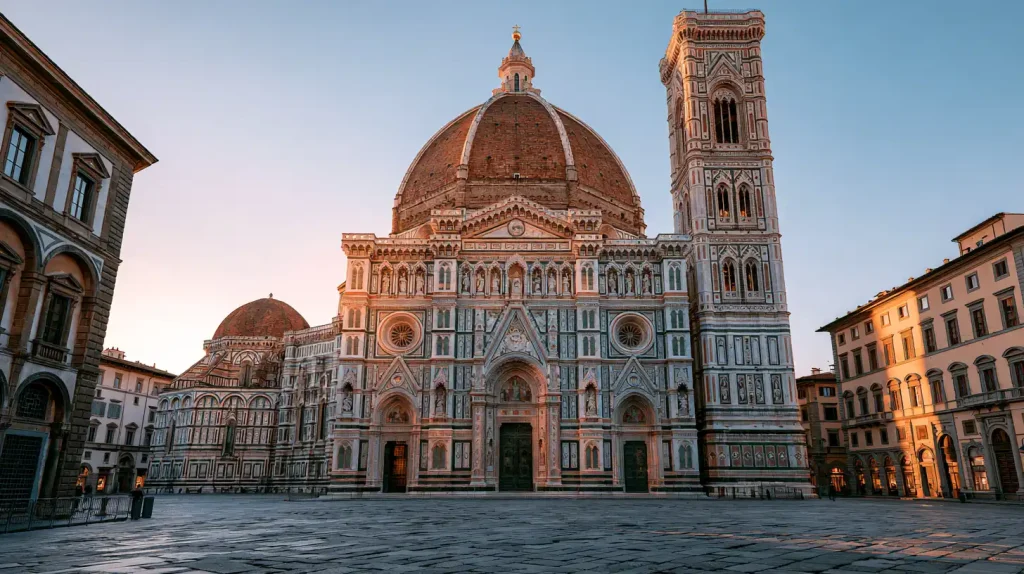
Climbing it is, at 463 steps with no lift and walls that lean inward as you ascend, one of the most specific and unusual physical experiences Florence offers. And the view from the lantern at the top — the full Arno valley, the terracotta roof-scape of the city, Fiesole on the hill to the north — is the best view in Florence.
What the Complex Covers
The Florence Cathedral complex (Piazza del Duomo) contains five distinct components, most of them covered by a single combined pass:
Santa Maria del Fiore Cathedral: the church itself — free to enter the nave, a space of roughly 8,300 square metres, one of the largest church interiors in Europe. You need a pass to access the dome climb and the crypt below.
Santa Reparata crypt: the earlier cathedral the current one was built over, accessible below the current nave.
Brunelleschi’s Dome: the dome climb — 463 steps, no lift, mandatory timed-entry booking.
Giotto’s Campanile: the freestanding bell tower — 414 steps, no lift, a different view of the dome and Florence.
Baptistery of San Giovanni: the octagonal building in front of the cathedral, famous for Ghiberti’s bronze doors.
Opera del Duomo Museum: the museum of works from the complex, including the original Gates of Paradise panels.
Which Pass to Buy
Three passes are available, all through the official site, duomo.firenze.it:
Brunelleschi Pass (€30 full / €12 reduced for ages 7-14 / free for 6 and under, though a free timed pass is still required): covers everything — dome climb, Campanile, Baptistery, Opera del Duomo Museum, and the Santa Reparata crypt. This is the right pass if you want to climb the dome — it’s the only one of the three that includes it.
Giotto Pass (€20 full / €7 reduced): covers the Campanile climb (Giotto’s tower), Baptistery, crypt, and museum — but not the dome. For people who want tower views but cannot or prefer not to climb 463 narrow steps inside the dome’s structure.
Ghiberti Pass (€15 full / €5 reduced): covers the Baptistery, crypt, and museum only — no tower climbs. For people primarily interested in the Baptistery and the museum. A limited “on-site” version of this pass is available only at the physical ticket office in Piazza San Giovanni, no. 7, and isn’t sold online.
The key decision: if you are physically able to climb 463 steps in a confined and sometimes warm space, the Brunelleschi Pass is the right choice. The dome climb is the defining experience of the Piazza del Duomo — it is architecturally unique and historically specific in a way that a regular tower climb is not. The Campanile offers roughly similar views of Florence with less of the interior engineering experience. Buy the Brunelleschi Pass and use its multi-day validity to space the components across your Florence stay rather than trying to do everything on one day.
One note on validity: the pass is valid across multiple calendar days from the date of your booked dome entry, but whichever site requires a timed reservation — chiefly the dome itself — needs to be visited on the first day. Book your dome climb for day one, then use the remaining validity window for the Baptistery, museum, and Campanile at your own pace. Since exact day-count details are occasionally adjusted by the Opera di Santa Maria del Fiore, confirm the current validity terms at checkout when you book.
Booking the Dome Climb
The dome climb requires a mandatory timed-entry booking. You cannot buy a walk-in ticket at the door. Book directly at the official Opera del Duomo website (duomo.firenze.it).
Since March 1, 2025, a valid photo ID (passport or ID card) is required alongside your ticket to enter the dome climb — this was introduced to prevent ticket reselling, and names on tickets are checked against ID at the gate. Bring it, and make sure the name on the booking matches.
How far in advance: in peak season (roughly April through September), book several weeks in advance where possible — the first morning slots are the most popular and sell out earliest. Weekday morning slots before 11am are generally easier to secure than weekend slots.
Entry point: you enter the dome climb via the Porta della Mandorla on the north side of the Cathedral building — not the main west facade entrance. The signage is clear but first-time visitors often miss this. The dome climb entrance is separate from the entrance to the cathedral nave.
Arrival window: plan to arrive around 15 minutes before your booked time, and no later than 5 minutes after it — late arrivals risk losing their slot entirely.
What is not allowed: medium or large bags, backpacks, pushchairs/prams. Not recommended for people with heart conditions, vertigo, claustrophobia, or pregnancy.
What the Climb Is Like
The ascent takes approximately 45 minutes from entry to the top lantern. It is not a conventional tower staircase in any way — the stairs are carved directly into the structural fabric between the inner and outer shells of the dome, which means the walls on either side of you as you climb are the actual masonry of the dome itself. This gives the experience a quality unlike any other tower climb in Europe.
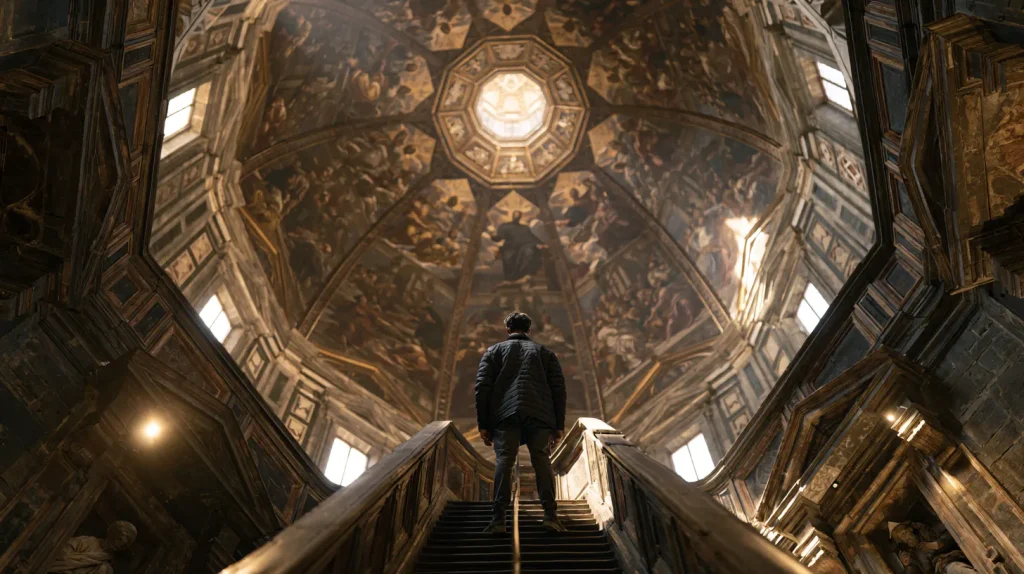
The first section is a standard stair climb through the Cathedral building. Partway up, you emerge onto the interior gallery — a walkway inside the dome at roughly two-thirds of the height, looking across and down at the floor of the Cathedral far below. From this gallery you can read Vasari and Zuccari’s Last Judgment fresco (covering roughly 3,600 square metres of the dome’s inner surface, completed around 1579) at close range. The figures are enormous and the detail visible from the gallery makes the fresco legible in a way it is not from the floor.
After the gallery, the climb continues between the two shells of the dome. The walls here lean inward at an increasing angle as the dome narrows toward the lantern at the top. The brickwork immediately around you is Brunelleschi’s herringbone pattern — you are physically inside a 600-year-old engineering solution, climbing through the space that was left between the shells to allow maintenance access. It is narrow, the ceiling is low in places, and in summer it gets warm without the benefit of ventilation. Bring water for the second half of the ascent. The final push to the lantern involves a very tight spiral stair that requires care and patience if people above you are moving slowly.
At the top: 360-degree views of Florence, the Arno valley, and the surrounding Tuscan hills. Looking straight down, the Piazza del Duomo — the Baptistery, the Campanile, the crowd of visitors below now the size of ants. Looking south, the Arno river and Ponte Vecchio. Looking north, the green hills of Fiesole above the city. Take your time on the way down — there is a narrow viewing gallery around the lantern base and it can back up when multiple people are trying to pass.
The Baptistery and the Gates of Paradise
The octagonal Baptistery of San Giovanni is the oldest building on the Piazza del Duomo — most scholarly accounts place its current structure to around the 11th or 12th century, though the exact origins and how much may incorporate earlier Roman-era material remain genuinely debated among historians. Dante was baptised here; it appears in the Inferno.
What most visitors photograph on the east doors — Ghiberti’s Gates of Paradise — are replicas. The originals are in the Opera del Duomo Museum. Ghiberti spent decades (roughly 1425-1452) creating ten gilded bronze relief panels depicting Old Testament scenes with a spatial depth and perspective that had never been achieved in bronze before. Michelangelo reportedly said they were worthy of being the gates of paradise, which is where the name came from.
See the replicas on the building — they read well at distance and the composition is what most people know from photographs — then see the originals in the museum at close range. The surface detail visible up close is extraordinary: Ghiberti’s spatial recession, the individual facial expressions, the specific textures of cloth and architecture rendered in gilded bronze. The difference between reading the replicas at ten metres and the originals at arm’s length is the difference between knowing what the doors look like and understanding what Ghiberti actually made.
The interior of the Baptistery has a Byzantine mosaic ceiling that covers the entire dome — Christ in Majesty in the centre, scenes from Genesis and the life of John the Baptist surrounding him. It is in excellent condition and reads well from the floor below. Note that the Baptistery interior has periodically been affected by restoration and scaffolding work in recent years, so if seeing the mosaic ceiling unobstructed matters to you, it’s worth checking current status before your visit.
Giotto’s Campanile
The bell tower to the right of the Cathedral facade was designed by Giotto starting in 1334, though he died the following year and the tower was completed by others over the following decades. The climb is 414 steps and offers views equivalent to the dome, with the added interest of looking across at the dome itself from outside — which is one of the better viewpoints for understanding the dome’s scale.
If you have the Brunelleschi Pass, both the dome climb and the Campanile are included in the same pass — you do not pay extra for either. Most visitors with limited time prioritise the dome, and rightly so. If you have a full day and good knees, both climbs are achievable — many visitors do the dome in the morning and the Campanile in the late afternoon when the light is different and the crowd has thinned. The Campanile does typically require a timed-slot reservation as well (unlike the free cathedral nave), though it isn’t as tightly bottlenecked as the dome — check current booking requirements when you buy your pass.
The Opera del Duomo Museum
The museum holds the original works removed from the Cathedral complex for conservation — including the original Gates of Paradise panels (as above), Donatello’s Penitent Magdalene (an extraordinary carved wood figure from around the mid-15th century), Michelangelo’s Pietà Bandini (his late, unfinished work that he reportedly tried to destroy), and Luca della Robbia’s Cantoria (marble singing gallery). It is genuinely one of the most significant museum collections in Florence — arguably the most significant after the Uffizi — and the one that most first-time visitors never reach because the exterior of the Duomo complex is so dominant that people don’t think to look inside a museum for more. If you have the Brunelleschi Pass and multiple days to use it, the museum on a later day of the pass validity is time very well spent.
Suggested Order for the Full Complex
If you have the Brunelleschi Pass and a few days to spread it across:
Day 1 morning: Dome climb (use your booked time slot) → Interior of Cathedral (free, walk through) → Coffee.
Day 1 or 2 afternoon: Baptistery interior → Opera del Duomo Museum (spend time with the Gates of Paradise and the Donatello Magdalene).
Day 2 or later: Campanile climb if energy and interest allow.
The Cathedral interior itself — the nave, the Gothic stained glass windows, the floor of inlaid marble — takes about 20-30 minutes at a relaxed pace. Entry to the nave is free with or without a pass. It is less overwhelmingly decorated than many Italian cathedrals (Siena’s Duomo interior, for instance, is more visually dense) and the interest is primarily in its scale and the way the building relates to the dome above rather than in individual altarpieces or chapels. The empty interior in the early morning, before tour groups arrive, has a particular quality of silence and proportion.
suggested link — Uffizi Gallery Florence: Tickets, What to See & How to Beat the Crowds
suggested link — 3 Days in Florence: First-Timer Itinerary & Top Highlights
Pass prices (Brunelleschi €30/€12, Giotto €20/€7, Ghiberti €15/€5), the March 2025 ID requirement for the dome climb, and cathedral dimensions verified August 2026 against the official Opera di Santa Maria del Fiore ticketing information. Baptistery dating remains a genuinely open question among historians rather than a single settled figure — treated here as such rather than stated as fact.