The queue outside the Uffizi on a July morning at 9am is long enough to make you wonder if you came to Florence to look at Renaissance paintings or to stand in a line in the heat. If you have pre-booked tickets for 8:15am, you walk past all of it — past the queue, through the security check, up to the second floor — in about 20 minutes. If you haven’t pre-booked, that line is yours, and it may well be 60-90 minutes long in peak season.
The Uffizi is one of the great art museums in the world — genuinely extraordinary in a way that few museums manage. It is not the largest (the Louvre has considerably more floor space), and it does not try to cover everything (there is no Egyptian collection, no Asian antiquities). It is a survey of Italian and European painting from Cimabue and Duccio in the 13th century through Caravaggio and beyond, with a concentration of work from the Florentine Renaissance that has no equal anywhere. The Botticelli rooms alone — Birth of Venus and Primavera in the same room, a few metres apart — justify the trip to Florence.
But visiting the Uffizi requires more pre-trip logistics than almost any other major sight in Italy, and those logistics changed significantly in late 2025 with the introduction of personalised ticketing. Here is what you need to know before you book.
The Ticket System (Changed October 2025)
Since October 13, 2025, all Uffizi tickets are personalised (nominative) — this is confirmed directly by the Uffizi’s own official notice. When booking, you must provide each visitor’s full name and date of birth. These details must match the physical identification document (passport, ID card — photocopies and phone photos of documents are not accepted) presented at entry. If there is a discrepancy, admission is refused and no refund is issued. This applies even to free tickets for under-18s, who still need to be registered by name and show ID at the door. The rule was introduced specifically to stop ticket touting and resale.
Book directly through the official Uffizi ticketing platform, managed by CoopCulture, linked from uffizi.it. Third-party booking platforms add fees and some are not authorised resellers — buying directly from the official site is both cheaper and avoids the risk of invalid tickets. Each account can buy up to 10 Uffizi tickets per day.
Ticket prices:
- Full price standard entry: €25 if bought in person on the day at the museum, or €29 if booked in advance (online or by phone) — the advance-booking surcharge is now built into a single higher price rather than shown as a separate fee.
- Afternoon entry (from 4pm): €20 online / €16 same-day in person.
- Free: first Sunday of each month (queues run 2-3x normal — arrive at 8:15am opening if you want this option), plus a small number of other free days tied to Italian national holidays (April 25 and June 2, for instance).
The museum opens at 8:15am; closing time and last entry vary somewhat by season, generally running toward early evening with last entry roughly an hour before close — confirm current hours for your visit date when booking, as the Uffizi adjusts these seasonally. It is closed Mondays.
How far in advance to book: In April through October, online tickets can sell out several days to a couple of weeks ahead, and walk-up tickets frequently sell out by mid-morning. In July and August, book as early as you can. Specific time slots at opening (8:15am) sell out earliest — this is the time that every guide recommends, and demand reflects it. The 4pm afternoon slot is an underrated alternative: significantly cheaper, tour groups have largely left by the afternoon, and the light in the western galleries in late afternoon is different and genuinely beautiful. It is often available with less lead time than morning slots.
If you arrive in Florence without a ticket and online slots are full, the museum’s on-site ticket offices remain operational even when the website shows no availability — worth checking in person, particularly on weekday mornings outside the peak summer period.
Getting In: The First Ten Minutes Matter
Your ticket has a specific time slot. Arrive within the window specified on your ticket — late arrivals risk being turned away even with a valid ticket. The security check (an airport-style metal detector at the main entrance) adds another 10-20 minutes in peak season, so plan to be at the entrance a few minutes early. Large bags, backpacks, and umbrellas need to go in the free cloakroom before you go through security; small handbags are fine to carry in.
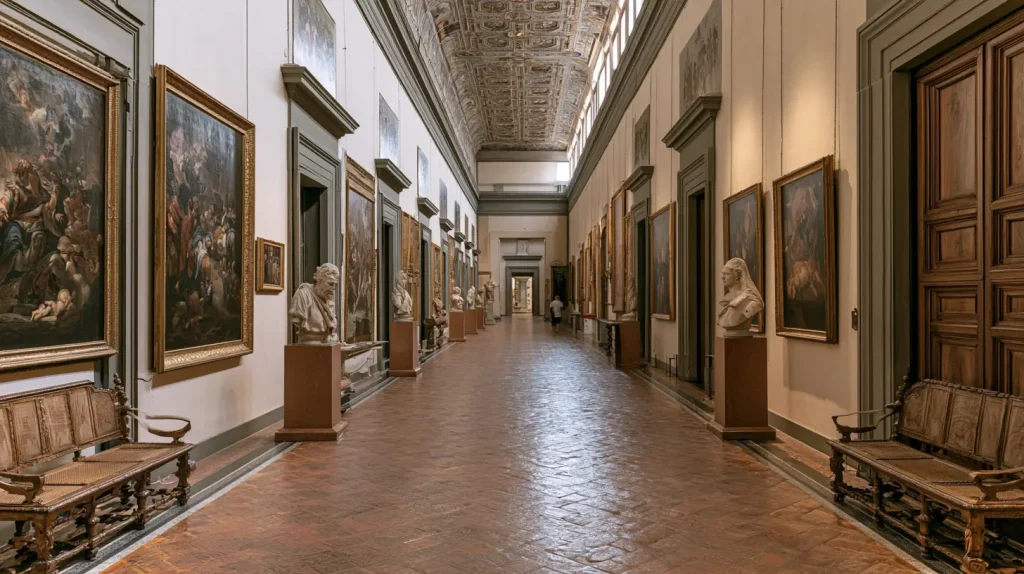
Once inside, the Uffizi unfolds across multiple floors in roughly chronological order — medieval painting on the lower levels, Renaissance masterworks on the second floor, later work above. The second floor is where most people spend most of their time and where the most significant paintings are.
The critical routing decision: when you reach the second floor, go directly to the Botticelli rooms. Resist the impulse to browse slowly through the early medieval rooms on entry — those rooms are important context for understanding what the Renaissance changed, but they are also where tour groups process quickly and chronologically. The groups that arrive at opening time move through the building in order and arrive at the Botticelli rooms around 9:30-10am, at which point the rooms fill rapidly and stay full until mid-afternoon.
If you are there at 8:15am and move with purpose to the Botticelli section, you can have 45-75 minutes with Birth of Venus and Primavera in relatively uncrowded conditions — close enough to read the detail, quiet enough to look properly. This is genuinely the difference between seeing those paintings and experiencing them. The medieval rooms will be quieter after 11am when most tour groups have moved through.
The Botticelli Rooms
The Birth of Venus and Primavera hang in the Botticelli rooms on the second floor (room numbering has shifted somewhat with recent reorganisations, so follow the current museum map rather than a specific room number from an older guide), and they are the heart of the Uffizi’s collection. Nothing quite prepares you for seeing the actual scale of them — both are large, the colours are vivid, and the density of detail in Primavera in particular rewards sustained looking rather than a glance.
Birth of Venus (mid-1480s): Venus rising from the sea on a shell, blown toward shore by Zephyr and Aura. The figures have a strange, elongated quality that looks both ancient and modern — Botticelli was working from classical models but producing something entirely his own. The white fabric catching wind on the right of the painting is technically virtuosic.
Primavera (early 1480s): A larger and more complex composition — Mercury, Venus, three Graces, Flora, Zephyr, and Chloris in an orange grove. The identity of all the figures and the exact meaning of the scene have been debated for centuries and remain genuinely unresolved. Looking at it long enough to notice all the figures and their interactions takes longer than most visitors allow.
Allow 20-30 minutes in the Botticelli rooms if you arrived early enough to use them well.
Other Key Works
Leonardo da Vinci — Annunciation: One of Leonardo’s earliest works, painted in the early-to-mid 1470s before he left Florence for Milan. The painting’s use of atmospheric perspective — distant hills rendered progressively more hazy as the eye moves deeper into the landscape — was technically new and would become foundational to subsequent painting. The angel’s wing, studied from actual bird specimens, has a physical reality that was unprecedented. This room is generally less crowded than the Botticelli section throughout the day, which means you can actually stand in front of the painting and look rather than hold your position against a crowd. Leonardo’s Adoration of the Magi, left unfinished when he departed for Milan, hangs nearby — a fascinating study in what Leonardo had already worked out by the time he abandoned the commission.
Michelangelo — Doni Tondo: The only completed panel painting by Michelangelo, and one of the most discussed objects in the Uffizi for what it tells us about how he worked in paint versus marble. The tondo (circular) format shows the Holy Family in a pose of impossible physical complexity — Mary twisted to receive the infant Jesus from Joseph in a continuous spiral of muscle and fabric. The bright, almost acidic colours — acid greens, vivid oranges — were a deliberate departure from the softer palettes of his contemporaries and influenced subsequent Mannerist painters significantly. The carved wooden frame was designed by Michelangelo himself and has faces carved into it whose identity and meaning are still debated.
Caravaggio — Young Bacchus: Painted in the late 1590s, it shows the god of wine in an unflattering, realistic way — slightly chubby, with pores and fingernails actually visible, and a bowl of rotting fruit on the table. Some scholars believe a self-portrait is hidden in the wine carafe’s reflection. This was provocative. The painting broke every convention of how divine or mythological subjects were supposed to look — no idealisation, no distance, just a real-looking young man with a glass of wine offering it to the viewer — and started an argument about realism in art that continued for decades. Also in the Caravaggio room: the famous Medusa on a convex shield (painted on an actual shield) and Abraham and Isaac, which features a close-up terror on the bound boy’s face that is hard to look at for long.
Titian — Venus of Urbino: A reclining nude that makes Botticelli’s Venus look modest by comparison. Titian painted it in the late 1530s, and it is so frankly sensual that Mark Twain, on seeing it in the 1880s, is widely reported to have called it one of the most obscene pictures he’d encountered — a reaction that says more about Victorian American sensibility than about Titian, but captures how confrontationally direct the painting is. The woman meets your gaze without apology. The white sheets are a tour de force — Titian understood fabric the way Caravaggio understood skin.
Raphael: The portrait of Pope Leo X with two Cardinals is one of the great psychological portraits of the Renaissance — three powerful men in a compressed space, their relationships suggested through posture and eye contact rather than stated. The Madonna of the Goldfinch is also here, quieter and more devotional. This room receives fewer visitors than the Botticelli and Leonardo rooms and is worth time if the crowds have made those rooms difficult.
The Vasari Corridor
The Vasari Corridor is the famous secret elevated passageway built in 1565 connecting the Palazzo Vecchio to the Pitti Palace across the Arno — running roughly 760 metres, directly above the Ponte Vecchio jewellers’ shops and through buildings along the riverbank. It closed for restoration in 2016 and reopened to the public at the end of 2024 after modern safety and accessibility upgrades, including air conditioning it never had before.
It’s accessible only via guided/staffed visits, not independently. The standard combined ticket — which includes Uffizi entry two hours beforehand — costs €47 for adults (€2 reduced for EU citizens 18-25, free under 18). There’s also a separate, cheaper evening-only “Friday special openings” ticket (roughly €20-24, running certain Friday evenings through the year) that doesn’t require the full Uffizi visit beforehand — worth checking if your interest is the corridor itself rather than a full gallery day. Either way, book well ahead: reservations are capped at five tickets per booking and slots are limited given the corridor’s narrow capacity. For most visitors, the standard Uffizi visit is the priority; the Vasari Corridor is for art-serious visitors with the time and budget for a second, more specialised experience.
The Ponte Vecchio Window
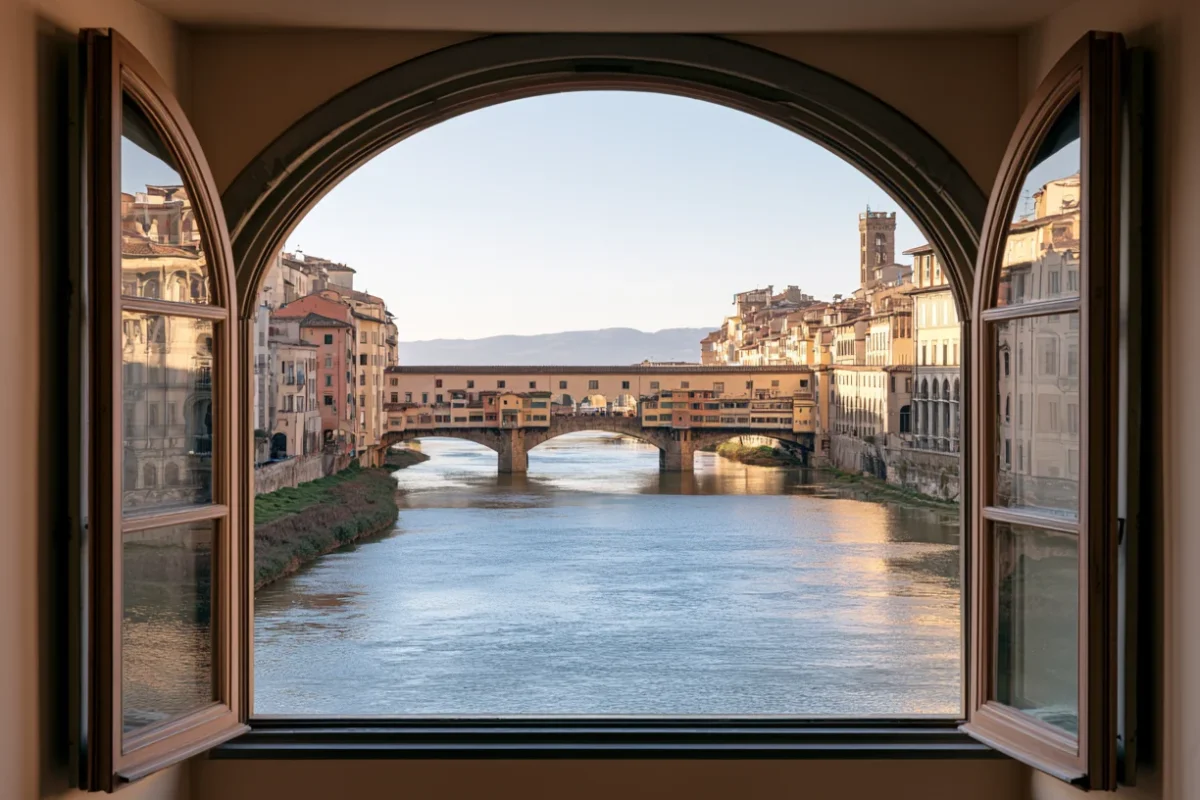
Inside the Uffizi, on the west corridor overlooking the Arno, there is a window with a direct view of the Ponte Vecchio and the river. It is easy to miss and almost never crowded. Worth a few minutes for the view and a brief rest from the galleries.
How Much Time to Allow
Minimum realistic visit (key masterpieces only): 2 hours — Botticelli rooms, Leonardo, Michelangelo, Caravaggio, Titian. This is very focused and requires moving purposefully rather than drifting.
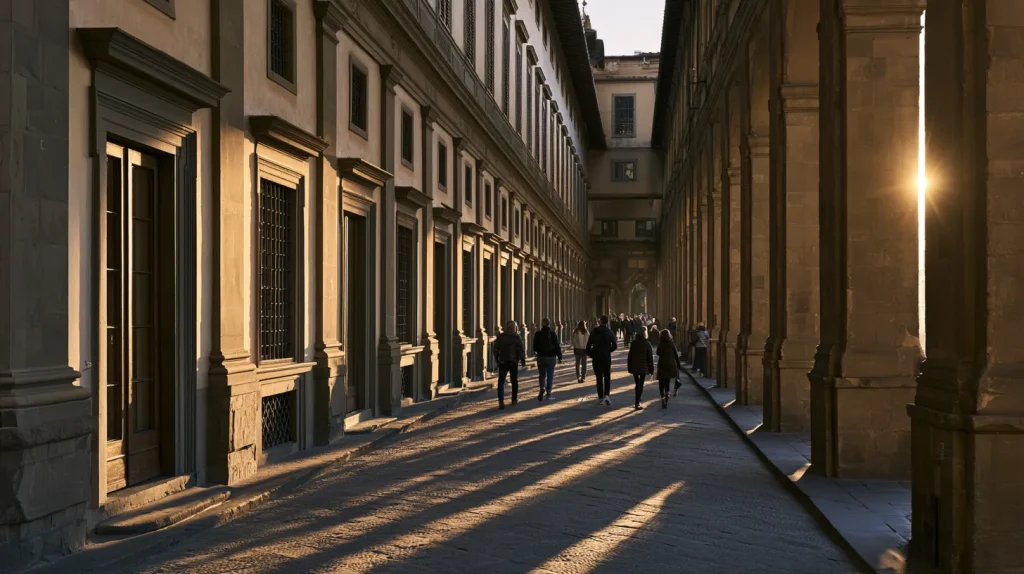
Comfortable visit: 3-3.5 hours — the above plus Raphael, the early rooms for context on what painting looked like before the Renaissance changed it, and the external corridors.
Full visit: 4+ hours — for people who actually want to look at every room rather than tick off the highlights. The Uffizi is genuinely one of the great survey collections of Western art and rewards extended engagement. This visit is exhausting but worthwhile if art is the point of your Florence trip.
What You Can Skip
The medieval rooms on the entry level (Cimabue through Giotto and the 14th-century masters) are genuinely interesting in context — they show what Italian painting looked like before the Renaissance and make the shift to Botticelli comprehensible — but they are the rooms that tour groups process quickly and chronologically. You see them at their most crowded first thing in the morning. It is more efficient to move past them toward the Renaissance works early and come back to them later.
The rooms of late Northern European paintings (Dutch and Flemish) are excellent but draw the fewest visitors and are worth half a room’s attention if time is limited.
The gift shop is the same museum gift shop content available at every major European art museum — postcards, prints, overpriced art books, and branded items. Not worth significant time if you have limited hours in the galleries, though the bookshop section has some genuinely good art history titles if you are buying them anyway.
The cafeteria on the third floor terrace has views over the Florence rooftops and is a reasonable place for a brief rest mid-visit. The food is unremarkable but the view is not. Worth a 15-minute stop if the visit is running long and feet are starting to hurt.
suggested link — 3 Days in Florence: First-Timer Itinerary & Top Highlights
suggested link — Accademia Gallery & Piazzale Michelangelo: Florence Art Guide
Ticket prices, the October 2025 personalised-ticketing rule, and Vasari Corridor pricing verified August 2026 directly against the Uffizi’s own official notices and CoopCulture’s official booking platform. Museum closing times shift seasonally — confirm the exact hours for your travel dates when booking, since this guide gives the reliably fixed 8:15am opening but not a single fixed closing time.