There are no cars in Venice. No buses, no trams, no bicycles on the main islands. You move by water or on foot, and those are the only options. Once you accept this — really accept it, not just know it intellectually — the transport question simplifies considerably.
The vast majority of a Venice trip happens on foot. The water transport system covers the distances that are too far or too inconvenient to walk, and gets you to the outer islands that walking cannot reach. Here is how it works.
Walking: The Primary Transport
Walking covers around 80% of what you need to do in Venice. The island is not large — you can walk from the train station (Ferrovia) to Piazza San Marco in about 30-35 minutes via the most direct route, or 45 minutes via the Rialto. Most neighbourhoods are 15-25 minutes apart on foot.
Navigation: the yellow directional arrows on building walls and yellow signs at intersections point toward the major landmarks — San Marco, Rialto, Ferrovia (train station), Piazzale Roma (bus terminal). They are not always consistent with each other and they do not represent the fastest route — just a signposted route. A downloaded offline map (Google Maps offline or Maps.me with no data connection) is more reliable for navigation through the smaller calli and back-routes, and lets you set a specific destination rather than following generic arrows.
Getting slightly lost in Venice is part of the experience. The island is small enough that you cannot be seriously lost — you will eventually hit water and be able to reorient. The best parts of Venice are often found in the alleys between the signed tourist routes, so veering off course tends to reward rather than penalise.
Flat, comfortable shoes are non-negotiable for walking Venice’s stone calli and the arched stone bridges. There are hundreds of bridges, each with steps up and steps down, which is harder on feet and knees than flat terrain. Plan for 12-18 km of walking per day on a full sightseeing day — significantly more than most city trips.
The Vaporetto (Water Bus)
The vaporetto is Venice’s public water bus system, operated by ACTV. It is the main public transport on the water and the way to reach the outer islands. The boats run from approximately 4:30am to 12:30am [VERIFY current schedule at actv.avmspa.it].
How to use it:
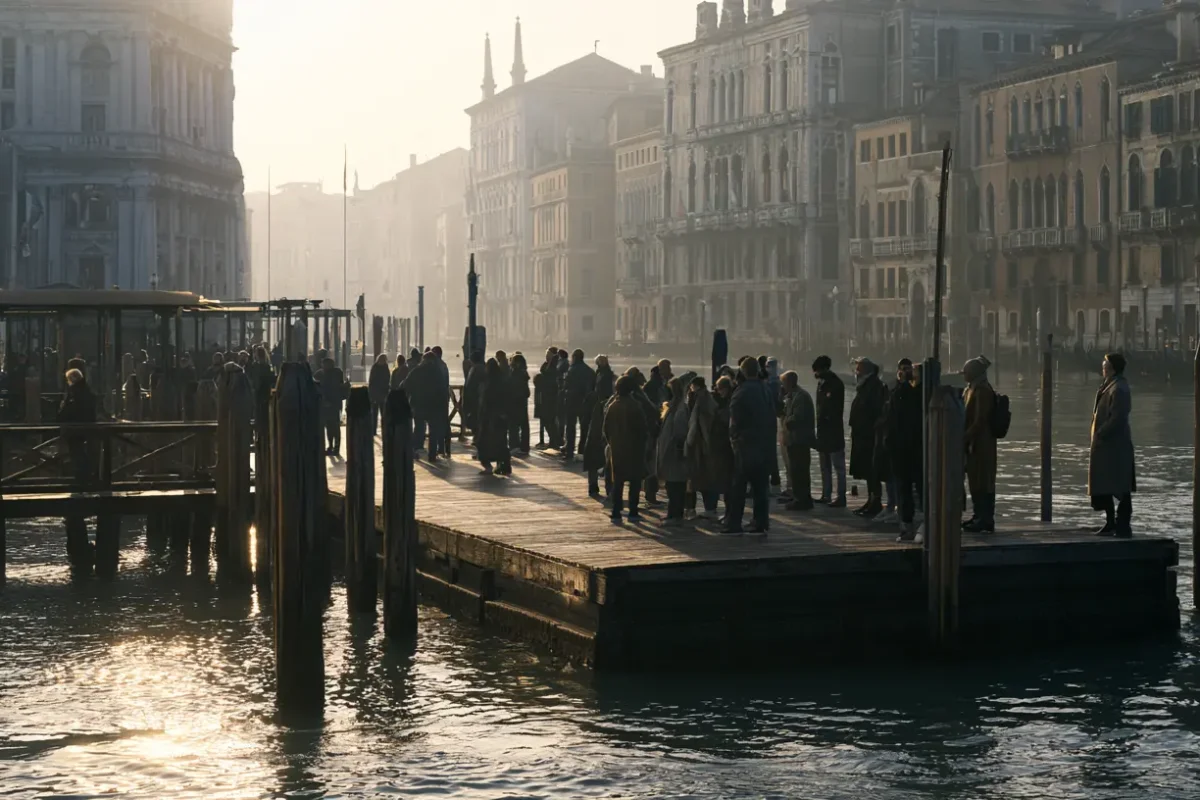
- Find the relevant vaporetto stop — the floating wooden platforms attached to the canal banks. Each platform is named and marked with the lines that stop there. Some stops have separate boarding areas for different directions (look for directional signs: per Rialto, per San Marco, per Ferrovia etc.).
- Buy a ticket at the ticket machine on the platform or at a tobacco shop (tabaccheria) before you board. If you have a multi-day pass, validate it at the orange card reader at the platform entrance every time you board a new boat — even if you validated it an hour ago on a different line. Not validating your pass on each new boarding counts as fare evasion and ACTV inspectors check regularly at busy stops.
- Check the line number and direction displayed on the front and sides of the approaching boat before boarding. Some stops serve multiple lines from the same platform space — the boat arriving first might not be your line, and boarding the wrong direction wastes significant time.
- Board via the gangway and find a position. In peak summer season, popular lines — especially Line 1 at San Marco and Rialto — can be standing-room only and the boat crew will stop boarding when capacity is reached. Earlier or later sailings are typically less crowded.
Fares [VERIFY all at actv.avmspa.it]:
- Single ticket: €9.50, valid for 75 minutes from validation (covers unlimited rides within that window including transfers)
- 24-hour pass: approximately €25
- 48-hour pass: approximately €35
- 72-hour pass: approximately €45
- 7-day pass: approximately €65
Rolling Venice Card: If you are under 29, get the Rolling Venice Card (€6, valid one year) before buying any pass — it significantly reduces the pass prices [VERIFY current discount schedule at actv.avmspa.it].
Break-even: if you make 3 or more vaporetto journeys in a day, a 24-hour pass costs less than individual tickets. For a trip that includes the island day (Murano, Burano, Torcello) plus daily Grand Canal crossings, the 72-hour pass almost always saves money.
The Key Lines to Know
You do not need to understand the full 20+ line network. You need to know five lines:
Line 1 — The Grand Canal Scenic Route
Runs the full length of the Grand Canal from Piazzale Roma to the San Marco basin and on to Lido. Stops at all 15+ stops along the canal, including Ferrovia, San Marcuola, Ca’ d’Oro, Rialto, San Silvestro, Sant’Angelo, San Toma, Ca’ Rezzonico, Accademia, Santa Maria del Giglio, and San Marco Giardinetti. Takes about 45 minutes end to end. Slow, which is the point: the Line 1 Grand Canal ride is one of the best architectural surveys you can do in Venice — the parade of Gothic, Byzantine, and Renaissance palazzi along the canal from the water gives a physical sense of the Republic’s centuries of accumulated wealth. Take it on your first day in Venice, ideally in the late afternoon when the western-facing palazzi are lit by direct sun. Sit at the front or back of the boat for unobstructed views rather than the enclosed middle section.
Line 2 — The Grand Canal Express
Also runs the Grand Canal but makes far fewer stops — gets you from Piazzale Roma to San Marco in roughly 15 minutes versus 45 on Line 1. Use when you need to get somewhere fast rather than sightsee. Also connects to Murano.
Line 3 — Direct to Murano
Runs directly from Piazzale Roma and Ferrovia to Murano in about 20 minutes, without the slow scenic stops. Use it when you want to get to Murano quickly.
Line 12 — The Island Day Trip Line
Runs Fondamente Nove → Murano → Burano → Torcello. This is the line for the island day trip. Depart from Fondamente Nove on the northern edge of Cannaregio, take Line 12 to Murano (about 15 minutes), then continue to Torcello (about 35 minutes from Murano), then hop to Burano (5 minutes from Torcello on Line 9 or 12). The return to Venice goes back to Fondamente Nove.
Lines 4.1/4.2 and 5.1/5.2 — The Circular Lines
These lines circle the perimeter of the main Venice islands (not through the Grand Canal), connecting to Murano, Giudecca, and Lido. Useful for getting to Fondamente Nove from the San Marco area without going through the Grand Canal, or for reaching Giudecca.
The Traghetto (Grand Canal Ferry)
The traghetto is a standing gondola used as a ferry crossing at several points along the Grand Canal. It costs €2 per person [VERIFY current price] and takes about 2 minutes to cross.
There are several traghetto crossing points along the Grand Canal at locations where there is no nearby bridge — locals use them to cross the canal without walking to the next bridge. For visitors, the traghetto is useful both as a practical crossing and as the cheapest way to be on a gondola, even briefly.
You stand on the boat rather than sit, crossing the Grand Canal in the same posture as the other passengers. Locals stand without holding on, even when the boat rocks; if you need to grip the sides, do so without embarrassment. The gondoliers operating traghetti are not giving a tourist experience — they are providing a public crossing service — so the atmosphere is workmanlike rather than romantic. But for a few minutes you are on a gondola crossing the Grand Canal, and that is not nothing.
Active traghetto crossing points shift over time [VERIFY current locations at comune.venezia.it]. Historically there have been crossing points at Santa Sofia (near Ca’ d’Oro), San Tomà, Santa Maria del Giglio, and a few others. Not all crossings operate every day or all year.
Water Taxis
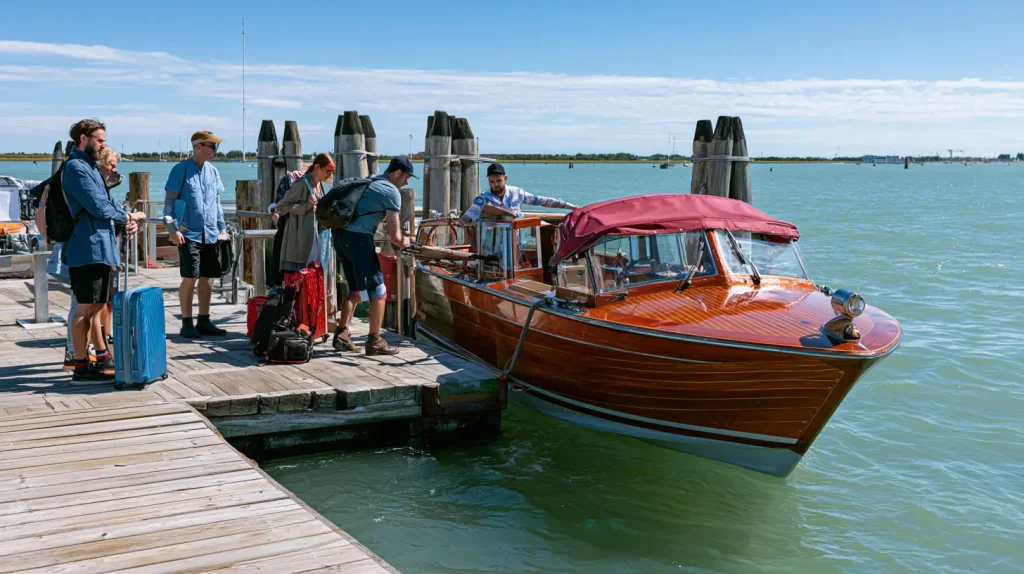
Water taxis (motoscafi) are private hire boats that will take you from any point to any other point in Venice, including the airport and the outer islands. They are fast, comfortable, and expensive.
A water taxi from Venice Santa Lucia train station or Piazzale Roma to the Marco Polo Airport runs approximately €100-130 for the boat (shared between all passengers in the boat, not per person) [VERIFY current prices at companies like Consorzio Motoscafi Venezia]. From the San Marco area the price is similar or slightly higher.
Water taxis are most practical for: airport transfers with heavy luggage when you do not want to manage bags on the vaporetto, very early or very late arrivals when Alilaguna and vaporetto service is reduced or irregular, and groups of four or more people travelling together where splitting the fixed boat cost makes the per-person price more competitive.
For a couple or solo traveller doing a standard mid-day arrival and departure, a water taxi is a luxury rather than a practical necessity. The Alilaguna from the airport or the land bus to Piazzale Roma followed by the vaporetto covers the same journey at a fraction of the price. The water taxi experience is genuinely pleasant — the boat is comfortable and fast — but it is a nice-to-have rather than the only option.
Airport Connections
From Marco Polo Airport to Venice:
Option 1 — Alilaguna water bus: Public boat service from the airport directly to various Venice landing points (San Marco, Rialto area, cruise terminal). Takes 60-90 minutes depending on line and number of stops [VERIFY current prices and schedule at alilaguna.it]. Slower and cheaper than a water taxi but runs on a fixed schedule.
Option 2 — Water taxi: About 30-40 minutes, significantly faster than the Alilaguna but costs €100-130+ for the boat [VERIFY].
Option 3 — Land bus to Piazzale Roma, then vaporetto: ATVO or ACTV bus from the airport to Piazzale Roma (Venice’s bus terminal on the main island), takes 20-25 minutes [VERIFY prices]. Then take the vaporetto from Piazzale Roma to your accommodation stop. This is the cheapest option but requires managing luggage on the vaporetto.
From Treviso Airport (Ryanair hub):
Further from Venice than Marco Polo. ATVO coach service runs to Piazzale Roma [VERIFY current schedule and price]. Takes about 70-80 minutes. Significantly cheaper than a taxi but a long journey.
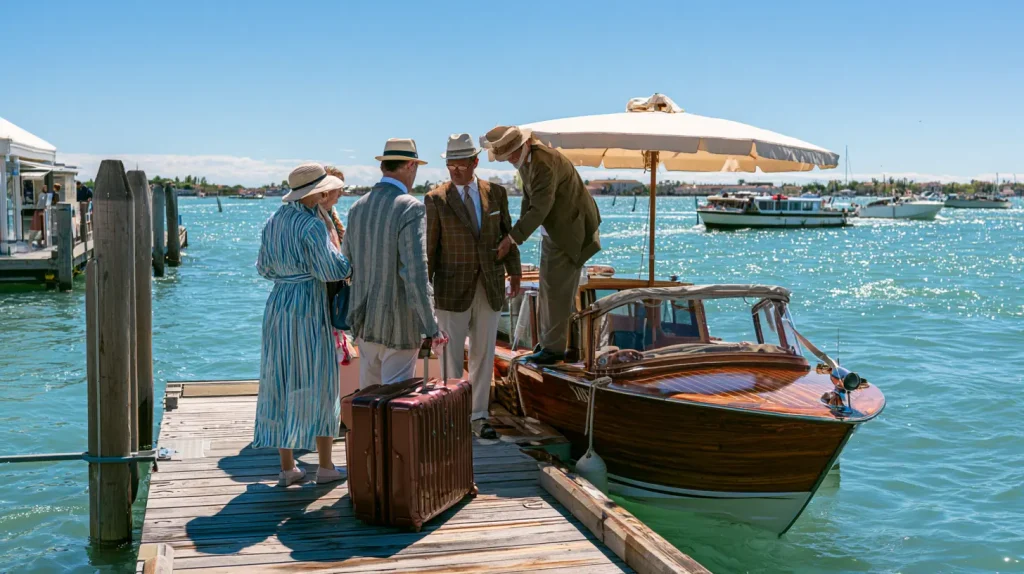
[PHOTO: realistic photography, Venice Marco Polo airport water taxi dock departure, passengers boarding private water taxi at airport dock with luggage, blue sky bright day, water taxi driver assisting, documentary travel photography, Canon EOS R5 35mm –ar 16:9 –style raw –v 6.1 | Alt text: Venice Marco Polo airport water taxi dock departure passengers boarding private water taxi at airport dock with luggage blue sky bright day water taxi driver assisting documentary travel photography]
Getting From the Train Station to Your Hotel
Venice Santa Lucia station opens directly onto the Grand Canal at the Ferrovia vaporetto stop. From here:
- To San Marco: Line 2 (fast, ~15 min) or Line 1 (scenic, ~40 min)
- To Cannaregio: walk 10-15 minutes east along the canal
- To Dorsoduro: Line 1 or 2 toward San Marco, exit at Accademia stop
- To Castello: Line 1 all the way to San Zaccaria
One practical note on luggage: the vaporetto platforms, the gangway onto the boat, and the boats themselves involve steps, narrow passages, and movement alongside other passengers. Large rolling suitcases on a crowded Line 1 vaporetto during peak hours are genuinely difficult to manage and inconvenient for everyone around you. If arriving with large or multiple pieces of luggage, Line 2 (faster, less crowded) is a better option than Line 1. A water taxi from the station is the most comfortable luggage option if the cost is manageable on your budget.
Alternatively, consider packing lighter for Venice specifically — a city where you carry your bags up and down bridge steps, through narrow passages, and across uneven stone, and where there are no escalators or lifts in the street environment.
The most important rule of Venice transport: validate your ticket. Always. Every time you board a new boat. Inspectors check regularly, particularly at the busy San Marco, Rialto, and Ferrovia stops, and the fine for an unvalidated ticket or pass is significantly larger than the cost of the ticket itself. The validation machines are simple — tap or insert your ticket at the orange reader at the platform entrance before stepping onto the gangway. This takes two seconds and prevents a €60+ fine. There is no reason not to do it.
Suggested topic — Venice on a Budget: Real Costs and What Actually Saves You Money
Suggested topic — 3 Days in Venice: First-Timer Itinerary & Top Highlights