Most of Venice’s famous sights are genuinely worth seeing. The Basilica, the Doge’s Palace, the Grand Canal — they earned their reputations. But if you spend three days only hitting the major sights, you miss the parts of Venice that stay with you longer.
These are the places that are still there when the crowds aren’t looking.
Squero di San Trovaso (Dorsoduro)
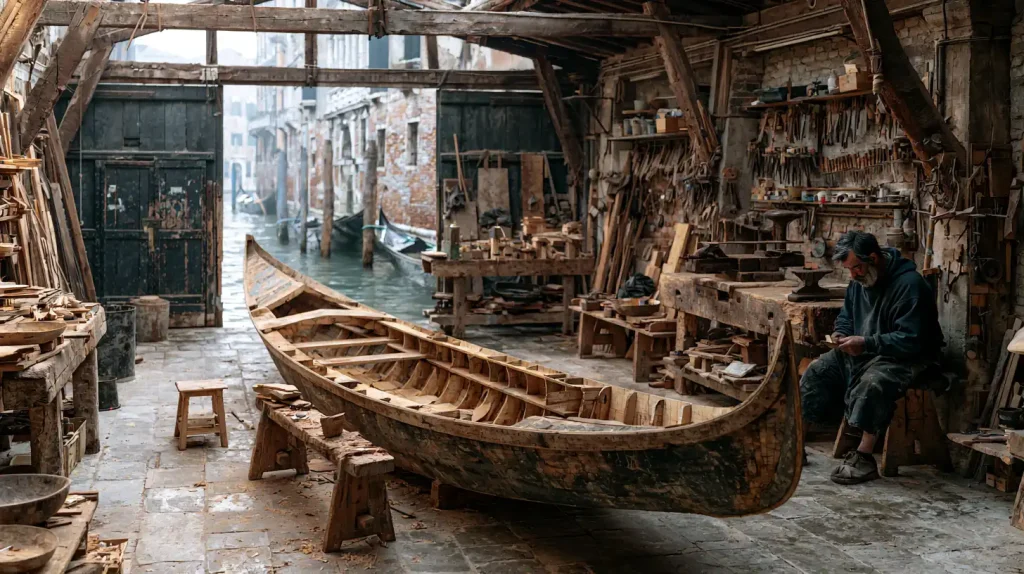
The gondola workshop at San Trovaso is one of only a handful of squeri (boatyards) still operating in Venice — the number has dropped from hundreds in the Republic’s heyday to fewer than five today. It sits at the junction of two canals in Dorsoduro, and unlike most things in Venice that cost you to enter, you can watch it for free from the opposite canal bank.
The workshop looks like a small Alpine chalet inexplicably placed in a Venetian canal — the architecture is a throwback to the craftsmen’s origins in the Dolomites. Gondolas are built and repaired here using traditional methods, with each boat taking several months to construct from a combination of 280 pieces of eight different types of wood. Standing across the canal watching a craftsman plane a hull plank is one of those simple, quiet Venice moments that the Piazza cannot give you.
The sight of a gondola — Venice’s most recognisable object — being built from scratch, in a working yard, by craftsmen using hand tools, is a useful corrective to the idea that gondolas are simply decorative. They are working boats, and the skill required to build one to the precise asymmetrical specifications that allow a single oarsman to propel it in a straight line is substantial. Each gondola is longer on the left side than the right to compensate for the single oar.
Best time to visit: weekday mornings when the workshop is most likely to be active. The yard can be seen from the Fondamenta Nani on the opposite bank.
Church of San Zaccaria and Its Flooded Crypt
The Church of San Zaccaria, a short walk from the Doge’s Palace in Castello, holds one of the great paintings in Venice — Giovanni Bellini’s Madonna and Child with Saints, painted in 1505 and hanging in the second chapel on the left. It is one of the finest altarpieces in Italy and receives a fraction of the attention that goes to the Accademia’s collection.
But the real oddity is below. For a small fee [VERIFY current price at the church], you descend into the half-flooded crypt — a room where medieval stone columns stand in permanent shallow water, the tombs of early doges sitting underwater. It is eerie in the best way. The combination of clear, still water and ancient stone and the silence of the crypt, set against the overwhelming noise and density of the San Marco tourist zone just a few minutes’ walk away, is one of the most striking contrasts the city produces. The water is not murky — it is transparent enough to see the floor tiles below, which makes it stranger rather than less so. Allow your eyes to adjust and spend a few minutes in the crypt before coming back up.
Madonna dell’Orto (Cannaregio)
This Gothic church on the northern edge of Cannaregio is where Tintoretto worshipped, worked, and is buried. His tomb is in the chapel on the right side. Two of his largest paintings hang in the church: the Presentation of the Virgin in the Temple and the Last Judgment, both painted specifically for the space they occupy. They are enormous, dramatic, and almost entirely unvisited compared to his work in the Doge’s Palace.
The church’s name (Madonna of the Orchard) comes from a rejected statue of the Madonna that was placed in a nearby garden (orto) after a different church refused it. The statue was later moved inside when people reported miracles occurring near it. This is typical of how Venetian churches acquire their names — through specific local stories that the guidebook names erase.
Entry is free or with the Chorus Pass
Santa Maria dei Miracoli (Cannaregio)
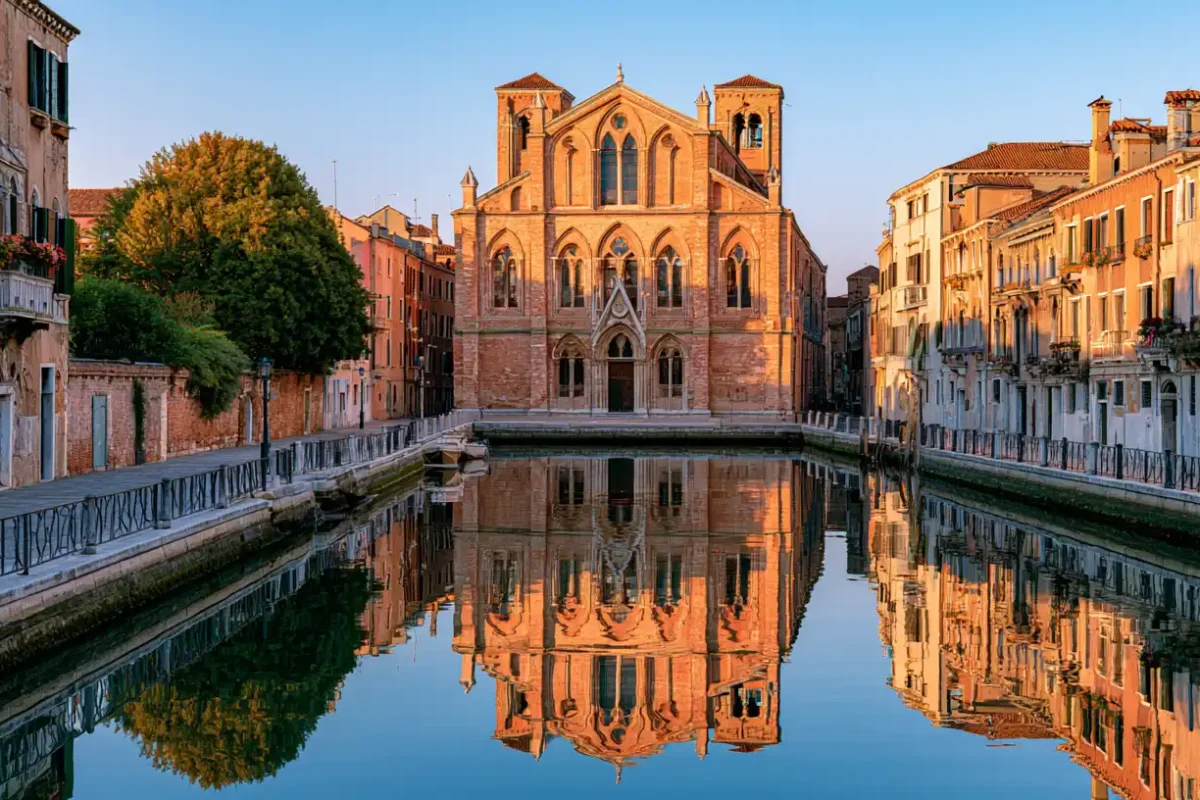
Known to Venetians as the marble church, Santa Maria dei Miracoli is a small Renaissance gem almost entirely clad in coloured marble — pink, grey, and white — on a small canal in Cannaregio. It is one of the earliest examples of the Venetian Renaissance style, built between 1481 and 1489, and its interior matches its exterior in refinement: a barrel-vaulted ceiling of portrait medallions, marble-lined walls, and a raised choir with carved figures on the balustrade.
The church is genuinely small. You can see it thoroughly in twenty minutes. But those twenty minutes contain more concentrated visual quality per square metre than most galleries manage in an hour.
It is often missed because it sits slightly off the main tourist paths through Cannaregio and is not signposted the way San Marco and the Rialto are. Worth finding. The church is small enough that it never feels overwhelming, and the quality of the marble carving on the exterior — the way the inlaid panels catch the light at different times of day — rewards even a short visit outside as well as in. Entry requires appropriate attire (shoulders and knees covered) as with all Venetian churches.
The Jewish Ghetto (Cannaregio)
The Ghetto Nuovo — the island in Cannaregio that became the world’s first Jewish ghetto in 1516 — is well-known to history students but undervisited by tourists, most of whom see it as a residential area without apparent sights. The area deserves more time than it usually gets.
The five historic synagogues are hidden inside what look like ordinary residential buildings — no external religious architecture, because that was forbidden. The interiors are rich: each synagogue represents a different Jewish tradition (German, Italian, Spanish, Levantine, Sephardic) and each is architecturally distinct inside. Tours run from the Jewish Museum of Venice [VERIFY current schedule at museoebraico.it]. The museum also contains a collection of Judaica spanning several centuries of Venetian Jewish community life.
The square at the Ghetto Nuovo is unusually wide by Venice standards — the island had to accommodate a large community in a restricted and confined space, which led to buildings being constructed upward rather than outward. The result is some of the tallest residential buildings in Venice, and the relatively large open campo at the centre has a different scale and atmosphere from most Venetian squares. There are kosher food shops and small restaurants in the area that serve the Jewish community and provide a different kind of lunch option from the city’s standard Venetian cuisine. The Ghetto is genuinely quiet — calmer than almost any comparably central location in Venice.
Campo San Giorgio dei Greci (Castello)
This small campo in Castello is easy to walk past without registering what makes it strange: the bell tower of the Greek Orthodox church here leans at a visible angle — more noticeable than expected once you know to look. The Church of San Giorgio dei Greci was built in the 16th century to serve Venice’s substantial Greek merchant community, and the tower has been leaning since its construction due to unstable foundations.
The church itself contains Byzantine icons and a screen (iconostasis) that separates the nave from the sanctuary — standard in Orthodox churches but rare in Venice — and gives the interior a completely different feel from the Catholic churches that fill the rest of the city. The adjacent museum holds Byzantine and post-Byzantine icons [VERIFY current opening hours and prices].
Via Garibaldi (Castello)
Via Garibaldi is the widest street in Venice — an anomaly in a city of narrow calli, created by Napoleon’s engineers when they filled in a canal in the early 19th century. It functions as Castello’s main commercial street, with a small market, hardware shops, a laundry, neighbourhood bars, and old men sitting on benches. It is several standard deviations from San Marco in terms of tourist density.
The walk along Via Garibaldi, east toward the public gardens (Giardini) and the Biennale grounds, passes through the most authentically working-class part of Venice’s main island — the eastern Castello district that most visitors simply never reach. The restaurants and bars along Via Garibaldi are priced for residents rather than visitors and serve straightforward, no-frills food with no tourist-menu pricing. There are good places to buy a panino or a coffee at bar prices (standing, not seated) and observe the neighbourhood going about its actual daily life rather than performing for tourists.
At the far eastern end of the walk, the public gardens (Giardini della Biennale) offer green space — rare in Venice — with large trees and benches. The Venetian lagoon is visible from the garden’s eastern edge.
Fondamenta della Misericordia (Cannaregio)
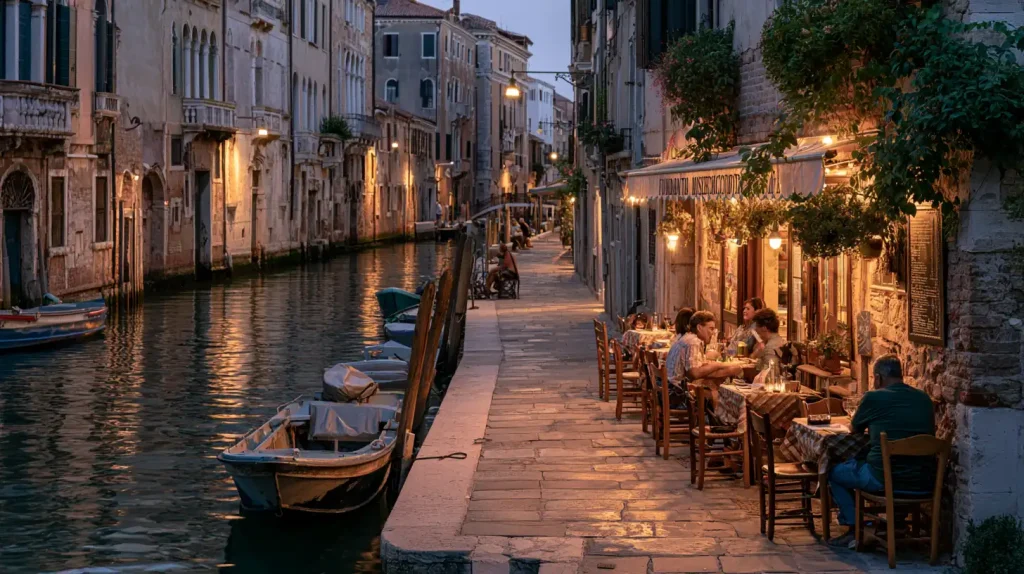
This canal-side walkway in northern Cannaregio runs for several hundred metres past a mix of local bacari, small artisan workshops, and residential buildings. In the evening it fills with Venetians — not tourists — sitting outside and drinking wine. The contrast with the San Marco area, ten minutes away by vaporetto, is remarkable.
Vino Vero on the Fondamenta della Misericordia is one of the better natural wine bars in Venice, with a narrow interior, a canal-side standing area in good weather, and a rotating list of small and independent Italian producers. The selection changes regularly and the staff are knowledgeable without being performative about it. Come early in the evening (before 7pm on busy nights) to guarantee a place at the bar or outside. The walking section of the Misericordia canal is also worth exploring on foot for its combination of small workshops, neighbourhood life, and the general sensation of being somewhere that tourists rarely end up.
Giudecca Island
The island of Giudecca runs parallel to the south side of Dorsoduro, separated by the Giudecca canal. The vaporetto from the Zattere takes five minutes and costs nothing extra with a standard pass. On the other side: no major tourist sights, almost no tourist restaurants, a long canalside walkway with views back toward Dorsoduro and the Salute, and a genuine residential atmosphere.
The Redentore church — Palladio’s 1577 masterpiece, built in thanksgiving after a plague that killed a third of Venice’s population — is here and is worth the visit for the architecture alone. Every third Sunday in July, the Festival of the Redentore involves a bridge of boats built across the Giudecca canal, connecting the main Venice islands to the Redentore church for a procession. The preceding Saturday night features fireworks over the basin — one of the best fireworks displays in Italy — and the canal fills with boats of Venetians celebrating through the night. If your visit coincides with the Redentore weekend, it is worth staying for. If not, Giudecca still repays a half-day visit for its calm, its views, and the Redentore church itself, which is one of the most carefully proportioned buildings Palladio ever produced.
Torcello Cathedral
The Cathedral of Santa Maria Assunta on the island of Torcello is covered in the day trip section of the three-day itinerary, but it deserves mention here as a hidden gem within the island day trip. Most visitors pass through it quickly. The full experience requires slowing down in front of the Byzantine Last Judgment mosaic on the west wall — it is one of the great pictorial narratives in medieval art, depicting in graphic and specific detail the stages of damnation, resurrection, and paradise. It was made in the 12th century and has not been significantly restored. Taking ten minutes to read it section by section from floor to ceiling changes what you understand about what you are looking at.
The Oratorio dei Crociferi (Cannaregio) is a further small gem — a tiny oratory next to an ancient almshouse with interior walls covered by a complete pictorial cycle by Palma the Younger, painted between around 1583 and 1591. [VERIFY current opening schedule, as the oratory has limited opening hours and may require advance arrangement.] The cycle depicts scenes from the history of the Crusader order that ran the adjoining hospice. It is one of the few remaining complete decorative cycles from that period to survive intact in its original setting and is rarely visited — which gives it a quality that the major museums cannot replicate.
Venice rewards the visitor who is willing to walk away from the signposted route. Most of what makes the city extraordinary is not where the arrows point.
suggested topic — 3 Days in Venice: First-Timer Itinerary & Top Highlights
suggested topic — How to Get Around Venice: Easy Transport Guide for First-Timers