Rome’s transport system is functional, reasonably priced, and genuinely useful for getting between airports and the city, and for covering the longer stretches of the city that are too far to walk. It is also not the way you will spend most of your time in Rome. The historic center is compact enough that walking is almost always faster than waiting for a bus, and many of the city’s major sights are closer together on foot than the map makes them look.
Understanding what to use and when — metro for specific corridors, bus for specific routes, walking for the historic center, taxi for airport and late-night — saves both time and frustration.
The Metro: Useful for Some Things, Not Others
Rome’s metro has three lines. Line A (orange) and Line B (blue) are the ones that matter for visitors; Line C is still being extended through the eastern suburbs and serves almost no tourist destinations.
What Line A covers: Termini (the main train station), Spagna (Spanish Steps and Trevi Fountain area), Ottaviano (Vatican Museums and Castel Sant’Angelo), Lepanto, and several residential neighborhoods. If you are staying near Termini and heading to the Vatican area, Line A is the direct route.
What Line B covers: Termini (connecting with Line A), Colosseo (Colosseum and Roman Forum), Circo Massimo (Circus Maximus and Palatine Hill). Line B puts you directly at the Colosseum, which is the most useful single stop in the entire metro system.
What the metro does not cover: The historic center — the Pantheon, Piazza Navona, Campo de’ Fiori, Trastevere, the Jewish Ghetto — has no metro station. These areas are all walkable from metro stops but not directly served. The Trevi Fountain is a 10-minute walk from Spagna. The Pantheon is not on any metro line.
Hours: The metro runs Sunday to Thursday until 23:30, and Friday to Saturday until 1:30am [VERIFY current hours at atac.roma.it]. This is earlier than most European capitals — plan your late-night return accordingly. If you are dining late, which is normal in Rome where restaurants fill up after 8pm and dinner can run until 11pm, you need to either take the metro before it closes or plan for a taxi home.
Frequency: Trains run approximately every 6-10 minutes during daytime hours and every 10-15 minutes in the evening [VERIFY current frequency]. The system is not as dense as London or Paris, and the stations can be hot in summer — Rome’s metro does not have the same ventilation infrastructure as northern European systems. This is a practical issue in July and August when platform temperatures can be high.
Buses: The Widest Coverage, the Steepest Learning Curve
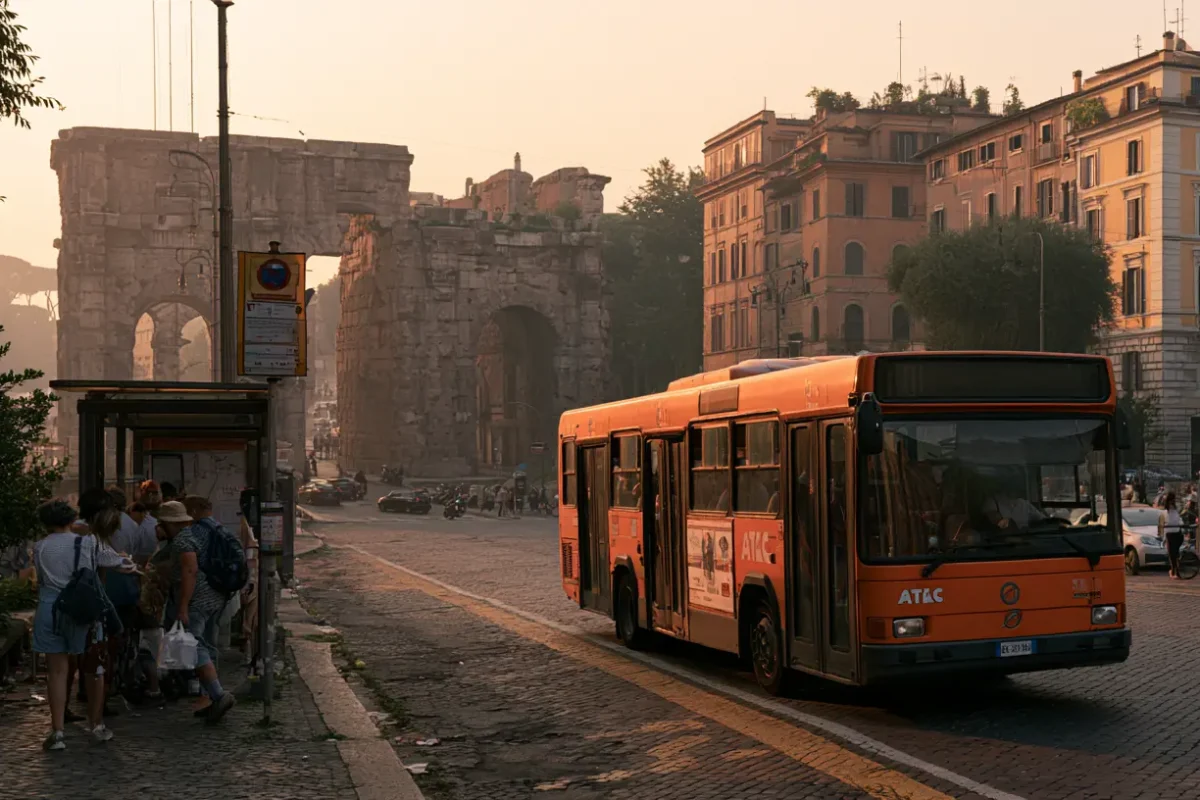
Rome has 338 bus lines and over 8,000 stops. This sounds more helpful than it is for a first-time visitor — the network is extensive but not easy to navigate without the ATAC or Google Maps app, and Rome’s traffic means that journey times vary significantly.
The routes actually worth knowing:
- Bus 40 and 64 (Termini to Vatican): The most tourist-heavy bus routes in Rome, notorious for crowds and pickpockets. If you take them, keep bags in front and phones pocketed. The alternative is the Line A metro to Ottaviano, which is faster and more comfortable.
- Bus 23 and 280 (along the Tiber): Useful for reaching Trastevere from the center.
- Tram 8 (Largo Argentina to Trastevere): The most tourist-useful tram line, connecting the historic center to the Trastevere neighborhood smoothly. Worth knowing.
- Night buses N1, N2, N3, N8, N10: Run after metro closure from approximately 12:30am to 5:30am on major corridors [VERIFY current night bus schedule at atac.roma.it]. Standard €1.50 tickets are valid.
Practical bus reality: For most tourist routes, the bus is slower than walking or the metro. Use it for longer distances or when you are too tired to walk. For crossing the historic center, your feet are faster. Bus reliability in Rome is affected by traffic in ways that are hard to predict — a journey listed as 20 minutes can take 40 in heavy congestion. Google Maps real-time data helps, but even that can underestimate Rome traffic delays. The safest approach is to treat bus journey times as estimates rather than schedules.
If you do take the bus, stand near the front or middle doors, keep your bag in front of you especially on busy routes, and watch your stop on Google Maps rather than relying on announcements. Stop announcements are not always clear on older buses, and some routes have unreliable audio systems.
Tickets and How to Pay
The BIT single ticket: €1.50, valid for 100 minutes from first validation [VERIFY current price at atac.roma.it]. Within those 100 minutes you can take unlimited buses and trams plus one metro entry. One ticket handles most single journeys.
Time-based passes: 24-hour (€7), 48-hour (€12.50), and 72-hour (€18) passes give unlimited transport for the stated period If you are using public transport multiple times a day, the 48-hour pass pays for itself after about four journeys.
Contactless payment: Most Rome metro turnstiles and bus validators now accept contactless bank cards, Apple Pay, and Google Pay — tap the red reader directly [VERIFY current contactless availability at atac.roma.it]. This is the most convenient option for visitors who do not want to hunt for ticket machines.
Where to buy tickets: Metro station machines (multilingual), tabacchi shops (the T-sign tobacco shops found throughout the city), and some newsstands. You cannot buy tickets on buses — buy before boarding. Getting on a bus without a valid ticket is technically a fineable offense and inspectors do check on the tourist-heavy routes.
Validation: On buses and trams, slide your paper ticket into the yellow or gray validators near the doors when you board. Metro tickets are validated at the turnstiles. If using contactless, tap at the reader — this both validates and pays in one action.
Walking: The Real Way to See Rome
The honest statement about Rome transport is this: the city rewards walking more than any other major European capital. The historic center — from the Colosseum to the Pantheon to the Vatican — spans roughly 4 kilometers at its widest. The Colosseum to the Pantheon is 25 minutes on foot. The Pantheon to the Trevi Fountain is 12 minutes. The Trevi Fountain to the Spanish Steps is 10 minutes.
Walking between these sights is not just practical — it is the experience. You pass baroque churches, piazzas, market stalls, and centuries of unplanned street life that no bus route replicates. Some of the best things in Rome are things you encounter while walking between other things.
The exception: in July and August, the midday heat (38-40°C on hot days) makes extended walking genuinely difficult. In those months, the pattern of sightseeing before noon and after 5pm — with a long midday rest — makes more sense than continuous walking throughout the day.
Rome’s streets are also not always flat or smooth. The cobblestone surfaces of the historic center — the sampietrini, the small basalt cubes that cover most of the old city streets — are beautiful and also genuinely hard on ankles and rolling luggage. Wear proper walking shoes. A single day of sightseeing in central Rome typically covers 12-15 kilometers on foot, much of it on uneven stone. Factor this into your planning: comfortable footwear matters more in Rome than in almost any other European city.
The Trastevere neighborhood is worth reaching specifically on foot from the center — crossing the Tiber on the Ponte Sisto pedestrian bridge takes about 20 minutes from Largo Argentina and puts you into the neighborhood with none of the stress of finding the right bus stop. Similarly, walking from the Colosseum toward the Circus Maximus and then along the Lungotevere (the riverfront road) gives you a completely different view of the city than any bus or metro ride.
Taxis
Rome taxis are metered, and the rates are city-regulated [VERIFY current tariff structure at comune.roma.it]. Taxis are useful for late-night returns after the metro closes, for reaching areas not well served by public transport, and for airport transfers. The starting rate is approximately €3, with a per-kilometer charge that varies by time of day and whether it is a weekend [VERIFY current tariff at comune.roma.it]. Sunday and nighttime rates are higher.
For most in-city journeys — from Termini to the Colosseum, or from the Vatican area back to your hotel — a taxi runs €10-15, depending on traffic [VERIFY]. During peak hours in heavy traffic, a taxi can be slower than walking the same distance while costing more. For clear-cut cases like getting back to your hotel after midnight or reaching a specific restaurant in the suburbs, taxis are the right answer.
Official taxis in Rome are white, always metered, and required by law to use regulated rates. Use official taxis or Uber (which operates in Rome with licensed NCC drivers rather than private individuals [VERIFY current Uber availability in Rome]). Avoid unmarked private cars that approach you at airports or stations offering rides — these are not official and typically overcharge significantly.
Flat rates apply for airport transfers — these are city-regulated and the driver is legally required to use them rather than the meter for airport routes.
Getting from the Airports
Fiumicino Airport (Leonardo da Vinci) — 34km from center:
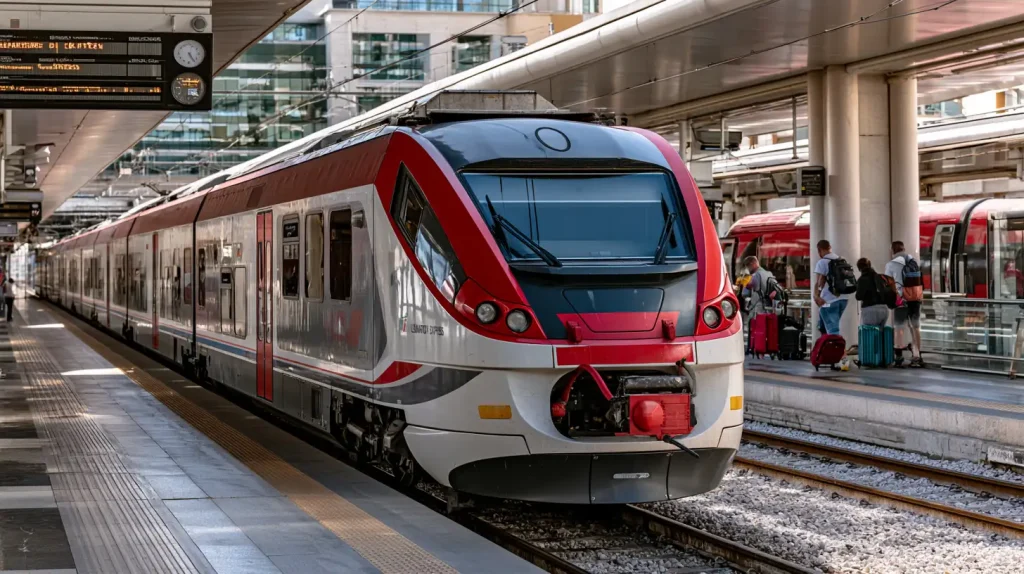
The Leonardo Express train runs non-stop from Fiumicino Airport to Roma Termini every 15-30 minutes, takes about 32 minutes, and costs €14 [VERIFY current price and schedule at trenitalia.com]. This is the fastest and most reliable option for reaching Termini.
The FL1 regional train costs approximately €8, takes slightly longer due to stops, but connects to Trastevere, Ostiense, and Tiburtina stations — useful if your accommodation is near those areas [VERIFY current schedule and price].
A taxi from Fiumicino to anywhere within the Aurelian Walls costs a flat rate of €55, regardless of traffic or exact destination [VERIFY current flat rate at comune.roma.it]. For two or more people, this is competitive with the Leonardo Express.
Ciampino Airport — 16km from center:
The Ciampino Airlink (combined bus and regional train service) connects the airport to Ciampino railway station and then to Roma Termini for approximately €2.70 [VERIFY current price]. Budget airlines including Ryanair use Ciampino.
Terravision and other direct bus services connect Ciampino to Termini in about 40 minutes at around €5-7 [VERIFY current prices and operators at ciampino-airport.com].
A taxi from Ciampino to within the Aurelian Walls is a flat rate of €40 [VERIFY current flat rate]. For small groups this is often the simplest choice.
Practical Summary
For most first-time visitors spending three to five days in Rome, the actual transport usage looks like this: Leonardo Express or taxi from Fiumicino on arrival; metro Line B to Colosseo for the Colosseum and Roman Forum; metro Line A to Ottaviano for the Vatican; walking for everything in the historic center; tram 8 or the Ponte Sisto walk for Trastevere; taxi for late evenings after metro closes.
The 48-hour pass is worth buying if you use transport more than twice a day. Otherwise, individual BIT tickets or contactless tap are equally practical. One habit worth building: whenever you pass a tabacchi, pick up a couple of BIT tickets if you are running low. Finding one when you urgently need to board a bus is far less stressful than scrambling at a metro machine with a line of commuters behind you.
Rome’s transport system is not the best in Europe by any objective measure — the metro coverage is thin, buses run late in traffic, and the network requires more planning than London or Paris. But it covers what tourists actually need, and the walking experience between the gaps is the best part of visiting Rome anyway.
The one thing worth planning in advance is your airport transfer on arrival day, particularly if you land at Fiumicino in the afternoon when traffic is heavy. The Leonardo Express runs on a fixed schedule regardless of road conditions and gets you to Termini predictably. From Termini, almost every accommodation in central Rome is reachable by metro, bus, taxi, or on foot — it is an excellent hub from which to start any itinerary.
suggested topic — Rome Hidden Gems: Lesser-Known Spots Worth Exploring