Chios produces 80% of the world’s mastic — a pine-scented resin that’s been harvested here for over 2,500 years and used in everything from chewing gum to pharmaceuticals, liqueur to toothpaste. The mastic trees grow only in the island’s southern villages, and thanks to a specific combination of soil, microclimate, and latitude that nobody has successfully replicated anywhere else, Chios holds a global monopoly on the thing. That single fact makes this island unlike every other Greek island on the map. Add medieval villages with geometric black-and-white painted facades, volcanic black pebble beaches, a UNESCO monastery, and almost no American tourists, and you have one of the better weeks Greece can offer.
| Best time to visit | April–June and September–October |
|---|---|
| Getting there | Fly Athens (ATH) to Chios (JKH), 45 min; or ferry from Piraeus (7–8 hrs) |
| Budget per day | $70–120 USD (mid-range comfortable) |
| Visa for Americans | No visa required; Schengen 90-day rule applies |
| Language | Greek; English widely understood at tourism level |
| Currency | Euro; cards accepted; carry some cash for villages |
Is Chios Worth Visiting Over Better-Known Greek Islands?
For the right traveler — unambiguously yes. The honest comparison: Chios has no infinity pools, no sunset bars crowded with Instagram shoots, no organized beach clubs, and no particular interest in making tourism smooth and convenient. The island functions as a real community with a port town, working fishing harbors, and southern villages where the mastic cooperative controls a global commodity. What it offers instead is the most historically specific and culturally distinctive experience in the northern Aegean — the mastic villages are genuinely unlike anywhere else in Greece or the world.
Downside to acknowledge: the main beaches in the northern and central parts of the island are unremarkable by Greek standards. The dramatic beaches (Mavra Volia’s black volcanic pebbles, Emporios bay) are in the south. A car is essential — without one, you’ll see Chios Town and maybe one mastic village. Rent a car the first morning.
The Mastic Villages: Pyrgi, Mesta, and Olympi
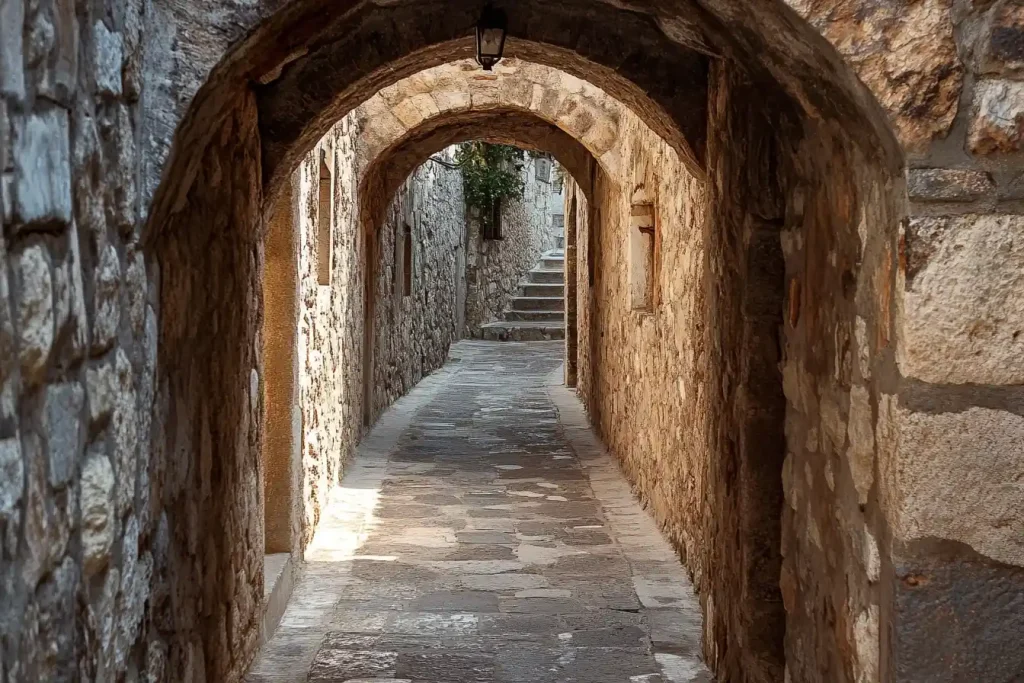
The Mastichochoria are 22 fortified villages in Chios’s southern region built by the Genoese in the 13th–15th centuries to house mastic workers and protect the resin stores from pirates. All are built with the same defensive logic: houses connected wall-to-wall forming a continuous outer barrier, with a central tower as last refuge. Three stand out:
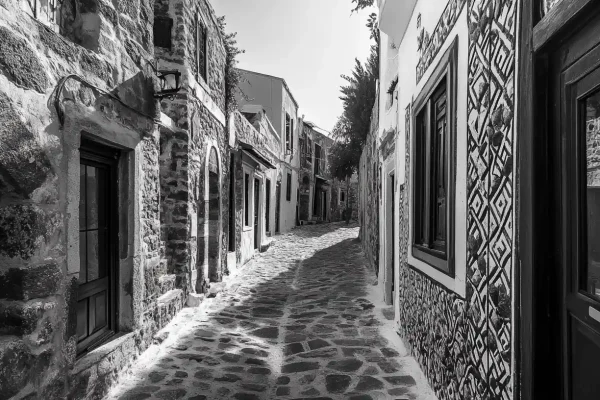
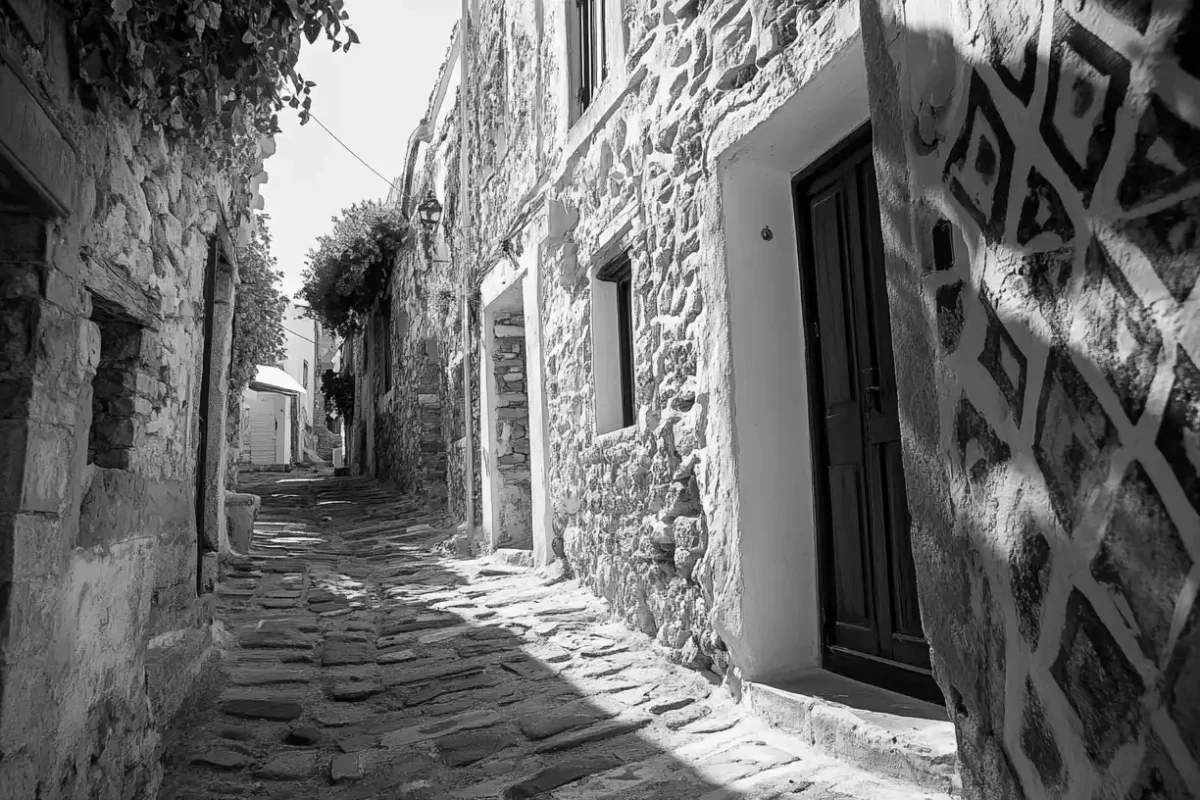
Pyrgi is the most visually arresting in Greece — possibly in all of Europe. Every building in the village is covered in xysta: geometric patterns created by applying black volcanic sand-mixed plaster over white, then scratching away the black to expose the white beneath. Zigzags, diamonds, stars, floral motifs — each house has different patterns, but the overall effect turns the entire village into a monochrome geometry puzzle. Spend two hours walking every alley. Pyrgi is 30 minutes south of Chios Town by car.
Mesta is the best-preserved medieval mastic village — walls intact, central tower standing, labyrinthine alleyways so narrow that only one person can pass at a time. It feels genuinely fortified rather than restored. There’s a hotel inside the village walls (Mesta Rooms, €90–150/night), and staying overnight is dramatically better than a day visit. After the day-trippers leave around 5pm, the village belongs to the few overnight guests and the handful of permanent residents.
Olympi is the quietest of the three — almost entirely a village for locals. The underground cave just outside Olympi (Olympi Cave) is worth the 20-minute detour: 230,000-year-old stalactites and stalagmites, reportedly the highest density per square meter in the Balkans. Guided tour, €8 ($8.70 USD), roughly 20 minutes inside. Open daily except Mondays.
Tasting and Buying Mastic
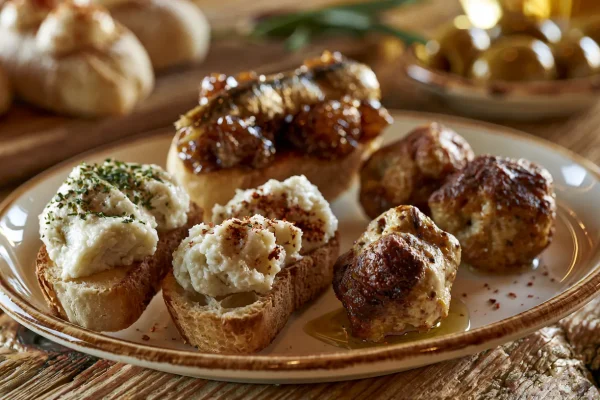
Mastic in its natural form is small teardrop-shaped crystals of resin, slightly translucent, with a piney, slightly camphor-like flavor that is genuinely unlike anything else. In Chios Town, the Mastihashop chain sells everything made with mastic: liqueur (Mastiha liqueur is excellent, around €15 for a bottle), gin, ice cream, cosmetics, chewing gum, dental products. The village shops in Pyrgi and Mesta have the same products, often slightly cheaper.
Souma is the local Chios distilled spirit — made from figs and grapes, not commercially bottled, found at restaurants in the villages but not in regular shops. It runs 40–45% ABV and the fig aftertaste lingers pleasantly. Order it at any village taverna and the bottle will appear from under the counter. Free pour, roughly €3–5 per glass.
Nea Moni Monastery
Eleven kilometers west of Chios Town, the Nea Moni Monastery was built in 1049 by Byzantine Emperor Constantine IX and is a UNESCO World Heritage Site, sharing the designation with two other Byzantine monasteries across Greece. The mosaics inside the katholikon are among the finest examples of Byzantine art surviving from the 11th century — gold tesserae of Christ, saints, and scriptural scenes that still carry their original vibrancy after a millennium. Entry is free, but dress codes are strictly enforced: shoulders and knees covered. Open daily 8am–1pm and 4–8pm.
The monastery’s ossuary contains the skulls of 3,000 Chians killed by Ottoman forces in 1822 — a massacre that prompted international outcry, including a famous painting by Delacroix. The bones are arranged in a small chapel and are not hidden or contextualized minimally — they are there as witness. It’s sobering in a way that a pure art visit wouldn’t be.
Mavra Volia Beach
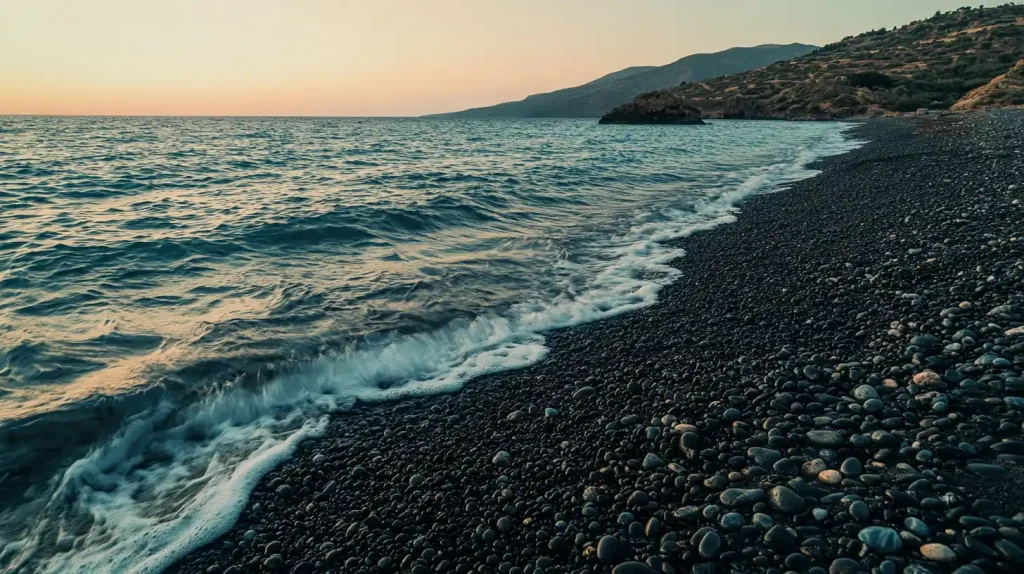
In the far south, past Emporio village, Mavra Volia (“black rocks”) is a beach of volcanic black pebbles and deep turquoise water. The black stones have been polished by the sea for millennia and make a distinctive clicking sound as waves pull back through them. Swimming here in June, the water was clearer and colder than anywhere else on the island. The access road is narrow — park at Emporio and walk 15 minutes. Parking right at the beach exists but fills by 10am in summer.
Getting to Chios from the US
Fly to Athens (ATH) from major US cities — typically $700–1,100 round trip. From Athens, Aegean Airlines and Sky Express fly direct to Chios (JKH) in 45 minutes for $50–100 USD one way. Alternatively, take an overnight ferry from Piraeus Port to Chios Town (7–8 hours, $30–60 USD deck/cabin) — a relaxed and scenic option. A rental car at Chios airport is essential: $35–60 USD/day for a small car.
Where to Stay
Budget ($60–90/night): Maria Rooms in Chios Town — excellent reviews, great location, simple but well-maintained. Castro Rooms near the Byzantine castle is slightly pricier but better positioned.
Mid-range ($90–150/night): Staying inside Mesta village itself — Mesta Rooms or similar small properties. The overnight atmosphere after day-trippers leave makes this worth paying for.
Splurge ($180+/night): Promenade Chios Port Residences — modern, central, outstanding reviews, right on the harbor front.
Best Time to Visit
April–May: Wildflowers in the mastic groves, comfortable temperatures (18–24°C), quiet. Some beach facilities not yet open. Best for photography and walking the village alleys without heat.
June–August: Peak summer, warm enough to swim comfortably. Gets crowded at peak, particularly with Greek domestic tourists. August very busy. Book accommodation well ahead.
September–October: My preferred window. Sea still warm, village restaurants and shops fully open, and the overwhelming summer crowds have eased. October is particularly lovely — the mastic trees are in late-season resin production and the harvest period adds a sensory dimension to the southern villages.
Practical Tips
You need a car. The mastic villages are 25–35km from Chios Town and public bus connections are infrequent. Rent from the airport on arrival. Roads are good quality; navigation is easy.
The Mastihashop in Chios Town is the best single stop for purchasing mastic products — prices are fixed and quality is guaranteed by the Chios Mastiha Growers Association cooperative.
Most tourists miss the inland area of Kambos — an area just south of Chios Town with medieval citrus estates, ornate gate-marked mansions from old Genoese noble families, and citrus groves so dense you can smell them before seeing them. No entrance fees; just drive through slowly.
Frequently Asked Questions
What is mastic and why is it special to Chios?
Mastic is a resin produced by the Pistacia lentiscus tree, which bleeds naturally from cuts in the bark. On Chios — and specifically in the southern Mastichochoria region — the trees produce mastic resin abundantly due to a specific combination of soil, microclimate, and latitude. Attempts to grow mastic-producing trees elsewhere have consistently failed. Chios holds a global monopoly. The resin is used in liqueurs, chewing gum, cosmetics, dental products, and traditional Greek and Middle Eastern cooking.
How do I get from Athens to Chios?
Fly from Athens (ATH) to Chios (JKH) on Aegean Airlines or Sky Express — 45 minutes, $50–100 USD one way. Alternatively, overnight ferry from Piraeus Port in Athens to Chios Town takes 7–8 hours and costs $30–60 USD. The flight is far more practical for most visitors.
Which mastic village is best to visit in Chios?
Pyrgi for the extraordinary black-and-white geometric buildings — the most visually unique village in Greece. Mesta for overnight atmosphere and best-preserved medieval architecture. Olympi for the cave nearby and the most local feel. All three are within 15 minutes of each other and can be visited in a single day by car.
Is Chios good for swimming and beaches?
The best beaches are in the south: Mavra Volia (dramatic black volcanic pebbles and clear turquoise water near Emporios) and Emporios bay itself. The northern beaches near Chios Town are pleasant but not exceptional. Avoid August if you want peaceful swimming — the island fills with Greek holidaymakers.
Do I need to speak Greek to enjoy Chios?
No. English is understood at guesthouses, restaurants, and the main tourist sites. In the smaller mastic villages, English is more limited — basic phrases and Google Translate cover everything. The Mastihashop in Chios Town has English-speaking staff who explain mastic products clearly.