Camembert village has fewer than 200 inhabitants and one main reason anyone drives there. It’s a small place in a wide green valley, surrounded by Norman hedgerows and dairy pasture. The cow statues and the directional signs near the museum confirm that this is, in fact, where you’re supposed to be.
The surprise is that the museum is actually worth the stop. And that the Pays d’Auge surrounding it — the half-timbered farms, the apple orchards, the cider producers and cheese dairies — makes for one of the better food days in France if you plan the route properly.
The Four Cheeses of Normandy
Norman cheese is organized into four AOC/AOP designations. Each has protected status tied to a specific production area, method, and milk source. They’re all made from local Norman cow milk — the Normande breed and the Jerseys and other dairy breeds common in the bocage pastures — which is noticeably richer in butterfat than industrial dairy milk. The grass quality in this wet Atlantic climate produces milk that tastes different, and the cheese reflects it.
Most visitors encounter one of the four. A day in the Pays d’Auge is a good opportunity to try all of them in context.
Camembert de Normandie AOP: The most famous. A soft-ripened cheese in a round white rind, traditionally made with unpasteurized milk and hand-ladled in five layers into the mould. The genuine AOP version is different from the mass-produced “Camembert” sold in supermarkets across France, which uses pasteurized milk and industrial production. If a label says “Camembert de Normandie AOP,” you’re getting the real thing.
Livarot AOP: Older than Camembert by several centuries. A washed-rind cheese with an orange exterior, strong smell, and rich, earthy flavor. The strips of sedge grass (or paper strips in modern production) wrapped around it are one of its identifiers. Known locally as “the colonel” for the stripes.
Pont-l’Évêque AOP: Square format, soft, and milder than Livarot. One of France’s oldest named cheeses. Named after the market town of Pont-l’Évêque in the Calvados department, where it was historically sold.
Neufchâtel AOP: Heart-shaped (or log or square), the most unusual-looking of the four. Drier and crumblier than the others. Comes from the Pays de Bray in Seine-Maritime. The least commonly encountered of the four outside Normandy. The heart shape is traditionally connected to a story about French soldiers being given heart-shaped cheeses by Norman women during the Hundred Years’ War — a folk explanation more than a documented fact, but a good story regardless.
Camembert Village and the Maison du Camembert
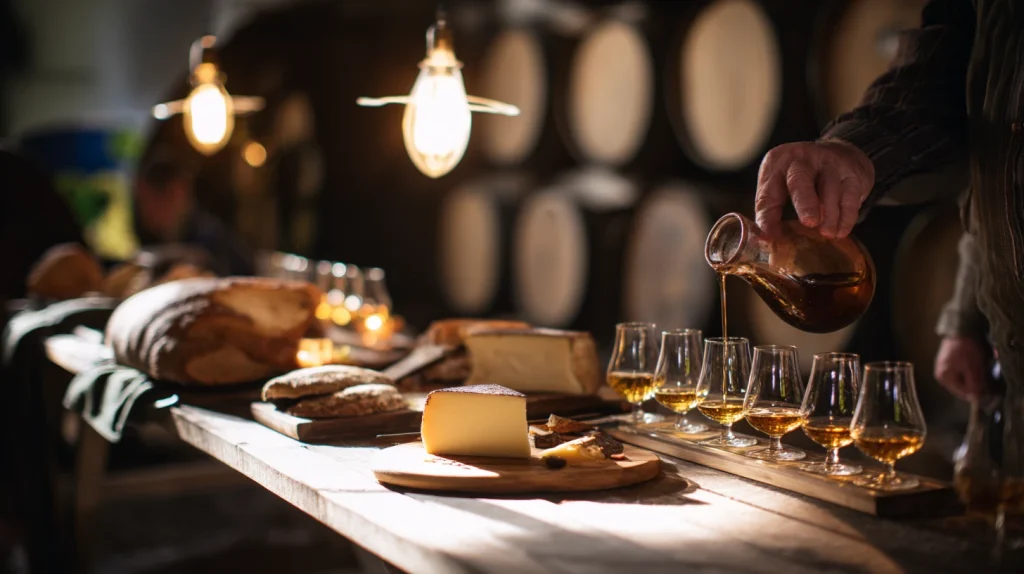
The Maison du Camembert is a museum inside an 18th-century Norman farm. It tells the story of Marie Harel, the farmer traditionally credited with developing the modern Camembert recipe in 1791, in the nearby Manoir de Beaumoncel — though like a lot of origin stories tied to a single named inventor, the historical record is thinner than the legend, and cheese historians generally see her as refining an existing regional recipe rather than inventing it outright. A printed and audio-guided visit is available in English and French, and the visit ends with a tasting of three types of Camembert — the AOP version, a semi-industrial version, and an organic version — which is the most useful part.
Entry runs around €4.50 for adults, half price for ages 11–14, and free under 10 — prices and exact hours shift slightly year to year, so it’s worth a quick check before you go. The museum is generally open daily from May through August, with reduced days (typically Wednesday through Sunday) in March, April, September, and October, and closed through the winter.
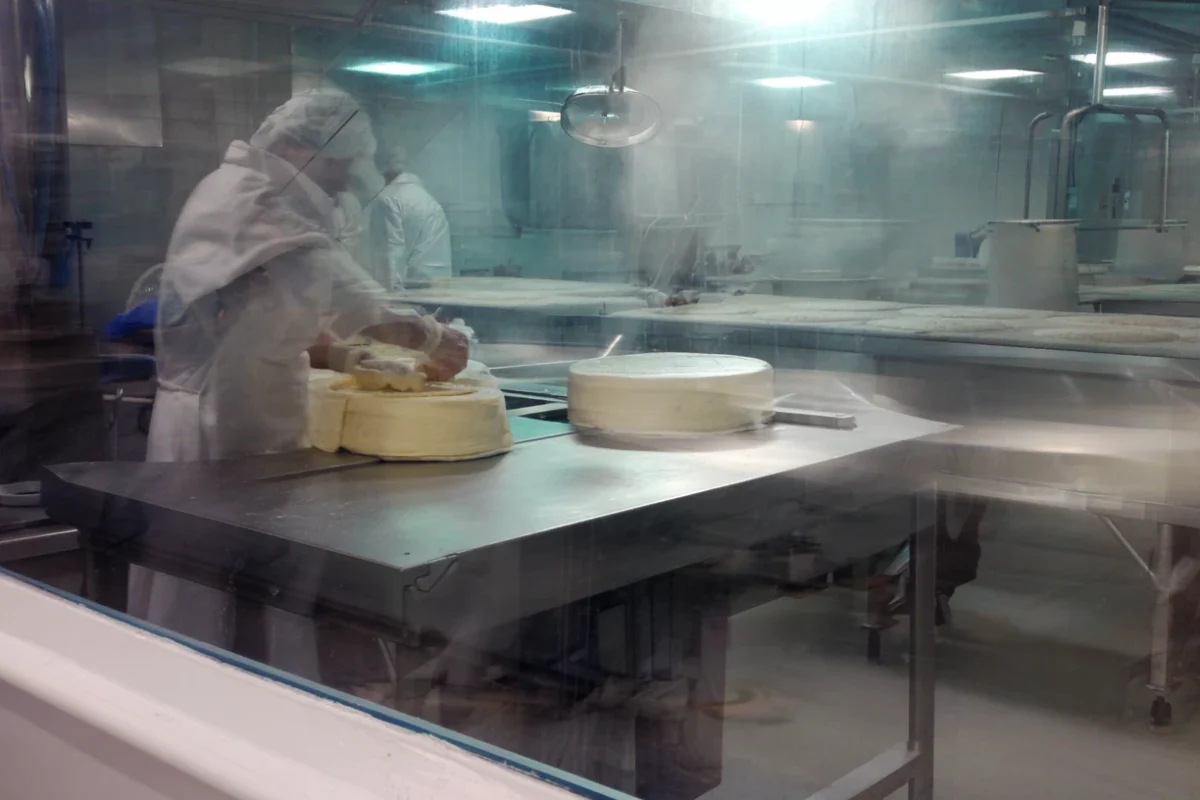
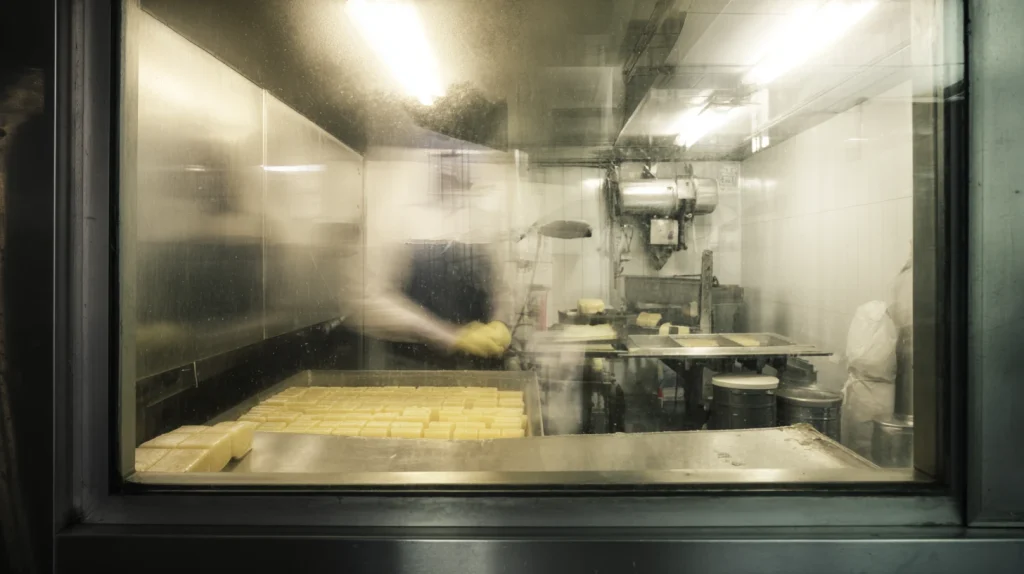
Adjacent to the museum, the Clos de Beaumoncel cheese factory allows visitors to watch production through large glass windows. Seeing the hand-ladling process through the window — five separate layers of curd added by hand into each mould — makes the price difference between AOP and supermarket Camembert immediately clear.
Allow one to two hours total for the museum and factory. The village itself has a small square and not much else — there’s no restaurant, no market. Eat in Vimoutiers (a few kilometers away) or bring a picnic.
The Pays d’Auge: What the Region Looks Like
The Pays d’Auge is Normandy’s heartland for both dairy and cider production. The landscape is a specific combination of bocage — a mix of hedgerows, orchards, and dairy pasture — and half-timbered farms that becomes recognizably Norman to the point of parody. On a grey morning in autumn with mist sitting in the valleys and cows standing in the wet grass, the Pays d’Auge looks like a painting of itself.
The roads between towns are narrow and mostly quiet. The villages have the same visual grammar: stone church, covered market hall, mairie, and somewhere a farm offering direct sales. Beuvron-en-Auge, on the Route du Cidre, is the prettiest — its central square is lined with 16th- and 17th-century half-timbered buildings and often appears on “most beautiful villages in France” lists. It’s small enough to cross on foot in ten minutes, but the architecture is genuinely exceptional — the kind of place that looks like a film set but predates cinema by several centuries.
Cambremer, Bonnebosq, and Beaufour-Druval are the other village stops on the Route du Cidre. None of them are as photogenic as Beuvron-en-Auge, but each has at least one farm where you can stop for a tasting. The combination of stopping at the museum, a farm or two, and a village square for lunch creates a rhythm that makes the day feel less like tourism and more like the actual Pays d’Auge habit of visiting neighbors to see what they’ve been pressing.
Driving the Pays d’Auge is the point. Taking the fast N-road between towns would miss the entire reason to be here. The D-roads between Camembert, Livarot, and Beuvron run through the landscape rather than above it.
Livarot and Fromagerie Graindorge
The town of Livarot, roughly 15–16km northeast of Camembert village, is home to Fromagerie Graindorge, an independent, family-run dairy operating since 1910 that produces Livarot and Pont-l’Évêque on site and offers a free self-guided walk-through with a tasting at the end that includes all four Norman AOP cheeses — Livarot, Pont-l’Évêque, Camembert de Normandie, and Neufchâtel.
The Livarot cheese itself is worth understanding before you taste it. The smell is strong — a washed rind builds a specific pungency from the bacteria used in its development. This puts people off before the first bite. The flavor is much milder than the smell suggests, with a creamy, earthy richness that pairs naturally with dry cider or a glass of local Calvados.
Livarot is sold in four sizes: the full round (about 500g), the three-quarter, the half, and the quarter. For tasting purposes on a day trip, asking for a quarter at a market or cheese shop makes sense — enough to understand it without committing to half a wheel you need to finish in three days. The washed rind needs to be kept cold and used quickly once cut.
Visiting the Graindorge dairy is worth it even if you’ve already tasted Livarot elsewhere — tasting all four cheeses in sequence at one location gives you the spectrum of Norman dairy in about twenty minutes and makes subsequent meals across the region make more sense. Visits are recommended in the morning to catch the production line actually running.
If you’re buying Livarot to take home, the smaller-format versions (demi or quart) travel better. The full wheel needs to be eaten quickly or wrapped extremely well. A well-insulated cool bag and an ice pack gets most Norman cheese safely through an eight-hour journey home.
Pont-l’Évêque
The market town of Pont-l’Évêque, roughly 35km northwest of Livarot by road, has its own cheese traditions and a local market that sells the local production alongside other Pays d’Auge products — ciders, calvados, pommeau, and butter from the nearby dairies.
The Pont-l’Évêque cheese is square, which makes it immediately distinctive on a cheese board. The rind is washed and slightly orange, the paste inside is soft and buttery. It’s the mildest of the four Norman cheeses — the one to recommend to someone skeptical of strong flavors. It goes particularly well with a glass of brut cider.
The town is also close to well-known Calvados producers of the Pays d’Auge, several of them long-established estates with roots going back well over a century, offering visits and tastings with advance notice in season. Tasting calvados at a Pays d’Auge estate, with the orchard outside and the barrels visible in the aging cellar, is a different experience from buying a bottle at an airport.
A One-Day Pays d’Auge Route
This works by car starting from Caen or Bayeux.
Morning (9am–12pm): Start at Camembert village. Museum opens at 10am in season — arrive at opening to beat any small groups. One to two hours for museum and factory. Drive to Vimoutiers for a coffee and supplies (market town, better facilities than Camembert itself). Vimoutiers has a weekly market and decent bakeries.
Late morning–lunch (12pm–2pm): Drive toward Livarot. Fromagerie Graindorge visit if the tour schedule works — mornings are best. Lunch in Livarot town or a picnic on one of the Route du Cidre’s pull-ins with a view. Buy a selection of cheese, bread, and cider from local shops and sit somewhere with a field in front of you. This is the most Norman thing you can do and costs relatively little.
Afternoon (2pm–5pm): Route du Cidre. Pick two or three farm stops between Livarot and Beuvron-en-Auge. At each farm: a tasting, a look at the barrels or the pressing equipment, and a decision about what to buy. Beuvron-en-Auge for a walk around the square and a coffee before heading back. If you’re staying the night, several gîtes and B&Bs operate in the village.
Evening option: Pont-l’Évêque for dinner or to explore the market town before the drive back. The town is livelier than Beuvron-en-Auge and has more restaurant options.
A car is the only practical option for this route — public transport doesn’t connect these stops at a useful frequency.
FAQ
Is it worth visiting Camembert village? Yes, if you’re combining it with other Pays d’Auge stops. On its own, the village is very small — the Maison du Camembert museum is genuine and worth the modest entry fee, and the factory viewpoint adds context. But the village has no restaurant and little else. Build it into a broader Pays d’Auge day rather than treating it as a standalone destination.
What is the difference between Camembert de Normandie AOP and regular Camembert? Camembert de Normandie AOP requires unpasteurized milk from Norman cows, hand-ladled production in five layers, and geographic production within the Normandy AOP zone. Industrial “Camembert” sold in French supermarkets often uses pasteurized milk, machine production, and no geographic restriction. The taste and texture difference is real — the AOP version has more depth, creamier texture, and develops more complexity as it ripens.
Where can you taste all four Norman cheeses in one place? Fromagerie Graindorge in Livarot produces Livarot and Pont-l’Évêque on site and offers a free tasting of all four Norman AOP cheeses — including Camembert de Normandie and Neufchâtel — at the end of the tour.
How long does a Pays d’Auge food day take? A full day from Caen or Bayeux with Camembert village, two Route du Cidre farm stops, Livarot, and Beuvron-en-Auge takes 8 to 9 hours including driving and meal stops. If you want to add Pont-l’Évêque, plan for 10 hours or make it a two-day trip.
When is the best time to visit the Pays d’Auge? June through mid-September gives the best combination of open farms, good weather, and accessible markets. October is worth considering for the apple harvest — pressing season begins and some farms allow visitors to watch. The Maison du Camembert runs on reduced hours or closes entirely from November through February, so check ahead if you’re visiting in the off-season.