Search for Provence hidden gems and the first thing you’ll notice is that most lists include Roussillon — the ochre village with the cliff trail and the red-orange houses, the one that shows up on a huge share of all Provence social media posts and now charges for entry to its own ochre trail.
Then they include Les Baux-de-Provence. And Sénanque Abbey.
At some point you start wondering what the word “hidden” actually means to these people.
Provence does have genuinely overlooked corners. Some are villages that don’t photograph as cleanly as Gordes and so never made it into the visual shorthand. Some are towns that feel too workaday for the lavender-and-hilltop narrative but have something specific worth the drive. And some are experiences that even people who’ve visited the Luberon five times haven’t gotten around to.
Here’s what actually flies under the radar.
Villeneuve-lès-Avignon: The Better View of Avignon
Most visitors to Avignon spend their entire time inside the city. A short drive west across the Rhône brings you to Villeneuve-lès-Avignon — a quieter, greener alternative that’s often completely empty even when Avignon is full.
The view alone is worth crossing the bridge. From the gardens of the Tour Philippe le Bel and from the hilltop Abbaye Saint-André, you look east across the river at Avignon’s full silhouette: the ramparts, the Palais des Papes rising above them, the broken arch of the Pont Saint-Bénézet stretched over the Rhône below. It’s a better view of Avignon than you get from anywhere inside Avignon itself. Nobody tells you this.
Villeneuve has its own history that’s entirely separate from what’s across the river. When the 14th-century popes settled in Avignon, their cardinals built palaces here — well over a dozen of them, some with formal gardens. The Chartreuse du Val de Bénédiction, founded in 1356 by Pope Innocent VI and once the largest Carthusian monastery in France, is the standout site: rose gardens, three cloisters, a 14th-century fresco chapel painted by Matteo Giovannetti, and the pope’s own restored tomb. A full visit takes about an hour, and there are no queues outside it, no audio-guide crowd moving at the same pace as everyone else.
The Maison Orsini, a guesthouse set in a former cardinal’s palace, is one of the more interesting places to stay in the greater Avignon area, perched with views over the city that shift through the day as the light changes.
If you’re here during the Avignon Theatre Festival in July, Villeneuve is the practical solution. It’s a short drive from the festival venues, generally costs less to stay in, and doesn’t require driving into a medieval city that wasn’t designed for cars.
Oppède-le-Vieux: The Abandoned Village Above the Inhabited One
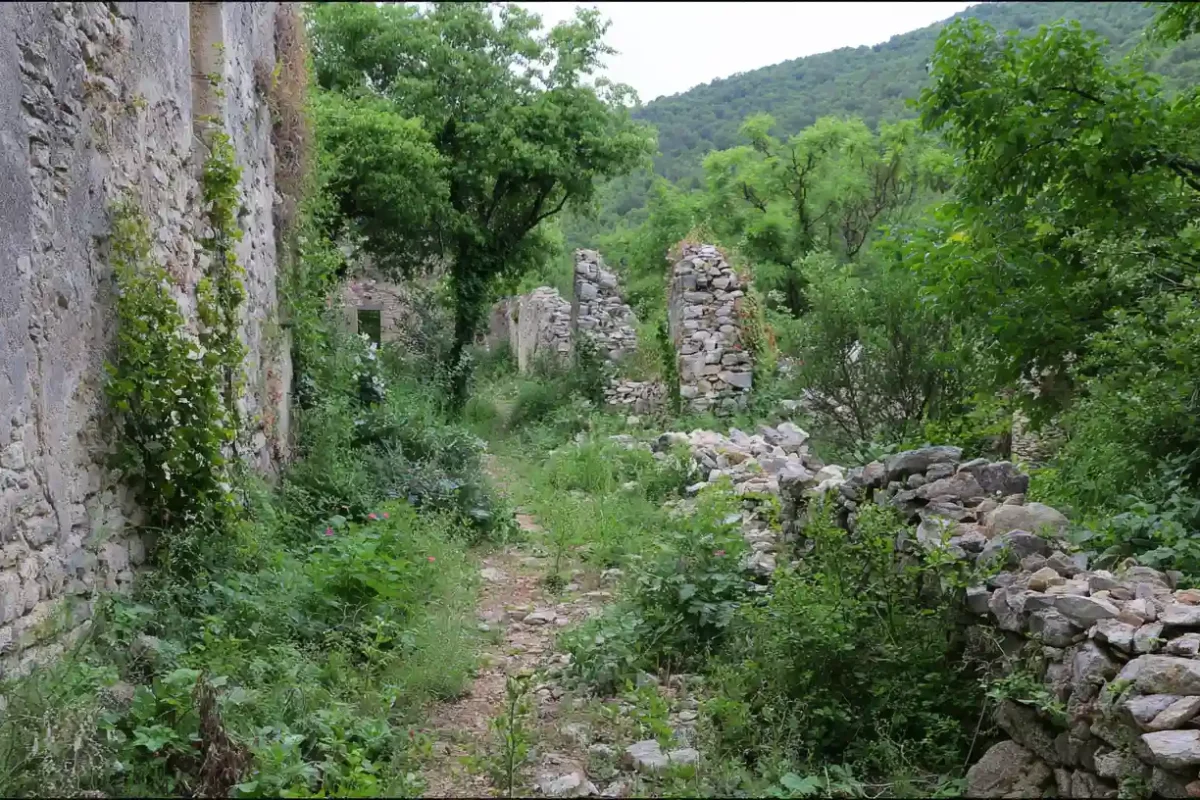
On most Luberon maps, you’ll see Oppède marked as a single village. What the map doesn’t show is that there are two Oppèdes. The modern village where people actually live sits down in the valley. Above it, up a steep path through oak woodland, the original medieval village stands in various degrees of ruin — empty, silent, slowly being reclaimed by fig trees and wild herbs.
The walk up takes about 20 minutes from the small parking area below. You pass through the remnants of the old village gate and continue up through a tangle of crumbling stone houses to the 16th-century church at the top, which is being slowly restored, along with the adjacent castle ruins. From up there, the view over the Luberon valley opens wide and clear in every direction. And you’ve earned it in a way you simply haven’t at Gordes, where you drive to the viewpoint and park.
Oppède-le-Vieux was inhabited until the mid-20th century, when the last residents moved down into the valley. The stone shells of houses are still standing, wrapped in vegetation. Nothing has been renovated for visitors. There are no souvenir shops at the top. It isn’t photogenic in the polished Gordes way — it’s too ruined and overgrown for that. What it is, is the Luberon before it became a lifestyle destination.
Go on a weekday. On summer weekends even this gets discovered.
Pernes-les-Fontaines: The Town With 36 Springs
Between Carpentras and L’Isle-sur-la-Sorgue, Pernes-les-Fontaines doesn’t get mentioned in the same breath as either one. It should.
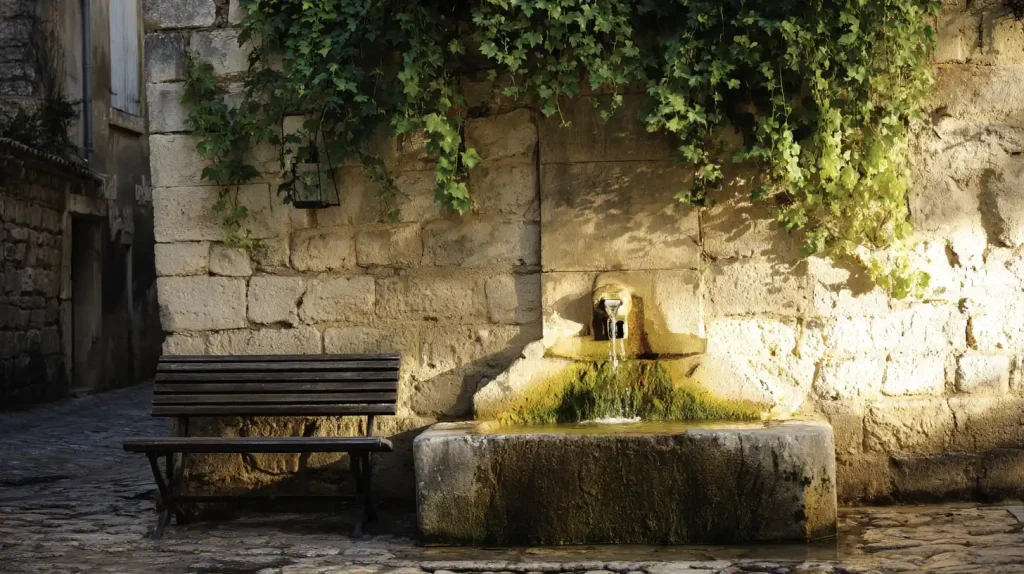
The town takes its name from the roughly three dozen spring-fed fountains distributed throughout its medieval streets, courtyards, and private squares. A pamphlet from the tourist office turns this into a proper afternoon — walking from one fountain to the next through lanes that have barely changed in centuries. The Cormoran fountain, at a bend in the old street, and the Gigot fountain at the base of the Ferrande Tower are two of the best.
The Ferrande Tower itself, a 12th-century structure, houses a set of 13th-century frescoes on its top floor depicting Charles of Anjou’s conquest of Sicily — sometimes described as among the earliest surviving secular fresco cycles in France. Visits are guided-tour only, arranged through the tourist office, with groups capped at a modest size — you climb a narrow stone stair to find the frescoes painted directly on the walls, no fanfare, no significant queue. The medieval ramparts are substantially intact and walkable. The 16th-century Notre-Dame Gate is one of the better-preserved town gates in the region.
There’s a covered market hall dating to the 17th century, a truffle market in January, and an evening market on Wednesdays from spring through autumn in the Place Frédéric Mistral. Orchards around the town produce cherries in late spring and Carpentras strawberries — a specific local variety — in April and May.
Pernes-les-Fontaines is not glamorous. But it’s a genuinely interesting place with more layers than its low profile suggests, and the drive from L’Isle-sur-la-Sorgue is about 15 minutes. Almost nobody bothers.
Saint-Saturnin-lès-Apt: The Village That Glows
The name alone keeps people away. Saint-Saturnin-lès-Apt reads on a map as an afterthought between Apt and the high Luberon plateau. What it actually is: a tiny medieval village with an 11th-century Romanesque chapel, an old windmill at the hilltop, castle ruins with views over the entire Luberon, and a Tuesday morning farmers’ market that draws local producers rather than souvenir stands.
When the pale limestone catches morning light, the village genuinely shimmers. It’s the color that made Provence’s light famous — the creamy, warm stone that Cézanne kept painting and, by his own account, never quite got right on canvas.
The Rue de la République, climbing through the village, is lined with sculpted lintels, doorways, and stone passageways spanning six centuries of architecture. You can walk the whole village in about 45 minutes and feel like you’ve seen more of real Provence than a week in Gordes.
The drive from Roussillon is only about 15 minutes, which means you can combine Saint-Saturnin with the ochre cliffs in a single morning without covering much distance.
Carpentras: On a Friday, In Winter
Carpentras is not conventionally pretty in the way the Luberon villages are. It’s a real town — a proper one with traffic, a covered market, a football stadium. This is also precisely why its Friday morning market is one of the best in all of Provence.
The market is vast, spreading across multiple squares and streets. It’s not aimed at tourists. It sells what local people actually buy: produce from local farms, fabric, tools, live plants, cheese, dried goods, clothing, cookware. The scale and noise and variety are different from the more curated village markets in the Luberon — more chaotic, more alive, more like what a market actually is when the audience isn’t on holiday.
Carpentras also has the oldest synagogue still in active use in France, built in 1367. The exterior is deliberately modest. Inside, the 18th-century Baroque prayer room is preserved with its original furnishings, and the lower levels hold the building’s oldest features: 14th-century ritual baths (mikveh) and a matzo bakery. The context is specific and moves you if you know any of it: the Jewish community here dates to the 13th century, when the popes of Avignon offered formal protection to Jewish populations settling in a small group of Provençal towns — Carpentras, Cavaillon, and L’Isle-sur-la-Sorgue among them. For centuries this “Comtat” community lived under papal protection while Jewish communities elsewhere in France faced repeated expulsion. Almost no one driving through on the way to Gordes knows this history.
In winter, Carpentras runs a genuine truffle market on Friday mornings in the Place Aristide Briand, running roughly from mid-November through mid-to-late March depending on that season’s harvest — worth checking exact current dates before planning around it. Dealers and farmers arrive before dawn, and by mid-morning the market is operating in earnest, truffles changing hands by the kilogram, by basket, by handful. The smell is unlike anything else. If you’re in Provence sometime between December and February and this is even slightly interesting to you, it’s not something to skip.
Fontaine-de-Vaucluse: Get Past the Shops
Most people who visit Fontaine-de-Vaucluse give up halfway. The approach through the village is a gauntlet of shops selling lavender products, pottery, and Provence-branded souvenirs. By the time you’ve run the commercial section, the will to continue has usually faded.
Continue anyway.
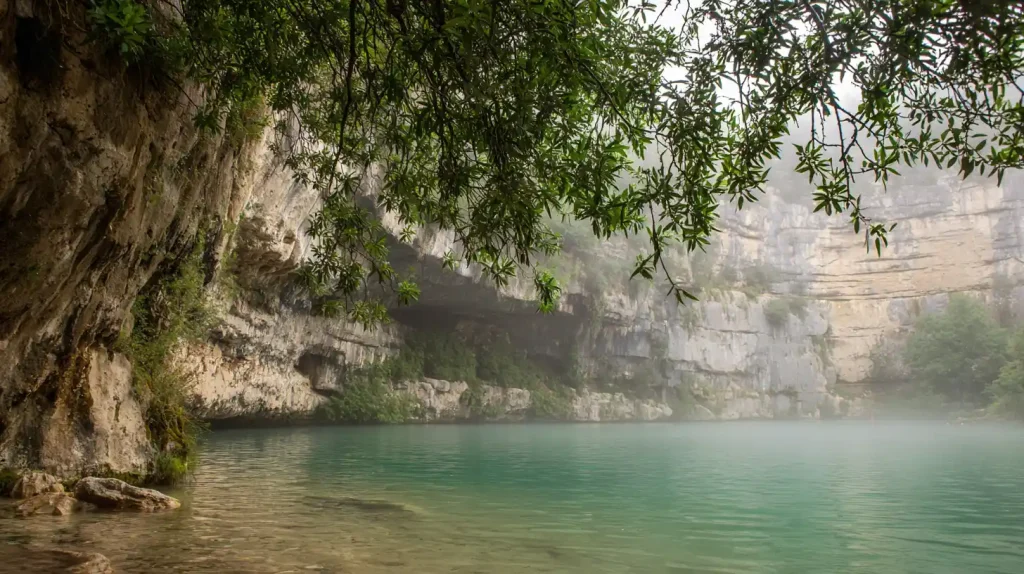
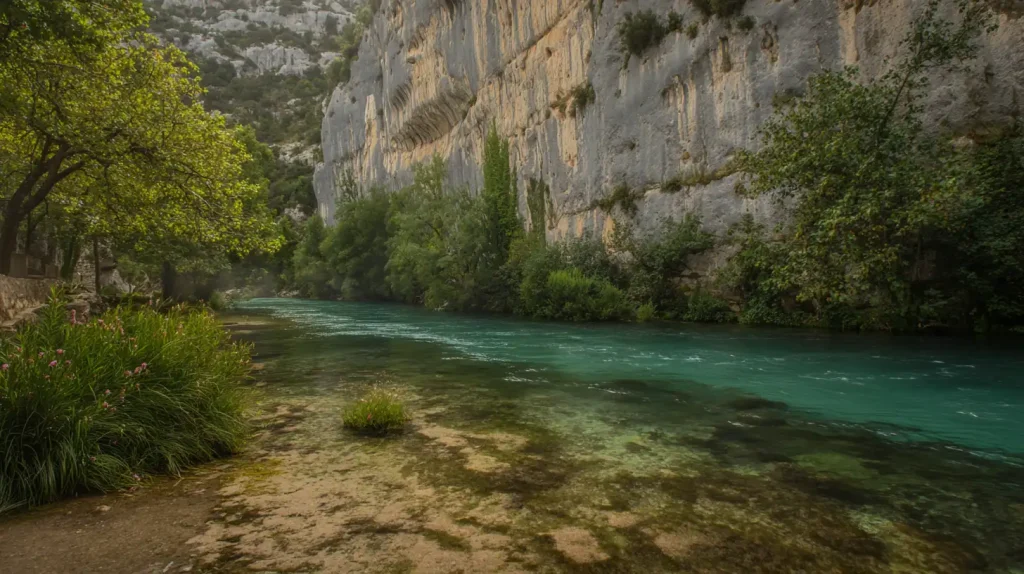
At the far end of the gorge, past the last restaurant and past the point where the tourist flow drops off, the river Sorgue emerges from a cliff face at the base of sheer limestone walls roughly 230 meters high. This is where the river begins — the largest karst spring in mainland France and among the largest of its kind in the world, fed by an underground cave system that divers have explored to depths of over 300 meters without ever finding its true bottom. In winter and spring, when the water table is high, the water surges up visibly from the rock. In summer it’s quieter, but the geological scale is impressive regardless: turquoise-green water welling from solid rock at the base of dramatic cliffs.
The Provençal poet Petrarch lived in the area for years in the 14th century, writing much of his Canzoniere and his sonnets to Laura here. There’s a small museum about him near the spring, the Musée Pétrarque, which is easy to skip and, if you know the poetry, worth not skipping.
From L’Isle-sur-la-Sorgue the drive is about 10 minutes; from Gordes, roughly 25. Go on a weekday or before 9am. The gorge walk from the village parking to the spring takes about 20 minutes each way on an easy path.
Things Even Luberon Regulars Miss
The Apt Saturday market is one of the largest in Provence and almost entirely skipped by visitors who assume Apt is just a transit town. It spreads through multiple blocks of the old town — olives, honey, dried lavender, tapenade, fresh produce, fabric, ceramics — at local prices rather than tourist prices. Apt itself isn’t handsome in the way of the hilltop villages, and that’s precisely why the market has stayed genuinely good.
The Mines de Bruoux at Gargas, just north of Apt, offer a different way into ochre country than the polished Sentier des Ocres at Roussillon. These are the actual former underground quarries where ochre was extracted until the early 20th century, and today you visit them on a roughly hour-long guided tour through the old mining galleries — a proper attraction with a reservation system rather than an untouched wild site, but a genuinely different experience from the surface-level Roussillon trail, with a distinct underground, industrial-heritage feel to it.
Cucuron is a southern Luberon village built around a large 15th-century basin of still water at the center of the main square, ringed by tall old elm trees. The reflection and the calm are entirely unlike the exposed hilltop drama of Gordes or Bonnieux. There’s a Tuesday market and a small medieval church. It’s about 10 minutes from Lourmarin and rarely makes anyone’s list.
FAQ
What are the most underrated villages in Provence? Villeneuve-lès-Avignon, Oppède-le-Vieux, Pernes-les-Fontaines, Saint-Saturnin-lès-Apt, and Cucuron all offer genuine Provençal character without the crowds. Pernes-les-Fontaines is particularly overlooked given how close it sits to both Carpentras and L’Isle-sur-la-Sorgue.
Is Roussillon actually a hidden gem in Provence? No. Roussillon is one of the most photographed villages in France and draws hundreds of thousands of visitors a year. The ochre trail has paid entry and a morning queue in summer. It’s absolutely worth visiting — the geology is genuinely striking — but the word “hidden” doesn’t really apply anymore. Go at opening time in the shoulder season if you want the cliff walk without the crowd.
When is the Carpentras truffle market? Friday mornings, running roughly from mid-November through mid-to-late March depending on the season’s harvest, held in and around the Place Aristide Briand. The market is functional rather than theatrical — dealers actually buying and selling — but the scale and smell make it a memorable morning even if you’re just there to watch.
How do you get to Oppède-le-Vieux? Drive to the small parking area in Oppède village. From there, a 20-minute walk on a marked path through oak woodland brings you up to the abandoned medieval village and church. The path is uneven, so wear actual walking shoes. No entrance fee, no set opening hours, and few crowds on weekdays.
Is Fontaine-de-Vaucluse worth visiting if I’ve already been to L’Isle-sur-la-Sorgue? Yes, as long as you walk all the way to the spring rather than stopping in the village. The gorge at the far end is the whole reason to go, and it’s a completely different experience from the canal town. The full out-and-back walk from the car park runs somewhere around 40 minutes.