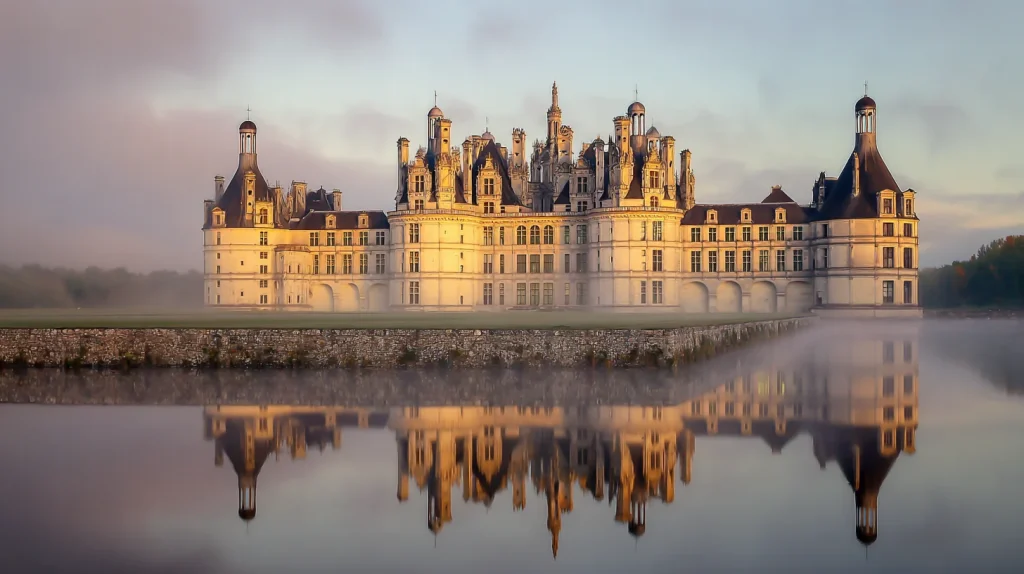
Château de Chambord is the château that makes every other Loire Valley stop look modest by comparison — not because it’s the prettiest (that argument usually goes to Chenonceau) but because of sheer, slightly absurd scale. A 156-meter-long facade. Somewhere around 440 rooms. 282 chimneys standing above the roofline like a small city of their own. And behind all of it, a walled hunting park bigger than the city of Paris. It’s the kind of place that photographs undersell, because nothing quite prepares you for standing at the base of it.
It was commissioned in 1519 by François I, a 24-year-old king who loved hunting and wanted somewhere spectacular to entertain the nobles he brought along for it. Construction ran for decades, well past his lifetime, and the finished building bears less resemblance to a hunting lodge than to a fantasy sketched out and then actually built. He reportedly spent only a few dozen nights there across his entire 32-year reign — which tells you the point of Chambord was never really comfort. It was a statement.
Here’s what to know before you go, what it actually costs in 2026, and how to get the most out of a visit.
Tickets and Prices: What Changed in 2026
This is worth reading closely, because the pricing structure changed significantly and recently.
As of January 14, 2026, Chambord introduced a two-tier pricing system, on an experimental basis through the end of the year. The reference (standard) price for château and French formal garden admission is €31. A preferential rate of €21 applies to visitors who are citizens or residents of a country in the European Economic Area, provided you can show valid proof (a passport, ID card, or residence permit) at the ticket counter. A reduced rate is also available for both categories with valid documentation — €28.50 for the standard rate, €18.50 for the EEA rate. EU citizens under 26 get in free, but the free ticket has to be collected in person at the ticket office rather than booked online.
That’s a substantial jump from what the château charged as recently as 2025 (around €19), so if you’re working from an older blog post or a friend’s memory of the price, expect it to be considerably more now. The stated reason is funding ongoing maintenance, conservation, and restoration work on the site.
The park itself — the walled forest surrounding the château — is free to enter and open every day of the year, separate from the château ticket. So even if you’re not going inside, driving or cycling through part of the grounds costs nothing.
Combined tickets: A combined château-plus-equestrian-show ticket and a broader “Chambord Passport” covering multiple activities are both available, and both now follow the same two-tier EEA/non-EEA pricing as the standard entry ticket. If you’re planning to see the horse show as well as the château interior, buying the combined ticket is usually more efficient than paying separately.
Where to buy: Book online in advance if you can, especially for a summer visit — it doesn’t guarantee a fixed entry time (the standard ticket is open-dated within opening hours), but it does let you skip the ticket-purchase line at the counter, though not the security check.
Opening Hours
Chambord is open 362 days a year, closed only on January 1 and December 25. Hours shift by season:
- Low season (early January through late March, and late October through mid-December): 9am to 5pm
- High season (late March through late October, plus the Christmas holiday period in late December/early January): 9am to 6pm
Last entry is always 30 minutes before closing, and the French formal gardens close half an hour before the château itself does. The park stays open all day, every day, regardless of château hours.
The Double-Helix Staircase — What You’re Actually Looking At
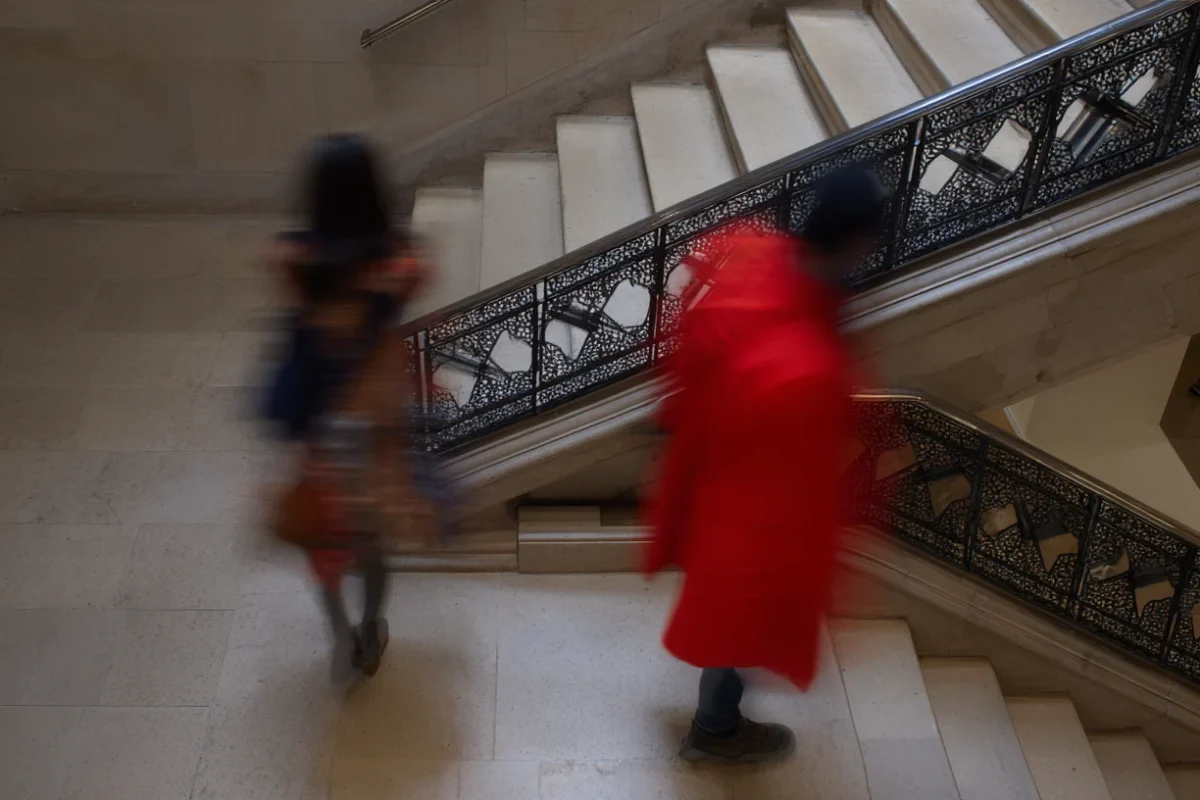
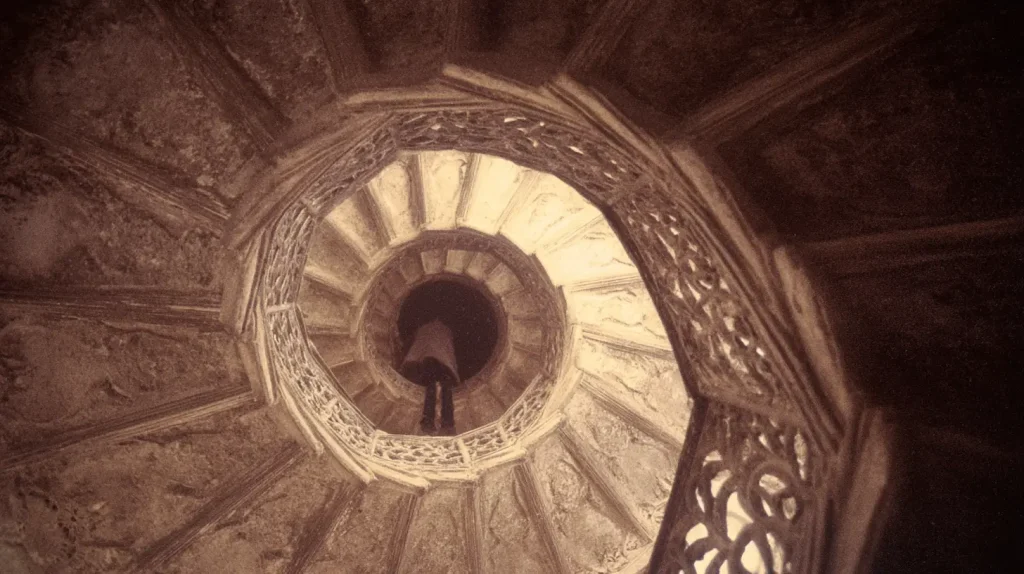
The single most famous feature of Chambord sits right at the center of the keep: a double-helix spiral staircase built as two separate, intertwined flights that never actually cross. Two people can climb and descend at the same time, on opposite spirals, catching only occasional glimpses of each other through openings cut into the central column — never actually meeting until they reach the top or bottom.
The design is widely attributed to Leonardo da Vinci, who spent his final years living nearby at Amboise as a guest of the French crown and died in May 1519, right around when construction began. Whether he personally drew up the final staircase plans or simply influenced the broader concept is genuinely debated by historians — construction of the staircase itself likely happened later, in the 1530s, under French and Italian architects working from ideas he’d introduced. Either way, it remains one of the more striking pieces of engineering you’ll walk through in any French château, and it’s worth pausing partway up just to watch it work rather than rushing to the top.
The staircase carries you up through the keep to the roof terraces, which is genuinely the part of Chambord that most surprises first-time visitors. Ground-level photos don’t prepare you for what’s up there: a rooftop landscape of turrets, dormers, and ornamental chimneys clustered around the central lantern tower, arranged with a density that looks almost like a miniature city skyline. Give yourself real time up here — it’s one of the more photogenic and least crowded parts of the whole visit.
How Much Time to Budget
Plan on roughly two and a half to three hours to do the château’s interior justice — the keep, the staircase, the royal apartments, the vaulted halls, and the roof terraces all reward a slower pace rather than a rushed lap. Add another one to two hours if you want to properly explore the grounds: the formal French gardens near the château (a relatively compact, geometrically laid-out space) and a stretch of the wider walled park, most of which is closed to the public but with a portion of the perimeter opened to walkers, cyclists, and horseback riders over recent years.
If you’re combining Chambord with other Loire Valley châteaux in a single day, it deserves to anchor the day rather than get squeezed into a quick stop — this isn’t a château you tick off in forty minutes.
The Park: More Than a Backdrop
The walled estate surrounding the château covers 5,440 hectares — genuinely comparable in size to inner Paris — making it the largest enclosed forest park in Europe. It’s ringed by a stone wall roughly 31 to 32 kilometers long, built in stages between the 1540s and 1640s, largely still intact.
Only around a fifth of that area is open to visitors; the rest remains a genuine wildlife sanctuary, home to red deer, roe deer, and wild boar living largely undisturbed. A handful of observation points and marked trails let you walk, cycle, or ride horseback into the accessible portion, and there are a couple of woodland viewing platforms where deer come to feed in the late afternoon.
The most memorable way to experience the park’s wildlife is during the autumn rut, when stags call out to challenge rivals and attract does — a genuinely dramatic, slightly eerie sound that echoes through the forest at dusk. The estate runs small, guided observation sessions during this period (typically limited to a modest group size, with a minimum age requirement), settling visitors into a discreet hide to watch and listen. It’s worth booking ahead if this interests you, since spots are limited.
The Horse Show
Since 2025, Chambord has run a purpose-built equestrian show, “Chambord, l’histoire à cheval,” staged in the historic stables of the Maréchal de Saxe near the château. For the 2026 season, it runs from April 4 through November 1, with performances generally around midday and mid-afternoon (times shift slightly by month and school holiday periods). It walks through roughly 500 years of the château’s history using horseback stunts, choreographed riding, and large-scale projections, with a tone that leans more toward broad, family-friendly spectacle than strict historical reenactment. The show is performed in French, but printed summaries are available in several other languages including English.
Arrive around 30 minutes early to get through the entry check comfortably — the stands are covered and shaded, so weather isn’t much of a concern either way.
Getting There
Chambord sits a little under two hours south of Paris by car via the A10 motorway (exit at Blois or Mer), and about 25 minutes from the town of Blois itself.
Without a car, the most reliable public transport route is by train to Blois-Chambord station from Paris Gare d’Austerlitz, followed by a connecting shuttle bus (line 2 of the local Rémi network) that now runs to the château year-round rather than just in summer, as it did in the past. A combined rail-and-shuttle ticket is available, and — worth knowing — presenting a same-day train ticket at the château entrance gets you the EEA-resident preferential rate on admission regardless of your actual residency status, which is a genuinely useful discount if you’re arriving by train.
Parking at the château itself isn’t free: expect somewhere in the €6–11 range depending on the specific lot and vehicle type, with cyclists and bus groups on separate arrangements. It’s a minor cost but worth budgeting for if you’re driving.
Best Time to Visit
Spring and early summer (May–June) tend to offer the best balance of good weather and manageable crowds, with the gardens in strong shape and the equestrian show running.
July and August are the busiest months by a wide margin — expect real crowds at the ticket counters and inside the keep, particularly around midday. Arriving right at opening, or in the last couple of hours before close, meaningfully cuts down on the density.
Autumn, particularly October, brings the stag rutting season in the park (a genuinely singular experience if you book the observation session) along with turning foliage across the estate — arguably the most atmospheric time to see the grounds, even if the equestrian show is winding down for the year.
Winter, while quieter and cooler, still has its own appeal: shorter queues, a starker, more dramatic look to the bare château against grey skies, and the château’s Christmas illuminations and decorations during the December holiday period. Just note the shorter opening hours (9am–5pm) during this stretch.
Practical Tips
Bring your own food if you want to save money — the estate has cafés and a sit-down restaurant, but picnicking is genuinely encouraged, with covered kiosks near the car parks and open lawns closer to the château itself where you can eat with the building as a backdrop.
Photography without flash is allowed throughout the interior for personal use; tripods and professional equipment technically require prior authorization.
If mobility is a concern, be aware that much of the château’s charm is tied up in staircases and upper floors — check the official accessibility information before planning a visit, since not every part of the building is easily reached without stairs.
FAQ
How much does it cost to visit Château de Chambord in 2026? As of January 14, 2026, the standard ticket for château and garden admission is €31, with a preferential rate of €21 for citizens or residents of the European Economic Area (proof required). EU citizens under 26 enter free but must collect the ticket in person. The surrounding park is free and separate from château admission.
How long does it take to visit Chambord? Budget two and a half to three hours for the château interior alone, and add another one to two hours if you want to properly walk the gardens and a portion of the park. It’s not a quick stop — treat it as the centerpiece of your day rather than one of several châteaux crammed into a single itinerary.
Is the double-helix staircase really designed by Leonardo da Vinci? It’s widely attributed to him, and he was living nearby at Amboise and consulting for the French crown right up until his death in 1519, as construction on Chambord was just beginning. The precise extent of his involvement in the final built staircase, constructed later in the 1530s, is genuinely debated among historians, but the connection to his ideas is well established.
What’s the best time of year to visit Chambord? May and June offer a good balance of weather and crowd levels. July and August are the busiest by far. October brings the dramatic stag rutting season in the park along with autumn color. Winter is quiet, with shorter hours but a starker, atmospheric look to the château, plus holiday illuminations in December.
Can you visit Chambord without a car? Yes. Take the train from Paris Gare d’Austerlitz to Blois-Chambord station, then a connecting shuttle bus that now runs to the château year-round. Presenting your same-day train ticket at the château entrance also gets you the preferential EEA admission rate, regardless of your actual nationality.