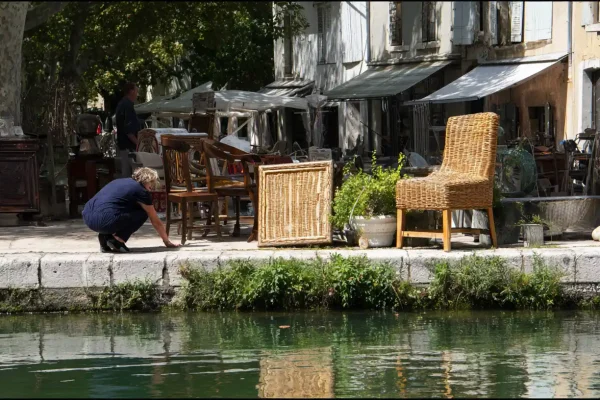
Aix-en-Provence old town doesn’t announce itself with a single must-see monument the way most French destinations do. At 8am on a Tuesday morning, Place Richelme smells like fresh thyme and warm bread. The market stalls are already set up under the plane trees — peaches, goat cheese, dried lavender, bundles of something floral you can’t quite name. A few regulars move through slowly, picking things up, putting things down. The cafés at the edge of the square are already open. Nobody is in a hurry.
Aix-en-Provence is not a typical sightseeing city. There are no blockbuster museums and no hours-long queues for a palace. The attraction list — Cours Mirabeau, the cathedral, the fountain-filled old town streets — reads shorter than you’d expect for a city of roughly 150,000 people with two thousand years of history. This is not a flaw. Aix is a place you inhabit for a few hours rather than race through. The experience is the city itself. Once you understand that, everything clicks.
Start at the Market
Before you do anything else, go to Place Richelme. There’s a food market here every morning from 8am to 1pm, year-round. On Tuesdays, Thursdays, and Saturdays, a larger general market fills the surrounding streets as well.
The market has been running since the 1300s. Farmers come from across the surrounding countryside — the Luberon, the Alpilles, the Durance valley. What you’ll find depends on the season: tomatoes and apricots in summer, mushrooms and truffles in autumn, citrus and greens in winter. There are always olives. There is always cheese.
Take your time here. Grab a coffee at one of the cafés facing the square and watch the market operate around you. The morning is when Aix feels most like itself — not performing for visitors, just going about its day. This is worth building your itinerary around.
Cours Mirabeau: Walk It Both Ways
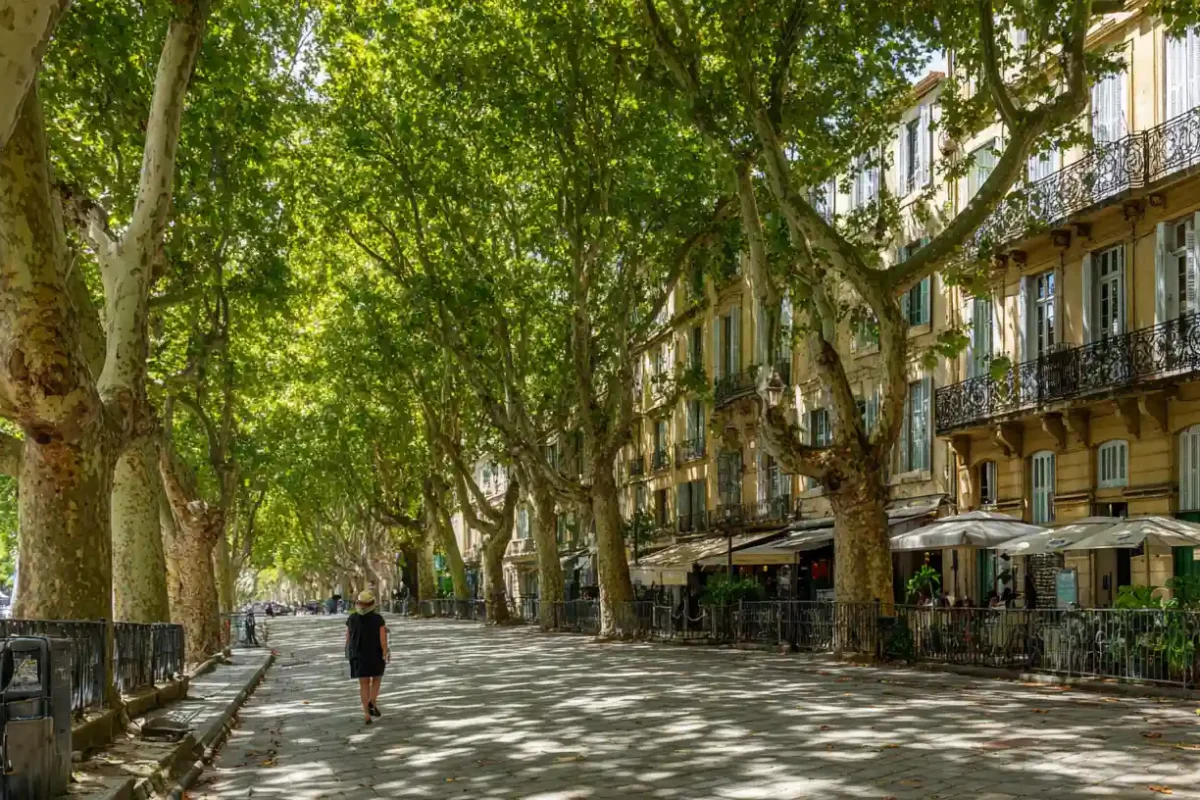
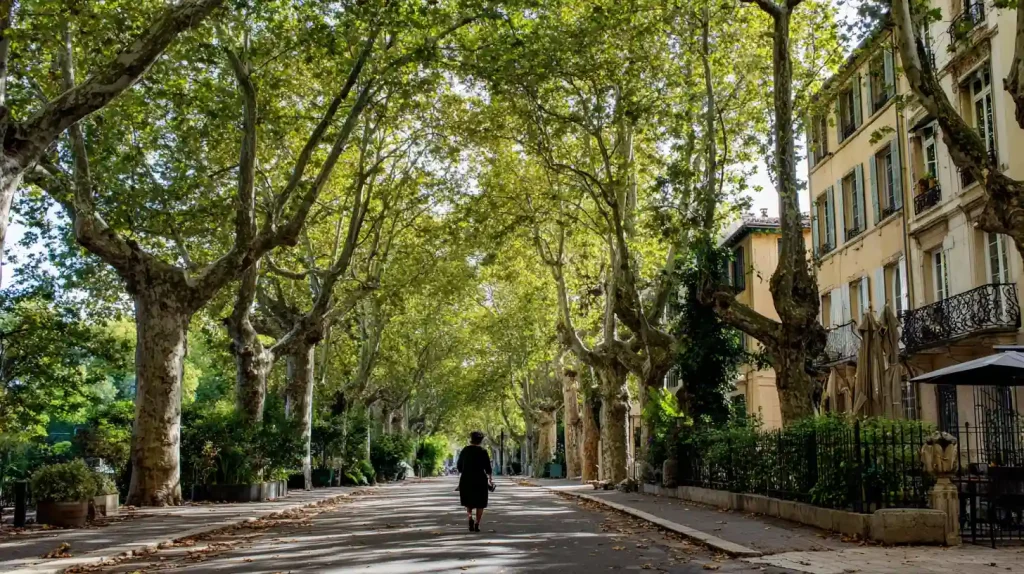
The main boulevard of Aix runs roughly east–west through the center of the city, about 440 meters long, shaded by enormous plane trees that have grown tall enough to form a complete tunnel of green overhead. On both sides, grand 17th- and 18th-century mansions with wrought-iron balconies and stone facades face each other across the wide central walkway.
Four fountains stand along the boulevard. The most famous is the Fontaine de la Rotonde at the western end — a large 19th-century fountain with three female figures representing Justice, Agriculture, and Fine Arts. Halfway down, the Fontaine d’Eau Chaude (Warm Water Fountain) is fed by an underground thermal spring the Romans knew about and part of why they founded a city here around 123 BC.
Walk the north side of Cours Mirabeau first, which puts the mansions on your left. Then cross and walk the south side back. The café terraces on the south are better for people-watching. The north side has the famous facades — the mansions with carved stone balconies and sculpted male figures used as columns to hold up the upper floors.
One specific thing to look for: the building where Paul Cézanne’s father ran a hat shop before parlaying it into a banking business. The Cézanne family money — which allowed Paul to pursue painting without worrying about sales — came from this street. Cézanne was born in Aix in 1839, studied law here at the university before abandoning it for art, and produced most of his paintings in and around the city he spent his whole life in. More on him shortly.
Into Vieil Aix
North of Cours Mirabeau, the city changes. The wide boulevard gives way to a maze of narrow lanes that have no grid, no logic, and no obvious hierarchy. This is Vieil Aix — the old town — and the easiest thing you can do here is get slightly lost on purpose.
The main pedestrian street is Rue Gaston-de-Saporta, which runs north from Place de l’Hôtel de Ville toward the cathedral. The city hall square is worth pausing in — a flower market sets up here on Tuesdays and Saturday mornings, and the 17th-century clock tower on one side of the square adds a formal contrast to the narrow lanes radiating off it.
Keep your eyes open for Place d’Albertas, a small square that feels like something a Baroque architect designed on a whim and then forgot to tell anyone about. It’s ringed on three sides by matching curved facades and has a fountain at its center. It tends to be almost empty even when the surrounding lanes are full of people — easy to walk past the entrance without noticing the turn.
The lanes of Vieil Aix have bookshops, ceramic ateliers, good bread, and the occasional courtyard that opens up unexpectedly when a gate stands ajar. Walk slowly. This is the part of Aix that can’t be rushed.
The Cathedral Nobody Warns You About
At the north end of Rue Gaston-de-Saporta stands the Cathédrale Saint-Sauveur, which is the kind of building that makes more sense as a timeline than as a single piece of architecture. It was built over multiple centuries across multiple architectural styles — Romanesque, Gothic, and Baroque are all present simultaneously, stitched together in ways that shouldn’t work and somehow do.
Walk inside and let your eyes adjust. The cloister attached to the north side is Romanesque, built in the 12th century, and has carved stone columns with figures that almost seem to be telling a story if you walk slowly enough around the perimeter.
The cathedral’s greatest treasure is the Triptych of the Burning Bush, commissioned around 1476 and painted by Nicolas Froment for King René of Anjou — a depiction of the Virgin and Child appearing in the burning bush from Exodus. The triptych is genuinely remarkable: the faces in it are highly individualized portraits rather than the generic saint-faces of medieval convention, with René himself and his wife, Queen Jeanne, shown kneeling in devotion on the inner panels. It’s one of the better surviving pieces of 15th-century Flemish-influenced painting in Provence, now displayed in a side chapel within the cathedral.
Entry to the cathedral is free.
Quartier Mazarin — Across the Boulevard
South of Cours Mirabeau, the city changes again. The Quartier Mazarin was built in the 17th century on a formal grid plan — a complete contrast to the organic tangle of Vieil Aix on the other side of the boulevard. Wide streets, symmetrical facades, quiet residential calm.
The anchor of the Quartier Mazarin is the Place des Quatre Dauphins, a small square with a 17th-century fountain at its center — four dolphins arranged back to back around a central column, water flowing from their mouths into the basin below. It’s the kind of fountain that rewards slowing down. The square feels complete, like a room someone designed carefully and then left to develop its own quiet life.
The Musée Granet is also in this neighborhood — a significant art collection housed in a former priory, with European paintings from the 16th to 20th centuries, plus a dedicated room of Cézanne oils. Pricing fluctuates through the year and rises noticeably during major temporary exhibitions (as of August 2026, standard adult admission runs around €14 due to a special show running through the autumn, up from roughly €7 earlier in the year), so check the current rate before you go. If you’re genuinely interested in European painting and have a half-day to spare, it’s worth the time. If you’re doing a single day in Aix and trying to fit in Cézanne’s studio as well, it may be one museum too many.
The Cézanne Situation (Be Honest With Yourself First)
This is where most Aix travel guides go quiet.
There is almost no actual Paul Cézanne artwork in Aix-en-Provence, aside from a small handful of pieces at the Musée Granet.
The city treats Cézanne as its primary cultural asset — and fairly so, since he was born here, worked here for most of his life, and painted the Montagne Sainte-Victoire ridge south of the city from roughly two dozen different angles over four decades. Bronze pavement markers are embedded in the sidewalks throughout the city, forming a self-guided “Cézanne trail.” The tourist office hands out walking maps for it.
But most of the actual paintings aren’t in Aix — they’re in Paris, London, New York, and Washington. What you’ll find in Aix is the landscape he painted, and the studio where he worked at the end of his life.
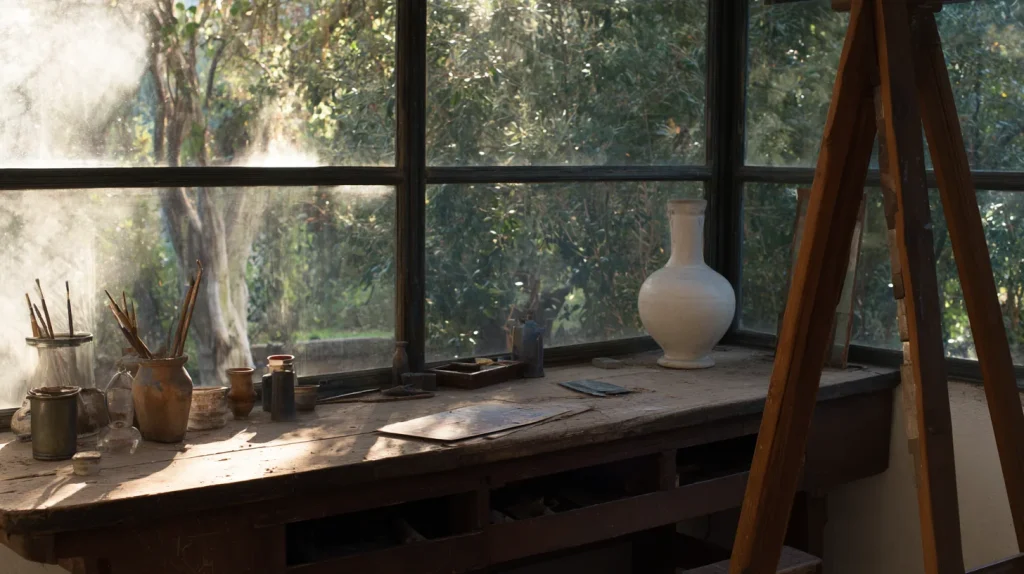
The Atelier des Lauves — Cézanne’s last studio, up a hill roughly a 20-minute walk from Cours Mirabeau — is preserved much as it was when he died in 1906. His easel is there. The large north-facing window that gave him working light is there. The porcelain vases and paper flowers and small plaster cupid that appear in so many of his still lifes are arranged on a shelf, as if he’d just stepped out. There are no paintings on the walls. There never were — he finished them and they left.
The studio reopened for the 2026 season on July 4 after a significant restoration, marking the 120th anniversary of Cézanne’s death, and runs through October 31. Self-guided audio visits cost €9.50 for adults and €7.50 reduced; guided tours run a bit more. Hours are daily 9am to 6pm from July through September, last visit at 5pm, shifting to 10am–5pm in October. Capacity is limited following the restoration, and reservations are now strongly recommended rather than just a nice-to-have — book ahead online rather than assuming you can walk in.
It’s genuinely moving if you know and love Cézanne’s work. If you’re more casual about it, the bronze pavement markers and the view of Montagne Sainte-Victoire from the right spot in the old town may satisfy the Cézanne experience without the uphill walk.
The city also runs the self-guided Cézanne trail using those bronze markers embedded in the pavements throughout the city center. Pick up the map at the tourist office on Place du Général de Gaulle. It takes about 90 minutes to walk in full.
Fountains, Squares, and the Rhythm of the Day
Aix calls itself the “City of a Thousand Fountains.” There are well over 100, which is still an impressive number for a mid-sized Provençal city. They’re scattered throughout both the old town and the Quartier Mazarin, ranging from large formal basins to wall-mounted spouts barely visible at street level.
The thermal one on Cours Mirabeau — Fontaine d’Eau Chaude — is covered in moss because the warm mineral water encourages growth. This isn’t a maintenance failure; the moss has been building up for centuries.
If you’re in Aix on a warm afternoon, the squares fill with students from the university, which traces its roots to 1409, making it one of the oldest university-level institutions in France. There’s a reason this city produced Cézanne and has sustained a café culture for centuries — it’s simply a good place to sit and think, and the light in Provence in the late afternoon is the kind that makes you order another glass of rosé instead of getting up to leave.
Which, honestly, is kind of the point.
How Long and How to Get Here
Aix-en-Provence rewards a half-day at minimum. A full day is better if you want to include the Atelier Cézanne, a long lunch, and an afternoon drink on a terrace.
The city center station (Gare d’Aix-en-Provence) is roughly 35–45 minutes by regional train from Marseille-Saint-Charles. Note this is separate from Aix-en-Provence TGV station, a fast but remote stop several kilometers outside the city that’s mainly used for high-speed connections and requires a shuttle bus into the center. Paris connects to that TGV station in roughly 3 hours on the fastest services, though the onward bus or taxi into the old town adds extra time to factor in. Avignon is roughly 45–60 minutes away by road.
If you’re using Aix as a base for the Luberon, you’ll want a rental car. The Luberon hilltop villages are 45–60 minutes away, and there’s no practical public transport to most of them.
FAQ
How much time do you need in Aix-en-Provence? A half-day covers Cours Mirabeau, the morning market, and a wander through both Vieil Aix and the Quartier Mazarin. A full day adds the Atelier Cézanne (about a 20-minute walk from the center), a proper lunch, and time to sit on a café terrace without feeling rushed. Aix rewards not rushing.
Is there much to do in Aix-en-Provence beyond walking around? The old town is the main experience, and it doesn’t require tickets. The Atelier Cézanne and the Musée Granet are the main paid attractions, and their prices shift seasonally, so check current rates before you go. The cathedral is free. The markets are free. This is very much a “the city is the thing” destination, not a museum-hopping one.
When is the best time of day to visit Aix-en-Provence old town? Early morning is best for the market and quieter streets before the crowds build. Late afternoon is best for café terraces and the light on the stone facades. Midday in July and August, the center gets genuinely congested and warm — worth planning around if you can.
Is Aix-en-Provence worth visiting if I’ve already seen Avignon? Yes — they’re quite different cities. Avignon has the Palais des Papes as a centerpiece, a specific, visit-it-and-leave attraction. Aix is more atmospheric, more about streets and cafés and living in the city for a few hours. They complement each other well on a Provence trip.
Can you visit Aix-en-Provence without a car? For the old town, yes — the city center is entirely walkable, and train connections from Marseille and Avignon are good. For the surrounding region (Luberon villages, the Montagne Sainte-Victoire hike, Cassis), you’ll need a car. Aix makes a good base for those day trips, but only if you rent one.