You descend 131 steps down a tight spiral staircase, the air getting cooler with each turn, and emerge into a narrow limestone tunnel. The lighting is dim and deliberately theatrical since the 2026 renovation. You walk for several minutes before you reach the ossuary.
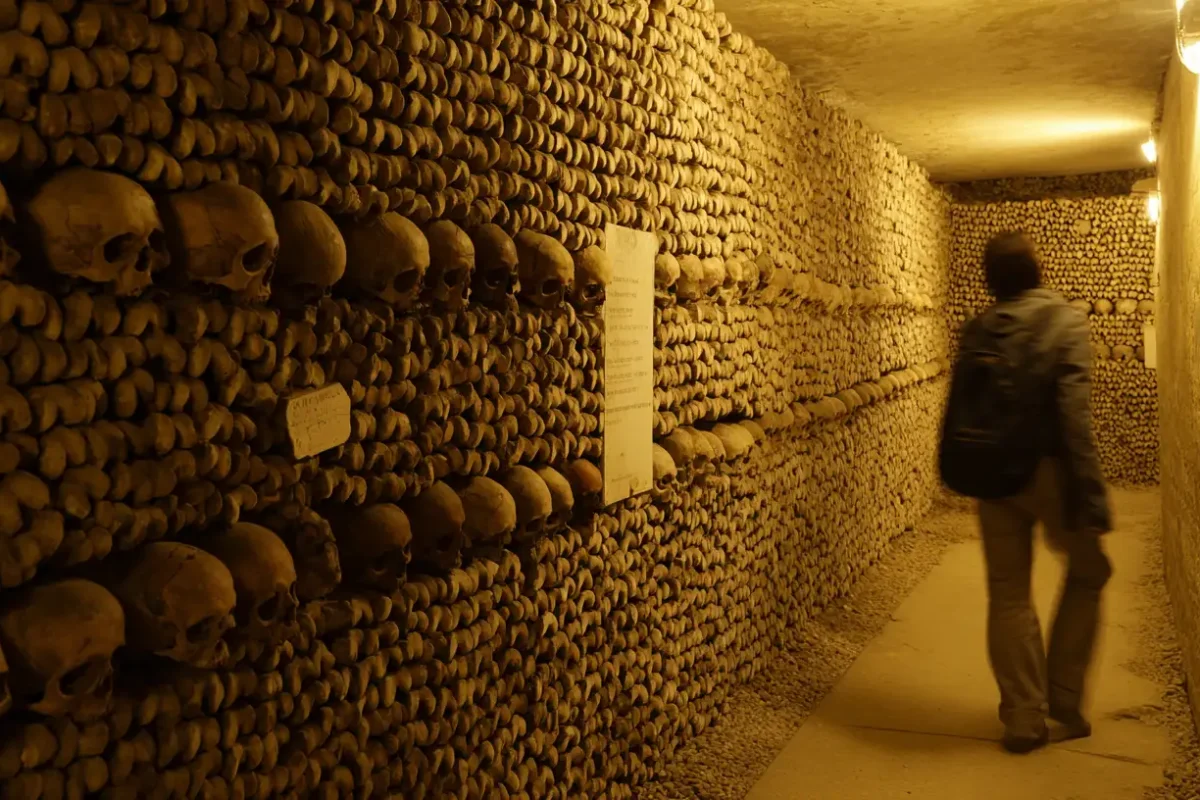
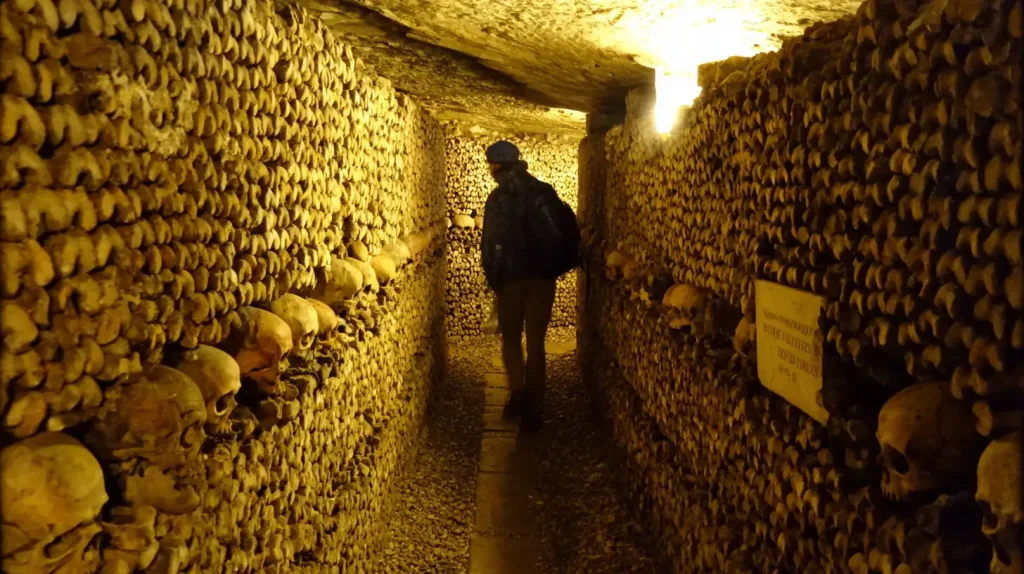
Then you turn a corner and see them: the remains of around six million Parisians, stacked to the ceiling in organized formations. Femurs arranged in rows, skulls set at intervals as decorative markers. Inscriptions above the rows quote Virgil, the Bible, and French philosophers on the nature of death. It’s formal, deliberate, and unlike anything else you’ll encounter in a European city.
Whether that’s fascinating or unsettling depends on the person. Almost nobody who goes says it left them unmoved.
The Catacombs Are Open in 2026 — With a New Look
The Catacombs closed on November 3, 2025, for a five-month renovation focused on the site’s electrical, ventilation, and fire-safety systems, plus a full redesign of the visitor experience. They reopened to the public on April 8, 2026.
The route itself is unchanged, but the presentation isn’t: new architectural lighting highlights details in the bone walls that were previously hard to see, and the audio guide has moved to a headset that triggers automatically at key points along the route rather than requiring visitors to key in stop numbers. Floors and several of the historic bone formations, including the ossuary known as Le Tonneau (“the Barrel”), were also restored as part of the project.
Because renovation and ticketing systems can shift, it’s worth a quick check of the official Catacombs website before you book, but as of now the site is operating normally on its regular schedule.
What the Catacombs Actually Are
The Catacombs are not natural caves — they’re repurposed quarries.
Paris sits on a network of limestone tunnels carved out over centuries to supply building stone, including the material used for Notre-Dame, the Louvre, and much of Haussmann’s Paris. By the 18th century, the quarrying had left parts of the city undermined and unstable, and streets were collapsing.
At the same time, Paris faced a public health crisis: its cemeteries were overflowing. The Cimetière des Innocents near Les Halles had been in use for centuries and was so full that decomposing matter was contaminating neighboring buildings and water supplies. Starting in 1786, city officials began transferring bones from Paris’s overflowing cemeteries into the abandoned quarry tunnels south of the city.
The transfer took years. Priests led processions of bones through the streets at night. Workers lowered remains by rope into the tunnels and eventually arranged them into the formations visitors see today, pulling remains from more than a dozen Parisian cemeteries. The ossuary was formalized in the early 19th century, with philosophical inscriptions carved into the walls as if the whole arrangement were a catalog of the dead.
This wasn’t gothic invention — it was a bureaucratic response to a genuine sanitation emergency that gradually became something far stranger than anyone intended. Understanding that before you go changes the experience: you’re walking through a city’s practical answer to a serious problem, not a horror attraction.
Tickets in 2026
All tickets must be booked online. There’s no walk-up ticket sales at the entrance for standard admission — the site cannot sell tickets on-site because of crowd control.
Current individual admission rates (per the official Catacombs website):
| Category | Price |
|---|---|
| Full rate (adult) | €31 |
| Reduced rate (ages 5–26, students, and certain member organizations, with valid ID) | €25 |
| Child rate (ages 8–17) | €15 |
| Under 8 | Free |
| Disabled visitors and one accompanying carer (with ID) | Free |
Paid admission includes the audio guide (French, English, Spanish, and German). Visitors in a free-entry category collect their ticket at the front desk on the day of the visit with proof of eligibility, and can add an audio guide there for €5. The age brackets for the reduced and child rates overlap slightly on the official site, so it’s worth double-checking which category applies to your child when booking.
Tickets are released online exactly seven days in advance. In practice, slots tend to open on a rolling basis matching the time of day — a 10am tour slot for a given date has historically become bookable around 10am Paris time seven days earlier, and so on through the day. Popular slots, especially summer weekend mornings, can sell out within minutes. Weekday afternoons in the off-season are far easier to book.
Tickets cannot be exchanged, refunded, or moved to a different date, and each order is capped at five tickets.
Opening Hours
Tuesday to Sunday: 9:45am to 8:30pm, last entry at 7:30pm.
Closed Mondays, and on January 1, May 1, and December 25. The Catacombs stay open on July 14, August 15, November 1, and November 11.
Tuesday tends to be the busiest day, since the Louvre is closed and some visitors shift plans elsewhere. Wednesday through Friday afternoons are generally calmer.
What to Expect: The Physical Reality
The descent — and the climb back up. There are 131 steps down the spiral staircase and 112 steps back up at the end — 243 steps total, with no elevator. The site is not wheelchair accessible, and it isn’t recommended for visitors with motor disabilities, cardiac or respiratory insufficiency, or significant claustrophobia, due to the narrow passages, uneven and sometimes slippery flooring, and dim lighting throughout. Children under 14 must be accompanied by an adult.
The temperature. The tunnels sit at a constant 14°C (57°F) year-round and can be quite humid. That’s cooler than Paris at almost any time of year — bring a layer, even in August.
The walk. The one-way circuit runs about 1.5 kilometers. Plan for roughly 45 minutes to an hour from entry to exit. The route cannot be reversed once you’re inside. Visitor numbers are capped at 200 people at a time, and entry can pause temporarily if the site reaches capacity.
Bags and strollers. Suitcases, large bags, and motorcycle helmets aren’t allowed. Bags must be no larger than roughly 40 × 30 × 20 cm and carried in front of or beside you. Strollers aren’t permitted either — bring a baby carrier if you’re visiting with an infant. There’s no cloakroom, which matters more than usual here since the exit is a genuine walk from the entrance.
Claustrophobia. The tunnels are genuinely narrow and dimly lit. Most visitors manage fine, but if you’re sensitive to enclosed spaces, it’s worth thinking through before booking a non-refundable ticket.
Photography. Personal photography is allowed; tripods and flash are not. The low light makes phone cameras struggle more than dedicated cameras with strong low-light performance, though the improved lighting since the 2026 renovation has made it noticeably easier to shoot without a flash.
Phone signal. There’s no signal underground. Download or screenshot your entry QR code before you descend — if it only lives in an email app and your battery dies, re-entry becomes a real problem.
Inside the Ossuary: What You Actually See
The bone arrangements are more varied than most photos suggest. Some walls are purely functional — femurs stacked tight from floor to ceiling, the practical storage solution of an overwhelmed sanitation project. Others are deliberately decorative: skulls set at regular intervals across the front of the stacks, sometimes arranged into crosses or other patterns.
Several named sections make up the ossuary circuit, including the restored bone formation known as Le Tonneau (“the Barrel”). The audio guide walks through the history of each section and which historic cemeteries the remains originally came from, including the long-since-vanished Cimetière des Innocents.
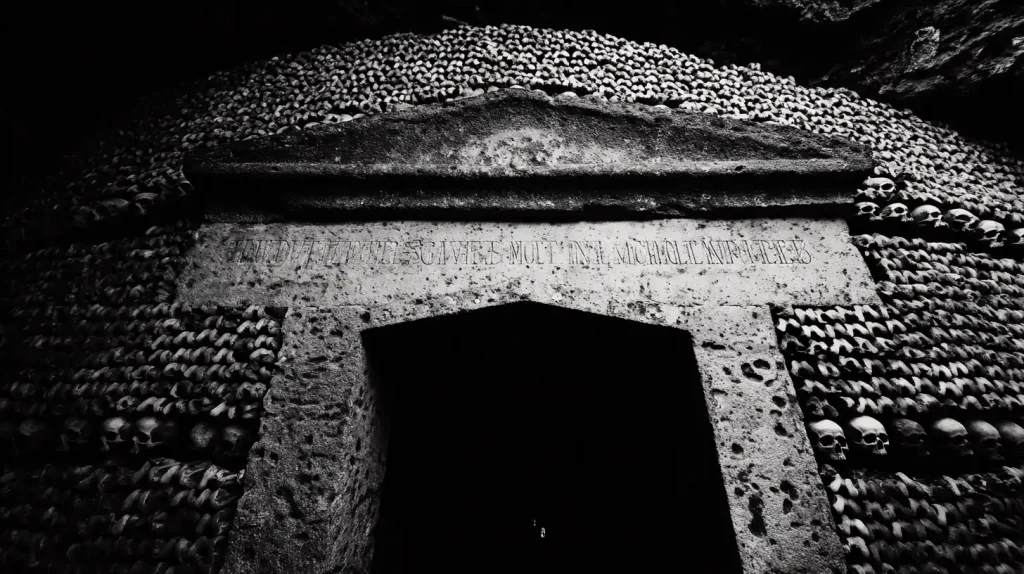
The inscriptions carved into the walls are worth slowing down for. Phrases drawn from Virgil, scripture, and French philosophers on mortality appear at intervals along the route — not horror-movie set dressing, but a genuine philosophical argument that someone with a chisel found compelling enough to carve into stone.
Is It Worth Visiting?
The experience doesn’t fit neatly into a category. It isn’t quite a museum, not a ghost tour, not exactly spiritual — it’s genuinely unlike most other things a city has to offer.
What tends to surprise first-time visitors: how organized and deliberate the bone arrangements are, how differently the philosophical inscriptions land when read while standing among millions of human remains, and how completely the darkness makes the city above feel far away.
It’s not for everyone. Children under about 8 often find it frightening rather than interesting, and travelers expecting a quick, spooky photo stop sometimes come away underwhelmed. Visitors who read a bit about the history beforehand tend to get more out of it. For anyone with an hour to spare and any interest in history, mortality, or the stranger corners of a city’s past, it’s a strong addition to a Paris itinerary — but it’s reasonable to skip if you’re already exhausted from days of walking and have no particular pull toward the subject matter.
Where You Exit (Not Where You Entered)
The exit is at 21 bis Avenue René-Coty — roughly 700 meters from the entrance on Avenue du Colonel Henri Rol-Tanguy. This catches a lot of visitors off guard.
If you’ve left bags, a rental bike, or a group waiting near the entrance, you’ll need to walk back after exiting. Plan for this before you go in, and there are restrooms available at both the entrance and the exit.
Best Time to Visit
By time of day. Morning slots sell out first and tend to feel busier. Afternoon slots are usually easier to book, and the underground experience — 14°C and dim lighting — is identical regardless of the time or weather above ground.
By day of week. Weekdays book up more slowly than weekends. Wednesday and Thursday afternoons tend to be the least competitive.
By season. Temperature, lighting, and the ossuary itself barely change with the seasons — January and August feel much the same underground. Season mainly affects how far in advance you’ll need to plan, since summer slots are harder to secure.
The Illegal Catacombs
A subculture exists around the unofficial sections of the wider quarry network — roughly 300 kilometers of tunnels beyond the official ossuary route. Urban explorers known as cataphiles access these through unauthorized entry points, a practice that’s been illegal since 1955.
A dedicated police unit patrols the tunnel network, and being caught in an unauthorized section carries a fine of around €60. This isn’t a recommendation to enter the illegal tunnels — it’s context for visitors who discover, after the fact, that the official tour covers only a small fraction of what’s actually down there.
Getting There
The entrance is at 1 Avenue du Colonel Henri Rol-Tanguy, right on Place Denfert-Rochereau in the 14th arrondissement.
Metro/RER: Denfert-Rochereau (lines 4 and 6, plus RER B) sits directly at the entrance square. Bus lines 38 and 68 also stop nearby, and there’s a Vélib’ station at 2 Avenue René-Coty. Paid parking is available on Boulevard Saint-Jacques.
The 14th arrondissement is a residential, low-tourist-density neighborhood — a good spot to find an unhurried local lunch without competing for a table at inflated prices. Many visitors skip this and rush straight back to central Paris, which is worth reconsidering.
FAQ
How much are Paris Catacombs tickets in 2026?
€31 for adults, €25 for the reduced rate (ages 5–26, students, and certain member groups with ID), and €15 for children 8–17. Children under 8 and disabled visitors with one carer enter free. All tickets are booked online only — there’s no walk-up entry.
Are the Paris Catacombs open in 2026?
Yes. The site closed for renovation in November 2025 and reopened on April 8, 2026, with a refreshed lighting design, restored bone formations, and an updated audio guide. It’s worth a quick check of the official Catacombs website before booking in case of any temporary closures.
Is the Catacombs suitable for claustrophobic people?
It depends on severity. The tunnels are narrow and low-ceilinged, and the route is strictly one-way — you can’t turn back once inside. The official site doesn’t recommend the visit for people with significant claustrophobia, though many mildly claustrophobic visitors manage fine.
How long does a visit to the Paris Catacombs take?
The circuit itself takes roughly 45 minutes to an hour. Budget extra time for the entry queue and the walk back from the exit, which is around 700 meters from the entrance.
Do I need to book Paris Catacombs tickets in advance?
Yes — booking is mandatory. Tickets go live online exactly seven days ahead of each date, and popular slots, particularly summer weekend mornings, can sell out within minutes.