The canyon looks nothing like you expect from the road.
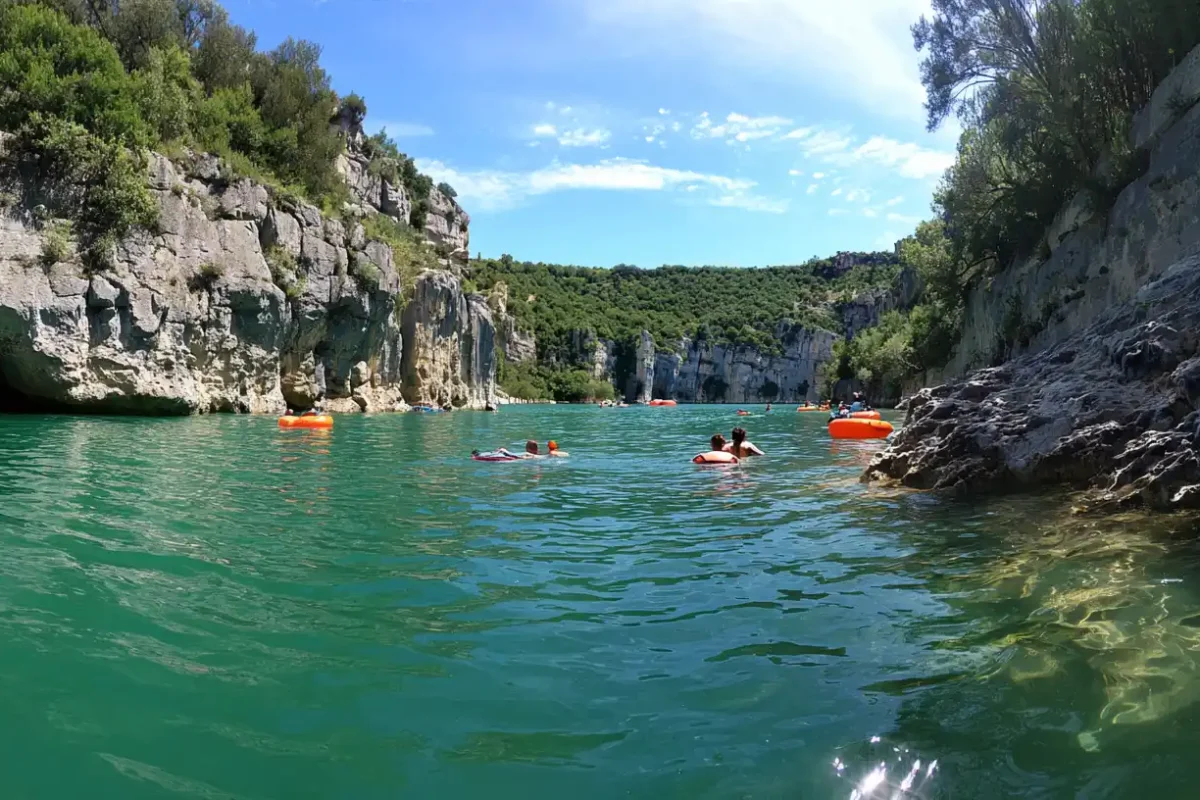
Standing above the Gorges du Verdon on the Route des Crêtes, the river below is a thread of turquoise impossibly far down — 300 meters, sometimes more. You can barely hear it. You could convince yourself it’s painted on. Then you get in a kayak and paddle into that same gorge, and everything inverts. The walls close in above you. The water turns cold and clear. The sky becomes a narrow strip of blue several hundred meters overhead.
Same canyon. Completely different place.
This is what most guides miss about the Gorges du Verdon. They list “kayaking” and “driving the rim” as two items on a to-do list without explaining that these aren’t variations on the same experience — they’re two different places to be. If you only have time for one, knowing the difference helps you choose. If you have a full day, you can do both.
What the Gorges du Verdon Actually Is
Around 250 million years ago, this entire area sat below a shallow sea. As tectonic plates shifted and glaciers retreated over millions of years, the Verdon river carved its way through limestone, leaving a canyon that now stretches roughly 25 kilometers between the town of Castellane to the east and Lac de Sainte-Croix to the west.
The cliffs reach up to 700 meters in some sections. To put that in perspective, that’s taller than two Eiffel Towers stacked on top of each other.
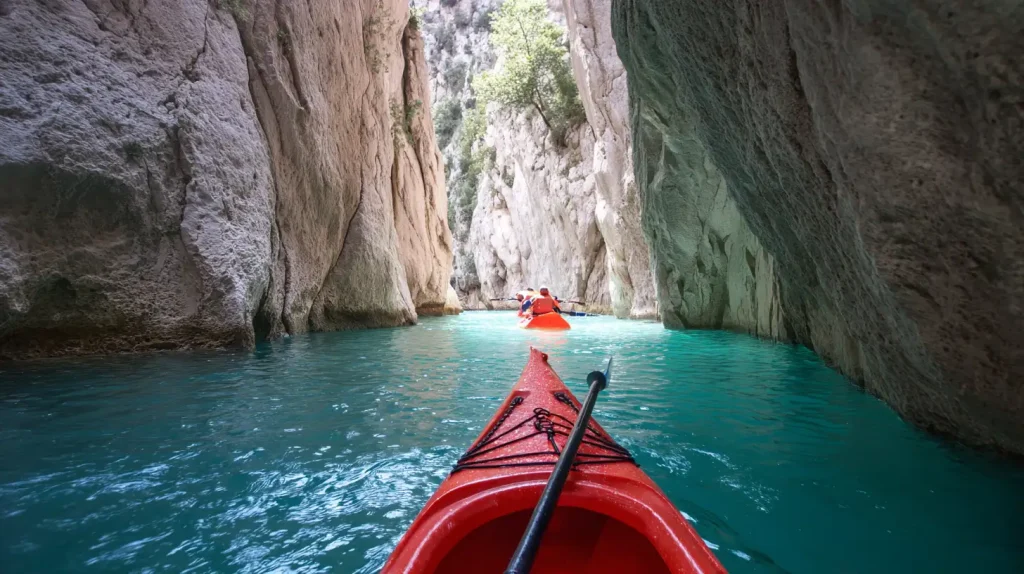
The water color comes from fine mineral particles — glacial flour — suspended in the river. Depending on the angle of light and the depth, the Verdon shifts from pale blue-green to deep jade to a dense turquoise. No filter required. It sits in the heart of Provence, roughly two hours by car from Nice, and about the same from Marseille. This makes it a long day trip from the coast, or a much more relaxed experience if you stay nearby.
The Kayak: Inside the Canyon at Water Level
Start at the Pont du Galetas bridge. This is where the Verdon river exits the canyon and opens into Lac de Sainte-Croix — and it’s where the kayak and paddleboat rental companies operate, lined up on both sides of the bridge.
The standard route: launch from Pont du Galetas and paddle upstream into the gorge entrance. The cliffs rise immediately as you cross under the bridge. The air drops a few degrees. The light changes. You go from an open lake to a narrow corridor of stone and water within the first few hundred meters.
The rental companies typically let you paddle as far as a set of marker buoys, roughly 2 kilometers into the canyon — this is the full extent of what’s navigable from this side; the deeper, more dramatic heart of the canyon further upstream is reached only by guided rafting or canyoning trips, not casual kayak rental. The round trip to the buoys and back takes about two to two and a half hours at a comfortable pace with stops.
Along the way you’ll find small rocky beaches where people swim and jump from low ledges. A small waterfall tucked into the cliff face — easy to miss if you’re not watching the walls. The sound of the water changes as the canyon narrows and the cliffs block out more sky. Climbers work the limestone faces above you without acknowledging the kayakers below. Everyone is doing their own thing in the same extraordinary space.
One rule: no music inside the canyon. The ranger will paddle over and ask you to turn it off. This isn’t a hardship — the absence of speakers is part of what makes the experience worth having.
On price: a solo kayak generally runs around €25 for two hours, €33 for three, or €40 for a full four hours; a two-person tandem kayak is roughly €30, €40, or €50 for the same time blocks. Pedal boats and electric boats start at similar hourly rates. Plan to rent for at least two hours — an hour in and you’re barely past the canyon entrance. Rental season generally runs from April through October; outside that window, boats aren’t available.
Get here early. By 11am in July, the rental area at Pont du Galetas fills with cars and the queue for boats builds. Arriving before 9am means you’re on the water while others are still parking.
The Rim Drive: Route des Crêtes
The Route des Crêtes runs along the southern rim of the canyon in a circuit near the town of La Palud-sur-Verdon. The road is narrow, winding, and largely without guardrails in places. Drive slowly. Pull over at the numbered viewpoints — they have small parking areas and short walks to the edge.
Looking down from the rim, the river looks impossibly far below. The turquoise reads from here as a bright line of paint. You can see where cliffs overhang and where they’ve fractured into vertical faces. On a clear morning, shadows from the eastern wall cut the canyon floor in sharp diagonals.
The full circuit takes roughly 90 minutes of driving with stops. Add time for short walks from the parking areas to the best viewpoints.
One honest note: the Route des Crêtes is not for drivers who feel anxious on narrow mountain roads. The drops are real, and the road isn’t wide enough for two cars to pass comfortably in many places. If that’s not your comfort zone, skip it and spend more time on the lake instead. The kayak view of the gorge is honestly more memorable anyway — being inside beats looking from above every time.
Hiking: Into the Canyon on Foot
The most famous trail inside the gorge is the Sentier Martel, a demanding route through the heart of the canyon that most hikers tackle over two days, since it ends far from where it starts and generally requires some logistical planning — a shuttle back to your car, or an overnight stop along the way.
For day visitors, shorter options approach the canyon from the rim. The GR4 trail runs along sections of the northern rim and offers serious hiking without entering the canyon floor. Various entry points near Castellane on the eastern end allow shorter walks into the gorge interior, though it’s worth checking current trail conditions and access locally, since sections can close after rockfall or heavy rain.
If hiking is your main reason for coming, a single day barely scratches the surface. Plan an overnight stay in La Palud-sur-Verdon or Castellane and treat the gorge as a two-day experience.
Lac de Sainte-Croix: The Lake at the Canyon’s Exit
Lac de Sainte-Croix was created in the early 1970s when a dam was built across the western end of the gorge, filling in 1974. The result: a deep, calm, turquoise-green lake that now serves as the main swimming area and the launch point for kayaks heading into the canyon.
The lake covers around 2,200 hectares, making it the largest lake in the Verdon Regional Natural Park and one of the largest artificial lakes in France. Surface water temperatures generally reach into the low-to-mid 20s Celsius by mid-summer, though the river water flowing in from the gorge itself stays noticeably colder year-round, fed by mountain snowmelt.
Swimming is permitted across most of the lake. No jellyfish, no waves, no tides. It’s a mountain lake swim in water the color of a pool in a film. Kids float here on inflatables. Adults paddle out past the kayak zone and tread water in the shadow of the canyon entrance.
The beach area near the village of Sainte-Croix-du-Verdon at the southwestern corner is quieter than the Pont du Galetas area. If you’ve done your kayaking in the morning and want somewhere to swim in the afternoon, drive about ten minutes around the lake.
Getting There and Where to Base Yourself
A car is non-negotiable. There is no meaningful public transport to the canyon, the lake, or the rim viewpoints — a handful of regional bus lines exist, but they’re infrequent and not built around tourist schedules. The roads between Castellane and Moustiers wind through remote mountain terrain.
From Nice or the French Riviera, plan roughly two hours by car. From Marseille, about the same. Rent a car in advance for summer — supply runs short.
For accommodation, Moustiers-Sainte-Marie at the western end near the lake is the most popular base. Small hotels and B&Bs line the village and surrounding roads, and they book out fast in July, so reserve well ahead if that’s your plan. La Palud-sur-Verdon on the plateau above the northern rim is a quieter option that puts you directly on the Route des Crêtes. Castellane, at the eastern end, suits a two-day hiking itinerary better than a single kayak-and-lake day.
One Day at the Gorges du Verdon: A Realistic Schedule
If you’re doing this as a day trip from the coast, here’s what actually fits:
- 7:00am — Leave Nice or Marseille, drive to Pont du Galetas (about 2 hours)
- 9:00am — Arrive, rent a kayak before queues build
- 9:15am–12:00pm — Kayak into the canyon and back
- 12:15pm — Drive 15 minutes to Moustiers-Sainte-Marie for lunch
- 1:30pm–3:00pm — Drive the Route des Crêtes if comfortable on narrow roads; otherwise swim at the lake
- 3:00pm–5:00pm — Swim at Lac de Sainte-Croix or explore the lake’s western shore
- 5:00pm — Begin the drive back to the coast
- 7:00pm — Arrive back in Nice or Marseille
This leaves no buffer for traffic or delays. If the kayak queue is long, cut the rim drive and spend that time at the lake instead. You’ll have a better day.
Best Time to Visit
July and August bring the canyon to full life — swimming, kayaking, climbing — but also peak crowds and queues. The kayak area at Pont du Galetas fills by mid-morning in peak season.
June and September are the smarter choices for most visitors. Fewer people, easier parking, and shorter waits for boats at the Pont du Galetas rental area. September light on the canyon walls is particularly good for photography, with warmer tones than midsummer. The water runs cooler in June but is still swimmable for most people.
The gorge is accessible year-round for driving and hiking, but kayak rentals operate seasonally, generally running from April through October. Outside that window, the canyon is quiet and the rim roads stay open, but you’re looking at a viewpoints-and-hiking trip rather than a kayak day.
Frequently Asked Questions
Is kayaking at Gorges du Verdon suitable for beginners? Yes. The rental companies at Pont du Galetas use stable two-person kayaks and paddleboats. No prior experience is needed — you’re paddling into relatively calm water, not fighting a strong current. Even nervous first-timers generally handle it without much difficulty.
Do I need to book kayak rentals in advance? Most rental companies at Pont du Galetas operate on a first-come basis rather than taking advance bookings. This is why arriving before 9am matters in July — by mid-morning, wait times can run well past half an hour, and some companies run out of boats by early afternoon.
Can I swim in Gorges du Verdon and Lac de Sainte-Croix? Yes. Swimming is permitted in the lake and in the calmer river sections near the canyon entrance. Lake water reaches the low-to-mid 20s Celsius by summer, while the river running out of the gorge stays noticeably colder year-round. Water shoes help at the rockier entry points.
Is a car needed to visit Gorges du Verdon? Yes, in practice. The canyon is remote, with no meaningful bus connections built around tourist schedules. Organized day tours from Nice, Marseille, and Aix-en-Provence include transport, but they follow fixed schedules and don’t give you the flexibility to kayak and drive the rim in the same day at your own pace.
How long does a full day at Gorges du Verdon take? Budget a full 10 to 12 hours including travel from the coast. The kayak takes about 2 to 2.5 hours. The rim drive takes roughly 90 minutes. Add time at the lake, lunch in Moustiers, and the drive each way, and you’re looking at a long but genuinely satisfying day.