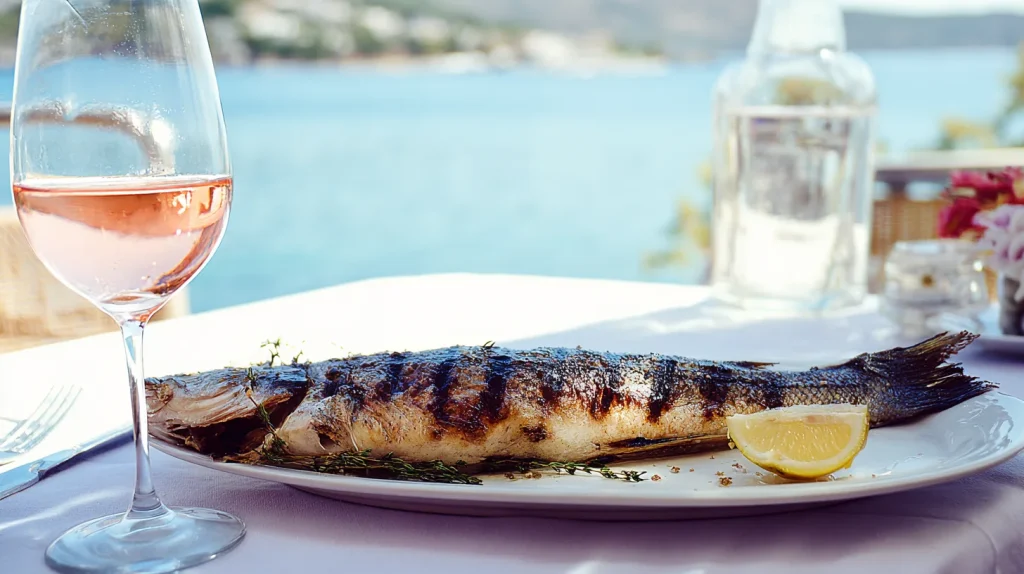
A whole sea bass, grilled over wood, with a wedge of lemon and a glass of rosé so pale it’s nearly clear. That’s the meal you’re after on the French Riviera, and a lot of visitors don’t quite find it, mostly because they don’t know what to look for on the menu.
The Riviera has some of the best seafood in Mediterranean France. It also has some of the most overpriced, disappointing fish restaurants in the country — places charging €40 for a bouillabaisse made from frozen fish, served before you’ve even finished reading the menu. The gap between the two isn’t always obvious until you know what to look for.
This is what Riviera seafood actually is, what to order, what to skip, and which glass to drink alongside it.
The fish worth knowing by name
The Riviera’s coastal waters produce a specific set of fish that show up on good menus consistently, and knowing them by name changes how you order.
Loup de mer — European sea bass — is the signature fish of the Côte d’Azur. Mild, delicate, and expensive, it’s at its best served simply: grilled whole over wood or fennel branches, with olive oil, herbs, and lemon. When a kitchen cooks loup de mer well, it needs nothing else. The skin should be lightly charred, the flesh just barely cooked through and still moist near the bone. If it arrives in a cream sauce or buried under a reduction, something went wrong upstream.
Rouget — red mullet — is small, intensely flavored, and one of the most prized fish in southern French cooking. It has a slightly strong, mineral note that divides opinion but is genuinely characteristic of the Mediterranean. A plate of rouget, pan-fried or grilled, with aïoli on the side and a glass of rosé, is as Riviera as a meal gets. The bones are small and need some attention, which is part of the ritual.
Daurade — sea bream — is another fixture, more approachable in flavor than rouget. It holds up well to simple grilling and is often the more affordable option on menus that also carry loup de mer.
Saint-Pierre — John Dory — shows up less often but is worth ordering when it does. Firm white flesh, good flavor, usually served filleted rather than whole.
Lotte — monkfish — is the workhorse of the fish kitchen. Dense and mild, it takes well to stronger flavors like saffron, which is why you’ll mostly meet it in bouillabaisse and stews rather than grilled on its own.
Sea urchin: the one to try once
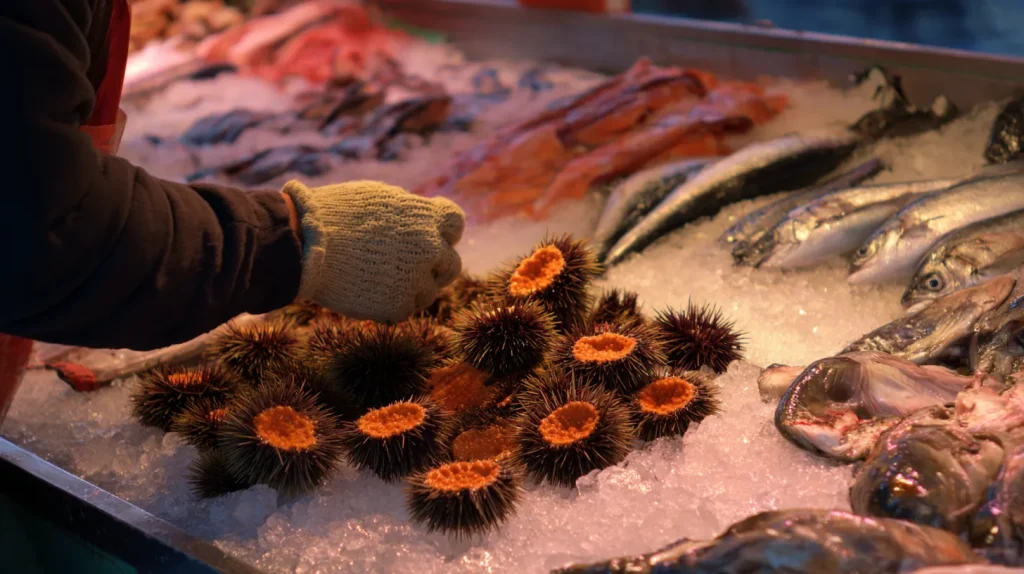
Sea urchins (oursins) are seasonal on the Riviera, available mainly in winter and early spring. When they’re genuinely fresh and in season, they’re one of the more singular eating experiences in Mediterranean France — briny, oceanic, faintly sweet, with a texture that all but dissolves on contact.
The eating is simple: the shell is split open and you scoop the roe out with a small piece of bread. Some places add nothing but a squeeze of lemon. That’s the right way to eat it.
The wrong way is ordering it out of season at a restaurant chasing a trend year-round. Out-of-season sea urchin is frozen or farmed, and neither version justifies the price or the experience. It’s worth simply asking whether they’re fresh before ordering.
Marché Saint-François in Vieux Nice sometimes carries sea urchin when it’s in season — worth a look on a Saturday morning if you want to get as close to the source as possible.
Bouillabaisse: the most misunderstood dish
Bouillabaisse is a fish stew that originated in Marseille and has become famous enough that nearly every restaurant along the Riviera now offers some version of it. Most of those versions aren’t worth ordering.
A real bouillabaisse uses at least four different fish — typically including rascasse (scorpionfish), Saint-Pierre, lotte, and rouget — cooked in a saffron-flavored fish broth. It’s served in two stages: the broth first, in a bowl, then the fish on a platter alongside it. You eat it with rouille, a spicy, garlicky red-pepper mayonnaise spread on toasted bread and submerged in the broth.
The broth should taste intensely of the sea, deeply colored by the saffron. The fish should be identifiable species by species, not dissolved into the soup. If what arrives looks like a generic fish stew or smells mostly of cream, it isn’t bouillabaisse — it’s fish soup with better marketing.
A properly made bouillabaisse is expensive — commonly somewhere in the €40 to €60 per person range at a serious kitchen, since it requires significant quantities of whole fish and real preparation time. At the high end, particularly at destination addresses on the Cap d’Antibes, the bill can run considerably higher once wine and courses are added — a couple of reported dinners at the top places have run well past €150 per person, so treat any single number here as a rough floor rather than a ceiling. A restaurant selling bouillabaisse for €18 is not making it from scratch that morning.
Maison de Bâcon, on the Cap d’Antibes and tracing its roots back to 1948, is among the most respected addresses in the region for classic bouillabaisse — though it now operates as a genuinely high-end restaurant with prices to match, so it’s worth going in with that expectation rather than as a casual lunch spot. Antibes is roughly 20 to 25 minutes by train from Nice.
In Nice itself, local diners point to a handful of small, honest kitchens for reliable fish cooking generally, even if bouillabaisse specifically leans more toward its Marseille roots.
Aïoli: the sauce that changes everything
Aïoli is a thick garlic mayonnaise made with olive oil rather than a neutral oil, which makes it richer and more assertive than a standard mayonnaise. On the Riviera it’s the standard accompaniment to grilled fish and fresh vegetables, and in its most traditional form it anchors a Friday lunch called Grand Aïoli, where poached fish and vegetables are served communally around a large bowl of the sauce.
A Grand Aïoli sounds simple and is: poached salt cod, boiled potatoes, carrots, green beans, hard-boiled eggs, raw fennel, all served at room temperature and improved enormously by the sauce. It’s more of a gathering than a dish. If you spot it as a daily special at a small bistro, order it.
Rosé on the Riviera: the right glass to order
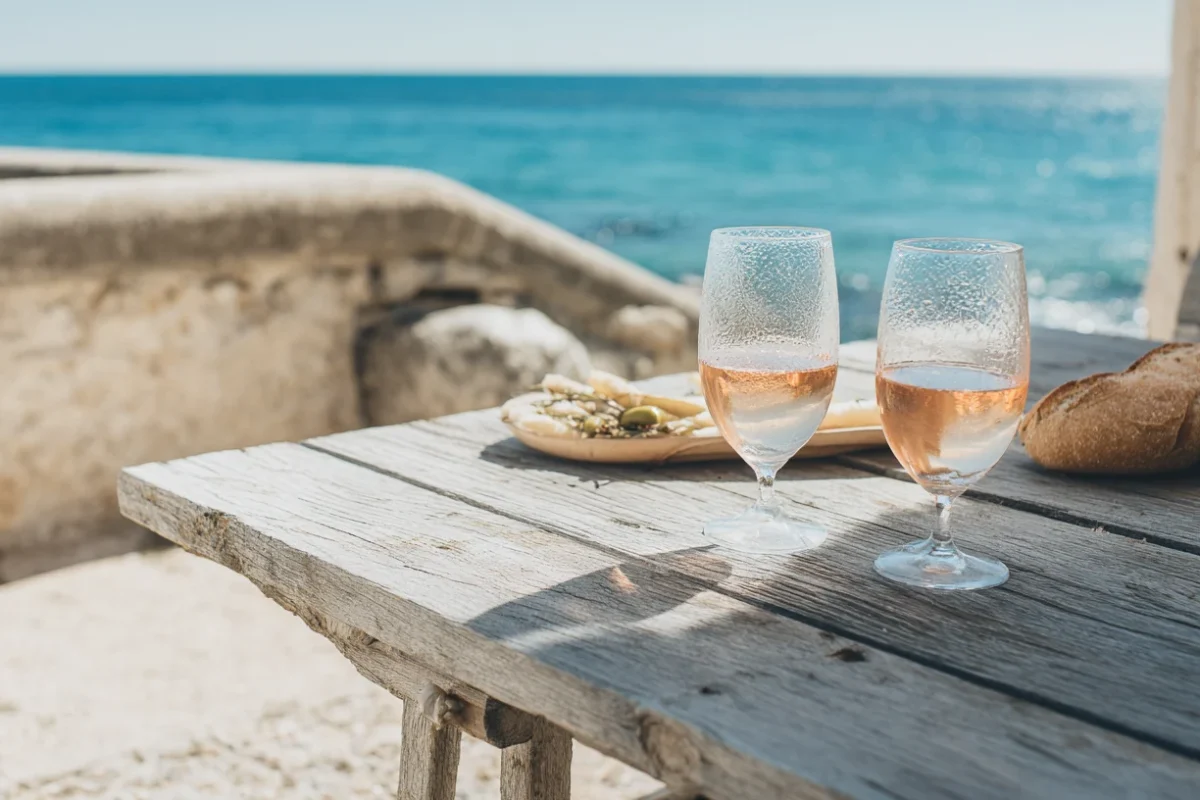
The French Riviera runs on rosé. Every terrace, every beach club, every lunch in the sun involves a bottle of pale pink wine, usually Provençal, usually from the Côtes de Provence appellation.
Côtes de Provence rosé is exactly what it advertises: light, dry, strawberry-scented, meant to be drunk cold and young. It pairs well with seafood precisely because it doesn’t compete — a background wine in the best sense, refreshing rather than complex. Expect to pay somewhere around €5 to €12 for a glass at a restaurant, or €8 to €20 for a bottle from a shop, prices that shift with the venue and season.
But there’s a more interesting rosé worth seeking out if you want to understand the place a little better: Bellet AOC.
Bellet is a tiny wine appellation covering roughly 50 hectares within the municipal limits of Nice itself, up in the hills above the city on terraced slopes looking down toward the coast — the only wine appellation in France located entirely inside a single city’s limits. Around nine producers make white, rosé, and red wine here, using grape varieties you won’t find much of elsewhere in Provence.
The rosé is built primarily around Braquet, often blended with Folle Noire and sometimes Grenache or Cinsault. Compared to the pale, delicate Côtes de Provence style, Bellet rosé tends to run deeper in color and fuller in body, with more strawberry and herb character.
The whites, made largely from Rolle (the local name for Vermentino), are arguably even better — mineral, fresh, with a faint saline quality that makes them a natural match for seafood. A bottle of Bellet blanc alongside a plate of fresh rouget at a hillside restaurant is, honestly, one of the better uses of your money on the Riviera.
Bellet wines are sold at specialty wine shops around Nice and directly at the wineries, most of which welcome visitors. They’re not widely exported, which makes seeking them out a genuinely local thing to do.
Where to eat: how to read the signals
The best seafood restaurants on the Riviera tend to share a few characteristics.
The menu changes daily, or has a “today’s catch” section. If every fish is listed as available every single day of the year, the kitchen isn’t working with what actually came off the boats that morning.
The fish is listed by species, not just as “fresh fish of the day.” Knowing exactly what you’re ordering, and being able to ask where it came from, is a reasonable expectation anywhere charging serious prices.
The room isn’t beautiful. The strongest fish restaurants in this region tend to put the money into the kitchen and the fish rather than the decor. A restaurant with a stunning waterfront terrace and a laminated menu with photos is almost never the best value.
La Merenda, tucked into Vieux Nice, is the most talked-about small restaurant in the city — a tiny room with around two dozen seats, a short, changing menu of traditional Niçoise dishes including whatever the market had that day, and cash-only payment. There’s no phone reservation line; bookings go through their website or social media, or you can try walking in. It’s closed Saturdays, Sundays, and Mondays. It’s genuinely worth planning around.
For the towns beyond Nice, Villefranche-sur-Mer and Beaulieu-sur-Mer are both a short hop east — well under ten minutes by train — and have a concentration of small port-side restaurants where the daily catch is quite literally what the local boats brought in that morning. Quality varies a lot from one address to the next, but the best tables there rival anything in Nice itself.
What not to order
Seafood risotto is usually a warning sign. A proper risotto takes around 18 minutes to cook; one that arrives in eight minutes wasn’t made to order.
Surf and turf on a menu primarily marketing its fish — a steak served alongside sea bass — suggests a kitchen trying to cover too much ground at once.
“Mediterranean fish platter” or plateau de fruits de mer, at a place that isn’t visibly a specialist seafood address, tends to be expensive and assembled rather than actually cooked — impressive to look at, forgettable to eat.
Practical notes
The old port area in Nice — Port Lympia — has several seafood restaurants with genuine harbor views. The views are real; the food quality varies widely from one terrace to the next. It’s worth walking the length of the port before sitting down at the first place with a greeter out front.
Marché Saint-François in Vieux Nice runs a fish market most mornings, Saturdays included. Buying straight from the stalls and eating at the port, or back at an apartment, is a legitimate approach if you’re self-catering.
Most of the better seafood restaurants don’t take lunch reservations and simply fill up early — arriving around 12:15pm generally gives you the best shot at a good table.
Frequently asked questions
What’s the most typical seafood to eat on the French Riviera? Loup de mer (sea bass), rouget (red mullet), and daurade (sea bream) are the most common and most representative choices. All are best ordered grilled — whole or filleted — with minimal sauce.
Is bouillabaisse from Nice or Marseille? Marseille. The dish originated there and remains most traditional in and around that city. Nice has plenty of restaurants serving versions of it, but it isn’t a Niçoise dish in the way socca or pan bagnat are. If bouillabaisse is a priority, Marseille itself or a Cap d’Antibes address like Maison de Bâcon are strong bets — with the latter running toward high-end pricing.
What is Bellet AOC wine? Bellet is a small wine appellation located entirely within the city limits of Nice, covering roughly 50 hectares of vineyard in the hills above the city. Its whites, made from Rolle (Vermentino), and its rosés, built around the local Braquet grape, are worth seeking out for something distinctly local. They’re sold at specialty wine shops in Nice and directly at the wineries.
When is sea urchin in season on the Riviera? Primarily winter and early spring, roughly December through April. Outside that window, ask before ordering — anything sold later in the year is very likely frozen or farmed.
How much should I expect to pay for a good seafood meal in Nice? For a main of grilled whole fish with wine at a solid restaurant, budget somewhere around €40 to €55 per person as a starting reference. A serious bouillabaisse tends to run €40 to €60 per person on its own, and considerably more at destination-level addresses. Smaller local bistros like La Merenda are generally the better-value route to honest cooking.