Nice is one of the five most-visited cities in France, pulling in several million tourists a year. Most of them see the same handful of things: the Promenade des Anglais, the Cours Saleya market, Vieux Nice’s painted alleyways, and Castle Hill. All good choices. None of them a secret.
But Nice and the coastline around it have a second layer — things that sit in plain sight but go unnoticed because they’re not on the standard tour route, or that require a short bus ride, a train hop, or a steep walk to reach. These are the spots where you’ll often be the only non-local around, where you’ll stop and wonder why nobody mentioned this sooner, and where the trip starts to feel like actual travel instead of a rehearsed sightseeing schedule.
Hidden in Plain Sight: Secrets Inside Nice Itself
The Adam & Eve House on Rue de la Poissonnerie
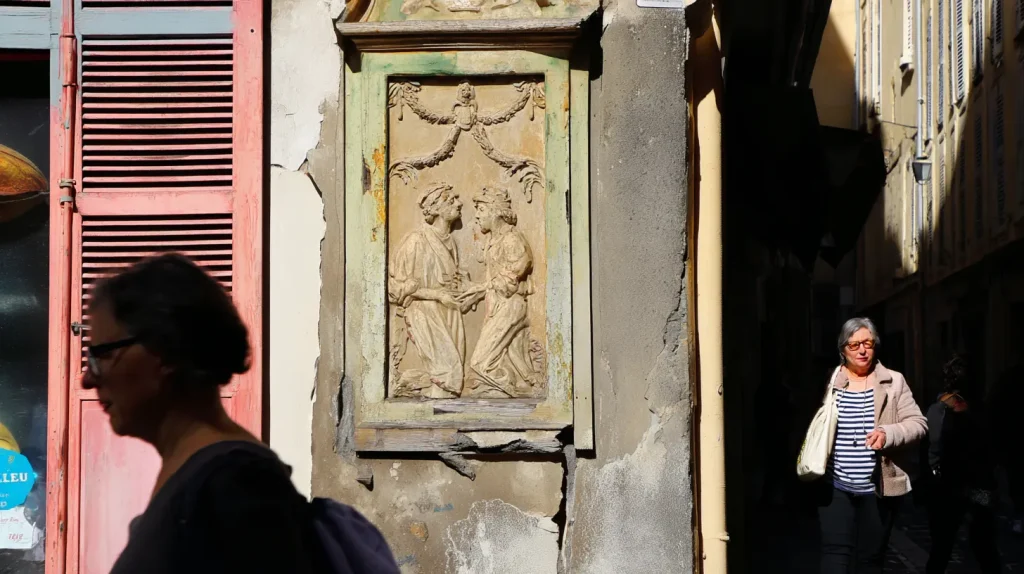
Walk along rue de la Poissonnerie in Vieux Nice and you’ll be moving with the flow of thousands of tourists. Almost none of them look up. About halfway along the street, on the façade of a building dating to 1850, there’s a bas-relief carved into the plaster — a sgraffito depicting what’s widely believed to be Adam and Eve in the Garden of Eden.
The more colorful version of the story is local folklore: some say the relief actually depicts the couple who lived there in the 19th century, immortalized in something close to scandal. Either interpretation makes the building worth five minutes of your attention. Look for it at first-floor level, between the colorful shutters.
The Midday Cannon on Castle Hill
Every day at noon, a small blast fires from Castle Hill. A puff of smoke rises above the city, a bang echoes across the rooftops, and anyone who didn’t know about it stops mid-stride in mild alarm. Locals don’t flinch.
The tradition is usually traced back to the 1860s, when a British expat named Sir Thomas Coventry is said to have arranged for a noon cannon so his wife would know it was time to head home for lunch — the story’s exact details shift depending on who’s telling it, and at least one local historian has questioned whether it happened quite that way. What’s not in dispute is that the tradition stuck: the original cannon has long since been replaced by a controlled firework, set off manually each day, but the sound and the smoke are genuine. If you’re on Castle Hill around noon, position yourself with a view westward for the full effect.
Parc du Vinaigrier: Nice’s Empty Hillside
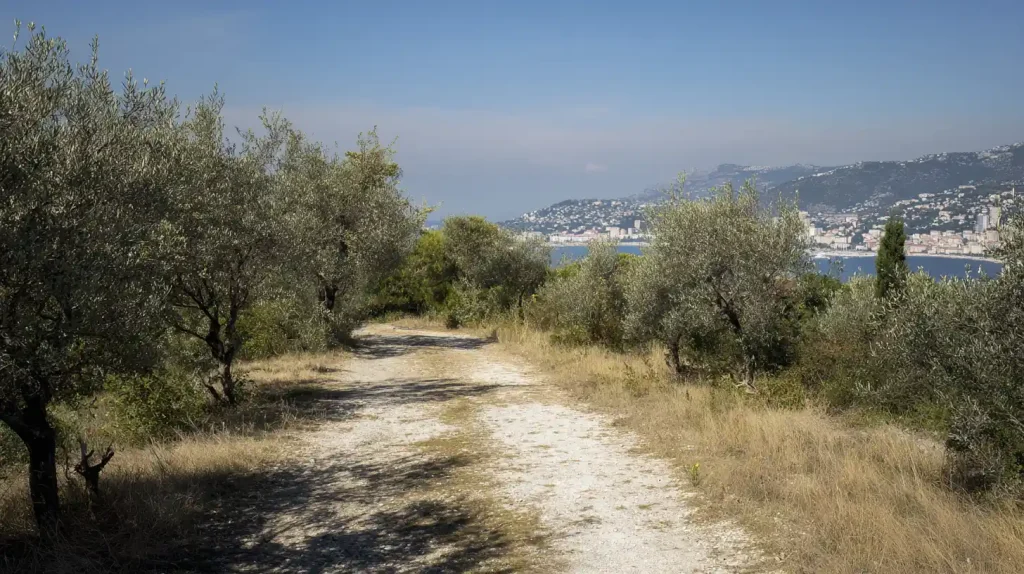
This is the one that surprises people most. A large hillside park just north of the city center, reachable in under half an hour from downtown, with olive groves, wild rosemary, and panoramic views over Nice’s rooftops and the Baie des Anges — and almost no one in it, even in summer.
Parc du Vinaigrier sits on the hills above the city, and the views across Nice toward the sea are genuinely wide. You’ll smell the rosemary before you see much else. To get there, take tram Line 1 to the Saint-Roch stop and climb the stairs uphill from there — a proper workout, but a short one — or take bus 84 to the Sainte-Anne stop for a gentler approach. The paths inside the park are informal and unpaved in places. In spring the wildflowers fill in the scene; in August you might have the entire hillside to yourself while the beaches below are packed edge to edge.
The Russian Orthodox Cathedral
A surprise at the end of an otherwise unremarkable underpass near Boulevard Tzarewitch: the Cathedral of St Nicholas, one of the most architecturally striking religious buildings in France. Six onion domes in greens and blues, intricate brickwork, and a scale that feels almost impossible for the surrounding streets.
The cathedral was built in the early 20th century, funded partly by donations connected to the Romanov family, and constructed near where the Tsar’s son, Nicholas Alexandrovitch, died of meningitis in 1865. Russia’s ties to the Riviera ran deep through the 19th century, and the building is the most visible physical remnant of that connection.
Entry is free. Photography is not permitted inside the cathedral itself, and shoulders and knees need to be covered to enter.
La Tête Carrée: The Library That Looks Like a Sculpture
Behind the MAMAC contemporary art museum near Place Garibaldi sits Nice’s main library, housed in a building designed by artist Sacha Sosno as a physical demonstration of the concept of “thinking inside the box.” The structure is enormous and cube-like, with a giant head carved into its façade — what Sosno called an “obliterated” sculpture. From certain angles it genuinely looks like a head in a box is staring at you from a municipal garden.
It’s free to enter the surrounding garden and view the exterior. The elevated green space stays quiet even on busy days, and the building’s silhouette shifts noticeably as you walk around it. Bring a camera — this is one of the stranger architectural sights on this stretch of the Mediterranean.
The Cannonballs on the Pénitents Bleus Chapel
On the façade of the Chapelle du Saint-Sépulcre-des-Pénitents-Bleus, an 18th-century baroque chapel in Vieux Nice, three cannonballs sit embedded in the stonework above the door. They’re said to date from the siege of Nice in 1543, fired by the Turkish fleet and never removed. Whatever their exact origin, they’ve been part of the building for centuries. The chapel is easy to walk past — the cannonballs aren’t labeled. Look up.
The Bellet Vineyards
Nice has its own wine appellation, and almost no visitors know it. The Bellet wine region sits on the hills north of the city, producing red, white, and rosé from grape varieties including Rolle, Folle Noire, and Braquet — varieties grown almost nowhere else in France. The wines are rarely exported, so drinking a genuine Bellet largely means being in or near Nice to do it. An annual Bellet Gourmand festival typically brings producers into the city center for public tastings, usually held in spring.
Visiting the estates themselves is best done by car, since most sit scattered across the hills and are only 15 to 20 minutes from the center by road. Nearly every estate — Château de Bellet, Château de Crémat, Domaine de la Source, and others — requires an advance reservation by phone or email rather than allowing walk-ins, so plan a few days ahead, especially in summer. If you don’t have a car, a handful of guided half-day tours from Nice include transport and tastings at two or three estates.
Half-Day Escapes: Getting Out of the City
Peillon: The Village Èze Hasn’t Found Yet
Peillon sits about 20km northeast of Nice in the mountains above the Paillon valley, and it’s everything Èze used to be before the tour buses arrived. The village occupies a dramatic rocky outcrop, nearly vertical on all sides, with houses stacked so tightly against the rock face that they look grown rather than built.
There are almost no tourist shops here. The streets are narrow stone passages. At the top, near the Romanesque-style parish church, the view stretches back across mountains and valley deep into the Alpes-Maritimes. Inside the village, the Chapelle des Pénitents Blancs holds a set of striking 15th-century fresco paintings attributed to Giovanni Canavesio — but the chapel is normally kept locked, and seeing the frescoes means stopping by the village’s small tourist office first to arrange access with a key holder.
Getting to Peillon without a car takes some patience: a direct bus (line 616, run by the regional Zou network) departs from Nice’s Vauban station a couple of times a day, Monday through Saturday, and takes around 40 minutes. Service is limited enough that it’s worth checking current timetables before you set out, and building the rest of your day around the bus schedule rather than the other way around. The payoff is arriving somewhere that still functions as a real medieval village, not a curated experience of one.
The Tête de Chien Hike Above Monaco
Most people who want a view of Monaco either visit Monaco directly or climb to the Trophée des Alpes at La Turbie. Both are good choices. The Tête de Chien — a rocky promontory above La Turbie — is arguably the better one.
The name translates to “dog’s head,” a nod to the rock’s profile from certain angles. The hike from La Turbie village to the summit takes roughly 45 minutes to an hour of moderate uphill walking. The views from the top take in Monaco directly below, Cap Ferrat and Cap d’Antibes to the west, and Cap Martin, Menton, and the Italian coastline to the east — arguably the widest single panorama on this stretch of coast.
La Turbie is reachable from Nice’s Vauban bus station on line 116, though service is infrequent enough that it’s worth checking the schedule the day before rather than assuming a convenient departure. Wear shoes with grip, since the path has some exposed sections, and bring water. Morning visits tend to have the clearest visibility.
Fort du Mont-Alban: Better Than Castle Hill
Castle Hill (Colline du Château) is the panoramic viewpoint everyone visits. Fort du Mont-Alban, on the same ridge system but higher and further east, is the one almost no one gets to — and the view is arguably wider.
The fort itself is a 16th-century military construction built to help guard Nice from the sea. It’s well preserved and set into pine forest, and the walk up from the road passes through enough trees to feel like a genuine escape from the city. The grounds and exterior are freely accessible; touring the interior generally requires arranging a visit in advance through Nice’s local heritage center, so treat this primarily as a viewpoint and forest walk rather than a full museum visit. Between the Nice bay to the west and the Villefranche bay and Port Lympia to the east, the panorama is more complete than what Castle Hill offers, since Castle Hill sits further west and misses part of that eastern sweep.
From central Nice, bus line 33 runs toward this side of the city, with a short walk from the nearest stop up to the fort itself. It sees a fraction of Castle Hill’s visitors, even on a busy day.
One Underrated Town Worth the Train Ride
Villefranche-sur-Mer’s Other Side
Villefranche-sur-Mer already gets some tourism — it’s a beautiful bay, and cruise ships anchor offshore regularly. But even visitors who come often miss two specific things.
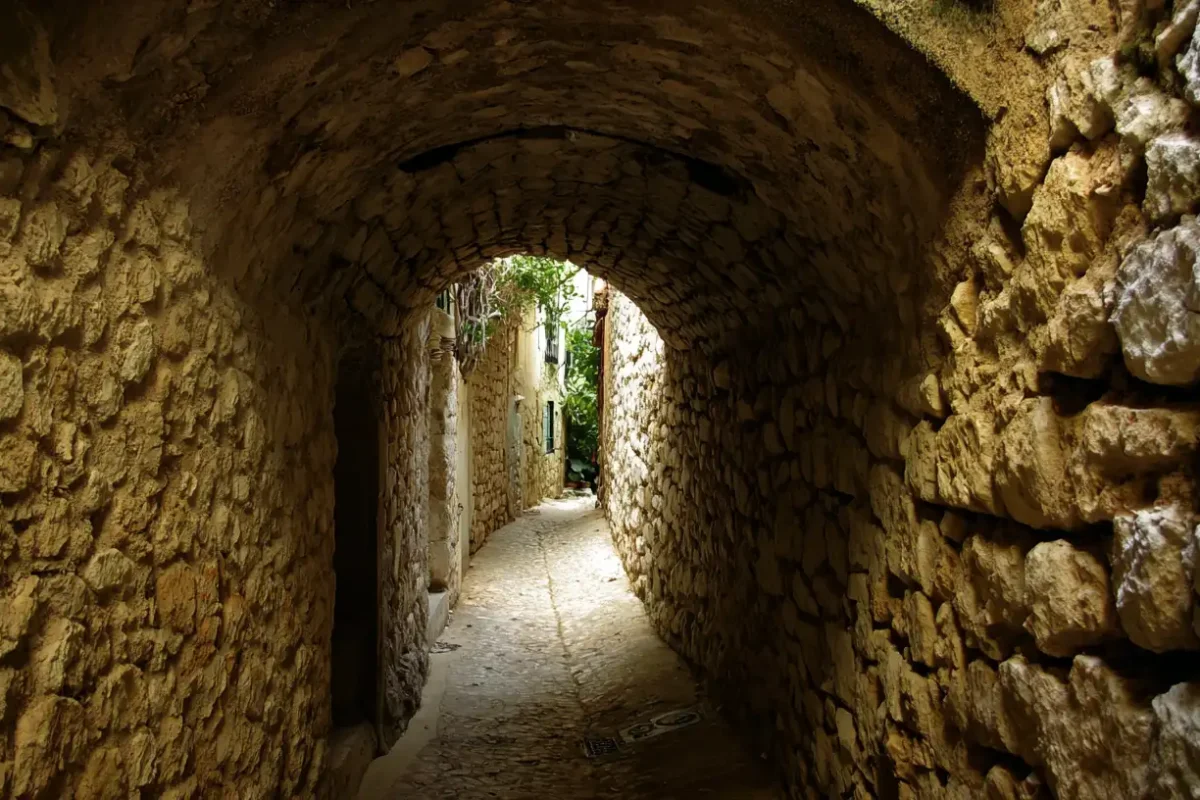
Rue Obscure is a vaulted medieval street running underneath the houses at the base of the old town, parallel to the waterfront. It’s genuinely dark inside, genuinely old (parts date to the 14th century), and was historically used as shelter during bombardment. Walk through it slowly. The quiet and the smell of old stone are nothing like the brightly colored seafront just one street above.
The second thing is the Chapelle Saint-Pierre, a small former fishermen’s chapel on the quay that Jean Cocteau decorated in the 1950s. Cocteau covered the interior with mural paintings depicting scenes from the life of Saint Peter, rendered in a style that’s immediately recognizable as his own. The chapel is typically open Wednesday through Sunday, with a modest entry fee (around €4 for adults, generally free for younger children), and closed Mondays and Tuesdays — worth checking current hours before you go, since small municipal sites like this do shift their schedules seasonally. Photography isn’t allowed inside.
Villefranche is about six minutes by train from Nice-Ville station, making it one of the easiest and quickest day trips anywhere on the Riviera.
A Note on What “Hidden” Actually Means Here
None of these places are unknown to locals. Some are well documented in travel guides and simply aren’t on the standard day-trip circuit. The Russian Cathedral, for instance, isn’t a secret — but a large share of Nice’s visitors never see it, because it’s not within easy walking distance of the Old Town. Parc du Vinaigrier is on every city map but rarely mentioned in tour recommendations. Peillon is only 20 kilometers from the city and might as well be a world away from the tourist infrastructure that surrounds Èze.
The honest version of “hidden gem” travel isn’t about finding places no one has ever been. It’s about being willing to take a slightly different bus, walk a slightly different route, or spend an afternoon in a village where the only café is closed on Tuesdays and the chapel is unlocked by appointment. That friction is the point. It’s where a trip starts to feel like yours rather than a rerun of everyone else’s itinerary.
FAQ
What are the best hidden gems in Nice itself? The Adam & Eve bas-relief on rue de la Poissonnerie, the midday cannon on Castle Hill, the hillside Parc du Vinaigrier, and the Russian Orthodox Cathedral of St Nicholas are among the most rewarding spots that most visitors walk straight past. None require much extra planning — just curiosity and a willingness to stray slightly off the main tourist route.
Is Peillon village worth visiting from Nice? Yes, for travelers who want to see a medieval hill village without the crowds that Èze now draws. Peillon is genuinely quiet, the views are striking, and the 15th-century chapel frescoes are considered historically significant. Getting there without a car takes some planning, since the direct bus runs only a couple of times a day, but it’s entirely doable.
What is the Tête de Chien and how do I get there? The Tête de Chien is a rocky promontory near La Turbie offering one of the widest views on the French Riviera — Monaco directly below, the Italian coast to the east, Cap Ferrat to the west. A moderate hike from La Turbie village reaches the summit in under an hour. La Turbie is reachable by bus from Nice’s Vauban station, though services run infrequently, so check the schedule before setting out.
What is Rue Obscure in Villefranche-sur-Mer? Rue Obscure is a vaulted medieval street running below the old town of Villefranche-sur-Mer, with sections dating to the 14th century. It was historically used as shelter during bombardments and remains one of the most atmospheric and least-visited streets on the Riviera. Villefranche is about six minutes by train from Nice.
What is the Nice midday cannon? Every day at noon, a controlled firework is set off from Castle Hill, producing a loud bang and a puff of smoke visible across the city. The tradition is generally traced to the 1860s. If you’re near Castle Hill around noon, you’ll hear it — most first-time visitors assume something has gone wrong before a local explains what’s going on.