The road from Nice to Monaco is one of the most dramatic drives on the French Riviera. The Grande Corniche cuts along the cliff face several hundred meters above the sea, and on a clear day the view east toward the Italian border is the kind of thing that makes you forget you were just arguing about where to have lunch.
Perched on that same stretch of coast, roughly halfway between Nice and Monaco, is Èze village — a medieval stone settlement balanced on a rocky spur 429 meters above the Mediterranean. It sounds dramatic because it genuinely is. And pairing Èze with a half-day in Monaco makes for one of the most satisfying day trips out of Nice, provided you get the logistics right.
That’s the part most people trip up on.
Done properly, Èze takes up a morning and Monaco fills the afternoon. The two places couldn’t feel more different — one is medieval stone and quiet lanes, the other is superyachts and Formula 1 money — and that contrast is part of what makes the day work so well. You get both ends of the Riviera’s personality in a single loop, without needing a car.
The Bus Trap: Read This First
Before anything else: if you’re getting from Nice to Èze village by public bus, do not take Bus #600.
Bus #600 goes to Èze-sur-Mer, the small coastal settlement down at sea level, below the medieval village. It’s a fine place in its own right, but it is not the hilltop destination people usually mean when they say “Èze.” Realizing the mistake after getting off the wrong bus is a genuinely frustrating way to start a day.
The buses you actually want are Bus #82, run by the city’s Lignes d’Azur network, and Bus #602, run by the regional Zou network. Both stop at Èze village and roughly alternate through the day, though frequency is modest — expect something in the range of once an hour, less on Sundays, when #602 typically doesn’t run at all. Both depart from the Vauban bus station in Nice: take Tram Line 1 to the Vauban stop, cross through the shopping area, and go through the tunnel under the train tracks to reach the bus platforms. The ride takes around 30 minutes, following the winding Moyenne Corniche road, and the views are reason enough to grab a seat on the right-hand side of the bus. A single fare runs a couple of euros either way — Bus #82 tickets are cheaper if bought from a machine in advance, while Bus #602 tickets bought from the driver cost a bit more.
Write this down before you leave your hotel: Bus #82 or #602 from Vauban → Èze village. Not Bus #600. Not the direct Monaco bus. The #82 or #602.
Èze Village: What to Do
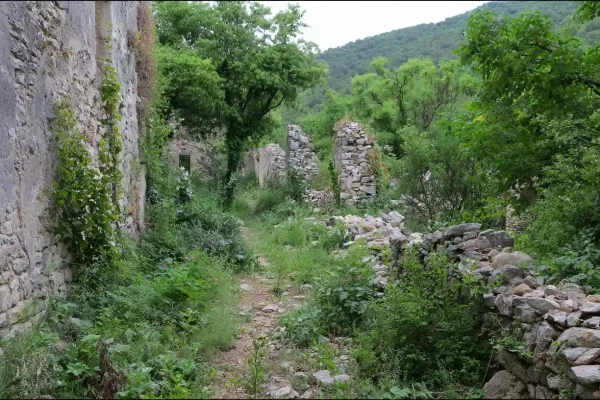
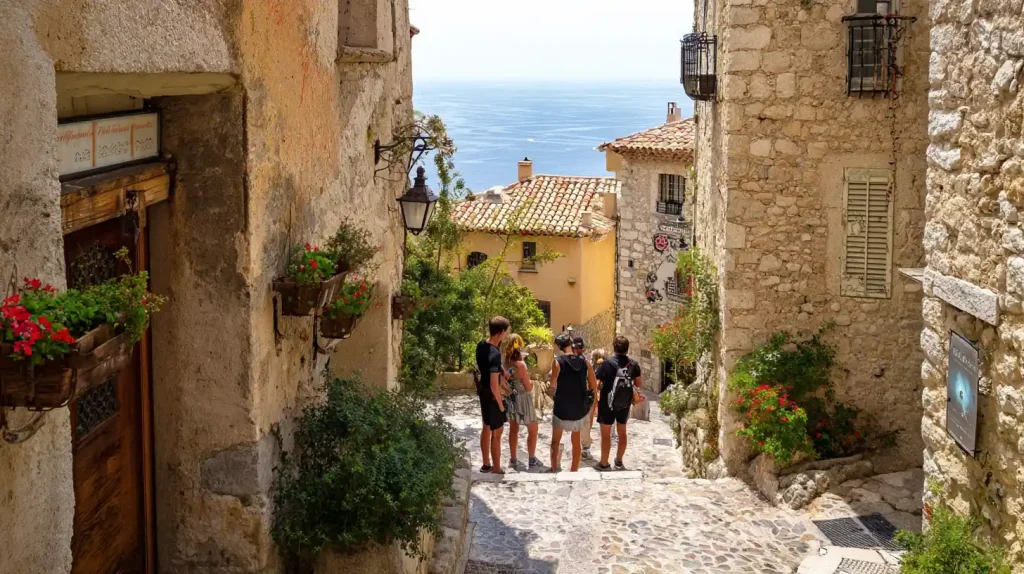
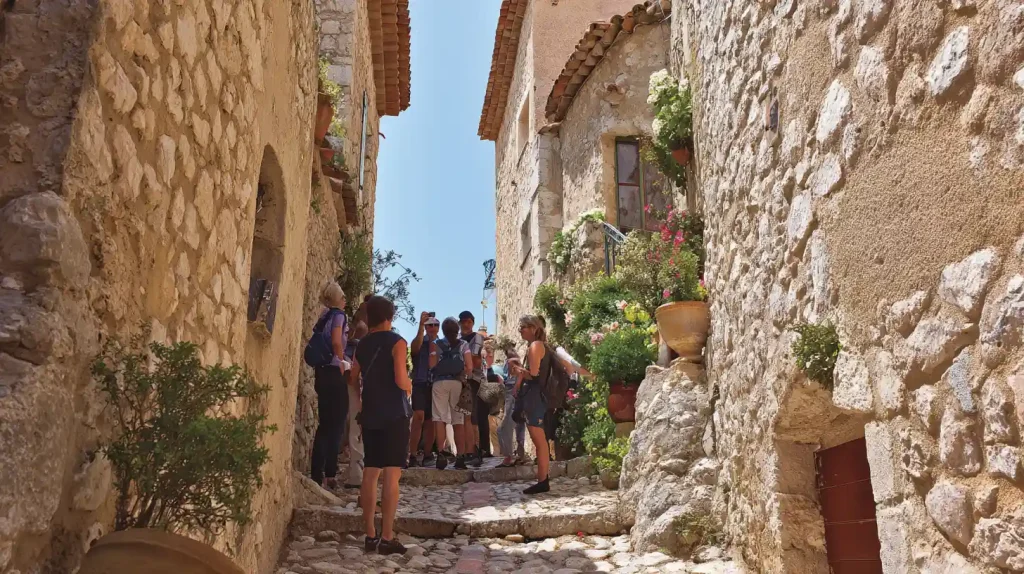
The village itself is small — you can walk its full length in twenty minutes. The value isn’t in the size, it’s in the density of the experience. Every lane is medieval stone. Every turn opens onto a view over the sea or back toward the mountains. The place has stood here since the 14th century, and it genuinely looks like it.
Wear flat shoes with real grip. The cobblestones are worn smooth from centuries of foot traffic and turn slippery fast after rain. Heels are a bad idea here, especially on the steeper stretches near the top.
Bring your own water. There’s no supermarket inside the village, and drinks from the cafés and restaurants come at a premium. A bottle from a shop in Nice costs next to nothing by comparison. Climbing through the village on a hot July afternoon without water is genuinely unpleasant, and there aren’t public fountains to rely on once you’re past the entrance.
There’s no car access into the village center at all. The bus drops you at a parking area near the entrance, and everything from there is on foot.
Jardin Exotique d’Èze sits at the very top of the village, built into the ruins of a medieval castle. It’s a cactus and succulent garden with sweeping views in every direction, and current admission runs around €10 per adult (tickets can be bought at a machine near the village entrance to skip the line at the top, or at the gate itself). Budget about 45 minutes to walk it properly. The view from the top is the best in the entire village — the ticket is worth it for the vantage point alone, even if gardens aren’t usually your thing.
Fragonard Parfumerie, the working perfume factory at the top of the village near the church, is open daily from roughly 9am to 6pm. Free guided tours run throughout the day at regular intervals, generally around every 30 minutes, and last about 20 to 30 minutes each. The tour covers both perfume production and the cosmetics laboratory where Fragonard’s skincare line is made, walking you through techniques like steam distillation and enfleurage that go back centuries in the Grasse perfume tradition. There’s no obligation to buy anything, though the shop at the end of the tour is laid out to make that a bit tempting. If you want to go further, an optional paid workshop lets you blend your own fragrance to take home.
The village also has a scattering of galleries, craft shops, and restaurants. Lunch here runs noticeably higher than in Nice — you’re paying for both the setting and the view. A few of the restaurants near the top, with terrace seating overlooking the coast, are genuinely worth the premium if your budget allows for it.
One of the more rewarding things about Èze is how easy it still is to find a quiet corner, even with tour groups around. The crowds tend to funnel along the main path toward the garden and the Fragonard entrance. Duck down one of the smaller side lanes — there aren’t many, but they exist — and you’ll often find an empty viewpoint and nothing but wind for company. It’s a village that rewards anyone willing to wander off the obvious route.
The Nietzsche Path (Chemin de Nietzsche) is a well-known hiking trail that descends steeply from the village down to Èze-sur-Mer on the coast. Friedrich Nietzsche reportedly walked it regularly during his stays on the Riviera, and is said to have worked out parts of “Thus Spoke Zarathustra” along the route. Going down takes around 45 minutes to an hour; going up is considerably harder. Wear proper hiking shoes if you’re taking it on — the path is scenic but unmanicured, rocky in places, and can get slippery after rain.
All told, plan on two to three hours for Èze village.
Getting from Èze to Monaco
The easiest route down to Monaco is to head from the village to Èze-sur-Mer, the coastal station below the cliff, and catch the train from there. It’s a short walk or a quick taxi ride down to the station. Trains run frequently — roughly every 15 to 20 minutes throughout the day — and the ride to Monaco–Monte-Carlo takes only about 8 to 10 minutes, with fares starting around €4. This is the recommended approach: spend the morning in Èze, then head down after lunch.
Some visitors instead take a taxi directly from the hilltop village to Monaco. It’s faster door-to-door but costs considerably more than the train-and-walk combination, so it’s really a question of how much your time is worth versus your budget.
Monaco: Honest Expectations
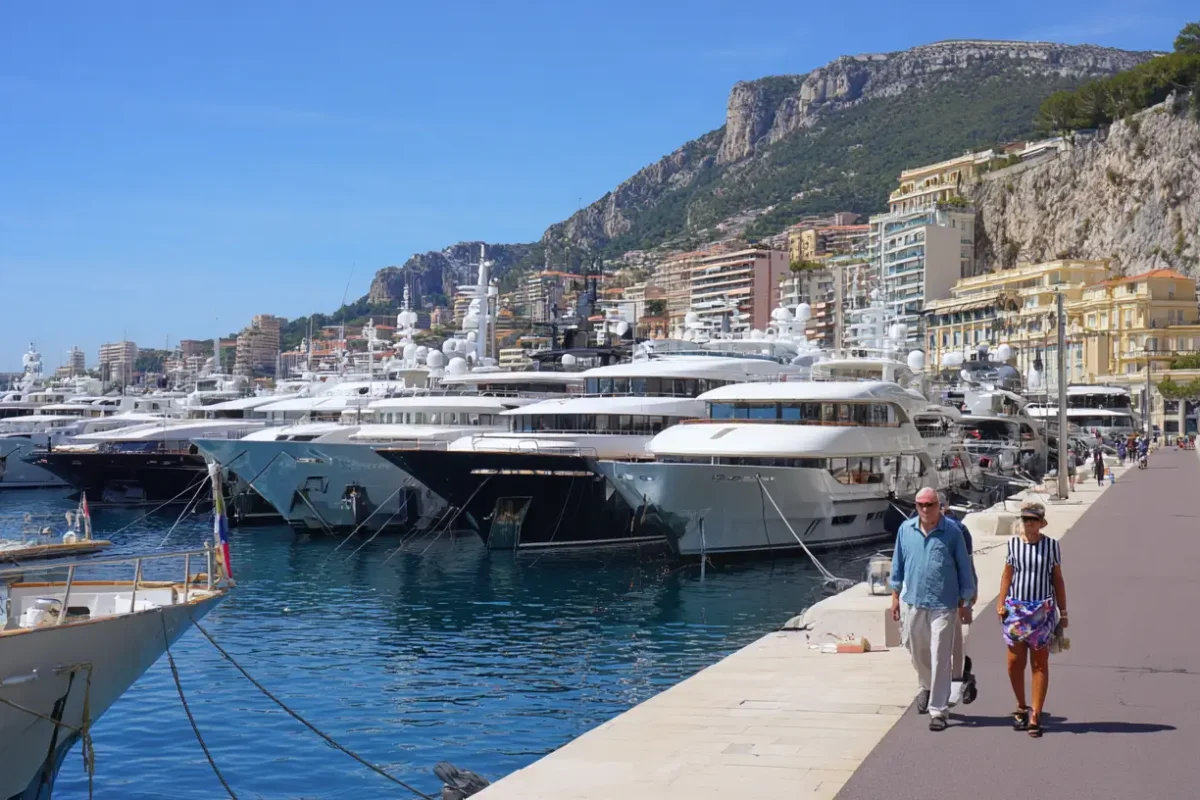
Monaco is the world’s second-smallest country, squeezed between France and the sea on a rocky peninsula, and it’s also the wealthiest country on earth by GDP per capita. The superyachts in Port Hercule are real. The supercars parked on ordinary streets are not rentals. The Casino de Monte-Carlo really is as beautiful as photos suggest.
None of that requires you to spend a cent.
What’s free in Monaco: wandering around Port Hercule watching the yachts; standing outside the Casino de Monte-Carlo for photos (going inside the gaming rooms costs money and requires smart dress); walking through Monaco-Ville, the old quarter perched above the port; and the Changing of the Guard at the Prince’s Palace, which takes place every day at 11:55am and costs nothing to watch. Arrive around ten minutes early for a decent spot.
The Cathedral of Our Lady Immaculate (Cathédrale Notre-Dame-Immaculée) in Monaco-Ville is free to enter and is where Princess Grace Kelly is buried, alongside generations of the Grimaldi family. It’s understated compared to the rest of Monaco’s glamour, and most visitors walk right past it without going in — worth the detour if you have a spare fifteen minutes.
The Jardin Exotique de Monaco — a separate garden from Èze’s, perched on Monaco’s western cliffs — reopened in March 2026 after a six-year, multimillion-euro renovation, and it’s one of the best viewpoints in the entire Principality. A single ticket covers the garden, the Observatory Cave beneath it, and the small Museum of Prehistoric Anthropology. Adult admission currently runs around €12, with reduced rates for children, students, and seniors. If you’ve already paid for the Èze garden and money’s tight, this one is skippable — the views overlap conceptually even if the plant collections differ. If you haven’t, it’s a worthwhile hour, especially now that it’s freshly renovated.
What costs money: entering the State Apartments of the Prince’s Palace runs €13 for adults, €11 for students, and €8 for children aged 6 to 17, with children under 6 admitted free. The State Apartments are open seasonally, roughly late March through mid-October, and the tour — covering the Throne Room, the State Gallery, and views across the harbor — takes about an hour to an hour and a half. It’s genuinely worth the ticket if you have any interest in the Grimaldi family’s history.
Eating and drinking in Monaco is expensive by any standard, and noticeably more so than in Nice for comparable quality. Casual, sit-down meals tend to start somewhere in the €20–30 range per person, and a coffee at a café on the main boulevards can easily run €5 or more. This isn’t the place to plan your regular daily meals around — treat it as a place to visit, not a place to eat three times a day.
The Formula 1 Grand Prix: Dates to Avoid
Monaco hosts the Formula 1 Grand Prix in late May or early June most years, and the race weekend reshapes the entire city while it’s on. During the event:
- The Prince’s Palace closes to visitors entirely
- Large parts of Monaco’s street network are closed or restricted
- Hotel rates in both Monaco and Nice climb sharply, often by 30 to 40 percent
- Port Hercule fills with private boats and becomes largely inaccessible to casual visitors
The 2026 race took place June 4–7. The following edition is provisionally scheduled for June 3–6, 2027, though F1 dates are always subject to final confirmation closer to the season. If your travel dates land anywhere near early June and you have flexibility, shifting your trip by a week in either direction avoids a lot of unnecessary cost and hassle. If you’re specifically planning around the Grand Prix itself, that’s a different kind of trip entirely, with its own ticketing and logistics to sort out well in advance.
Recommended Day Schedule
Morning: Leave Nice by around 9:00am to catch an early bus toward Èze.
Èze village, roughly 9:30am–12:30pm: Jardin Exotique, the Fragonard factory tour, a walk through the lanes, and lunch either in the village or something packed from Nice.
Travel to Monaco: Walk or taxi down to Èze-sur-Mer, then take the short train ride to Monaco, arriving by early-to-mid afternoon.
Monaco, roughly 1:30pm–5:30pm: Port Hercule, Monaco-Ville, the Prince’s Palace if you’re paying to go in, and the square outside the casino. Head back to Nice by train from Monaco station.
This schedule is entirely doable on public transport without joining a tour. Total transport costs for the full loop — bus to Èze, train down to Monaco, train back to Nice — typically land somewhere around €10 to €15 per person, depending on which bus line you catch and how you buy your tickets. A guided tour from Nice handles all of the transport logistics for you and usually covers both stops in a five-to-six-hour outing; prices vary widely depending on group size and what’s included, so it’s worth comparing a few options if that route appeals to you more than figuring out bus schedules yourself.
FAQ
Can I do Èze and Monaco in one day without a car? Yes. Buses and trains handle the route efficiently. The key sequence is: bus from Nice to Èze village in the morning, train from Èze-sur-Mer to Monaco in the afternoon, then train back to Nice in the evening. The full loop typically takes around eight hours door to door.
Which bus goes to Èze village from Nice? Bus #82 or Bus #602, both departing from the Vauban bus station (reachable via Tram Line 1 to the Vauban stop). Do not take Bus #600 — that one goes to Èze-sur-Mer on the coast, not the hilltop village.
Is Monaco worth visiting as a day trip? For most visitors, yes — at least once. The views around Port Hercule and Monaco-Ville are genuinely impressive, and the Changing of the Guard and the palace exterior cost nothing to enjoy. Spending a full day there on a tight budget is harder, since food and drink prices run high. Two to four hours is usually enough to take in the highlights without it feeling like you’re just watching other people spend money.
When should I avoid visiting Monaco? During the Formula 1 Grand Prix, typically held in late May or early June. The palace closes, streets are blocked off, and prices spike noticeably. The weekends immediately before and after the race also see elevated prices and heavier traffic.
How long should I spend in Èze village? Two to three hours is generally enough to visit the Jardin Exotique, take the Fragonard factory tour, wander the lanes, and grab lunch or a coffee with a view. It’s a small village, and a much longer stay starts to feel like you’re stretching it out rather than enjoying it.