Eating at a Michelin-starred restaurant in Paris does not have to mean a €200-per-person bill. The best-kept open secret in French dining is the weekday lunch menu — a fixed set of two or three courses priced at a fraction of what the same kitchen charges at dinner. Same chef, same ingredients, same star. You’re just showing up at noon instead of 8pm.
Right now, the most accessible Michelin-starred lunch in the city starts at €32 for two courses. That’s at a restaurant that has earned an actual Michelin star — the kind of accolade that, in plenty of other cities, comes with a €150 tasting menu attached. It’s a genuine anomaly in the world of fine dining, and it’s worth understanding properly before you plan a trip around it.
The Three Tiers You Need to Know
People throw around “Michelin restaurant” pretty loosely, and it causes a lot of confusion when you’re trying to book something. There are really three distinct categories at play.
Michelin Stars. One, two, or three stars — the awards everyone’s heard of. One star signals a genuinely excellent restaurant. Two stars means the cooking is worth a detour. Three stars means it’s worth planning an entire trip around. Paris currently has around 127 starred restaurants, more than any other city in the world holds, spread across roughly a dozen arrondissements rather than clustered in one neighborhood.
Bib Gourmand. This is the category most first-time visitors have never heard of, and it’s arguably the more useful one if you’re eating on a budget. A Bib Gourmand isn’t a star — it’s Michelin explicitly flagging a restaurant for excellent cooking at a fair price, with a full meal in Paris averaging around €45 per person. No star, but a real endorsement of both quality and value from the same inspectors who hand out stars. France added 75 new Bib Gourmand restaurants in the 2026 selection, 12 of them in the Paris region.
Michelin Guide listed. Beyond stars and Bibs, the Guide simply lists thousands of restaurants with no award attached at all — just an inspector’s nod that the place is worth eating at. No badge, no star, no Bib. A lot of restaurant marketing blurs this line on purpose. If a place advertises itself as “Michelin-recommended” or “featured in the Michelin Guide” without specifying a star or a Bib, it very likely just has a plain listing — which is a real thing, but a much lower bar than most people assume.
The Lunch Menu Strategy, Explained
Most Michelin-starred restaurants in Paris run a “menu déjeuner” — a fixed lunch menu — on weekdays. This isn’t a promotional gimmick or a limited-time deal. It’s simply how these restaurants price midday service to keep tables full at an hour when a purely à la carte approach would leave the dining room half empty.
Here’s how it plays out in practice: you sit down, and you’re offered the lunch menu alongside the full à la carte options. At dinner, à la carte at a one-star restaurant can easily run €80–120 per person. At lunch, the same kitchen’s fixed menu might land at roughly half that, sometimes less.
A few things are worth knowing before you book:
- Lunch menus are almost always weekday-only — typically Monday to Friday, seated between noon and 2pm or so.
- They’re rarely offered on weekends, when these restaurants fill at full price without needing the discount.
- A handful of restaurants run a Saturday lunch menu, usually priced a bit higher than the weekday version.
- Public holidays typically knock the lunch menu off the table entirely.
- Reserve ahead, even for lunch. Popular starred restaurants can book out weeks in advance.
The Most Accessible Starred Lunch in Paris
Benoit (20 Rue Saint Martin, 4th arrondissement) is, at the moment, the easiest entry point into Michelin-starred dining in Paris. It’s a one-star restaurant under Alain Ducasse, operating out of the same room since 1912 — genuinely one of the oldest continuously running bistros in the city, and the only Michelin-starred address that still feels, first and foremost, like a bistro. The weekday lunch menu runs €32 for two courses and €42 for three, amuse-bouches included.
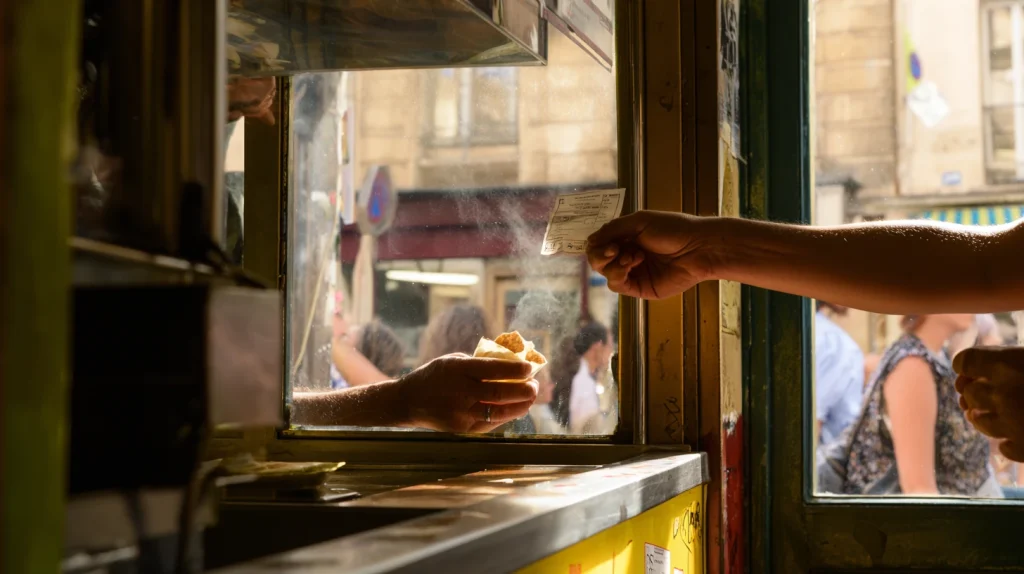
The cooking is classic French bistro fare taken up a notch: garlicky snails, braised beef cheek, the profiteroles the restaurant is genuinely known for, and a millefeuille that has people planning return visits around it. The room is warm and, at lunch, fairly loud — nothing like the hushed reverence some starred restaurants cultivate. It reads as a serious neighborhood bistro that happens to cook at a Michelin level, because that’s essentially what it is.
At €42 for three courses plus the kitchen’s amuse-bouches, this is one of the strongest value propositions in Parisian dining, full stop. It’s a considerably better deal than most of the tourist-facing bistros clustered in the surrounding Marais streets, many of which charge similar prices for food that doesn’t come close.
Ze Kitchen Galerie (4 Rue des Grands Augustins, 6th arrondissement, Left Bank) is another strong option if you want something less classically French. It’s a one-star restaurant from chef William Ledeuil, who trained in and travels regularly to Southeast Asia, and it shows in the finished plates — galangal, ka-chai, wasabi, and turmeric worked into otherwise French technique. The weekday lunch runs on a set-course structure, with pricing that generally lands in the low-to-mid €40s depending on which combination of starter, main, and dessert you choose — reviewers and the restaurant itself consistently describe it as one of the better-value starred lunches on the Left Bank. It’s open weekdays for lunch (roughly noon to 2:15pm) and closed Saturday lunch and all day Sunday, so plan around that if you’re set on going.
Bib Gourmand: Better Value, Less Pressure
If the formality of a starred dining room isn’t really what you’re after, the Bib Gourmand list is the better target. These are restaurants Michelin has certified as excellent value — real cooking, good ingredients, a full meal for around €45 per person — without any of the theatre that comes with fine dining.
The 2026 Bib Gourmand additions in the Paris region included Le Cornichon in the 14th arrondissement, À L’Improviste in the 17th, Adami, Le Coucou, and Le Savarin in the 9th, Épopée and Lissit in the 11th, and Kodawari Ramen – Yokochō in the 6th — a Japanese ramen specialist where broths simmer for hours and the noodles are made on-site from wheat grown and ground in-house.
Bib Gourmand restaurants tend to feel noticeably more relaxed than starred ones. Dress code is generally smart casual, or whatever you’d wear to a nice neighborhood bistro. The pace is faster, the noise level is higher, and you’re more likely to be seated next to actual Parisians on their lunch break than at a starred restaurant, where the clientele skews more heavily toward visitors.
What to Realistically Expect
“Budget Michelin” is a relative term, and it’s worth being honest about that. A €42 three-course lunch at Benoit is extraordinary value for a Michelin-starred experience. It is not inexpensive in absolute terms. Add a glass of wine (roughly €8–15, depending on the restaurant and the bottle) and a coffee, and you’re realistically at €55–60 per person once the bill actually lands.
That’s still meaningfully less than a dinner at the same restaurant would cost. It’s also more than a baguette sandwich from a boulangerie. Knowing which comparison you’re actually making going in will save you from either sticker shock or disappointment.
What you do get that you don’t find at cheaper restaurants: ingredients sourced at a level most kitchens can’t match, technical execution that’s consistently precise rather than occasionally good, and generally a service style that’s attentive without hovering. The amuse-bouches that arrive before your first course aren’t on the menu and aren’t on the bill — they’re the kitchen introducing itself before the meal officially starts.
What you don’t always get at the budget end of Michelin lunch is the full ceremony of a starred dinner service. Sommelier-led wine pairings, an elaborate cheese or dessert trolley, the slower, more theatrical pacing — some of that is dinner-only at these restaurants. Lunch is service, not spectacle. The cooking is identical either way.
One genuinely useful tip: if a restaurant offers counter seating facing the open kitchen, take it. A number of Paris restaurants, including several Bib Gourmand spots, seat diners right along the pass. Same food, same price, and you get to watch it happen.
A Few Bib Gourmand Picks Worth Knowing
Le Cornichon (14th arrondissement) is a neighborhood bistro that earned its Bib Gourmand doing French classics properly — seasonal menus, a wine list that leans natural, and a room that reads as an actual local restaurant rather than something built for visitors. The 14th is a residential district, and the clientele reflects that: mostly regulars, with a growing number of food-focused travelers finding their way in. Worth calling ahead or booking online, since the dining room is small.
Kodawari Ramen – Yokochō (29 Rue Mazarine, 6th arrondissement) is an interesting case: a Japanese ramen shop that earned a Bib Gourmand from Michelin’s French inspectors, which says something about how seriously it’s taken. The broths are built from scratch and simmered for hours; the noodles are made in-house from wheat grown and milled on site. In a city as fiercely proud of its own food culture as Paris, a ramen shop earning Michelin recognition is a genuine signal. Be warned that it’s tiny and extremely popular — queues form outside during peak times, and walk-ins should expect a wait.
Neither of these is a €12 lunch. The Bib Gourmand designation means around €45 per person for a proper meal, not bargain-basement dining. What it signals is that the price is fair for what you’re getting — not that it’s cheap in an absolute sense.
That distinction matters in a city like Paris, which has no shortage of restaurants charging €40 per person for perfectly ordinary food in a nice-looking room. A Bib Gourmand restaurant charges roughly the same for food that Michelin inspectors have visited multiple times and specifically certified as worth it.
When Not to Do Budget Michelin
Most guides skip this part, but it matters.
If your priority on a Paris trip is maximizing the number of things you see in a day, a Michelin lunch probably isn’t the right call. A proper lunch at Benoit takes 90 minutes at an absolute minimum — you’ll be seated, served amuse-bouches, work through two or three courses, have coffee, and settle the bill. Your afternoon will be largely gone before you leave. That pacing is the point of the experience, but it doesn’t mesh well with a tightly packed sightseeing itinerary.
If formal restaurant service tends to stress you out rather than relax you, the Michelin lunch experience might not be worth the price even at €42. The service at these restaurants is professional and warm rather than stiff, but there’s still a degree of ceremony — napkins placed for you, courses explained by the server, a pace set by the kitchen rather than by you — that some diners find awkward instead of enjoyable. It’s worth being honest with yourself about which camp you’re in.
The right person for a budget Michelin lunch is someone genuinely interested in food as its own experience, with a flexible afternoon and some curiosity about what French restaurant cooking looks like at its best. If that’s you, a weekday lunch at Benoit or a solid Bib Gourmand restaurant is one of the better ways to spend money in Paris.
How to Book
Paris Michelin restaurants can generally be booked directly through their own websites, through the Michelin Guide’s own site, or through TheFork (branded as LaFourchette within France). Most require a credit card to hold the reservation, and most charge a cancellation fee if you no-show or cancel too late — the exact amount varies by restaurant, so it’s worth reading the fine print when you book rather than assuming. No-showing at a Michelin restaurant is genuinely poor form in a city with limited tables and real demand for them, and it costs real money on top of that.
Book at least a week ahead for most starred restaurants, and longer for the most in-demand ones. The city’s best-known two- and three-star dining rooms can book out months ahead for dinner, with their (rarer) lunch menus going weeks in advance. Benoit, despite being the most accessible starred option on this list, tends to book up faster than you’d expect for a weekday lunch — aim for two weeks out if you’re visiting during the summer months.
FAQ
What is the cheapest Michelin-starred restaurant in Paris? Benoit (20 Rue Saint Martin, 4th arrondissement) currently offers the most accessible entry point into starred dining in the city — a two-course weekday lunch for €32 and a three-course version for €42.
What is a Bib Gourmand restaurant? A Bib Gourmand is a Michelin Guide designation for restaurants offering genuinely excellent cooking at good value — around €45 per person for a full meal in Paris. It isn’t a Michelin star, but it’s a real endorsement of both quality and price. The 2026 guide added 12 new Bib Gourmand restaurants in the Paris region.
Can I eat at a Michelin restaurant in Paris for under €50? Yes, at a small number of restaurants via the weekday lunch menu. Benoit offers three courses for €42; add a glass of wine and coffee and you’re closer to €55–60 total. It’s exceptional value for the quality on offer, though not cheap in absolute terms.
Do I need to dress up for a Michelin lunch in Paris? For one-star restaurants, smart casual is generally fine at lunch — skip ripped jeans and trainers, but formal wear isn’t required. Two- and three-star restaurants can have stricter expectations. When in doubt, check the restaurant’s website or call ahead.
What’s the difference between a Michelin star and a Bib Gourmand? A Michelin star recognizes excellence in cooking. A Bib Gourmand recognizes good quality at good value. Both require repeat visits from Michelin inspectors, and both mean something — but a Bib Gourmand restaurant is specifically singled out for the value it offers, not the cooking alone.