Stand at the top of the Arc de Triomphe at dusk and look down the Champs-Élysées toward the Louvre, and you’ll finally understand why Baron Haussmann redesigned Paris the way he did. Twelve avenues radiate outward from this single point like spokes on a wheel. The city is a star, and you’re standing at its exact center. The scale of it — eight lanes of traffic circling 200 meters below you, twin lines of trees stretching two kilometers toward the Obelisk at Place de la Concorde — is one of those views that earns the word “grand” without any embarrassment.
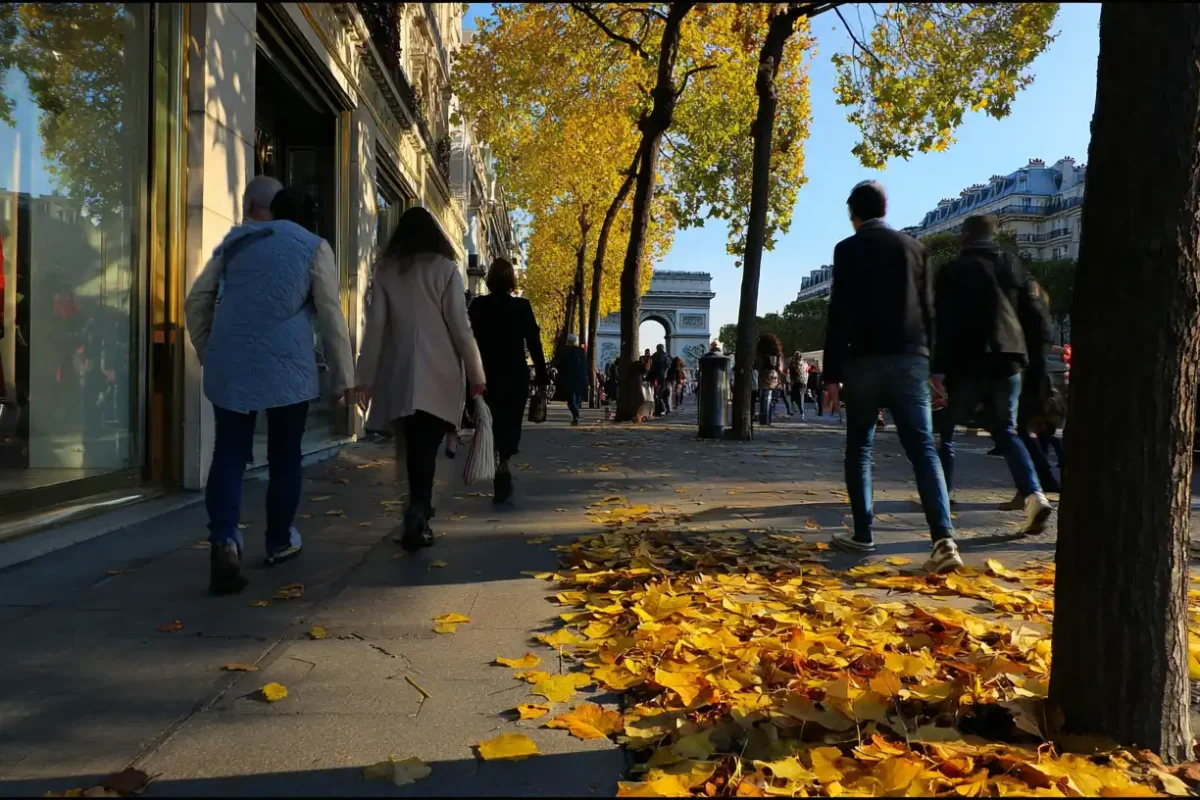
Then you come back down and walk along the Champs-Élysées itself, and the spell shifts a little. What you’re actually walking through is, in large part, a high-end shopping strip in open air — Louis Vuitton, Zara, McDonald’s, car showrooms, tourist cafés charging two or three times what you’d pay one street over. The Champs-Élysées is extraordinary as an idea and as a view. As an afternoon of actual walking and browsing, it’s mostly worthwhile if you want a specific brand or haven’t found a better alternative yet.
Here’s how to use your time here well — what the Arc actually costs to climb in 2026, when to go, and which parts of the avenue are genuinely worth your time versus which parts you can happily skip.
The Arc de Triomphe: What It Actually Is
The Arc de Triomphe was commissioned by Napoleon after the Battle of Austerlitz in 1806. It took 30 years to finish — Napoleon died before it was completed, and his funeral procession famously passed beneath it in 1840.
The arch itself stands 50 meters tall. The reliefs carved into its faces depict the revolutionary and Napoleonic battles that France considers part of its founding military history. The most famous of these is La Marseillaise by François Rude, on the right pillar as you face the arch from the Champs-Élysées side — a winged female figure leading soldiers into battle, dramatic enough that it’s worth stopping to look at closely from street level before you ever go up.
Beneath the arch sits the Tomb of the Unknown Soldier, holding the remains of an unidentified French soldier from the First World War. Above the tomb burns an eternal flame that has been lit continuously since November 11, 1923 — the only eternal flame in France. Every single evening at 6:30pm, without exception, a small group from a coalition of French veterans’ associations gathers to relight it in a short, quiet ceremony. It lasts about ten to fifteen minutes: someone sounds a bugle call, a few words are spoken, the flame is fanned back to life. Most tourists walk right past it without knowing it’s happening. If you’re anywhere near the Arc around 6:30pm, it’s genuinely worth pausing for — standing there with traffic circling endlessly overhead while this small, solemn ritual plays out below makes the whole monument feel less like architecture and more like what it actually is: a war memorial that people still show up for, every single day, rain or shine.
Tickets and How to Get Inside in 2026
Pricing here is seasonal, and it’s worth knowing the split before you show up expecting one number and getting hit with another.
From April 1 through September 30, the individual ticket is €22, except on Wednesdays, when it drops to €16. From October 1 through March 31, the ticket is a flat €16 every day. Either way, the ticket covers the full monument and the rooftop terrace — the Tomb of the Unknown Soldier itself is free to view at ground level regardless of whether you buy a ticket to go up.
Free admission applies to a fairly wide range of visitors: anyone under 18, EU nationals and legal residents of France aged 18–25, disabled visitors plus one accompanying companion, registered jobseekers with proof, and teachers holding a valid French Éducation Pass. On top of that, admission is free for everyone on the first Sunday of January, February, March, November, and December — worth building a trip around if your dates happen to line up. The Arc de Triomphe is also included in the Paris Museum Pass, so if you’re already planning to hit several paid sights, it’s worth checking whether the pass works out cheaper overall.
Now, the part every first-timer gets wrong: do not try to cross the roundabout on foot to reach the Arc. There’s no pedestrian crossing anywhere on the Place Charles de Gaulle traffic circle — it’s one of the busiest, fastest-moving roundabouts in Europe, and pedestrians are flatly not allowed in it. The correct way in is through the Passage du Souvenir, a pedestrian underpass beneath the roundabout, accessible from either the top of the Champs-Élysées or from Avenue de la Grande-Armée on the opposite side. Just follow the signs from street level — the entrance is easy to spot once you know to look for it, right near the Charles-de-Gaulle–Étoile metro exits.
The Rooftop: What to Actually Expect
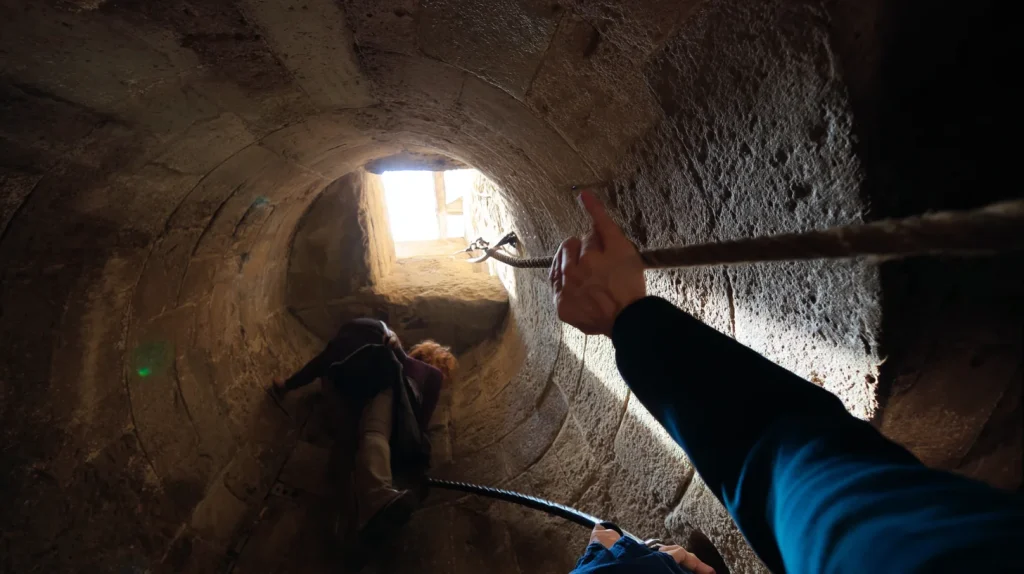
Getting to the top means climbing 284 steps up a tight, winding staircase that narrows noticeably as you near the summit. Budget around ten minutes at a moderate pace, and know that there’s a small landing partway up if you need to catch your breath. A lift does exist for visitors who need it, and you don’t have to book it in advance — but it’s there specifically for accessibility, not as a general alternative to the stairs, so most visitors will be walking up.
Once you’re on top, an open-air terrace wraps all the way around the arch with a genuine 360-degree view, and it splits into three distinct sightlines worth knowing before you go up.
Looking east down the Champs-Élysées, the avenue runs in a dead-straight line toward Place de la Concorde, with the Tuileries garden and the Louvre visible beyond it — on a clear day, you can even pick out the glass pyramid at the Louvre’s entrance. Looking west down Avenue de la Grande-Armée, the same geometry plays out in reverse, aiming toward the Grande Arche de la Défense out in the modern business district — a contemporary echo of the original arch, deliberately built on the same historical sightline. And looking south, on a clear day, the Eiffel Tower rises above the rooftops of the 7th arrondissement.
Honestly, the view from up here is better than anything you’ll get from street level, in ways photos struggle to capture. The whole logic of Haussmann’s star-shaped street plan — twelve avenues radiating out at once — only really clicks when you can see all of them simultaneously from above.
As for hours: from April 1 to September 30, the Arc is open Wednesday through Monday from 10am to 11pm, and on Tuesdays from 11am to 11pm. From October 1 to March 31, it’s Wednesday through Monday from 10am to 10:30pm, and Tuesdays from 11am to 10:30pm. Last admission is always 45 minutes before closing, and the monument does close early or adjust hours around specific dates — heatwaves, national ceremonies, the Tour de France finish, and a handful of annual closures on dates like May 1, May 8, July 14, and the morning of November 11. If your visit falls near any of those, it’s worth a quick check of the official site before you head over.
Best Time to Visit the Arc
Dusk to early evening is the consensus pick for best time to go up, and honestly, the consensus has it right. As the city lights start switching on and the traffic circling below begins trailing light, the view shifts from impressive to genuinely spectacular. Aim to arrive somewhere between 60 and 90 minutes before sunset, get your ticket sorted, climb up, and just let the transition happen around you.
In summer, sunset doesn’t come until after 9pm, and since the Arc stays open until 11pm from April through September, catching that transition is entirely comfortable — no need to rush. In winter, sunset lands around 5pm, and with the Arc open until 10:30pm, you’ve got a long stretch afterward to enjoy the illuminated city from above.
If your dates line up with a first Sunday in January, February, March, November, or December, that’s free entry for everyone — worth planning a morning visit around if it works for your itinerary.
Try to avoid midday visits in summer if you can help it. The rooftop offers essentially no shade, and the heat up there can be brutal. Weekend afternoons also bring the heaviest crowds, and since the staircase is narrow, passing groups coming the other direction tends to slow everyone to a shuffle.
The Champs-Élysées: An Honest Assessment
The avenue itself runs 1.9 kilometers, from the Arc de Triomphe at the western end down to Place de la Concorde at the eastern end. Walking the full length takes about 20 to 25 minutes at a relaxed pace — longer if you actually stop anywhere.
Walking it is worthwhile, and not just as a box to tick. The sheer scale of the avenue — the width of it, the double rows of trees, the sense that this is where the city puts on its biggest public moments — is real and genuinely impressive. The Bastille Day parade, the finish line of the Tour de France, the massive New Year’s Eve crowds: all of this happens here specifically because there’s nowhere else in Paris that can hold this many people with this much visual grandeur at once.
The shopping, though, isn’t really the draw. The flagship Louis Vuitton store, the Disney Store, various car showrooms — these exist here because the address itself carries prestige, not because they offer some uniquely Parisian retail experience you can’t get elsewhere. If you’re actually looking for interesting shopping in Paris, the Marais does it better, and so do the covered passages near the Palais Royal. The flagship stores along the Champs-Élysées are mostly good for buying things you could just as easily pick up at any international airport.
There’s one real exception worth calling out: Ladurée, at 75 Champs-Élysées, is a genuine Parisian institution — the original pastel-colored macaron house dating back to 1862. The macarons are legitimately excellent, and the interior, with its restored 19th-century salon styling, is worth stepping into even if you don’t end up buying anything. The teas and hot chocolate hold up too. The prices, predictably, reflect the address.
Worth noting as well: the Christmas market that takes over the Champs-Élysées each year, typically running from mid-November through early January, is the largest of its kind in Paris — hundreds of stalls the full length of the avenue selling mulled wine, decorations, and food. It’s touristy, and the prices lean high, but the atmosphere — the entire avenue lit up at night, crowds moving through, the illuminated Arc glowing at the far end — is genuinely festive in a way that’s hard to replicate anywhere else in the city.
The Historical Walk: Upper Champs-Élysées to the Obelisk
If you walk the full length of the avenue, the character shifts noticeably near the eastern end, close to Place de la Concorde. The Grand Palais sits here on the right — a Belle Époque exhibition hall built for the 1900 World’s Fair, capped by an enormous glass-and-steel dome. After a lengthy renovation, it’s now fully reopened and running a full calendar of rotating art exhibitions year-round, so it’s worth checking what’s currently on display before your visit. The Petit Palais sits directly across the street and is worth a look as well.
At the far end of the avenue, Place de la Concorde is one of the largest public squares in Europe. At its center stands the Obelisk of Luxor — a roughly 3,300-year-old Egyptian granite column gifted to France by Egypt in 1830. This same square has a much darker history than its current bustling, tourist-filled atmosphere suggests: Louis XVI was guillotined here in 1793, as was Marie Antoinette later that same year, back when the square was called Place de la Révolution. Roughly 1,300 executions took place on this spot during the Terror.
None of that history is remotely obvious from the square as it exists today, which is exactly why walking the full axis from the Arc down to the Obelisk — and actually knowing what you’re looking at along the way — turns this into a genuinely interesting historical route rather than just a pleasant stroll past shop windows.
If you’ve still got energy left, the Tuileries garden picks up right on the other side of Place de la Concorde, and continuing through it toward the Louvre completes the grand historical sightline — the same axis originally planned under Louis XIV and later extended by Napoleon and Haussmann across three centuries of city planning. It’s one of the great urban walks in Europe, and it doesn’t cost a thing.
Practical Information
Metro: Charles de Gaulle–Étoile (lines 1, 2, and 6, plus RER A) puts you right at the Arc de Triomphe. George V (line 1) drops you roughly halfway along the Champs-Élysées. Franklin D. Roosevelt (lines 1 and 9) is your best bet for the lower half of the avenue, closer to Place de la Concorde. Several bus lines, including 22, 30, 31, 52, 73, and 92, along with the Balabus, also stop near the Arc.
Getting to the entrance: Look for the pedestrian underpass signage right near the Charles de Gaulle–Étoile station exits — that’s the Passage du Souvenir, and it’s the only safe way to reach the Arc on foot.
Photography: The rooftop offers excellent, unobstructed sightlines in every direction, but tripods aren’t permitted, along with selfie sticks, flags, and a handful of other bulky items. For the best photo of the Arc itself from outside, position yourself in the middle of the Champs-Élysées looking west, ideally right at blue hour when the avenue’s streetlights are on and the arch is lit from below.
Bags and belongings: Maximum luggage size is 40 x 40 x 20 centimeters. There’s no left-luggage office at the monument itself, though the Paris tourist office maintains a list of left-luggage locations around the city if you need to store something bigger. Strollers aren’t allowed inside, but you can leave one with the access control staff at the entrance and pick it up when you’re done. Dogs are prohibited as well, apart from guide dogs for visually impaired visitors.
Accessibility: The 284 steps have no general elevator alternative for most visitors, but a lift is available specifically for those who need it, without requiring advance booking. Anyone unable to make the climb can still visit the base of the arch at no charge to see the Tomb of the Unknown Soldier and the exterior relief sculptures up close.
Frequently Asked Questions
How much does it cost to go up the Arc de Triomphe in 2026? €22 from April through September, dropping to €16 on Wednesdays during that period. From October through March, it’s a flat €16 year-round. Admission is free for under-18s, EU residents aged 18–25, disabled visitors and one companion, registered jobseekers, and certain teachers — plus free for everyone on the first Sunday of January, February, March, November, and December.
How do I get inside the Arc de Triomphe without crossing traffic? Use the Passage du Souvenir, the pedestrian underpass running beneath the roundabout. You can access it from either the Champs-Élysées side or the Avenue de la Grande-Armée side. Never attempt to cross the traffic circle on foot — it’s both illegal and genuinely dangerous.
Is the Champs-Élysées worth visiting? Walking it once is absolutely worth doing. The Arc de Triomphe rooftop is genuinely excellent and one of the best views in Paris. The shopping itself is mostly upscale international chains you can find elsewhere. The strongest reason to walk the full avenue is the historical context, especially if you continue on to Place de la Concorde at the far end.
What time should I visit the Arc de Triomphe? Dusk is the best window — arrive 60 to 90 minutes before sunset and go up as the city lights start coming on. That transition is when the view is at its most dramatic. Summer evenings, when the Arc stays open until 11pm, make this especially comfortable to plan around.
How many steps is the Arc de Triomphe? 284 steps to reach the rooftop terrace. The climb takes roughly ten minutes at a comfortable pace, and the staircase narrows noticeably near the top. A lift is available for visitors who need it, without requiring advance booking.