When Notre-Dame caught fire in April 2019, people stood on the bridges over the Seine and watched the spire collapse in silence. It felt like losing something permanent. Five years later, in December 2024, the cathedral opened its doors again — restored, brighter than before, and in many ways more extraordinary to visit than it was at any point in living memory.
If you visited Notre-Dame before 2019, what you saw then and what you’ll see now are not quite the same building. The restoration cleaned centuries of soot from the stone. The interior light is different. The new bell tower visitor route, which opened in September 2025, takes you up a staircase that didn’t exist before. It’s worth understanding what changed before you arrive.
What to Know Before You Visit in 2026
The single most important thing: entry to Notre-Dame is free. No ticket price. No booking fee.
A reservation is strongly recommended from April through October, when visitor numbers overwhelm walk-in capacity, though it’s not strictly mandatory — walk-ins are accepted, but peak-season queues without a reservation can run anywhere from 30 minutes up to a genuinely painful 3 hours in the worst stretches. Timed-entry slots can be reserved at the official reservation site, notredamedeparis.fr, but the booking window is short — slots typically open only 2-3 days before your visit date, not weeks ahead, so this isn’t something you can lock in from home months in advance. Book as soon as the window opens for your date.
From November through March, the cathedral is less crowded and walk-in entry is easier to manage without a pre-booking.
One important distinction worth getting right: the bell towers are not booked through the same site as the free cathedral reservation. They’re managed by a completely separate organization, the Centre des Monuments Nationaux (CMN), with their own ticketing platform. Don’t expect one booking to cover both. The archaeological crypt and the Treasury (a separate small paid area inside the cathedral itself, holding relics and liturgical objects) are also both distinct, separately-ticketed experiences.
Opening Hours
Monday through Friday: 7:50am to 7pm. Thursdays the cathedral stays open until 10pm.
Weekends: 8:15am to 7:30pm.
Last entry is roughly 30 minutes before closing.
The cathedral is open every day and holds regular Mass. If you arrive during a Mass, you can observe respectfully, but the full tourist visit (walking the nave, approaching the altar area) is paused while services are underway. Guided tours specifically are not permitted on Sundays, Saturday afternoons, or religious feast days — worth knowing if a guided visit is part of your plan.
Mass times to be aware of: generally weekdays around 8am, 12pm, and 6pm, with a fuller Sunday schedule including morning and evening services. The Sunday morning masses bring the largest congregations and turn the cathedral into a functioning place of worship rather than a visitor attraction — worth witnessing if you’re interested, but plan your visit time accordingly, and check the cathedral’s own site for the exact current schedule, since Mass times can shift around religious feast days.
What’s Changed After the Restoration
The fire destroyed the spire (the 19th-century addition) and much of the roof. But the structural walls, the main towers, and much of the interior survived. What the restoration added was an opportunity to clean and restore what the centuries had darkened.
The interior is genuinely brighter than it was before 2019. The stone is lighter. The great rose windows — North, South, and West — catch light differently in a clean building than they did behind decades of candle soot and urban grime. Visitors who saw Notre-Dame pre-fire often say the current interior looks almost entirely different.
The new spire, rebuilt to Viollet-le-Duc’s original 19th-century design, went back up in 2023. From the outside on the south side, you can see the new copper finish — it will turn green over decades, as the original did.
New contemporary stained-glass windows, designed by the artist Claire Tabouret, are planned for installation in six chapels along the south aisle of the nave, with a targeted completion around December 2026 — this will be the most significant change to the cathedral’s interior since the 19th century when it happens. Depending on exactly when you visit relative to that timeline, some scaffolding or partial closures around these chapels may affect your visit, so it’s worth a quick check closer to your travel date if this area matters to you.
The Bell Towers: Is the €16 Worth It?
The bell towers of Notre-Dame reopened to visitors on September 20, 2025 — timed deliberately to coincide with European Heritage Days — for the first time since the 2019 fire. And this is not the same visit it was before.
The new access route features a wooden double-helix staircase — reportedly the largest wooden structure of its kind in the world — that winds visitors up through the north tower (commonly cited around 422-424 steps, no lift) to a viewing gallery at 69 meters. From here you get 360-degree views over Paris: the Seine curving below, the spire above you, Montmartre on the horizon.
What’s different from the pre-2019 bell tower visit: the route has been completely redesigned. The famous gargoyles and chimera — the stone creatures who watch over Paris from the gallery level — are now encountered face-to-face at a closer viewing distance than before. The experience feels like it was rethought, not just reopened.
Cost: €16 per adult. Free for visitors under 18 (any nationality), EU residents aged 18-25, and Paris Museum Pass holders — though everyone, including free-entry categories, must still book a timed slot. Tickets are booked exclusively online through the Centre des Monuments Nationaux’s own site (monuments-nationaux.fr or its dedicated tours-notre-dame-paris.fr booking portal) — there are no on-site ticket sales at all, for anyone, at any price. Tower hours generally run longer than the cathedral’s own hours, roughly 9am to 11pm in the April-October season. The tower visits have limited capacity per slot and sell out faster than the cathedral itself.
Worth it? If you’re visiting Notre-Dame for the first time, yes. The views from 69 meters are some of the most interesting in Paris because they’re at cathedral height — above the city’s haussmannian rooflines but below the Eiffel Tower. And the gargoyle gallery is genuinely unlike anything else in Paris.
The Archaeological Crypt
Beneath the parvis (the square in front of the cathedral), a separate entrance leads down into the Archaeological Crypt — a museum of Roman-era and early medieval ruins excavated when the square was renovated in the 1960s.
The crypt shows the layered history of Île de la Cité from Roman Lutetia through the medieval city. There are ancient road surfaces, hypocaust heating systems from Roman baths, foundations of earlier churches that stood on this site before Notre-Dame was built in the 12th century.
It’s smaller and quieter than the cathedral itself, and takes about 45 minutes. A separate ticket is required, priced modestly (around €9, though check current pricing, as this is a smaller municipal site with pricing that isn’t as consistently documented as the major monuments). Worth adding if you have a deeper interest in Paris’s history below the surface — less compelling for visitors doing a tight schedule.
Don’t Walk Past Sainte-Chapelle
Three hundred meters from Notre-Dame, through the gates of the Palais de Justice on the same island, is Sainte-Chapelle — and a significant number of visitors to Île de la Cité walk right past it.
This is a mistake.
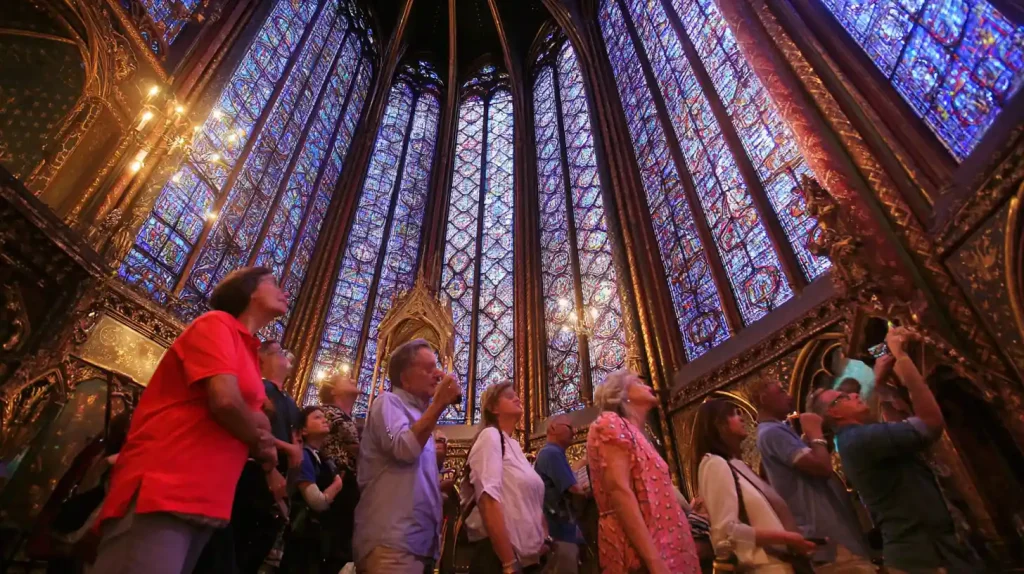
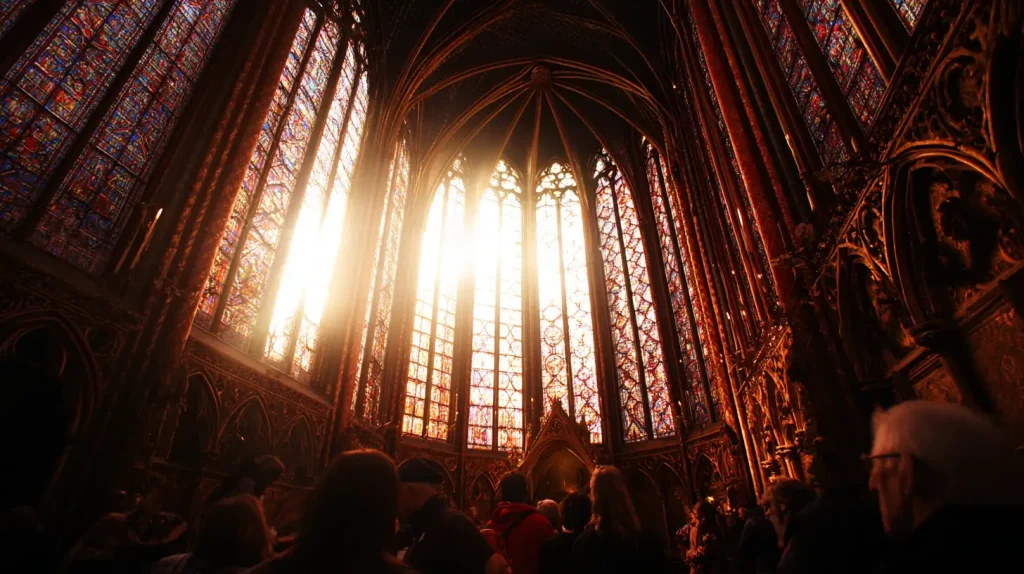
Sainte-Chapelle was built in the 13th century to house relics including the Crown of Thorns. The upper chapel is almost entirely made of stained glass — 15 massive windows rising 15 meters, covering 600 square meters of biblical narrative in glass. On a sunny day, the effect is unlike anything else in Paris. The light inside the upper chapel on a clear afternoon is extraordinary.
Pricing changed as of January 12, 2026, and now follows the same EEA/non-EEA tiered structure that’s shown up across several major Paris and France sites this year: €22 for non-EEA visitors, €16 for EEA nationals and residents (of more than 4 months). A combined ticket with the Conciergerie (the medieval royal palace turned Revolutionary prison, also on the island) costs €30 non-EEA / €23 EEA — a real saving over buying both separately, and worth it if you’re doing both, which you should. Free entry applies for under-18s, EU/EEA residents 18-25, and on the first Sunday of the month from November through March.
The queue at Sainte-Chapelle can be significant at peak times — it shares the Palais de Justice security check. Go early in the morning or late afternoon.
If you had to choose between Notre-Dame interior and Sainte-Chapelle for a stained-glass experience, Sainte-Chapelle is arguably more spectacular as a pure visual moment. Notre-Dame offers more as an architectural and historical encounter. Ideally, do both.
The Rest of Île de la Cité (What’s Within Walking Distance)
Île de la Cité is one of two islands in the Seine at the heart of Paris. It’s small enough to cross on foot in ten minutes, and most visitors rush through it focused only on Notre-Dame. But the island has a few more things worth slowing down for.
The Conciergerie is the other large Gothic building on the island, about 300 meters from Notre-Dame on the north side facing the river. It was the royal palace before the Palais du Louvre was expanded, and later became a Revolutionary-era prison where Marie Antoinette was held before her execution. The medieval Gothic hall inside — the Salle des Gens d’Armes — is one of the largest surviving secular medieval interiors in Europe. It’s quiet, atmospheric, and almost never crowded. Standalone entry runs €11.50 for the 2026 season; the combined ticket with Sainte-Chapelle described above is the better value if you’re doing both.
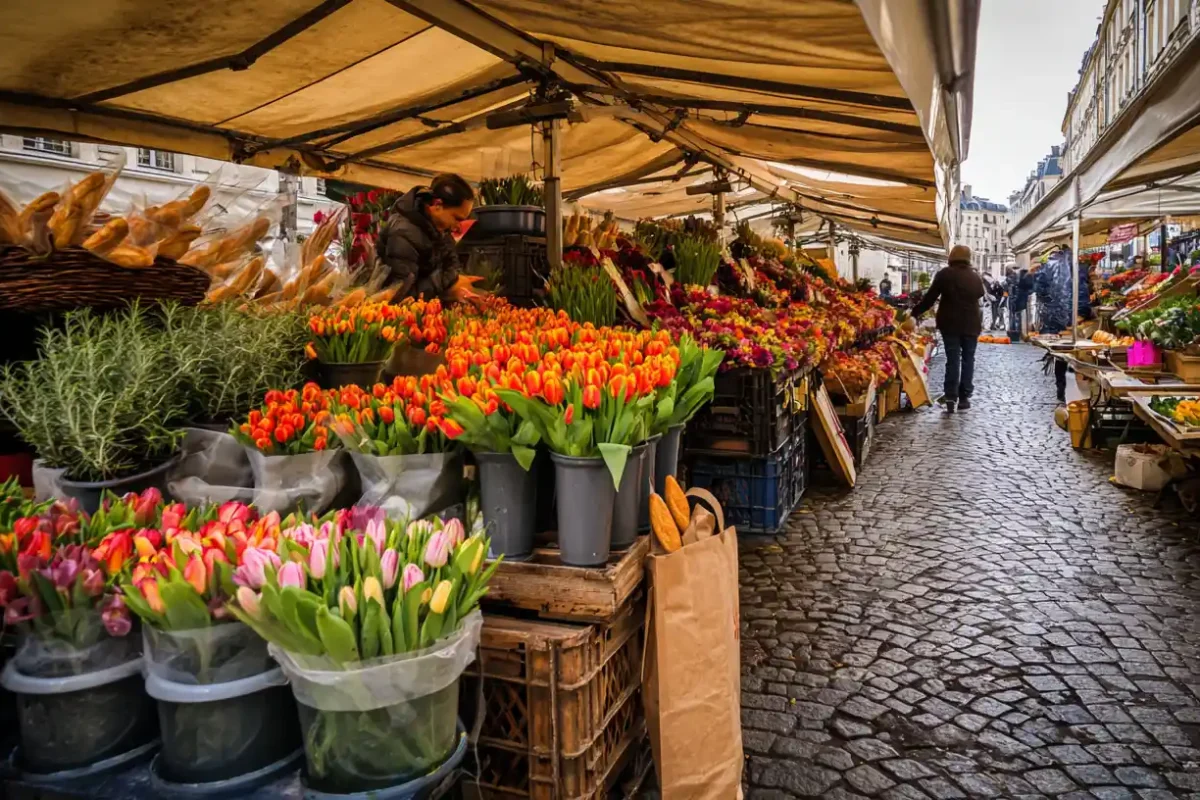
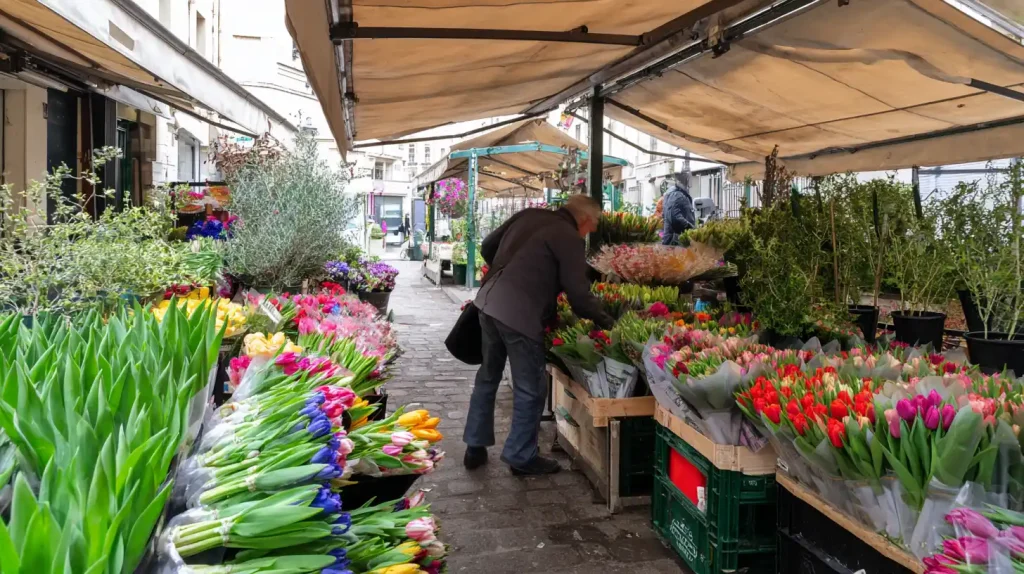
Marché aux Fleurs Reine Elizabeth II is a flower market that runs on the island Monday through Saturday, just behind the Palais de Justice. Fresh cut flowers, potted plants, seed vendors, the occasional bird stall. It’s a functional Paris market, not a tourist set piece. Good to walk through on the way between Notre-Dame and Sainte-Chapelle.
Pont Neuf — despite the name (which means “New Bridge”), this is actually the oldest bridge in Paris, completed in 1607. It crosses both branches of the Seine from the western tip of the island. The triangular viewpoint at the tip of the island — Square du Vert-Galant, one step down from the bridge level — is one of the better spots in Paris to sit at water level and watch the Seine. It’s often empty on weekday mornings.
Île Saint-Louis connects to Île de la Cité by a small footbridge (Pont Saint-Louis). It’s a quieter, residential island where wealthy Parisians have lived for four centuries. The main street, Rue Saint-Louis en l’Île, is lined with small restaurants, cheese shops, and Berthillon — the famous Parisian ice cream maker. If you cross over on a warm afternoon, a Berthillon scoop is as good as its reputation suggests.
Combining Notre-Dame, the bell towers, Sainte-Chapelle, and a walk around the rest of the island makes for a full half-day. Doing all of it properly — without rushing — takes around 3–4 hours.
Best Time to Visit Notre-Dame
By time of day: Early morning, right at opening (7:50am on weekdays), is the quietest period. The cathedral fills steadily through the morning. Midday is the most crowded. Late afternoon (4–6pm) sees some thinning as day-trippers leave. Thursday evening until 10pm is an unusual and relatively quiet option.
By day: Weekday mornings outside of Mass times. Sundays are both more crowded and more authentically alive as a working cathedral — a different kind of experience, valid in its own right.
By season: Spring and summer are the busiest. October through March brings significantly lower visitor numbers, and the light through the rose windows on a winter afternoon has its own quality. On overcast days, the diffused light through stained glass actually looks more even and luminous than on bright sunny days — don’t write off a grey Paris morning as bad timing.
Reserve your slot if visiting April–October, and remember the booking window only opens 2-3 days ahead — don’t expect to lock this in from home weeks in advance the way you might for the Louvre or Versailles.
Dress Code and Practical Notes
Shoulders and knees must be covered. On summer days, this catches visitors in tank tops and shorts. A lightweight scarf or a small packable layer solves it. The cathedral will turn away non-compliant visitors — this rule is consistently enforced, not a suggestion.
Men should remove hats on entry. Photography is permitted. Flash is not. Maintain quiet in the nave — it’s an active place of worship.
Getting there: Metro line 4, Cité station, puts you closest to the cathedral itself. Saint-Michel (line 4) or the RER B/C Saint-Michel–Notre-Dame station are also close, on the Left Bank side of the island. From any of these it’s a 3–5 minute walk to the cathedral.
FAQ
Do you need a ticket to visit Notre-Dame in 2026? No ticket is required — entry to the cathedral interior is free. A free timed-entry reservation is strongly recommended from April to October, though walk-ins are accepted (with potentially long queues in peak season). Reservation slots open only 2-3 days before your visit date on notredamedeparis.fr.
Are the Notre-Dame bell towers open in 2026? Yes. The bell towers reopened on September 20, 2025 with a newly designed visitor route, including the world’s largest wooden double-helix staircase and a close encounter with the gargoyle gallery. Tickets are €16 per adult (free for under-18s, EU residents 18-25, and Museum Pass holders, who must still book a slot) and must be booked online in advance through the Centre des Monuments Nationaux — a different booking system from the free cathedral reservation.
What happened to Notre-Dame in the fire? The 2019 fire destroyed the cathedral’s spire and much of the lead roof, but the structural walls and main towers survived. The interior was damaged but not destroyed. Restoration took five years and the cathedral reopened in December 2024, now noticeably brighter and cleaner than before the fire.
Is Sainte-Chapelle worth visiting if I’m already at Notre-Dame? Yes. It’s 300 meters away on the same island and is one of the most spectacular stained-glass spaces in the world. If you’re already on Île de la Cité, skipping it doesn’t make logistical sense. As of January 2026, admission is €22 (non-EEA) or €16 (EEA residents), with a combined Conciergerie ticket at €30/€23.
How long should I spend at Notre-Dame? The cathedral interior takes about 30–45 minutes. Add the bell towers and budget roughly 90 minutes total. With Sainte-Chapelle, the full Île de la Cité visit runs 2.5–3 hours.
Notre-Dame cathedral hours, the free reservation system, and the September 2025 bell tower reopening (including the separate CMN booking system and €16 price) verified August 2026 against the cathedral’s official site and CMN-linked sources. Sainte-Chapelle and Conciergerie pricing reflects the new EEA/non-EEA tiered structure introduced January 12, 2026 — a genuine change from flat pricing that older sources may still quote. The Claire Tabouret stained-glass installation timeline (targeted December 2026) is current planning information and may shift.