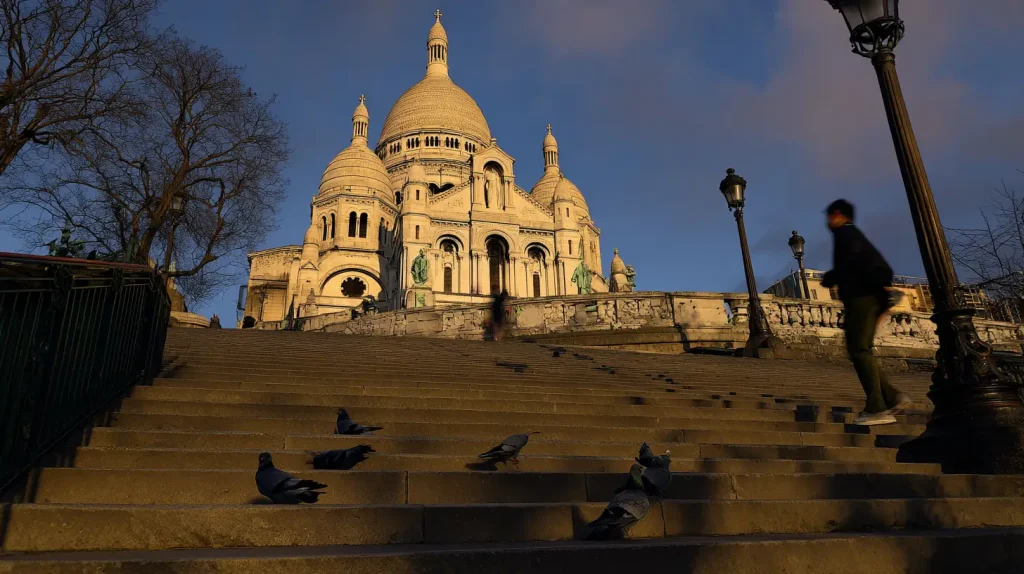
At 7am on a weekday, Montmartre is one of the most beautiful neighborhoods in Paris. The boulangerie on Rue Lepic opens early and smells exactly right. The steep streets are empty. The light hits the white stone of Sacré-Cœur at a low angle and makes it glow. You can stand on the steps with practically no one around and watch Paris wake up below you.
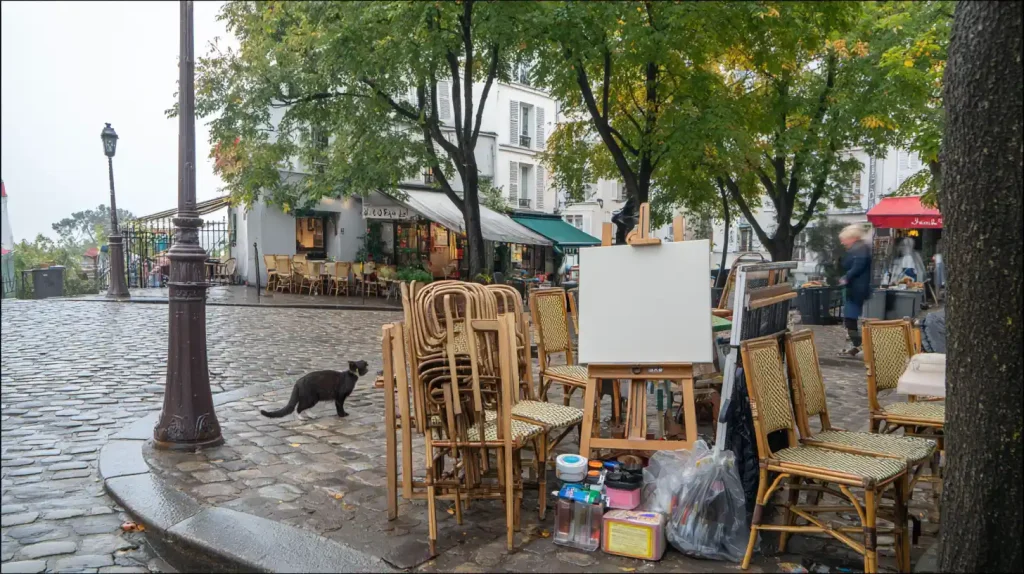
By 10:30am, the same streets are thick with tour groups, the steps are crammed, and the bracelet sellers are already working their way through the arriving crowds. Place du Tertre, the so-called artists’ square, is a wall-to-wall souvenir operation.
Both of these Montmartres exist. The difference is when you go. This guide helps you find the good version.
Sacré-Cœur: What It Is and What It Costs
The Basilique du Sacré-Cœur is a Roman-Catholic basilica at the top of the Butte Montmartre — the highest natural point in Paris at 130 meters. It was built between 1875 and 1914 and consecrated after the First World War. The white travertine stone is notable for a particular quality: it whitens over time rather than darkening, which is why it still looks almost new despite being over a century old.
Entry to the basilica is free. It opens at 6:30am and closes at 10:30pm daily. No ticket, no reservation, no booking required. You walk in — though note there’s a dress code (shoulders and knees covered) and photography isn’t permitted inside the basilica itself, only outside and up in the dome.
The dome is paid: €8 for visitors 16 and over, €5 for those 15 and under. Unlike most major Paris sights these days, the dome climb still works the old-fashioned way — cash or card at an on-site ticket booth only, no advance online booking. The climb involves roughly 280-300 narrow, winding steps (sources differ slightly on the exact count, which tells you something about how disorienting the spiral staircase is) — no elevator, and not recommended for anyone with mobility issues, heart or back problems, or claustrophobia. At the top, the view is 360 degrees over Paris. Worth it for the physical experience of being at the very top of the city’s highest neighborhood; slightly less spectacular than the Eiffel Tower summit in pure visual terms, but more intimate and less crowded.
Dome hours run daily, opening at 10:30am, with last admission around 9pm to allow time for the visit before the basilica’s own 10:30pm close — hours can shift seasonally and are also subject to closure for maintenance or weather, so it’s worth checking the official site (sacre-coeur-montmartre.com) the day before if the dome is a priority for your visit.
Getting There: The Funicular vs The Steps
You have two options for reaching the basilica from the bottom of the hill.
The steps (commonly cited between roughly 197 and 220, depending on which flight you count from) are free. The climb takes about five to ten minutes. On the way up, you’ll pass through the main gathering area where the bracelet sellers operate — a group of men who tie friendship bracelets on tourists’ wrists and then demand payment. Don’t stop, don’t engage, don’t let anyone near your wrists. Keep moving with purpose.
The funicular (funiculaire) costs exactly the same as one standard Paris metro/RER ticket — €2.55 as of the 2026 fare update — and is included at no extra cost if you’re using a Navigo pass or a Paris Visite pass that day. It’s operated by RATP, the same company running the metro, so a standard transit ticket or pass works directly; there’s no separate funicular-specific fare. It runs daily from 6am to around 12:45am, roughly every few minutes, from the bottom station near Square Willette up to a station just below the basilica. The ride takes about 90 seconds. It’s useful for those who find steep stairs difficult and for anyone traveling with strollers or heavy bags — both stations have elevators and level boarding.
Metro stop: Anvers (line 2) is the main base station. Abbesses (line 12) deposits you in the heart of Montmartre village — more useful if you’re exploring the neighborhood rather than heading straight to Sacré-Cœur.
What to Actually Look at Inside Sacré-Cœur
Most visitors walk in, look up at the ceiling mosaic, and walk out. Which is a reasonable plan, but there’s more worth noticing.
The main apse mosaic — the enormous image of Christ above the altar — is one of the largest mosaic artworks in the world, covering about 480 square meters. It was completed in 1922. The gold and blue tones catch the light differently depending on time of day and season.
The crypt runs beneath the main basilica and contains the tombs of several bishops and religious figures associated with the construction. It’s dim, quiet, and almost always uncrowded even when the main basilica is full. Entry is included with the dome ticket.
The view from the basilica esplanade (the terrace in front, before you go inside) is itself worth noting. From here you look out over the north of Paris — the 9th, 10th, 18th arrondissements — in a sweeping panorama. This view is free and doesn’t require entering the basilica at all.
Place du Tertre: Honest Assessment
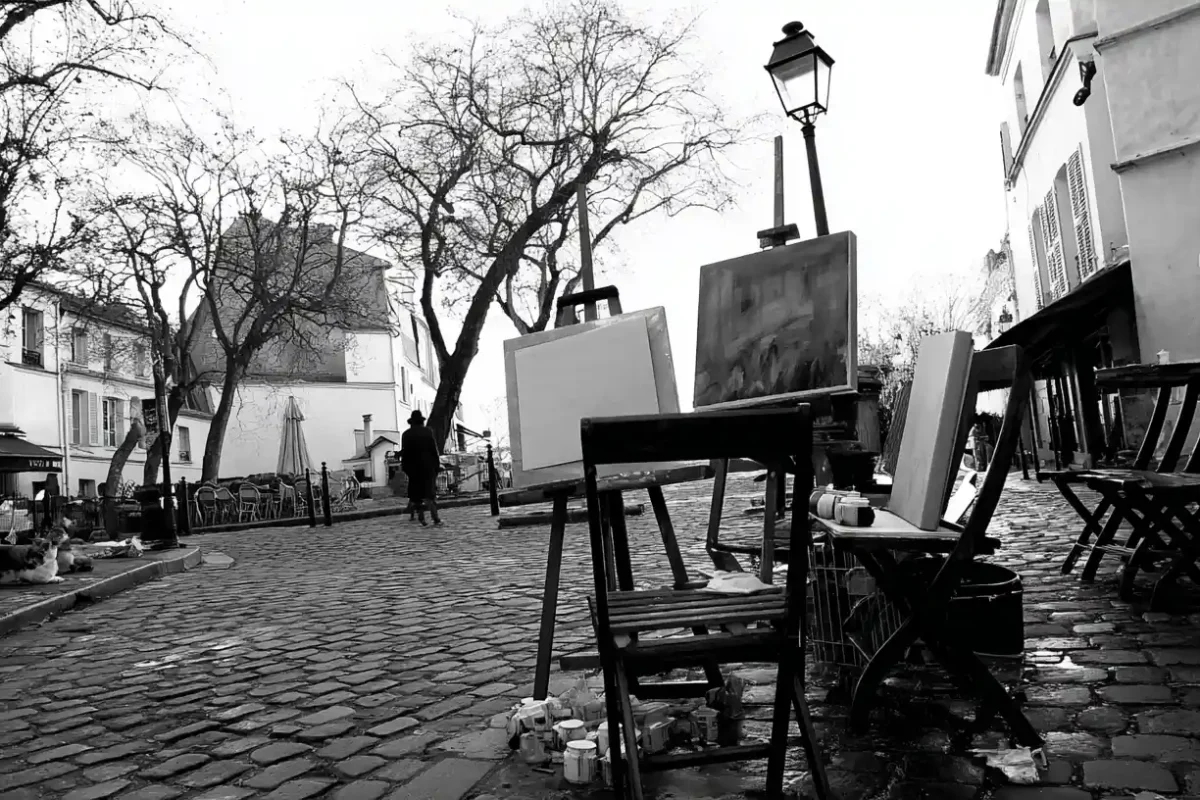
Place du Tertre, a square behind the basilica, is marketed as the historic artists’ square of Montmartre — the place where Picasso, Renoir, and Toulouse-Lautrec once painted.
The history is real. The current experience requires some candor.
Today, Place du Tertre is filled with portrait painters and watercolorists who offer to paint your likeness while you wait. The square is run by a formal organization with a regulated, limited number of licensed artist spots. Many of them are genuinely skilled — portraiture on demand in public is a real craft. But prices for portraits start around €30–50 and the selling environment is persistent — agree the full price before you sit down, not after.
The surrounding cafés around the square charge tourist prices — expect to pay €5–7 for a coffee. The “authentic Parisian experience” positioning is real only in the sense that this has been a commercial artist’s market since the early 20th century. It’s not a quiet painters’ retreat.
Worth walking through for ten minutes? Yes. Worth sitting down for lunch? Probably not when better options are five minutes away.
The Real Montmartre: Streets Worth Slowing Down In
Five minutes from the Sacré-Cœur crowds, Montmartre becomes a neighborhood again.
Rue de l’Abreuvoir curves away from the tourist area and is one of the most photographed quiet streets in Paris — low stone walls, creeping ivy, a narrow lane that still feels like the rural village Montmartre was before Paris absorbed it. La Maison Rose café sits at one end of it, painted pink, often with a short queue of photographers outside.
Rue Lepic is where actual Montmartre residents buy groceries and get their bread. The Moulin de la Galette windmill (one of two surviving windmills from when the hilltop had over thirty) is at the top of Rue Lepic. The street descends steeply past a good fromagerie and the café where Van Gogh’s brother Theo used to drink — a small plaque marks it.
Vineyard of Montmartre — there’s an actual working vineyard on the hillside below Sacré-Cœur, planted in 1933. It produces a modest annual yield and is not open for tastings, but you can see it from the street. The annual grape harvest festival in October is one of Montmartre’s more genuine local events.
Cimetière de Montmartre is a 15-minute walk from the basilica and contains the graves of Émile Zola, Edgar Degas, Stendhal, and François Truffaut. It’s calm, green, and almost never crowded. If you find yourself in Montmartre in the afternoon with time to spare, it’s worth the detour.
Where to Eat and Drink in Montmartre
Montmartre has a stark split between tourist pricing near Place du Tertre and Sacré-Cœur, and genuinely good value if you walk even five minutes away.
Good bets near the summit: Le Consulat on Rue Norvins is often photographed — the terrace and the yellow façade are genuinely old and pretty. Prices reflect the location: expect to pay more than you would elsewhere. Worth a coffee if you want to sit where artists used to. Not worth a full meal at those prices.
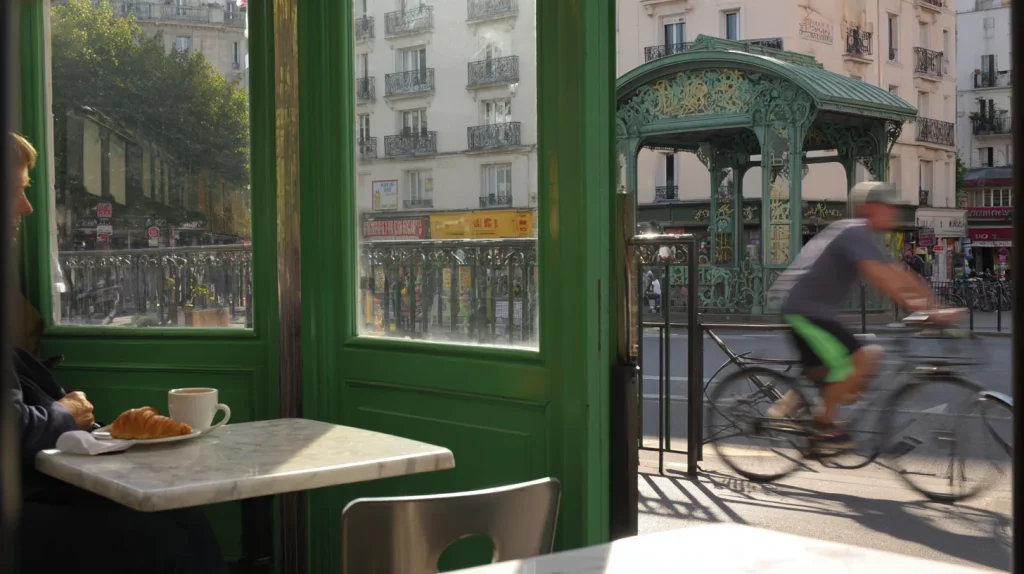
A better option: walk down Rue Lepic to Rue des Abbesses and the Place des Abbesses at the foot of the hill. This square has a good selection of cafés with reasonable prices and is still within the Montmartre neighborhood. The Abbesses metro entrance (with its original Art Nouveau glass canopy by Hector Guimard) is here and worth photographing.
For a proper breakfast: the boulangeries on Rue Lepic have long been among the better ones in Montmartre. Go before 9am and you’ll get croissants and baguettes fresh from the morning batch.
One honest recommendation: neighborhood bistros around Rue Caulaincourt, well away from the summit, tend to serve a plat du jour at lunch for meaningfully less than anything near the basilica — this is the kind of place that doesn’t appear in tourist guides because it’s a regular lunch spot for locals. Prices and specific opening hours at any single small bistro shift often enough that it’s worth checking current listings or simply walking the street rather than relying on one name.
The Montmartre History That Makes It Worth Visiting
Part of what makes Montmartre compelling beyond the view is its specific history — it’s not just any neighborhood that happened to become famous.
In the late 19th and early 20th centuries, Montmartre was cheaper than the rest of Paris (it was only formally annexed to the city in 1860) and attracted artists who couldn’t afford elsewhere. Renoir painted here. Toulouse-Lautrec documented the Moulin Rouge from this hill. Picasso and Braque developed Cubism in a studio building called the Bateau-Lavoir on Place Émile Goudeau — a ramshackle structure that burned in 1970 and was rebuilt. Van Gogh lived on Rue Lepic with his brother Theo for two years and painted at least two oil paintings of the view from the hill.
The artists are largely gone now — the rents rose as the fame did. But the physical streets and structures they moved through are still here. That’s the appeal that survives the tourist trade: walking the same steep lanes, looking at the same panorama, even if what you’re buying is a souvenir portrait instead of a square meter of canvas.
One small piece of that history worth finding: the Musée de Montmartre, housed in the oldest surviving building on the hill, has a permanent collection on the neighborhood’s artistic past and runs changing temporary exhibitions. It’s quiet, well-curated, and currently priced around €16 for the full ticket during an active exhibition period (with reduced rates for various categories, and free entry for young children) — open daily, generally 10am-7pm with last entry 45 minutes before closing. The rear Renoir Gardens overlook the Montmartre vineyard. It’s the best half-hour you’ll spend away from the main tourist circuit.
Moulin Rouge (On the Edge of the Neighborhood)
The Moulin Rouge sits at the bottom of the Montmartre hill on Boulevard de Clichy, in the Pigalle district. It’s not in the heart of the neighborhood but most guides bundle it in.
The building with the famous red windmill is photogenic from the street at any hour. Entry for a show costs significantly more — dinner and show packages commonly run well over €150-200 per person, with show-only tickets somewhat less; exact tiers vary by seating and whether champagne or dinner is included, so check current packages directly before budgeting a specific figure. The show itself is a well-produced cabaret with professional dancers and a full theatrical production. Worth it? Depends heavily on your interest in that style of entertainment and your budget. Photographing the exterior is free.
Boulevard de Clichy around Moulin Rouge and along Pigalle has a sex-industry strip presence (adult shops, clubs) that some visitors find surprising. It’s not dangerous, but it’s worth knowing before you bring children through this particular stretch.
Best Time to Visit Montmartre
Early morning on a weekday. Get there before 9am. This is consistently the advice every long-time Paris visitor gives, and it consistently turns out to be correct. The neighborhood is still residential at that hour, the tourists haven’t arrived, and Sacré-Cœur is yours to approach slowly.
If early morning doesn’t work, late afternoon (after 4pm) sees crowds thin as tour groups depart. The golden hour light on the basilica from the steps is worth staying for.
Avoid: weekends between 11am and 3pm. This is when Montmartre reaches maximum tourist density. Place du Tertre is almost impossible to move through, the funicular queue is long, and the steps to the basilica are a slow shuffle.
suggested internal link — Is France Safe to Visit
FAQ
Is Sacré-Cœur free to visit? Yes — entry to the basilica is free, open 6:30am to 10:30pm daily. The dome climb (roughly 280-300 steps) costs €8 for adults, €5 for under-16s. No reservation is needed for the basilica or the dome — the dome is cash/card on-site only.
What is the best time to visit Montmartre? Early weekday mornings before 9am are the least crowded and most atmospheric. Weekends between 11am and 3pm are the most packed. October through March sees significantly fewer tourists overall.
Is Place du Tertre worth visiting? Worth a brief walk-through, yes. It’s a genuine historic artists’ square with skilled portrait painters. It’s also heavily commercialized and expensive by Parisian standards. Go early if you want to see it at anything approaching its best — the artists set up around 9–10am before the tourist tide arrives.
What is the funicular and should I take it? The funicular is a cable car that runs from the bottom of the Sacré-Cœur hill to near the top. It costs exactly one standard Paris transit ticket (€2.55) and is included free with a Navigo or Paris Visite pass. Useful for those who can’t manage the steps, and for anyone who wants a different perspective on the hill. The steps are free and offer more to look at on the way up.
How long should I spend in Montmartre? Two to three hours covers Sacré-Cœur, a walk through Place du Tertre, and a wander through the residential streets. Adding the dome climb adds about 45 minutes.
Sacré-Cœur dome pricing (€8/€5), hours, and the cash-only on-site ticketing process verified August 2026 against the basilica’s own official site, sacre-coeur-montmartre.com. Funicular fare (€2.55, matching the standard 2026 Paris transit ticket price) and operating hours verified against RATP-sourced guides. Musée de Montmartre pricing reflects its current exhibition-period rate and may differ between exhibitions. Moulin Rouge show pricing is given as a broad range rather than a fixed figure, since packages vary significantly by seating tier and inclusions.