The first thing most people notice is the hands. They are disproportionately large — the right hand especially, a fist of marble the size of a small child’s torso. Art historians explain this as intentional exaggeration for visual effect when viewed from below, a classical trick. Standing in front of the David for the first time, though, the hands just look enormous and slightly unsettling, which is probably closer to the effect Michelangelo was after.
The Galleria dell’Accademia is one of the most booked museums in Europe and one of the most surprisingly good ones. Most visitors expect to see the David, nod respectfully, and leave. What they find instead is a museum that takes a coherent argument about one artist across a career — Michelangelo — and makes it through a handful of works, all in the same building, in a visit that takes 90 minutes rather than a full day.
Getting Tickets to the Accademia
The queue to buy a ticket at the door can run well over an hour at peak times, plus additional time for security. The line stretches down Via Ricasoli and does not move fast. There is no particular benefit to being in that line.
Book online in advance. The official booking is through galleriaaccademiafirenze.it (also mirrored via the b-ticket.com booking system). Standard admission is €16 at the door or €20 booked online (the online price includes the reservation fee); under-18s enter free. A combined 48-hour Accademia + Bargello ticket has also been introduced recently, priced at €26. Third-party booking sites often charge more and are not necessary.
Guided tours (typically starting somewhere in the €30-40 range including admission, depending on operator and group size) include reserved entry and are worth considering if you want context delivered to you in real time rather than from a printed guide or audio device. For a first visit with limited time, a 90-minute guided tour that walks you through the Prisoners, the David, and the most significant paintings in the other galleries is a reasonable investment — particularly if Michelangelo’s work and the Renaissance period are subjects you want to understand rather than simply see.
For independent visitors: an official audio guide is available for rent and covers the major works, though the written room labels in the Accademia are more informative than in many Italian museums and can be read on their own.
Best timing: peak hours run roughly late morning through mid-afternoon, and weekends can be busier than weekdays. If you have a morning slot, take it. The gallery opens at 8:15am and the first two hours are notably calmer. The David does not get less interesting later in the day, but it does get harder to stand in front of it for long enough to look properly.
The Accademia is closed Mondays. This catches visitors off guard because most major Florence museums are closed a different day, though the Uffizi shares the same Monday closure.
Michelangelo’s David: What to Actually Look At
The David was carved between 1501 and 1504 from a single block of Carrara marble that had been sitting in the Opera del Duomo’s workshop for around 25 years, partially worked and then abandoned by previous sculptors. It was originally intended for Florence Cathedral, but was placed in the Piazza della Signoria instead — where it stood for centuries until it was moved indoors in the 1870s to protect it from weather damage. The original has been in the Accademia since 1882 (unveiled to the public there in 1873, with the move and installation process spanning a few years), and a copy stands in the original outdoor location in the piazza today.
The statue is 5.17 metres tall including its integral base, and weighs roughly 5.5 tonnes — a figure confirmed by the Accademia’s own conservation records. The scale is one of the things that surprises almost every visitor — photographs do not convey it, and standing at the base of the apse that was specifically built to house it, looking up, it is simply larger than you expect.
What to look for, in rough order of time spent looking:
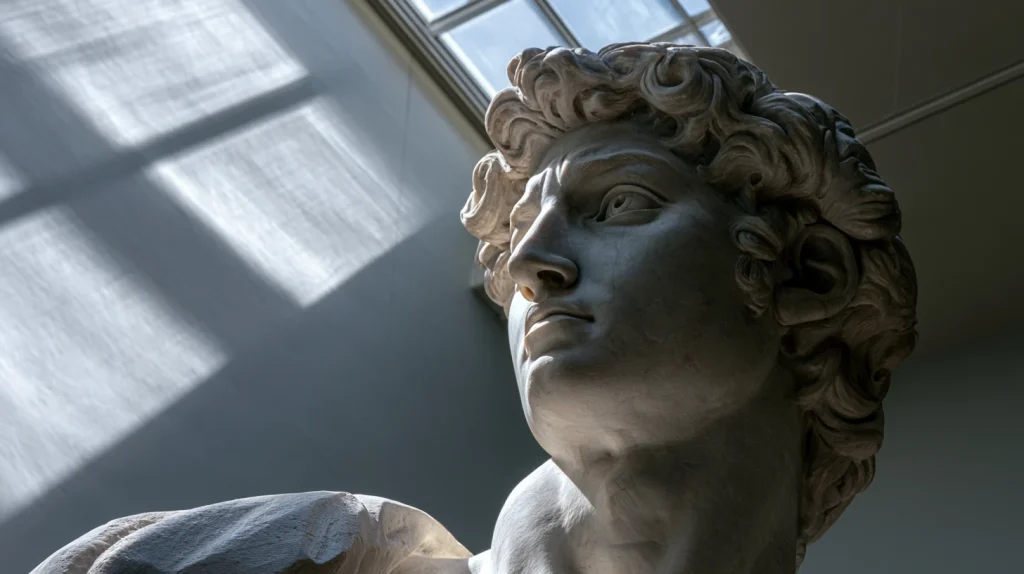
The face first. The David is depicted before the fight with Goliath, not after — he is tense, concentrated, and looking to the side at something not in the room. The expression is one of the most studied in all of Western art: determination that has not yet been tested, the exact psychological moment between decision and action.
Then the hands. The right hand holding the stone, fingers curled. As noted, large. The left hand holding the sling over his shoulder, more relaxed. Art historians argue that Michelangelo scaled the hands and head up somewhat to emphasise them for viewers looking up from below and for the statue’s originally intended elevated position on the cathedral roofline.
Then the surface finish. The marble is worked to different degrees of polish across the body — the face and torso are highly finished, the back of the hair less so, the base rougher still. You are looking at gradations of effort that are invisible in photographs.
Spend at least 20 minutes in the David room. Walk around the full circumference of the statue — the museum is arranged to allow this. The back is as carefully worked as the front, with the sling over the shoulder visible from behind, and it is rarely photographed because most visitors stay on the front side and leave.
The apse housing the David was purpose-built in the 1880s with a domed skylight that floods the statue with natural light from above. This was intentional — the conservators and curators wanted the same quality of light Michelangelo would have worked under. Go in the morning when the skylight light is direct. In the afternoon the diffused light is softer but less revealing of the surface texture.
Most visitors spend well under ten minutes in the David room and leave. This is not enough time. If the room is busy when you arrive, wait a few minutes — groups tend to cycle through quickly and there are moments when the space clears.
The Rest of the Accademia
The David gets the attention, but the Accademia has a second unmissable room: the Prisoners, or Slaves, gallery. This is a long corridor you walk through before reaching the David, and it contains four large unfinished sculptures — also by Michelangelo — that were intended for the tomb of Pope Julius II and never completed.
The Prisoners matter because they are unfinished. You can see the tool marks, the rough stone base, the figures emerging from the stone and stopping mid-emergence. It is the rare case in Renaissance sculpture where you see the process rather than the product. Michelangelo’s concept of sculpture as releasing the form already inside the marble is legible here in a way that a finished work cannot show you.
After the David and the Prisoners, the remaining galleries — mostly Florentine paintings from the 13th to early 16th century — are excellent in their own right but can be visited selectively. The altarpieces and Madonna paintings are conventional to the period. The museum’s collection of historic musical instruments, assembled from the Medici and Lorraine grand-ducal collections, is specific and interesting if that subject appeals to you.
One observation about the Prisoners that most visitors miss: the four figures in the Accademia are not the only Prisoners Michelangelo made for the Julius tomb. Two more, more finished, are in the Louvre in Paris. Seeing both sets gives you a spectrum from near-complete (Paris) to barely emerged (Florence). The Florence ones are more interesting precisely because they are less done.
Total visit: 1.5 to 2 hours is enough to see everything worth seeing without rushing. If the queue situation allows, 2 hours is the better number. If you have children with you or limited stamina for museum galleries, prioritise the Prisoners corridor and the David room — those two sections together take 45 minutes and contain everything the Accademia is most worth attending to.
Piazzale Michelangelo
From the Accademia it is roughly a 30-40 minute walk south through the city and across the Arno to Piazzale Michelangelo. Alternatively, bus number 12 or 13 from the city centre runs toward the Piazzale area (confirm the current stop on the day, as Florence’s bus network is periodically adjusted). Or you walk up from the Oltrarno neighbourhood (10-15 minutes of uphill walking from the Arno).
The piazzale itself is a 19th-century terrace designed by architect Giuseppe Poggi, built as part of a broader urban plan for Florence after Italian unification. The bronze David replica in the centre is worth knowing about: it is a replica, the original being the one you just saw in the Accademia, and the casting dates to the same general period as the original’s move indoors.
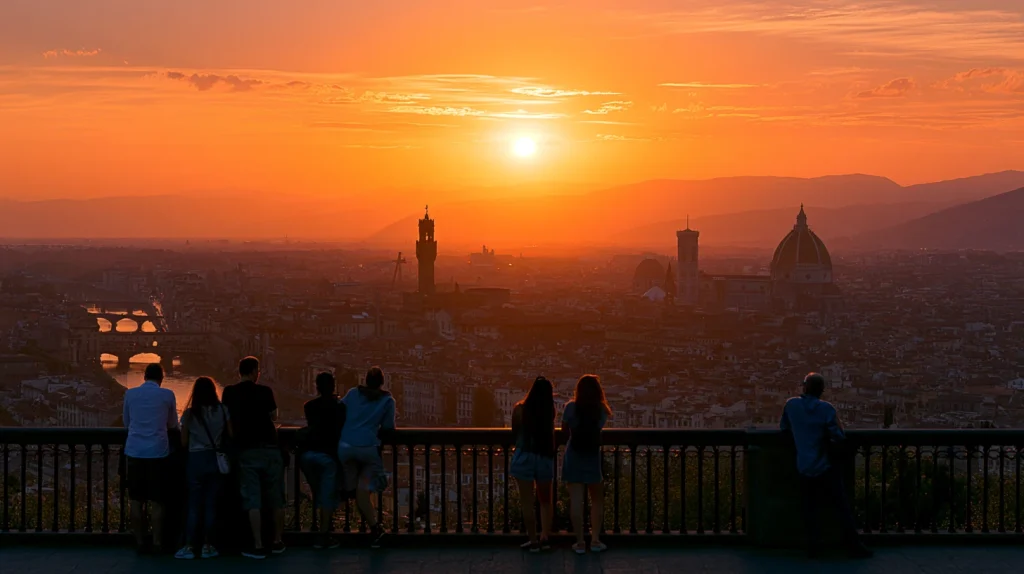
The view: north across the Arno to the entire Florence skyline, with the Duomo dominating the centre, the Campanile and Palazzo Vecchio tower visible to the left, the Arno bending in the middle distance, and the hills of Fiesole behind the city. On a clear day you can see for a long way. It is the view that appears in roughly half of all photographs taken of Florence.
For sunset: arrive at least 45 minutes before the sun goes down. The terrace fills from about an hour before sunset on any day without rain. The best positioning is along the railing on the north side — not the David end — where you have an unobstructed line to the Duomo. The northeast corner gives the best Ponte Vecchio angle.
Most people leave when the sun drops below the horizon. This is a mistake. The blue hour that follows, when the sky turns a deep violet and the city lights come on in sequence, is in many conditions more photographically interesting than the sunset itself. Stay 30 minutes past sunset.
San Miniato al Monte
Most visitors stop at the piazzale. If you continue uphill for another 10-15 minutes on foot, you reach the Basilica di San Miniato al Monte — one of the oldest churches in Florence, begun in the early 11th century, and one of the best examples of Florentine Romanesque architecture in existence.
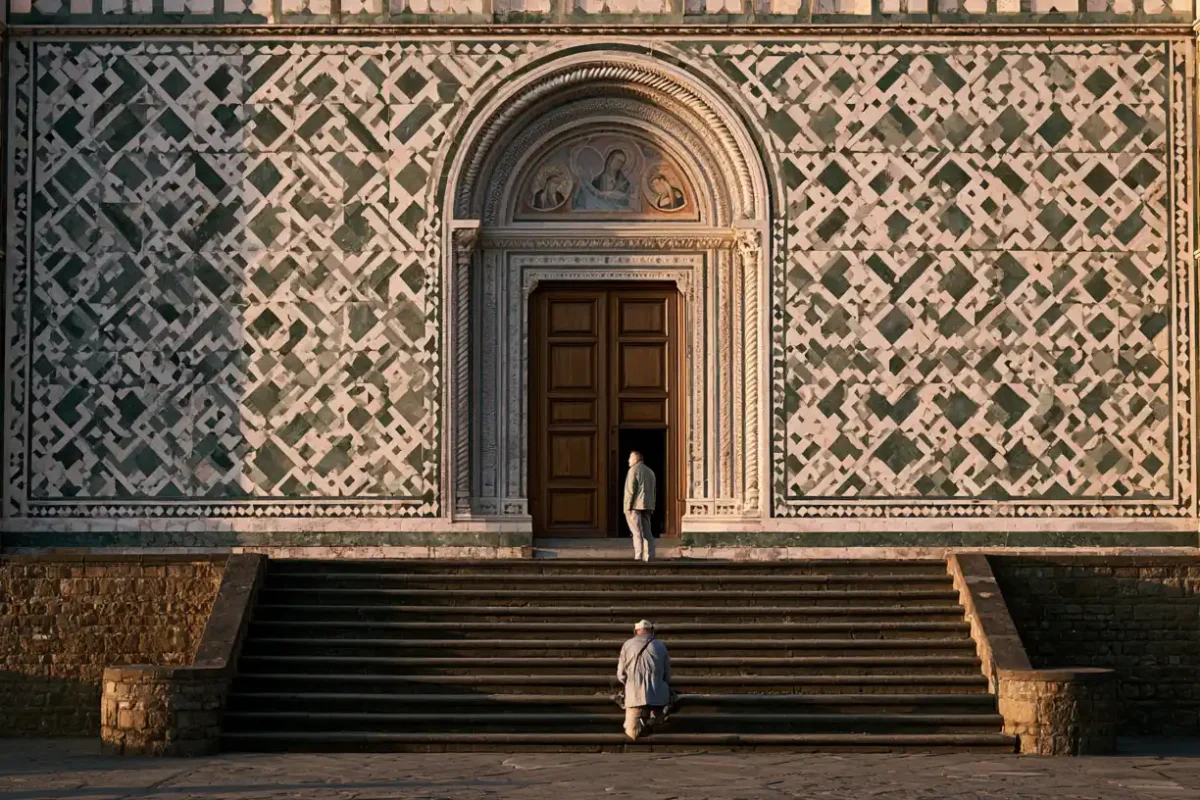
The marble facade is green and white, geometric, and older-looking than anything else visible from the piazzale below. Inside: a 13th-century floor of inlaid marble with signs of the zodiac, a raised presbytery with a 13th-century apse mosaic, and a quiet that is difficult to find elsewhere in Florence at this time of day.
The Olivetan Benedictine monks who maintain the abbey sing a service with Gregorian chant most days in the late afternoon or early evening. Reported timing has varied somewhat across sources and seasons — commonly cited around 6pm on weekdays with vespers following shortly after, and an earlier main sung celebration on Sundays — so this is genuinely worth confirming directly at sanminiatoalmonte.it or by asking at the church before you plan your evening around a specific time. If you can time your visit to arrive during the sung service, the combination of the building, the late-afternoon light through the windows, and the unaccompanied plainchant is one of the more unexpectedly affecting experiences in Florence. No charge — you take a seat in the wooden choir stalls or on the steps and listen. The contrast with the noise of Piazzale Michelangelo 10 minutes below is considerable, and that contrast is somewhat the point of making the effort to climb past the piazzale.
The church shop sells honey produced by the monks — Tuscany in a jar, and a genuinely good thing to bring back.
The viewpoint from the terrace in front of San Miniato is higher than the piazzale below and slightly different in angle — you see more of the surrounding hills and slightly less of the city foreground. On a busy evening when the piazzale is crowded, the San Miniato terrace has far fewer people and a more considered version of the same view.
Coming back down: the walk from San Miniato to the Oltrarno neighbourhood takes roughly 20-25 minutes on foot. You pass back through the piazzale and descend via the steps and paths that Poggi built into the hillside — the steps are steep in places; good footwear matters for the full descent. End the day in Oltrarno — which you have now earned a meal in, having done a full day on your feet — and this becomes one of the better full Florence days you can design. It is a lot to cover in a day, but the three pieces (Accademia in the morning, Piazzale at sunset, San Miniato at the sung service) fit together with an afternoon gap that works for lunch and a long coffee in the city centre in between.
David’s dimensions and history verified against the Galleria dell’Accademia’s own published records. Accademia ticket prices and hours verified August 2026 against the official booking platform. San Miniato’s evening service schedule has genuine variation across sources and seasons and should be checked directly before planning around a specific time; the same caveat applies to current bus stop locations for routes 12/13, since Florence’s transit network is adjusted periodically.