Pelion is a hook-shaped mountain peninsula in central mainland Greece — east of Volos, between the Pagasetic Gulf to the west and the Aegean Sea to the east — and it has two completely different coastlines that correspond to two completely different travel experiences. The western side (Pagasetic Gulf) is calm, warm, sandy, family-beach Greece. The eastern side (Aegean) is dramatic, rugged, deep-water, rocky-cove Greece, with beaches you reach by hiking. Mount Pelion itself reaches 1,624m, covered in dense chestnut and beech forest that gives the peninsula a green, almost northern European atmosphere at altitude. According to Greek mythology, the mountain was home to the centaurs and the summer residence of the gods. Standing on the ridge in September, looking down at two seas, you understand why they would have stayed.
| Best time to visit | June–September (swimming); May and October (quiet + hiking) |
|---|---|
| Getting there | Drive from Athens (3.5 hrs) or train to Volos then car rental |
| Budget per day | $80–130 USD; cheaper than most Greek islands |
| Visa for Americans | No visa; Schengen 90-day rule applies |
| Language | Greek; English widely understood in tourist areas |
| Currency | Euro; cards accepted; cash useful in smaller villages |
Is Pelion Worth Choosing Over a Greek Island?
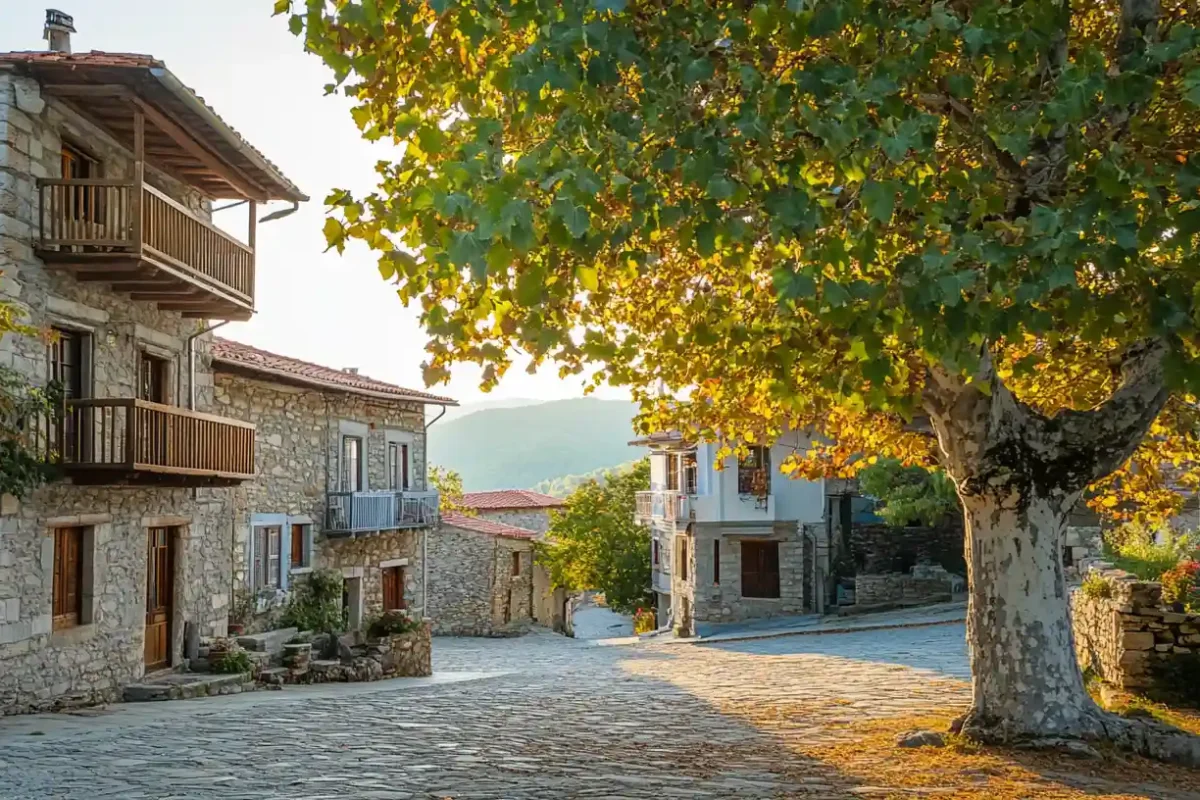
For certain travelers — yes, strongly. The comparison to consider: a Greek island gives you sea, sun, whitewash architecture, and tourist infrastructure. Pelion gives you sea, sun, stone villages, dense mountain forest, hiking trails, the architecture of northern Greek folk tradition (two-story stone houses with carved wooden balconies, central plane tree squares), and roads that require a car but reward one. No ferries. No crowds trying to watch the same sunset. The accommodation is meaningfully cheaper than Santorini or Mykonos at comparable comfort. The food — Pelion lamb, fresh seafood from both coasts, local cheeses, tsipouro — is genuinely outstanding. The beaches on the Aegean side are among the finest in mainland Greece and most require a 20-minute hike from the road, which eliminates 90% of potential competition.
The Villages
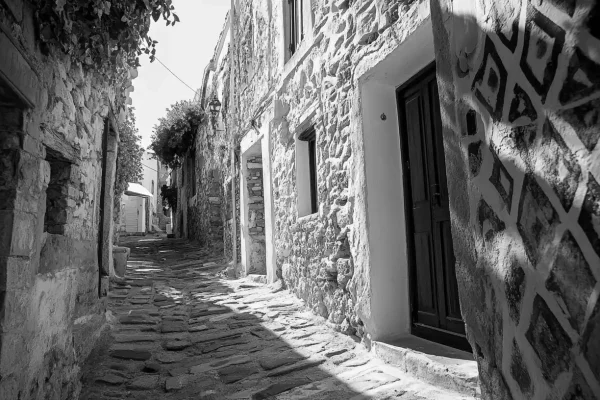
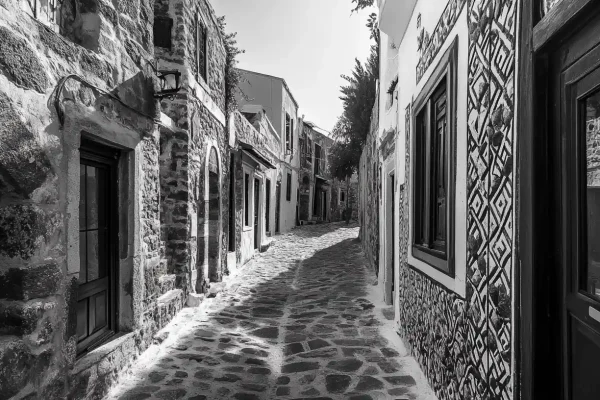
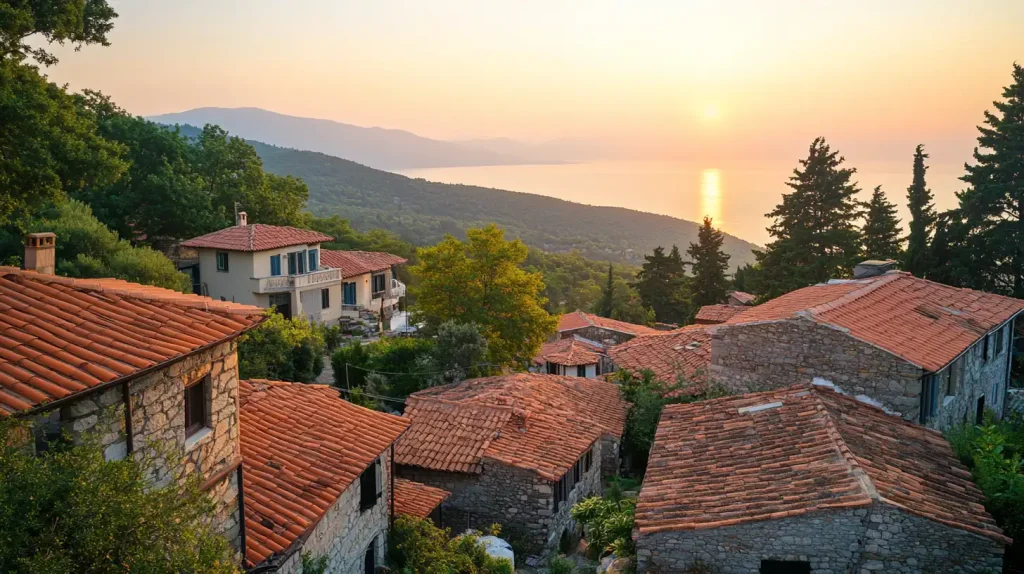
There are 24 traditional stone villages on Pelion, each distinct. The most visited are Portaria and Makrinitsa above Volos — both within 15km of the port city, both heavily photographed, both genuinely atmospheric with cobblestone paths and central plazas shaded by massive plane trees (one plane tree in Tsagarada is over 1,000 years old and requires 18 adults to encircle its trunk). Tsagarada on the eastern Aegean slopes is the most appealing base for Aegean beach access: it’s a village of four separate neighborhoods across a ridge, connected by stone paths, above the finest concentration of Pelion beaches.
Milies, on the western slopes, is where the narrow-gauge Pelion railway (Moutzouris, “the snub-nosed train”) runs on summer weekends — 29km from Ano Lechonia to Milies through the mountain, over stone viaducts, through dense forest, at 20km/h. Not efficient transport; entirely charming. Tickets are available at Ano Lechonia station; departs weekends and holidays from May through October.
Beaches: East vs. West
Western side (Pagasetic Gulf): Kala Nera, Agios Ioannis, Horto — sandy, calm, warm, well-served with sunbeds and tavernas. Family-appropriate. Predictable in the best sense. Sea temperature 2–3°C warmer than the Aegean side in summer.
Eastern side (Aegean): Mylopotamos, Fakistra, Damouchari, Papa Nero. These are different. Mylopotamos is reached by a 20-minute walk through forest and arrives at a beach split by a stone arch, with a small waterfall. The water is deep, clear, and cold by comparison to the western side. Fakistra requires a 45-minute hike on a cliff path and has no facilities — bring food and water. It consistently appears on lists of Greece’s most beautiful beaches. Damouchari was the filming location for the Greek village scenes in Mamma Mia; the small fishing harbor with its stone dock is genuinely picturesque without the film association.
Hiking on the Peninsula
The ancient kalderimi paths — cobblestone mule tracks connecting the villages across the mountain — still exist throughout Pelion and are maintained as hiking routes. The path from Kala Nera (western coast) through Milies to Tsagarada (eastern coast) covers 16km over 5–6 hours with the full Pelion cross-section: western sea views, oak and chestnut forest, alpine meadows, eastern Aegean panorama. Marked throughout with red-white trail markers. Download offline maps before setting out — cell signal is intermittent above 800m.
The hike to Fakistra beach from Tsagarada (45 minutes, cliff path above the sea) is the single most dramatic accessible walk on the peninsula, ending in a reward that justifies every step.
Food and Drink
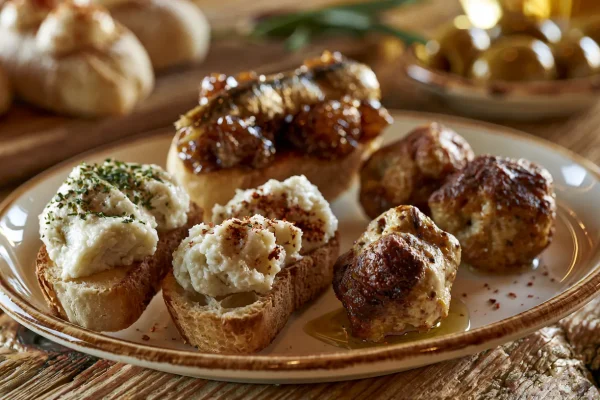
Pelion food has a reputation in Greece — known particularly for lamb dishes, fresh seafood from both coasts, local honey (thyme honey from the Aegean slopes is excellent), and chestnuts in fall. The local spirit is tsipouro — a pomace distillate related to grappa, served cold in small glasses alongside seafood at every harborside taverna. The taverna in Agios Saranta village (eastern side, near Tsagarada) has been praised repeatedly for the quality of its cooking — tables practically on the beach, fresh fish from that morning, the kind of meal you remember years later.
In Volos, the city at the base of the peninsula, tsipouro culture is serious: dozens of tsipouradika (tsipouro bars) serve the spirit with a rotating selection of small plates (octopus, smoked fish, cheese, fried zucchini). A full lunch at a good Volos tsipouradiko costs €15–25 per person including drinks. It’s one of the better cheap lunch options in Greece.
Getting to Pelion from the US
Fly to Athens (ATH) — direct from New York, Chicago, Philadelphia, and other US hubs on United, Delta, or Olympic Air, typically $700–1,000 round trip. From Athens, drive north on the E75 motorway toward Larissa, then east to Volos — about 3.5 hours. Alternatively, train from Athens Larissa Station to Volos (3.5–4 hours, €25 USD), then rent a car at Volos station for the peninsula. A car is essential for Pelion — the villages are at different altitudes with limited bus connections between them.
Where to Stay
Budget ($50–80/night): Village guesthouses throughout the peninsula — the Pelion has a well-developed agritourism sector. Simple stone rooms in Tsagarada or Milies for $50–70/night, breakfast included.
Mid-range ($100–160/night): Boutique stone hotels in the traditional mansions (archontika) that characterize Pelion architecture. Several in Tsagarada and Vizitsa have excellent reviews.
Splurge ($200+/night): Arhontiko Karamarlis in Tsagarada — a converted 19th-century mansion with exceptional views; or Kritsa Hotel in Agios Ioannis, directly above the Aegean beach.
Frequently Asked Questions
How do I get from Athens to Pelion?
Drive north on the E75 toward Larissa, then E65/E92 east to Volos — about 3.5 hours with moderate traffic. Alternatively, train from Athens Larissa Station to Volos (~4 hours, ~$25 USD), then rent a car in Volos. A car is necessary once on the peninsula — buses run to major villages but infrequently and don’t connect beaches well.
What is Pelion famous for?
Traditional stone village architecture, two dramatically different coastlines (calm Pagasetic Gulf west, wild Aegean east), Fakistra and Mylopotamos beaches (among Greece’s finest), the Pelion narrow-gauge railway (Moutzouris), the Mamma Mia filming village of Damouchari, excellent Pelion lamb and tsipouro, Greek mythology connections (home of the centaurs and summer residence of the gods), and being mainland Greece’s best non-island beach destination.
Which Pelion beach is the best?
Fakistra (45-minute hike, no facilities, no crowds, dramatic cliffs and clear deep water) for the most spectacular experience. Mylopotamos (20-minute walk, stone arch, waterfall, small taverna) for accessibility and photographic impact. Damouchari (easy access, Mamma Mia harbor, taverna) for convenience and charm. All three are on the Aegean side. Western side beaches (Kala Nera, Agios Ioannis) are better for families and easier swimming.
Is Pelion good for hiking?
Excellent. The ancient kalderimi cobblestone paths connecting villages predate modern roads and are maintained as hiking routes throughout the peninsula. The full west-to-east crossing from Kala Nera to Tsagarada (16km, 5–6 hours) is the classic route. The cliff path from Tsagarada to Fakistra beach is the most dramatic shorter hike. Download offline trail maps (Wikiloc or Maps.me) — GPS coverage is more reliable than cell signal at altitude.
How is Pelion different from a Greek island?
No ferries, no ferry schedules, no ferry crowds. Mainland access by car. Dense forest at altitude (unusual for Greece). Two completely different coastlines separated by mountain. Stone village architecture from the northern folk tradition rather than Cycladic whitewash. Cheaper accommodation at comparable quality. Better hiking. Slightly cooler temperatures in summer at altitude. The trade-off: less of the crystalline Aegean island aesthetic that many people picture when they think “Greece.”