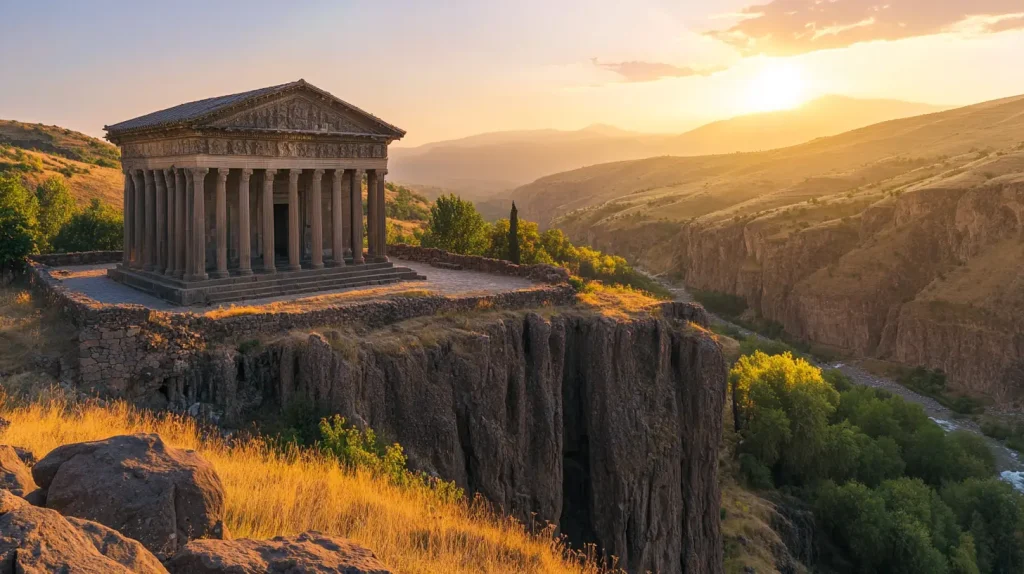
The Temple of Garni is a Greco-Roman colonnaded temple from the 1st century AD sitting at the edge of a cliff above the Azat River Gorge, 30km east of Yerevan — the only surviving Hellenistic building in the former Soviet Union. Armenia adopted Christianity as a state religion in 301 AD, and all pagan temples were subsequently ordered destroyed. Garni survived, for reasons historians still debate (possibly converted briefly to secular use, possibly just overlooked), until a 1679 earthquake reduced it to rubble. It was reconstructed using the original stones between 1966 and 1976, during the Soviet period, and stands today exactly as it did in the 1st century: 24 Ionic columns, a crepidoma of three steps, and a location on a dramatic basalt promontory that the Armenian kings used as a royal summer residence. Combine it with Geghard Monastery (UNESCO, carved into a cliff face 15 minutes away) and the Symphony of Stones (a basalt column formation that looks exported from Iceland), and you have one of the best half-day trips in the Caucasus.
| Distance from Yerevan | 30km east; ~40 minutes by bus or car |
|---|---|
| Entry fee | 1,500 AMD (~$4 USD) for Garni; Geghard is free |
| Best time | Year-round; spring (April–May) for wildflowers; avoid midday summer heat |
| How to get there | Bus 266 from Gai Station, Yerevan (250 AMD, ~40 min) or taxi/GoTrip |
| Time needed | Half day for Garni and Geghard; full day with Symphony of Stones hike |
Is the Garni Day Trip Worth It?
Unambiguously yes — it’s one of the most logistically simple and visually rewarding day trips from any Caucasus capital. The combination of three entirely different experiences (the classical Roman architecture of Garni, the cave monastery of Geghard, and the geological spectacle of the basalt columns) within 15km of each other makes it unusually efficient. The bus from Gai Station in Yerevan costs 250 AMD (about $0.65 USD) each way and takes 40 minutes. The entrance fee for Garni is 1,500 AMD ($4 USD). Geghard Monastery is free. You can do the whole day for $10–15 USD in transport and entry fees, lunch included, and be back in Yerevan for dinner.
Garni Temple
The temple is smaller than its photographs suggest — 24 columns, a cella, and a pronaos, covering a footprint of about 14 by 8 meters. What compensates is the setting: the plateau edge drops dramatically into the Garni Gorge below, and the river far beneath reflects the afternoon light. Walk slowly around the perimeter. Look at the column capitals (Ionic order, still detailed after 2,000 years) and the carved entablature. The inscription stone near the path entrance — discovered in 1945 in the village cemetery — helped archaeologists date and contextualize the temple; it reads, in ancient Greek: “Tiridates the Great, king of the Greater Armenia, the ruler built this impregnable temple and fortress for the queen in the 11th year of his reign.”
Don’t miss the Roman bath ruins behind the temple — most visitors walk past them. The remaining mosaic floor decoration (depicting marine and river gods, fish, and waves) has survived 2,000 years of Central Asian earthquake cycles partially intact. It’s just to the right of the main temple platform, unroofed and unpretentious. It’s also one of the more extraordinary small sights in Armenia.
Opening hours: 10am–9pm in summer, 10am–5pm in winter. Entry 1,500 AMD ($4 USD); children under 12 free.
Symphony of Stones
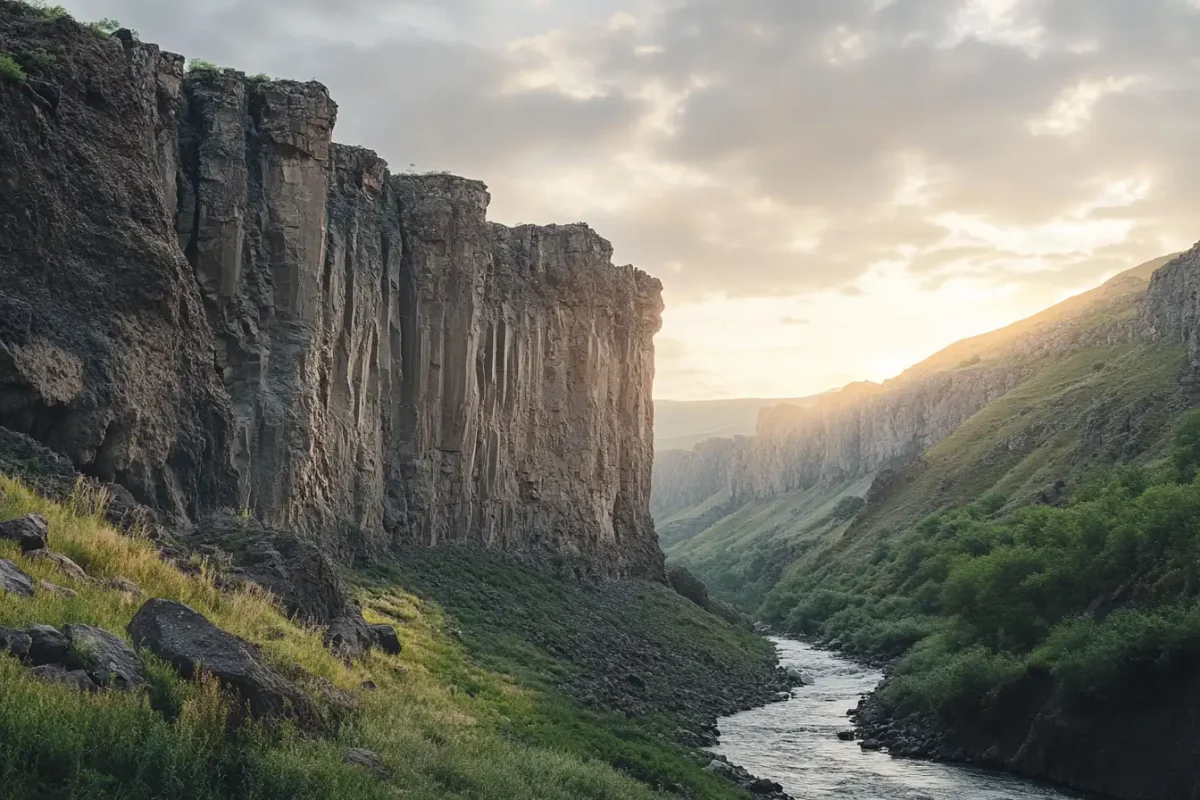
Between Garni and Geghard, a short walk leads to the Garni Gorge’s Symphony of Stones — a cliff face of perfectly hexagonal basalt columns that formed when a lava flow cooled over millions of years. The columns run 50–60 meters tall, packed so tightly they appear engineered rather than geological. The specific combination of gray basalt, green canyon vegetation, and river below has made this one of Armenia’s most photographed natural formations. It genuinely looks like the Reynisfjara beach in Iceland, reinterpreted in a canyon context. Allow 30 minutes at the columns themselves; the walk down to the gorge floor for the best view takes 15 minutes each way and is moderately steep.
Geghard Monastery
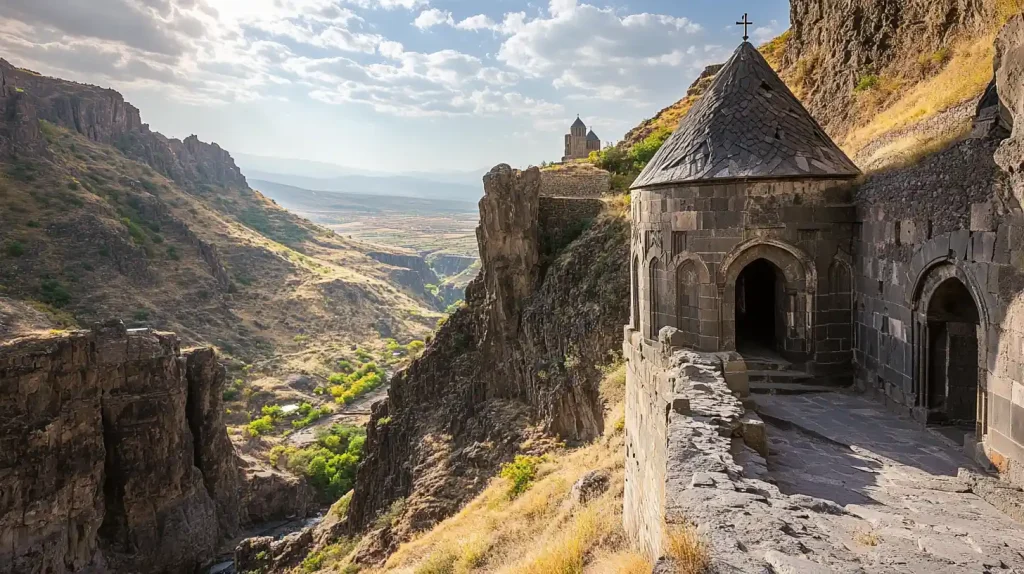
Geghard (Geghardavank — “Monastery of the Spear”) is a UNESCO World Heritage Site 9km from Garni, built in the 4th century and expanded significantly in the 12th–13th centuries. The main hall is constructed in the conventional style; the additional chapels, sacristies, and burial chambers are carved directly into the cliff face behind it — excavated from solid basalt, their walls decorated with intricate geometric stone lacework. The monastery’s name refers to the spear that pierced Christ at the crucifixion, which Armenian tradition holds was brought here by the Apostle Thaddeus. The spear is now at the Echmiadzin Cathedral museum, but the spiritual energy of the site remains palpable.
Entry is free. Cover your head if entering the main hall (scarves available at the gate). The monastery is still active — services happen on Sundays and feast days. If you arrive early morning, you’ll often have sections of the carved cave chapels entirely to yourself — the contrast of dark stone walls, candlelight, and complete silence is extraordinary. Arrive before 9am or after 3pm to avoid coach groups from Yerevan.
Getting There
Bus 266 from Gai Station (Gai Avtokayanar) in Yerevan departs roughly every hour and costs 250 AMD ($0.65 USD) to Garni village. Pay on the bus. The driver will stop at the Garni Temple entrance on request — ask. From Garni to Geghard, take a taxi (negotiate from the Garni parking area, typically 1,000–1,500 AMD/$2.60–4 USD for the 15-minute ride) or walk 5km through the gorge. From Geghard, shared taxis back to Yerevan depart from the parking lot when full, running all day.
Alternatively: hire a driver through GoTrip or arrange through your Yerevan guesthouse for about $30–40 USD for the full day including Garni, Symphony of Stones, and Geghard. Worth it if you’re adding other sites (Lake Sevan or Khor Virap) to make a longer day.
Where to Eat
The best meal near Garni: the lavash bakery demonstrations in Garni village, where local women bake traditional flatbread in a tonir (underground clay oven) and sell it warm with fresh cheese for a few hundred AMD. Most tour groups include this as a stop; ask your driver or look for the signs in the village. The on-site restaurants at both Garni and Geghard serve basic Armenian food at inflated tourist prices — better to bring provisions from Yerevan and picnic at the gorge viewpoint.
Frequently Asked Questions
How do I get from Yerevan to Garni Temple by public transport?
Take bus 266 (also numbered 284 in some references) from Gai Bus Station (Gai Avtokayanar) in Yerevan — the station is on Gai Avenue, accessible by metro to Gai station. Cost: 250 AMD (~$0.65 USD). Journey: about 40 minutes. Buses depart roughly every hour from 9am. Tell the driver you want Garni Temple; the stop is at the entrance gate.
What is special about Garni Temple?
Garni is the only surviving Greco-Roman colonnaded building in the former Soviet Union — a 1st-century AD pagan temple that survived the mass destruction of pagan sites when Armenia converted to Christianity in 301 AD. It was destroyed in a 1679 earthquake and reconstructed using original stones in 1966–1976. The location on a basalt cliff above the Azat River Gorge is as impressive as the architecture itself.
Can I combine Garni and Geghard in one day trip?
Yes, easily — this is the standard day trip. Garni and Geghard are 9km apart. By public transport, take the bus to Garni, then a taxi or shared ride to Geghard and back to Yerevan. By hired car, both sites plus the Symphony of Stones takes about 4–5 hours. A half-day is sufficient; a full day if you add a gorge hike.
Is there an entrance fee for Geghard Monastery?
No. Geghard Monastery is free to enter. Respectful dress required — cover shoulders and knees; scarves are available at the entrance for those who need them. Sunday services and religious feast days bring larger crowds of Armenian pilgrims; if attending coincides with your visit, observe from respectful distance.
What is the best time to visit Garni and Geghard?
Year-round — both sites are open in all seasons. Spring (April–May) offers wildflowers in the gorge and the best combination of mild temperatures and green landscape. Summer mornings before 10am are best for beating tour groups. Fall (September–October) has exceptional light and comfortable temperatures. Winter visits are possible (both sites open) and the snowy gorge landscape is beautiful, but check road conditions and dress warmly.