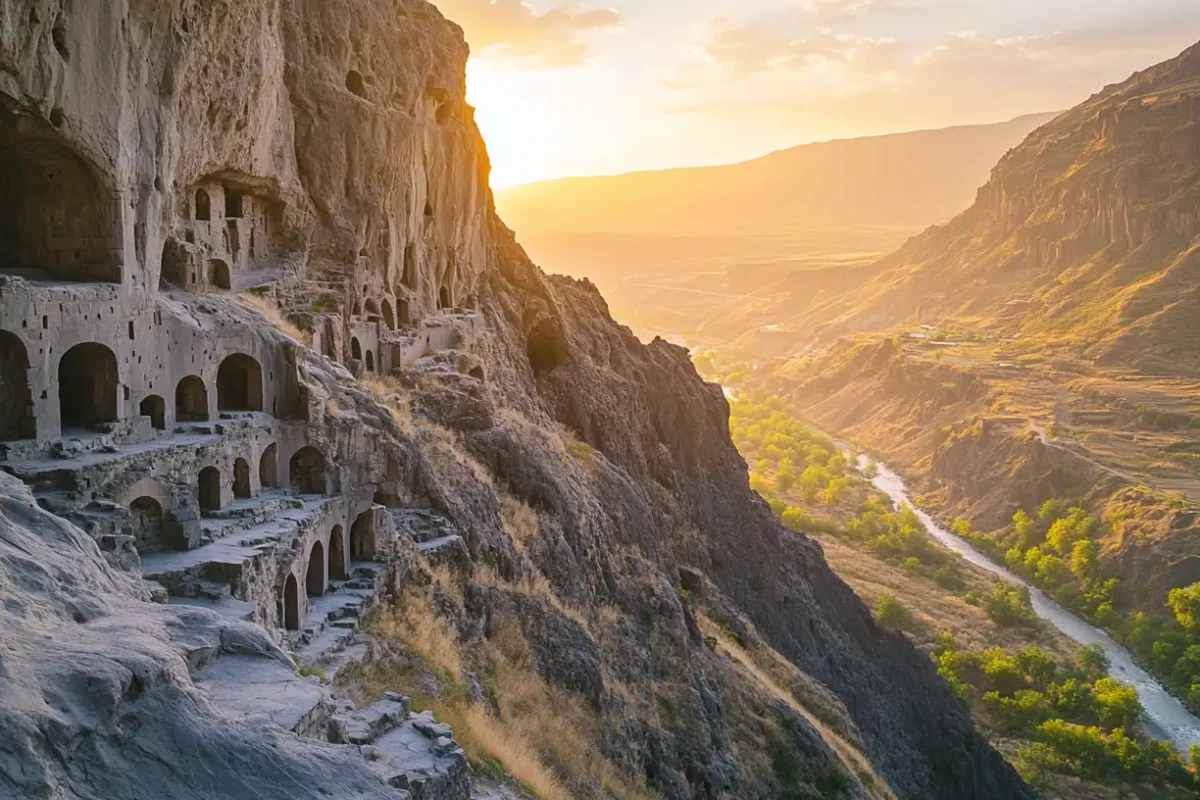
Vardzia is a cave city carved into a volcanic cliff face in southern Georgia — 13 tiers of caves, approximately 3,000 rooms, a church with original 12th-century frescoes, interconnecting tunnels, and the remnants of a throne room and wine cellar carved directly into the basalt. It was built under Queen Tamar, who ruled Georgia from 1184 to 1213 in what historians call the Georgian Golden Age. It was built quickly, in secret, as a military refuge against Mongol invasion. An earthquake in 1283 exposed the previously hidden complex to the world and shook away the outer cliff face, revealing the cave city to anyone looking from the Mtkvari River gorge below. What remains is one of the most extraordinary medieval sites in the Caucasus and one of the least visited significant historical sites in Europe.
| Best time to visit | April–October; May–June ideal; July–August busy with Georgian tourists |
|---|---|
| Getting there | Drive from Tbilisi (~4.5 hrs); tour from Tbilisi; or stay overnight in Akhaltsikhe (2.5 hrs from site) |
| Entry fee | 15 GEL (~$5.50 USD); cave monastery active — monks in residence |
| Time needed | 2–3 hours at the site itself; full day from Tbilisi with Akhaltsikhe |
| Combine with | Rabati Castle in Akhaltsikhe (45 min away); Khertvisi Fortress (en route) |
Is Vardzia Worth the Long Drive?
Without qualification — yes. Vardzia is 290km from Tbilisi, which translates to about 4.5 hours of driving on Georgian mountain roads. That’s real effort. The return is proportional: you’re looking at a cliff face that appears completely ordinary from a distance until you notice the windows and doorways cut into it at intervals, then the tunnels between them, then the entire 13-story vertical city reveals itself. It’s the kind of sight that takes time to fully register. The on-site monastery still has a small community of monks; services are held in the cave church, which contains 12th-century frescoes of Queen Tamar that remain remarkably vivid. The cave wine cellar nearby was used to store wine in 8th-century qvevri clay jars embedded in the floor — several are still there, empty but intact after 800 years.
The smart approach: combine with an overnight stay in Akhaltsikhe (the nearest town, 45 minutes away) and visit both Vardzia and Rabati Castle in a comfortable two-day trip from Tbilisi. A there-and-back day trip is doable but leaves you exhausted.
Navigating the Cave City
Entry costs 15 GEL ($5.50 USD). The path through the site runs for about 500 meters along the cliff face, with internal staircases connecting the tiers. Allow 2–3 hours to explore without rushing. The upper tiers require some scrambling on uneven rock steps — nothing technical, but not comfortable in sandals or dress shoes. Wear proper walking shoes.
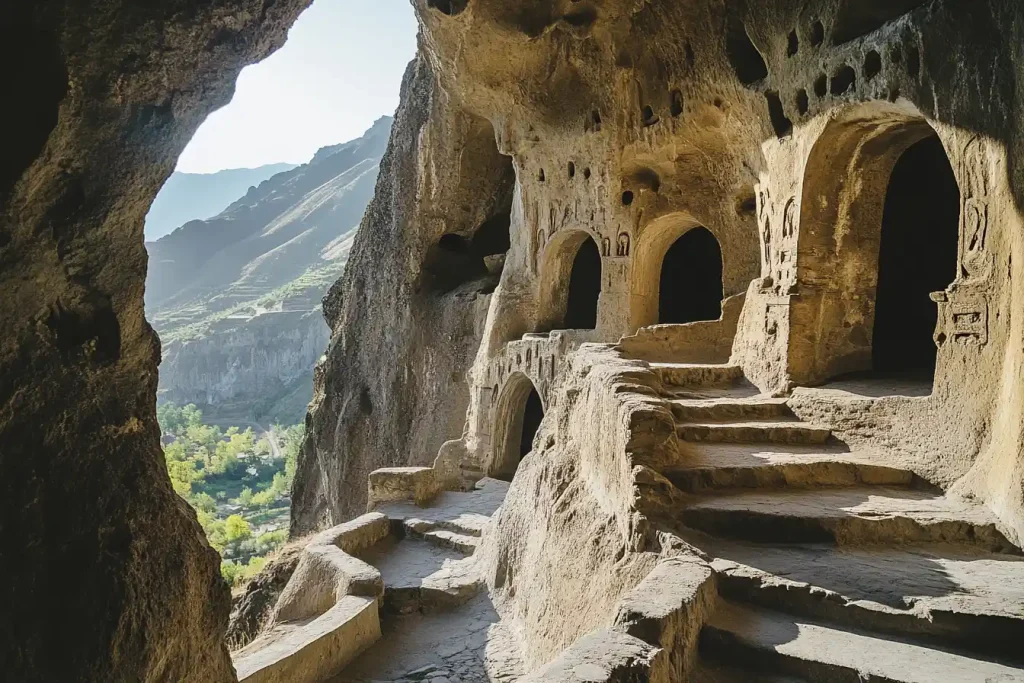
The cave church (Assumption Church) is the centerpiece: the frescoes inside include a famous image of Queen Tamar — the only contemporary portrait of her that survives, painted during her lifetime. The reds, blues, and golds have faded but remain legible. This is a functioning place of worship; monks conduct services on Sunday mornings. If you’re there on a Sunday, stay for the liturgy — the sound of Georgian polyphonic chanting inside a cave church is something without precedent in most travelers’ experience.
The secret tunnel that connected Vardzia to the Mtkvari River below (for water supply during siege conditions) is partially accessible; ask the ticket booth staff which sections are open on your visit day.
Khertvisi Fortress and Rabati Castle
On the drive between Akhaltsikhe and Vardzia, Khertvisi Fortress (one of Georgia’s oldest, first documented in the 2nd century BC) sits on a rocky outcrop above the river confluence. It’s free, partially accessible, and a worthwhile 20-minute stop for the view and the sense of the Silk Road trade route it once guarded.
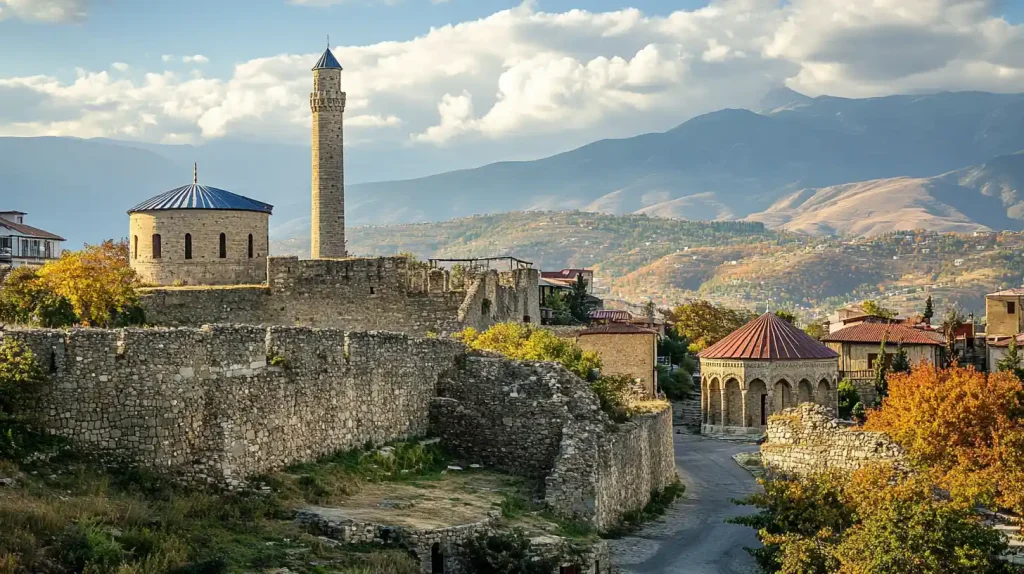
Rabati Castle in Akhaltsikhe is a remarkably preserved fortress complex rebuilt by the Ottomans in the 18th century that now functions as a museum campus — a mosque, a Georgian church, a minaret, and castle walls in one compound. Entry 15 GEL. It’s a genuinely unusual mix of Georgian, Ottoman, and Russian historical layers in one site. The restoration is controversial among historians (over-restored, some argue), but the site itself is worth the visit and conveniently located in Akhaltsikhe town center.
Getting to Vardzia from Tbilisi
Option 1 — Self-drive: Rent a car in Tbilisi (plentiful, $30–50/day) and drive south via Borjomi. The route takes about 4.5 hours. Georgian mountain road driving requires attention but the road quality has improved significantly and is manageable for any experienced driver. The return the same day makes for a very long day; the overnight in Akhaltsikhe is strongly recommended.
Option 2 — Organized day tour from Tbilisi: Several operators run Vardzia day tours for $40–70 per person, typically including Rabati Castle and Khertvisi. Convenient and saves the driving effort. The trade-off is shared group time at the site and the long round trip.
Option 3 — Marshrutka: Minibus from Tbilisi’s Didube bus station to Akhaltsikhe (3 hours, 15 GEL), then local marshrutka to Vardzia (40 minutes, 5 GEL). Cheaper but requires multiple connections and limits flexibility at the site.
Where to Stay Near Vardzia
Budget ($20–35/night): Several guesthouses in Akhaltsikhe town offer simple accommodation. Guesthouse Seny and Kldekari are well-reviewed options near the Rabati Castle area.
Mid-range ($50–90/night): Akhaltsikhe has a few small hotels. Alternatively, the Aspindza area near Vardzia has a few guesthouses for those who want to be closer to the site itself.
There are also guesthouses in the village directly below Vardzia for those who want sunrise access to the site before day-trippers arrive — worth checking availability.
Practical Tips
Arrive early. Vardzia is popular with Georgian families on weekends and in summer. Weekday mornings before 10am you can have the cave city largely to yourself. The light on the cliff face is better in the morning (east-facing) and again in late afternoon. Midday in summer is both crowded and flat-lit.
The site is active — monks live there and religious observance is ongoing. Dress appropriately: shoulders and knees covered, no loud behavior near the church. Photography inside the church is generally allowed without flash.
Frequently Asked Questions
How do I get from Tbilisi to Vardzia?
By car: 4.5 hours via the Borjomi route. By organized tour from Tbilisi: $40–70 per person for a day trip including Rabati Castle. By public marshrutka: bus from Didube station to Akhaltsikhe (3 hrs, 15 GEL), then minibus to Vardzia (40 min, 5 GEL). A rental car gives the most flexibility; the overnight stay in Akhaltsikhe makes the trip much more comfortable than a single long day.
What is Vardzia and why is it significant?
Vardzia is a 12th-century cave monastery and city carved into a volcanic cliff in the Samtskhe-Javakheti region of southern Georgia, built under Queen Tamar during Georgia’s medieval Golden Age as a military refuge. The complex has 13 tiers of carved rooms, approximately 3,000 chambers, interconnecting tunnels, a church with original 12th-century frescoes, and a throne room. It’s one of the most significant medieval sites in the Caucasus and a still-functioning Orthodox monastery.
Is Vardzia a UNESCO site?
Vardzia is included on Georgia’s tentative UNESCO World Heritage list but has not yet received full designation. It is protected as a Georgian national monument. The nearby Gelati Monastery near Kutaisi (also from the reign of Queen Tamar) is a UNESCO site.
Can I visit Vardzia without a guide?
Yes — the site is open to independent visitors. The cave complex is self-navigable with the clear path through the cliff. Informational signage exists but is limited. For understanding the historical and religious context of the frescoes and the construction history, a guide adds significant value. Guides are available at the site for approximately $20–30 USD for a 2-hour tour.
What is the best time to visit Vardzia?
May and June for comfortable temperatures, green landscape, and fewer crowds. April has cooler temperatures but good conditions. July and August are warm but busier with Georgian domestic tourists. September and October are excellent — the light is lower and warmer, crowds reduce, and the surrounding mountains are in fall color. Winter visits are possible (site stays open) but road conditions require caution and the site may be quiet to the point of solitary.