Most people come to the Amalfi Coast for Positano and leave having seen only what the ferries can reach in a long day. There is another coast operating alongside it — smaller, slower, and considerably more interesting in the way that places are interesting when tourism has not smoothed all the edges off. You have to want to find it, and you sometimes have to walk down steep stairs or take a bus that comes twice a day. Entirely worth it.
Atrani: Five Minutes from Amalfi, Barely Any Tourists
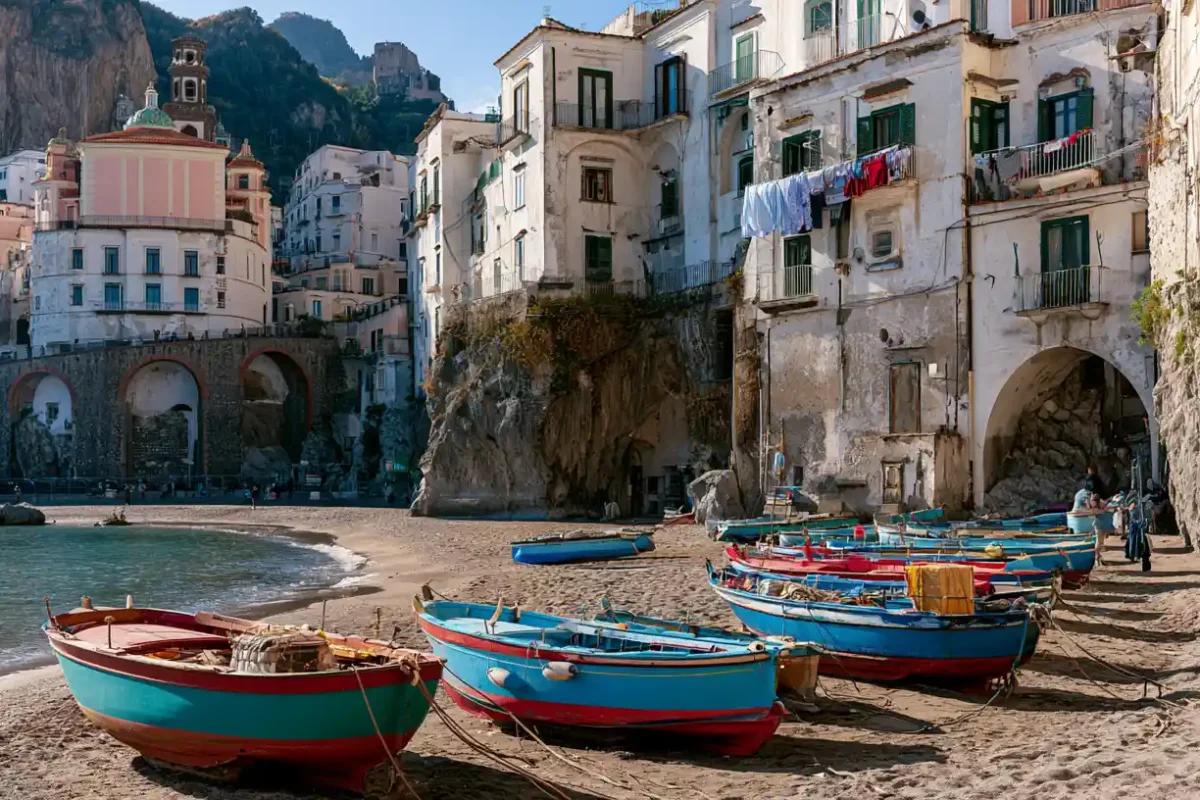
Atrani is not just close to Amalfi — it is right next to it. Walk through the pedestrian tunnel at the east end of Amalfi’s waterfront (five minutes flat, no stairs) and you come out in a completely different place. A small piazza with a bar and a church. A tiny beach where the fishing boats actually get used. Laundry hanging between buildings that are squeezed so tightly against the cliffside they almost touch.
Atrani has fewer than a thousand residents and an area of 0.12 square kilometers — it is consistently listed as the smallest incorporated municipality in Italy. Despite that, and despite being a literal five-minute walk from one of the coast’s busiest spots, most tourists walk past the tunnel entrance without noticing it.
The beach is small and pebbly. It is not where you go to sunbathe. You go to sit in the piazza at Pasticceria Pansa — actually the original location, before the famous Amalfi branch — or to have lunch at one of the restaurants that faces the sea at a price point 20-25% lower than anything on Amalfi’s waterfront.
If you are staying in Amalfi, visit Atrani early morning. The light on the buildings around 7-8am is genuinely beautiful and there is almost no one there.
Cetara: Go Specifically to Eat
Cetara is about 45 minutes east of Amalfi by SITA bus. It is a small fishing village built around a harbor, and it does not try to be photogenic or tourist-friendly in the Positano sense. It has a watchtower, a beach, and a handful of restaurants.
The reason to go is colatura di alici — an intensely savory amber liquid made from fermented anchovies, the Italian descendant of Roman garum. The production method in Cetara dates back centuries and the product is deeply specific to this village. You can buy bottles in the small shops along the waterfront (expect to pay €10-20 for a small bottle of good colatura). More importantly, you can eat it the way locals eat it: tossed with spaghetti, garlic, olive oil, capers, and chilies. Order it at lunch at Acqua Pazza or any of the other restaurants on the harbor. It is one of the more distinctive things you can eat on the entire coast.
Beyond the food: Cetara is simply a working Italian coastal village. The fishermen do not exist for your photograph. The morning market is actual commerce. This is what the coast looked like before Positano became an international symbol of Italian summer.
Fiordo di Furore: The Coast’s Most Photographed Secret
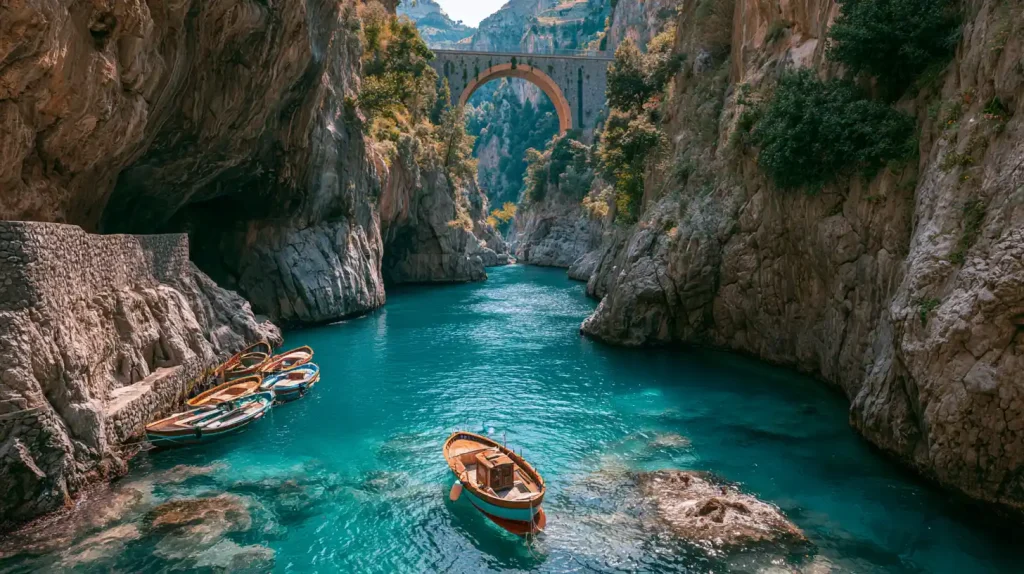
Furore is a village divided between a hilltop settlement and a narrow inlet (the fiordo) that cuts deep into the cliff. The inlet — Fiordo di Furore — is the thing people come to see: a deep stone ravine with a tiny pebble beach, fishing boats moored against the cliff walls, a small bridge overhead, and water that is an implausible shade of turquoise.
The SITA bus stops at the SS163 road level, and from there you walk down a staircase of about 300 steps to reach the beach. You will hear the sound of the water before you see it. The scale of the ravine — high cliff walls on both sides, the sky a narrow strip above — makes it one of the more dramatic spots on the coast.
It is not entirely unknown. Photographers find it. But compared to the queues at Positano’s Spiaggia Grande, the Fiordo di Furore on a weekday morning is close to empty. Go before 10am.
Every July, the Fiordo hosts a competitive diving event from the bridge above — cliff divers in front of a crowd gathered on the steep stone steps. If you happen to be on the coast in July, it is a genuinely surreal scene.
Grotta dello Smeraldo: A Sea Cave Worth the Queue
Conca dei Marini sits between Positano and Amalfi on the coast road, population around 700. Its main claim is the Grotta dello Smeraldo — an emerald cave below sea level, accessible by elevator cut into the cliff or by boat from Amalfi.
The cave is not entirely secret. Tour boats visit it regularly. But most visitors to the Amalfi Coast do not include it in their itinerary, which means it is significantly less crowded than the Blue Grotto in Capri (where you might queue an hour) while offering a broadly similar experience.
The cave gets its name from the green light filtering through submerged openings in the rock, illuminating the water and the stalactites and stalagmites inside. The effect is best in morning light — visit between 9am and 11am for the strongest emerald glow. Entry costs around €5 (elevator/cliff access) or is bundled with boat tours from Amalfi at around €15.
The village of Conca dei Marini itself is worth a brief walk — quiet, well-kept, with a 16th-century watchtower. The sfogliatella pastry is said to have been invented by nuns in the monastery here, which is either apocryphal or the most useful piece of food history on the coast depending on your priorities.
Scala: Above Ravello, Virtually No Tourists
Ravello gets attention for its villas and its festival. The village of Scala, directly across the valley from Ravello, gets almost none. It is accessible from Ravello by a short road, or by a walking path that takes about 20-25 minutes through the terraced hillside.
Scala is one of the oldest settlements in the region — it predates Amalfi as an administrative center. The cathedral (Duomo di Santa Maria Assunta) dates to the 12th century and has a mosaic-covered facade. The village has a handful of bars and one or two restaurants. Almost no tour groups.
The view across the valley to Ravello from Scala is arguably the best view of Ravello you can get — which is ironic since everyone in Ravello is looking the other direction, out to sea.
Combine a Scala visit with Ravello: take the SITA bus up to Ravello, do the villas, walk across to Scala in the afternoon, and take a local bus or walk back to Ravello before catching the last bus down to Amalfi.
Valle dei Mulini: Amalfi’s Hidden Valley
Most visitors to Amalfi town see the cathedral, the cloister, and the waterfront. They eat lunch, they buy limoncello, and they get back on the bus or the boat. Very few walk ten minutes inland to the Valle dei Mulini — the valley of the paper mills.
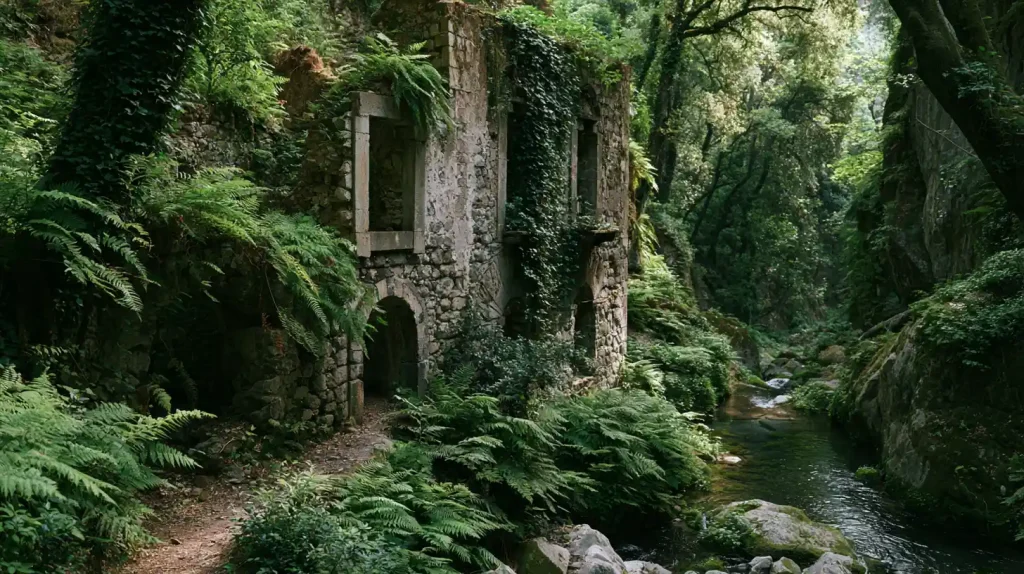
The valley follows the stream above Amalfi town, with ruins of the old paper mills (Amalfi was Europe’s first center of paper production in the 13th century) visible along the path. The walk is easy, shaded, and takes about 30 minutes round-trip. There is a small paper museum at the end.
It is not dramatic. But it is a complete change of texture from the coast — green, cool, quiet, with the sound of running water instead of ferry engines. On a hot August afternoon, when the waterfront is at its most crowded, the Valle dei Mulini is pleasantly empty. The walk itself takes about 30 minutes there and back. The small paper museum at the end costs around 1-2 EUR. The real point is the walk, not the museum.
Marina di Praia: A Beach That Earns Its Walk
Most beaches on the Amalfi Coast are either crowded (Positano’s Spiaggia Grande, Amalfi’s beach) or inaccessible without a boat. Marina di Praia, below the village of Praiano, splits the difference: you can walk to it, and it is still quiet enough to feel like a discovery.
From the SS163 coast road in Praiano, a steep lane (and then a staircase) drops about 150 meters to the beach. The cove is small — maybe thirty meters of pebbles — flanked by dramatic cliff walls that block the wind and turn the water a deep clear green. Two restaurants face the beach: Da Armandino and Il Pirata. Lunch here (fresh fish, local wine) with the cove walls above you and almost no one else around is one of the Amalfi Coast’s better experiences.
The walk down takes 10-15 minutes. The walk back up takes longer and is steep enough to warrant taking it slowly. Worth every step.
In Praiano itself, the Church of San Gennaro sits on the cliff’s edge with a tiled dome visible from the coast road. The interior is calm and the views from the terrace outside are directly west — meaning it catches the sun going down better than almost any spot on the coast. Sunset from San Gennaro’s terrace in September is something the tour buses do not stop for, which means you will almost certainly have it largely to yourself.
Minori: The Pasta Village
On the far eastern side of the coast between Maiori and Amalfi, Minori is a small town with a wide promenade, a reasonable sandy beach, and a 1st-century AD Roman villa (Villa Marittima) that most visitors skip entirely. The villa has well-preserved mosaic floors and frescoed rooms buried below the modern town, and entry costs around 3 EUR.
What makes Minori slightly famous among Italians is pasta: the town produces dried pasta and has done so commercially for over a century. There is a small pasta museum (Museo della Pasta di Minori) that is genuinely interesting if you care about food production, and considerably less interesting if you do not. But the town’s pastry shop tradition is strong — Sal De Riso, the most famous patisserie on the coast, is based in Minori and is worth finding for the delizia al limone cake.
Minori has none of the tourist infrastructure of Positano or Amalfi. The restaurants serve Italian families on holiday rather than first-time international visitors. This is what the pricing reflects. A full lunch here costs about what a coffee costs in Positano.
Practical Notes
The spots above divide into two categories: reachable by SITA bus (Cetara, Furore, Conca dei Marini, Minori) and reachable on foot from existing stops (Atrani, Valle dei Mulini, Scala, Marina di Praia). The bus-reachable ones require checking the SITA schedule in advance — some stops have only three or four services per day in each direction. The Amalfi-to-Salerno route hits Cetara, Minori, and Maiori, so these can be combined on one eastward journey. Missing the last bus from Cetara means a taxi or a very long wait, so check the afternoon return times before you leave.
For the on-foot spots: wear shoes that are comfortable on uneven stone. The descents to Marina di Praia and the Fiordo di Furore are steep and the steps can be slick when wet. Early mornings and late afternoons give you better light and fewer people at all of these spots.
Cetara is the furthest east and takes the most commitment. The others are all accessible as short detours within a normal day on the coast. None of them require more than a half-day, which means you can combine two of them without racing.
FAQ
Is Atrani worth visiting on a day trip?
Yes, especially if you are already in Amalfi. The five-minute walk through the tunnel requires almost no effort and gives you a completely different experience from the tourist circuit.
How do I get to Cetara from Amalfi?
SITA bus from Amalfi’s main piazza heading east toward Salerno. About 45 minutes. Check the return schedule before you go — services thin out in the late afternoon.
Can you swim at the Fiordo di Furore?
Yes. The tiny beach is swimmable and the water is calm and clear. Arrive early before the day-trippers arrive from tour boats.
Is the Grotta dello Smeraldo as good as the Blue Grotto in Capri?
Comparable experience, much shorter queue, lower cost. Worth doing from the Amalfi Coast if you are not planning a Capri trip. If you are going to Capri, the Blue Grotto is the more famous version.
Is Scala difficult to reach from Ravello?
No. A 20-25 minute walk along a well-marked path, or a short local bus. Entirely manageable as part of a Ravello day.