Understanding What You Are Actually Visiting
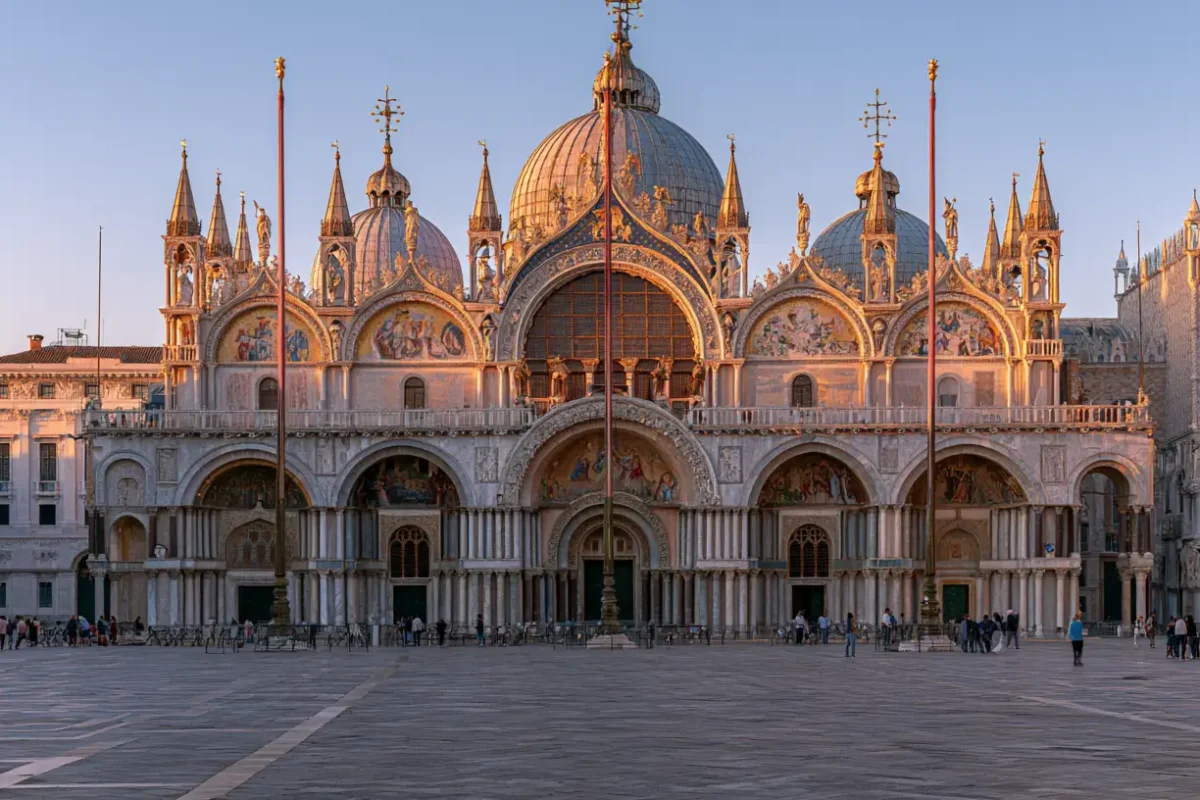
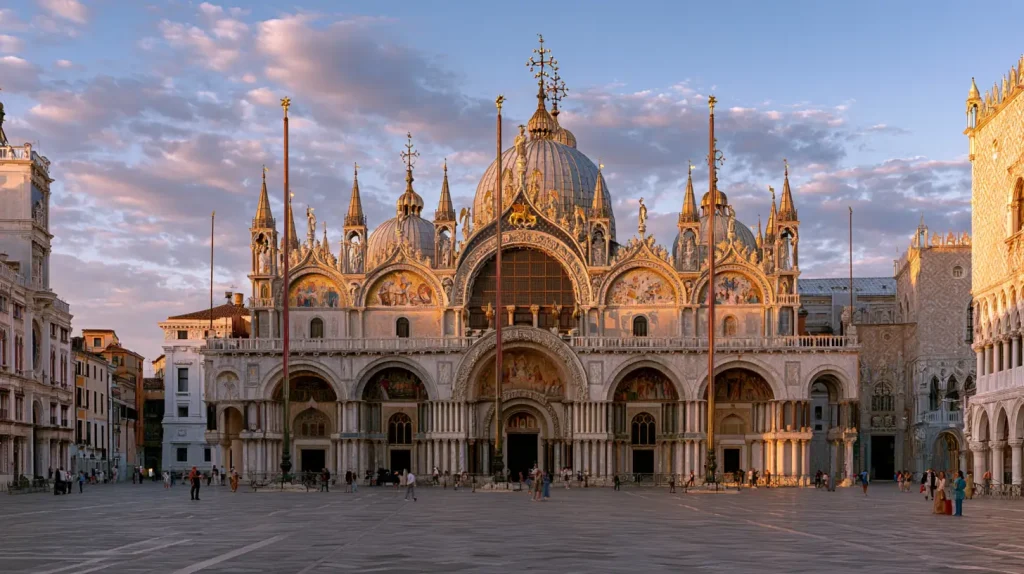
St. Mark’s Square and St. Mark’s Basilica are not the same thing, though most visitors treat them as a unit. The square — Piazza San Marco — is one of the most famous public spaces in Europe: a large open rectangle flanked by the Doge’s Palace, the Procuratie buildings, the Campanile (bell tower), and the basilica itself at the far end. Entry to the piazza is, and always has been, free.
Venice separately runs a day-tripper access fee (the contributo di accesso) on a set list of peak dates each year — but as of publication, the 2026 trial period for this fee ended on July 27, and it is not currently in effect. If Venice reintroduces or extends the scheme, dates and payment details are published at the city’s own portal, cda.ve.it.
The basilica itself is a separate visit. It is a working church and one of the finest examples of Byzantine architecture in the Western world. Entry is managed separately, requires advance booking as of 2025, and comes with a strict dress code.
Understanding both parts of this visit — the free public square and the ticketed basilica — helps you plan the day well.
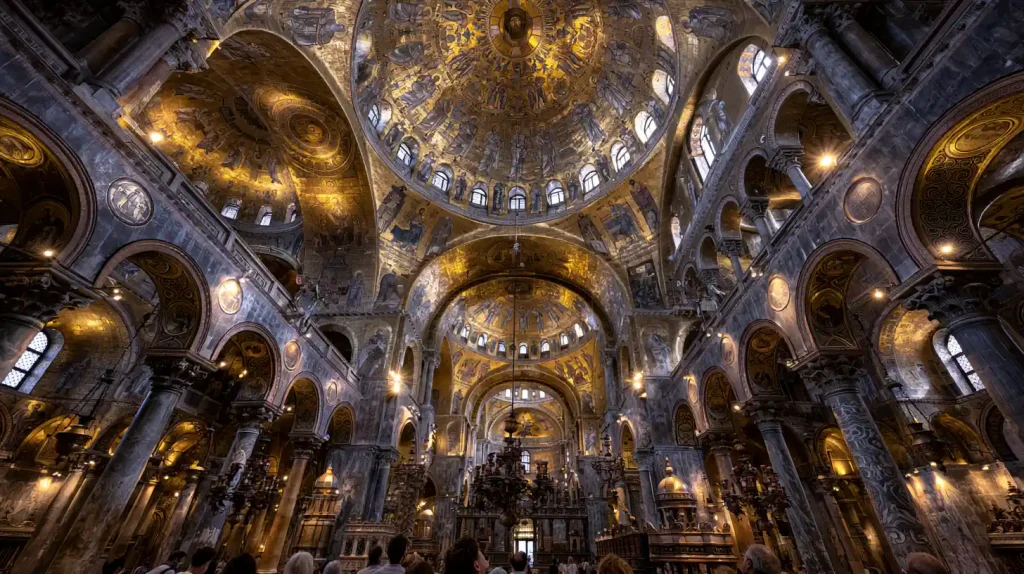
The basilica was built to house the relics of Saint Mark the Evangelist, brought to Venice from Alexandria in 828 AD. It served as the private chapel of the Doge (the elected leader of the Venetian Republic) for centuries before becoming a cathedral in the 19th century. Its exterior and interior both reflect Venice’s position as a trading and cultural bridge between the Byzantine East and the Latin West — the architecture, the mosaics, and the art inside were accumulated over more than a millennium from across the Mediterranean world.
Tickets for St. Mark’s Basilica: What Changed in 2025
As of July 2025, St. Mark’s Basilica no longer sells tickets on-site. All entry requires online booking in advance, through the basilica’s official platform (tickets.basilicasanmarco.it). This means visitors who arrive at the door without a reservation cannot enter — regardless of queue length or season. This is a significant change from previous years when walk-up queuing was possible, and it catches many visitors by surprise. If you are planning a Venice trip, booking the basilica should go on your to-do list at the same time as booking your accommodation — not as an afterthought the day before.
Current official pricing (individual bookings):
- Basilica only: €10. Covers the main nave, the narthex (entrance hall), and the primary mosaic areas. Timed entry — you are assigned a slot and must arrive within that window.
- Basilica + Pala d’Oro: €20.
- Basilica + Museum and Loggia dei Cavalli: €20.
- Full ticket (Basilica, Pala d’Oro, Museum, and Loggia dei Cavalli): €30.
- Museum and Loggia only (Sunday mornings, when the main basilica is closed to visitors for Mass): €14.
- Bell Tower (Campanile): ticketed separately, roughly €15 through the basilica’s own booking system (third-party resellers often price it higher, up to €25).
Children under 10 generally enter free; students up to 26 and some other groups qualify for reduced rates, checked at the door — bring ID if you expect to claim one.
Skip-the-line and guided options exist through third-party operators starting around €23-32 for a standard guided visit, with combo tickets (basilica plus Doge’s Palace, or plus a gondola ride) running €55-85+, and after-hours “night tour” experiences priced considerably higher, around €129. These aren’t official prices — they’re markups for convenience, commentary, or bundling, so weigh them against booking the €10-30 official tickets directly and reading up on the mosaics yourself.
Paid extras inside the basilica:
Pala d’Oro: The altarpiece behind the main altar — a Byzantine gold panel studded with over 2,000 precious stones. Worth the extra cost. Most visitors to the basilica miss this because it requires the upgraded ticket tier above, not a purchase at the desk inside.
Loggia dei Cavalli (terrace): The terrace above the main entrance gives a close-up view of the replica horses (the originals are in the museum inside) and an elevated view over the piazza. Included in the Museum/Loggia ticket tier. Recommended if you want photographs of the piazza from above.
Museum: Housed within the basilica, the museum contains the original bronze horses (brought from Constantinople in 1204), Byzantine artifacts, and historic textiles. Bundled with the Loggia in the same ticket tier described above.
Booking timing: In peak summer (May through September), popular time slots — particularly the 9:30am opening slot and late afternoon slots — sell out one to two weeks ahead. Tickets are typically released around 45 days in advance, which is the best time to book if your dates are fixed. In low season (November through March, excluding Carnival), availability usually exists three to seven days out.
Dress Code: Strictly Enforced
The basilica is a functioning church and its dress code is applied without exceptions. Both men and women must have shoulders and knees covered. This means no tank tops, no sleeveless shirts, no shorts above the knee, and no short skirts. This applies regardless of temperature — even in July heat, you need to be covered before entering.
If you arrive inappropriately dressed, you will be turned away and lose your timed entry slot. The queue for linen wraps or cover-ups sold by nearby vendors is not a reliable backup plan — your slot will have passed. Cover up before arriving. Pack a scarf or light layer in your bag if you are wearing summer clothing.
Bags are subject to security screening, and security checks apply even to skip-the-line tickets — they bypass the ticket queue, not the checkpoint. Large bags and suitcases cannot be brought inside.
Best Time to Visit the Basilica
9:30am opening slot: The first slot of the day is consistently the least crowded. Arriving at opening gives you the best light through the windows (depending on season), the quietest atmosphere, and the most time to look at the mosaics without being pressed by crowds.
Late afternoon: As afternoon tour groups thin out, the basilica gets noticeably quieter from around 4:30pm onward. Light at this hour can be particularly good for the gold mosaic backgrounds, which absorb and reflect warm afternoon sun in a way that midday overhead light does not replicate.
Avoid: Late morning and midday (11am to 2pm) is when tour group density peaks and the main nave becomes genuinely crowded. This is not the best time to appreciate the mosaics at your own pace. Note also that on Sunday mornings until around 2pm, the basilica itself is generally closed to tourist visits for Mass — only the Museum and Loggia are open to visitors during that window.
Photography inside is permitted without flash. The flash restriction is not arbitrary — the gold leaf in the mosaics is genuinely sensitive to repeated light exposure, and the basilica actively monitors compliance. Staff and volunteers are positioned throughout the interior and will approach visitors using flash immediately.
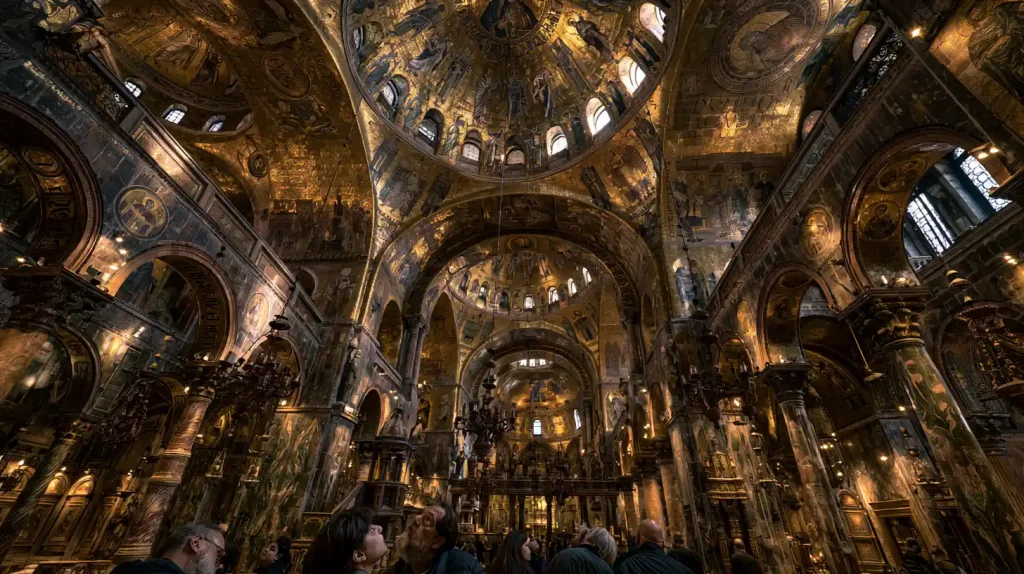
One detail worth knowing: the basilica interior is dark by modern standards. Your eyes need several minutes to adjust from the bright Venice daylight outside. Do not rush the first few minutes — give your vision time to adapt before trying to read the mosaics, or you will underestimate what you are looking at.
How to Actually See the Mosaics
The mosaics covering the walls and ceiling of St. Mark’s Basilica total approximately 8,000 square meters of gold and glass. Most visitors look up briefly and move on. The mosaics reward slower attention than that.
The oldest mosaics — in the atrium (narthex) just inside the main entrance — date to the 13th century and depict Old Testament scenes from Genesis and Exodus in remarkable detail. Spend time here before moving into the main nave, because the atrium mosaics are among the best preserved and least studied by visitors.
The four domed mosaics of the main nave cover the life of Christ, the descent of the Holy Spirit, the Ascension, and the Last Judgment. Standing in the center of the nave and looking up at each dome in sequence takes around 20 minutes if done properly.
The Pala d’Oro altarpiece behind the altar requires the upgraded ticket and a few extra minutes of positioning, but the level of craftsmanship — enamel panels, gold filigree, gemstones in a work completed over several centuries — is unlike anything else in the basilica. Most visitors who skip it because of the small extra cost regret it after they see it.
One practical tip for the mosaics: bring a pair of small binoculars or zoom in with a camera telephoto lens. Many of the most detailed mosaic panels are high up on the arches and walls, and the detail is invisible from floor level with the naked eye. The faces, hands, and textile patterns in the upper register mosaics are extraordinary when viewed closely.
Piazza San Marco: When to Go
The piazza itself does not require tickets, but its experience varies dramatically by time of day. At 7am, it is nearly empty and peaceful. By 10am in summer, it is filled with tour groups and the famous pigeons. By 2pm it is at maximum density.
For photographs without crowds, arrive before 8am. The light at that hour falls obliquely across the basilica facade and the stone paving in a way that midday overhead light completely flattens. For a relaxed coffee at the famous historic cafes — Caffè Florian (opened 1720) and Caffè Quadri, which flank the piazza under the Procuratie arcades — go in the morning or early evening. The cafe prices are extremely high — a coffee with the small orchestra playing typically runs into the €15-25+ range and varies by season and seating, so check the posted menu before sitting — but the setting is one of the most historically layered in the world. Going once for the atmosphere is worth it; the experience does not improve if repeated.
The Campanile (bell tower) is a separate ticket and gives one of the best elevated views of Venice and the lagoon — the terracotta rooftops, the Grand Canal, the outer islands, and on clear days the Alps on the northern horizon. The line for the tower is separate from the basilica line and forms its own queue. Worth doing on a clear day; less worthwhile in overcast conditions when the lagoon views disappear. The current tower is a 1912 reconstruction — the original campanile collapsed suddenly in 1902 and was rebuilt using much of the same materials in the same form. This context is worth knowing because the tower looks ancient but is actually just over a century old.
High water (acqua alta) floods the piazza regularly between October and April, sometimes several times per week in a bad season — the piazza sits at one of the lowest points in Venice. Flooding typically reaches ankle height and lasts several hours. The city posts forecasts at least 24 hours ahead and vendors along the edges sell waterproof boot covers. It is an experience in itself — the piazza with water reflecting the basilica lights is genuinely remarkable — but it does complicate the visit logistics. Always check the current-season forecast directly, since frequency varies significantly year to year with sea levels and weather patterns.
The raised walkways (passerelle) installed during high water periods allow passage through the piazza without getting wet, but they are narrow and slow to navigate in crowds. If you are visiting in autumn or winter, checking the acqua alta forecast for your visit day is worth doing the night before. The forecast is available on the municipality website and through dedicated apps.
Practical Notes
Getting to the piazza from most parts of Venice involves either a vaporetto (water bus) to the San Marco stop, or a walk through the city. The walk from Rialto to San Marco takes about 20 minutes through the sestiere San Marco and is well-signed — yellow signs at most intersections point toward San Marco and the train station in opposite directions. From the train station (Santa Lucia), the vaporetto Line 1 or Line 2 is the most direct route, taking around 30-40 minutes depending on stops. Line 1 stops at every landing stage along the Grand Canal and is the slowest but most scenic option. Line 2 makes fewer stops and is faster.
The area around the piazza is among the most expensive in Venice for food and drink. Walking two or three streets back from the piazza reduces prices significantly. Use the immediate piazza cafes for the experience once; eat actual meals elsewhere.
One more practical note: the piazza and basilica area is one of the most heavily visited spots in all of Europe, and pickpocketing is active in the high-season crowds. Keep bags closed and in front of you, especially in the narrow calli (alleyways) approaching the piazza from the Rialto direction. The approach through the sestiere is one of the main congestion points in Venice and a predictable area for opportunistic theft.
Finally, the basilica is a place of worship used by the local Venetian community, not only a tourist attraction. Services take place throughout the day — most notably Sunday mornings, when tourist access to the main basilica is restricted until around 2pm. Checking the schedule before your timed entry slot and being respectful of any ongoing services is both courteous and part of understanding what the building actually is.
Prices last verified August 2026 directly against the basilica’s official ticketing platform (tickets.basilicasanmarco.it) and the Venice municipal access-fee portal (cda.ve.it). Basilica ticket tiers, the Sunday Mass restriction, and the current status of the Venice access fee are all current as of publication; café prices and acqua alta frequency are typical ranges rather than fixed figures and should be checked closer to your travel dates.