Where to stay in Normandy shapes your entire trip more than accommodation choice does in most French regions, because the distances here are real and unforgiving if you get them wrong.
Bayeux to Étretat is 90 minutes by car. Honfleur to the D-Day beaches is nearly an hour in the other direction. Mont Saint-Michel sits in the far southwest of Normandy, closer to Brittany than to Bayeux in driving terms. If you’re splitting your time between the war sites, the cliffs, and the abbey, you’ll either move your base mid-trip or accept a lot of driving on long days.
Picking the wrong base doesn’t ruin the trip, but it adds hours of backtracking that eat into actual sightseeing time. Picking the right one means more time on the ground and less time behind a steering wheel watching the same exit signs repeat.
This guide matches the base to what you’re actually planning to do.
Bayeux: The Central Base for D-Day and Normandy
Best for: D-Day beaches, Pays d’Auge food route, general Normandy circuit
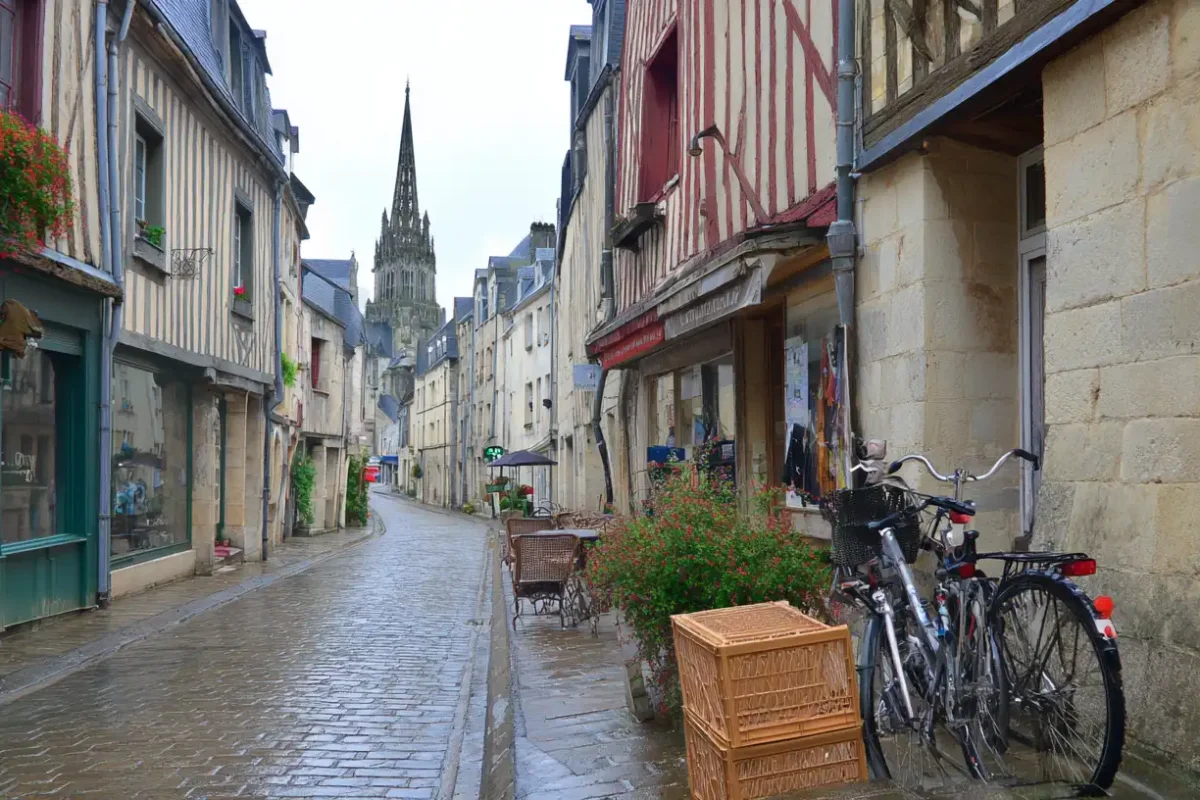
Bayeux is the right base for most first-time visitors to Normandy. It’s the most walkable and characterful of the main towns, it survived World War II largely intact (unlike Caen), and it sits in the middle of the D-Day geography.
From Bayeux:
- Omaha Beach and the American Cemetery: 30–40 minutes
- Pointe du Hoc: 40 minutes
- Utah Beach: 55 minutes
- Mont Saint-Michel: roughly 1.5 hours
- Étretat: 2 hours
The town has a good range of hotels from budget guesthouses to boutique properties in the old town, with prices generally running a bit higher than nearby Caen for comparable quality but well below what you’d pay in a resort town like Honfleur in peak season. There are also a handful of chambres d’hôtes (French B&Bs) within walking distance of the cathedral that tend to undercut hotel prices while offering a better breakfast.
Book well ahead for June, particularly the first and second weeks, when D-Day anniversary commemorations bring in visitors from North America, the UK, and veterans’ groups. The town is genuinely small and fills up fast during this window. May and September carry far less pressure.
The Bayeux market runs Wednesdays and Saturdays. If you’re arriving mid-week, timing your arrival for Wednesday morning gives you immediate access to local cheese, cider, and Norman charcuterie before you even start sightseeing. The Saturday market is larger and worth planning around if you’re staying the weekend.
One honest caveat: the Bayeux Tapestry Museum is closed for renovation until October 2027, and the tapestry itself has been on loan to the British Museum in London since September 2026. If the tapestry was part of your Bayeux plan, adjust expectations — but the cathedral, the war cemetery, and the town itself still justify the base. The tapestry used to be the specific reason to go to Bayeux; without it, Bayeux is still the right place to sleep when visiting the D-Day sites.
Honfleur: The Coastal Base
Best for: Étretat, coastal Norman towns, artistic itinerary, Pays d’Auge from the north
Honfleur sits at the mouth of the Seine estuary, with a medieval harbor lined with tall 17th-century slate-fronted houses and a genuine art history — Monet, Courbet, and Boudin all painted here. The old port quarter (Vieux-Bassin) is one of the more photogenic small harbors in France.
From Honfleur:
- Étretat: 40 minutes
- Caen: 1 hour
- Bayeux: 1 hour 15 minutes
- D-Day beaches: 1 hour 30 minutes
- Mont Saint-Michel: 2 hours 30 minutes
Honfleur works well as a base if your priority is the coastal Normandy sites — the Étretat cliffs, the Norman ports — rather than the D-Day beaches. For a D-Day-focused trip, it’s too far west from the main beach sites and too far east from Mont Saint-Michel to serve efficiently.
Hotels in Honfleur tend to run more expensive than Bayeux equivalents for comparable quality, largely a function of the town’s status as a tourist destination in its own right. Boutique and historic property options are particularly strong here — the 18th-century mansion hotels near the port are genuinely atmospheric, several occupying converted merchant houses with low beams, uneven floors, and window views straight out over the harbor.
The town can be crowded on summer weekends, and parking is genuinely limited — the main paid lots fill up on Saturday afternoons in July and August, and the residential streets around the old port are largely unavailable to visitors. Arriving Thursday afternoon rather than Friday sidesteps the weekend surge and gives you Friday morning in the town before the crowds arrive.
One honest note: Honfleur is a town that photographs extremely well and doesn’t always quite match the photograph when you’re standing in it in August. It’s still worth a base if the coastal circuit is your priority — just go in with realistic expectations about summer crowds on the quayside.
Caen: The Practical Option
Best for: D-Day beaches, budget travelers, car rental base, train connections
Caen is the largest city in the region and the practical choice rather than the atmospheric one. It was heavily bombed in 1944, and the center is largely modern reconstruction — less appealing to walk than Bayeux or Honfleur. If you arrive expecting a medieval Norman city, you’ll be disappointed. If you arrive expecting a functional French regional capital with a good museum and easy logistics, it works fine.
Its advantages are real: direct train connections to Paris (roughly 2 hours, with the fastest services closer to 1 hour 55 minutes), a larger selection of rental car operators at the station and airport, and proximity to both the D-Day beaches and the Caen Memorial museum.
The Mémorial de Caen covers the Second World War more thoroughly than any other museum in Normandy, tracing the full context from interwar Europe through the Normandy campaign and its aftermath, along with sections on the Cold War. It’s larger and more historically ambitious than the individual beach museums, and a full visit runs around four hours. Adult admission is €20.80. It’s worth half a day before visiting the beaches themselves.
Hotels in Caen are generally cheaper than Bayeux for equivalent quality, which is a real point in its favor for budget-conscious travelers who don’t mind trading atmosphere for savings.
Near Mont Saint-Michel: Mainland Options
Best for: Mont Saint-Michel as the primary destination, budget-conscious travelers
The area around Mont Saint-Michel on the mainland offers significantly cheaper accommodation than either the island itself or the main Norman towns.
Pontorson, the nearest market town (about 9km from the island), has a range of budget hotel options. It’s a functional stop rather than a particularly interesting town in its own right, but it works well as a cheap base if you’re spending your time on the island.
Several hotels operate in the zone between the parking area and the island, at La Caserne and around the causeway approach, generally at mid-range prices with the practical advantage of being walkable to the shuttle bus stops and, in some cases, having views of the island from their windows or terraces.
Staying on the Island: The Honest Assessment
There are seven hotels on Mont Saint-Michel island itself, strung along the main street, plus a single bed-and-breakfast run by one of the village’s oldest families. Prices in season run well above mainland equivalents — expect a genuine premium for the location, particularly in July and August.
The argument for: you get the island at dawn and after 6pm, once the day visitors are gone. The main street, silent at 5:30am, is a completely different place from what it is at noon. The souvenir shops are shuttered, the sound of the tide replaces the coach-tour commentary, and the abbey lit against a dark sky looks like something a monk painted rather than something a tourist board photographed. These are real experiences, not easily replicated by a mainland stay with a very early shuttle.
The argument against: the price premium is very real. Rooms in some island hotels are noticeably smaller than mainland equivalents for more money. Island restaurants charge a location tax on top of already-premium Norman dining prices. Some hotels on the main street deal with noise from other guests and from the street itself late into the evening. You’re paying for geography, not necessarily for service quality.
Worth being honest about, too: the gap between arriving on the island at 7am from a mainland hotel (very doable) and actually waking up on the island at 5:30am is smaller than the price difference suggests. You’ll miss the earliest dawn light, but you’ll also spend considerably less and eat dinner somewhere with more reasonable prices.
The honest calculation: if you can absorb one night on the island without distorting your budget, do it once — it’s a specific experience worth having. If the cost difference is significant for your trip, a very early mainland arrival before 8:30am on a weekday gets you close to the island-overnight atmosphere at a fraction of the cost.
In winter, on-island hotel prices drop substantially from their summer peak. If you want the island experience without the peak-season premium, November through February is the window where it makes the most financial sense — with the tradeoff of colder, greyer weather and shorter days.
Rouen: Eastern Normandy Base
Best for: Étretat, Fécamp, upper Normandy coast, visitors connecting from Paris by train
Rouen is about 1.5 hours from Paris by train and sits in eastern Normandy, making it an efficient first stop for visitors arriving from the capital by rail.
The city is worth visiting independently of its role as a base — the Gothic cathedral (famously painted by Monet in multiple light conditions), the medieval old town, and the Jeanne d’Arc history are all worthwhile. Rouen is the most genuinely urban of Normandy’s cities, with a restaurant scene and evening life that Bayeux doesn’t have.
But as a base for Mont Saint-Michel or the D-Day beaches, it sits at the wrong end of the region — around two hours from Bayeux by car, and considerably more to the island. It’s better used as a stop on a longer Normandy loop (Paris → Rouen → Honfleur → Bayeux → Mont Saint-Michel) than as a fixed base you return to each night.
FAQ
Where is the best base for visiting the D-Day beaches? Bayeux. It’s centrally located between the main American sector beaches (Omaha, Pointe du Hoc, Utah) and sits 30–40 minutes from Omaha Beach and the American Cemetery. It’s also the most walkable and atmospheric of the main Norman towns. Caen is a larger, generally cheaper option with good transport links but less character.
Is it worth staying on Mont Saint-Michel island? Once, if your budget allows. The early morning and late evening atmosphere on the island, once day visitors have gone, justifies the premium for many travelers. Prices drop substantially in winter, when the experience can feel even more atmospheric without the summer crowds. If budget is a concern, a very early mainland arrival (before 9am on a weekday) gets you close to the island experience at a much lower cost.
How far is Bayeux from Mont Saint-Michel? Roughly 1.5 hours by car under normal traffic. Bayeux works as a base for both the D-Day beaches and Mont Saint-Michel if you’re comfortable with the driving on the Mont Saint-Michel day. Some visitors prefer to spend their second night closer to the island rather than driving back to Bayeux.
What’s the difference between staying in Honfleur vs Bayeux? Honfleur is better positioned for the coastal Norman sites — Étretat, Fécamp, the Seine estuary. Bayeux is better positioned for the D-Day beaches and the Pays d’Auge interior. They’re about 1 hour 15 minutes apart. For a mixed itinerary, choose based on your first or last stop, or consider one night in each.
Are there budget accommodation options near Mont Saint-Michel? Yes. Pontorson, about 9km from the island, has a range of budget hotels, and the causeway-area hotels near the shuttle stops offer mid-range prices with occasional views of the island. Staying on the island itself is the expensive option; mainland alternatives are significantly cheaper for comparable quality.