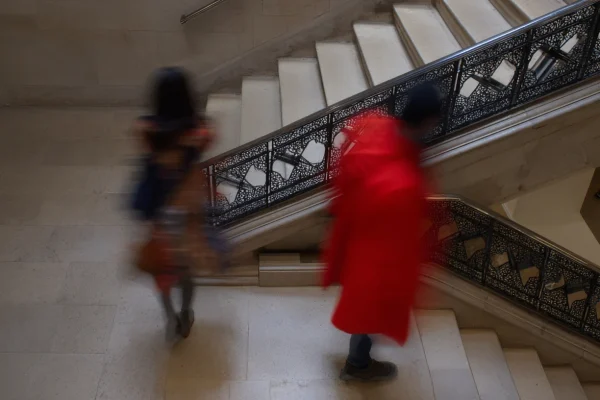
Mont Saint-Michel Abbey sits at the top of a climb that genuinely earns the view. By the time you reach the abbey church, your legs are burning and the panorama behind you looks completely unreal — the bay spreads out below in every direction, the causeway, the village rooftops, and the flat Norman coastline all shrinking beneath you. The building you’re standing inside was started in the eleventh century. Benedictine monks climbed these same stairs for a thousand years. It hits differently up here than it did at the bottom, where the souvenir shops were selling crepe spatulas shaped like the island.
Mont Saint-Michel draws close to 2.8 million visitors a year to the site as a whole, with roughly 1.6 million of those actually buying a ticket to the abbey itself. Most people walk the main street, eat something, take a photo from the ramparts, and leave. A smaller group buys a ticket and climbs to the abbey. A smaller group still actually understands what they’re looking at inside.
This guide is for that last group.
What Mont Saint-Michel Abbey Actually Is
People sometimes assume the whole island is the abbey. It’s not.
The island has three layers. At the bottom: the causeway, parking, the shuttle bus stop. In the middle: the medieval village, Grand Rue (the main commercial street), and the rampart walls. At the top: the abbey.
You can walk the entire village without paying anything. The abbey — the actual religious complex at the summit — costs €16 per adult from April 1 to September 30, and €13 per adult from October through March. Under-18s enter free, and EU and EEA residents aged 18–25 enter free with valid ID. Book tickets in advance through the official CMN portal (tickets.monuments-nationaux.fr) — they’re released one month ahead and do sell out on peak summer days. A printed self-guided visit booklet is included free with every ticket, in over a dozen languages; a more immersive audio or tablet tour is available as a paid add-on if you want it.
Opening hours: May 1 to August 31, the abbey opens at 9:00am and closes at 7:00pm. September 1 through April 30, hours are 9:30am to 6:00pm. Last entry is one hour before closing, and last audioguide withdrawal is 90 minutes before closing if you’re using one. The abbey is closed on January 1, May 1, and December 25, plus the occasional additional closure — worth double-checking the official site if you’re planning a trip specifically around the abbey.
The climb from the entrance gate to the abbey door takes about 10–15 minutes of steady uphill walking through the medieval lanes. Most of it is stairs. Not brutal stairs — the route is well-maintained — but real ones. If mobility is a concern, check CMN’s accessibility information before booking.
The History Worth Knowing Before You Go In
In 966, Benedictine monks settled on this rock. They found an existing chapel and began transforming the island into one of the leading religious centers of medieval Normandy.
Over the following three centuries, the complex grew in layers. Each century added something — a new chapel, expanded living quarters, fortifications, a crypt. The architectural result is a jumble of Carolingian foundations, Romanesque nave, and Gothic additions that somehow holds together as a coherent whole.
The 13th century brought the abbey’s defining achievement: La Merveille (The Marvel), a Gothic building constructed in under two decades on the north face of the rock. It’s one of the finest pieces of medieval architecture in France, and it’s why the abbey is worth the ticket price.
During the French Revolution, the monks were expelled and the building was nationalized. For decades it served as a prison. The monks returned in 1966, exactly a thousand years after the original community settled. A small monastic community still lives on the island today — not in the main abbey, but in a smaller location on the island.
Inside the Abbey: What You’re Actually Looking At
The visit follows a set route. You can’t free-roam — you move through the rooms in sequence. This is actually useful because the route is designed to build toward the best part.
The terraces and the Romanesque church. The first impression is the exterior terrace with its outrageous view. The abbey church here is Romanesque in structure — a long nave with thick stone walls built for weight and endurance rather than height and light. The effect is solid and slightly austere. There’s a statue of the archangel Michael inside, doing what archangels do in medieval iconography: standing over a fallen dragon. The stained glass in the choir is more recent; the medieval glass didn’t survive.
The church is impressive, but it’s not the emotional peak of the visit. That comes later.
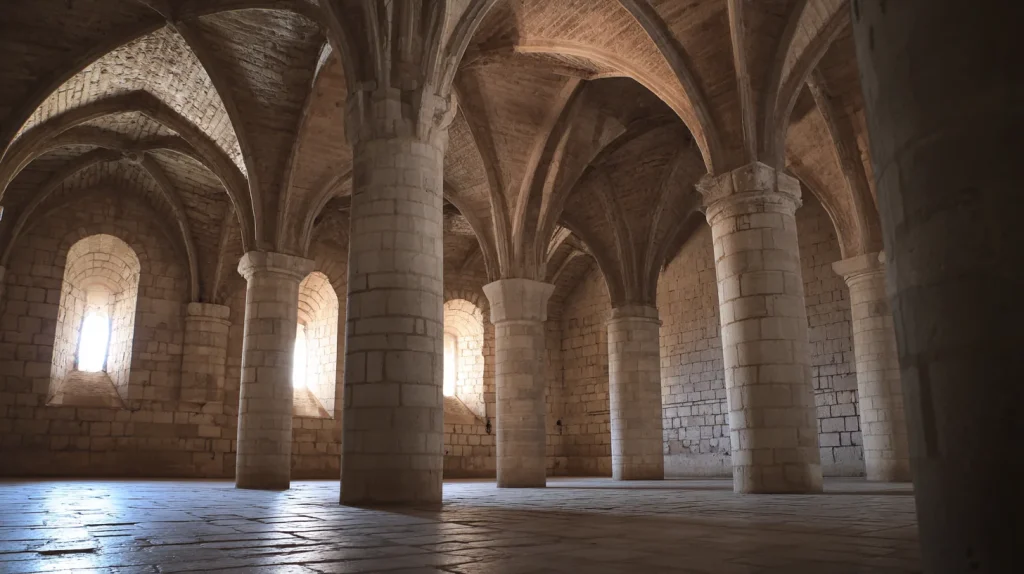
The crypts and undercroft. Underneath the church, carved into the rock itself, are the crypts — low-vaulted stone rooms that supported the weight of the church above. These aren’t particularly pretty rooms, but they have a specific feeling: the cold of deep stone, the awareness that you’re inside a medieval engineering solution as much as a religious space. The crypt of the Mighty Pillars (les Gros Piliers) is where that sense hits hardest. Twelve enormous cylindrical columns hold up the entire south end of the abbey.
La Merveille. This is the part that justifies the ticket.
The Marvel was built between 1211 and 1228 — two buildings stacked three stories high, clinging to the north face of the rock. The levels from bottom to top: the Cellar and the Almonry (ground floor), the Knights’ Hall and the Guests’ Hall (middle floor), the Refectory and the Cloister (top floor). The whole structure stands about 35 meters tall.
The Knights’ Hall is one of the largest indoor Gothic spaces you’ll encounter at the abbey — four columns, five naves, a forest of medieval stone designed for scribes and monks who spent their days copying manuscripts. It’s cold in there even in summer.
The Refectory. The monks’ dining hall is a long, narrow room that seems to absorb light rather than reflect it. Tall narrow windows on the south wall let in strips of illumination without destroying the sense of enclosure. The acoustics make even quiet footsteps echo. When the room is empty of other tourists, it’s genuinely affecting. When it’s crowded, less so.
The Cloister. The cloister is at the very top of La Merveille, suspended between the abbey church and the refectory. It’s small — walkable in a couple of minutes — and built from Chausey granite, Caen limestone, and English Purbeck marble. The twin columns supporting the arches are set in offset rows, so from any angle you see a kind of visual rhythm instead of a static wall of stone.
Standing in the center of the cloister on a clear day, with the Norman sky above and nothing visible below, feels like standing at the edge of the medieval world. The monks who sat here for centuries weren’t admiring the view — they were copying texts, praying, moving from meal to prayer to work in a schedule designed to fill every waking hour. Being there now, with a tourist ticket and a printed guide booklet, is a different experience. But the space still does something to you that the souvenir street did not.
The Tides: Why They Actually Matter
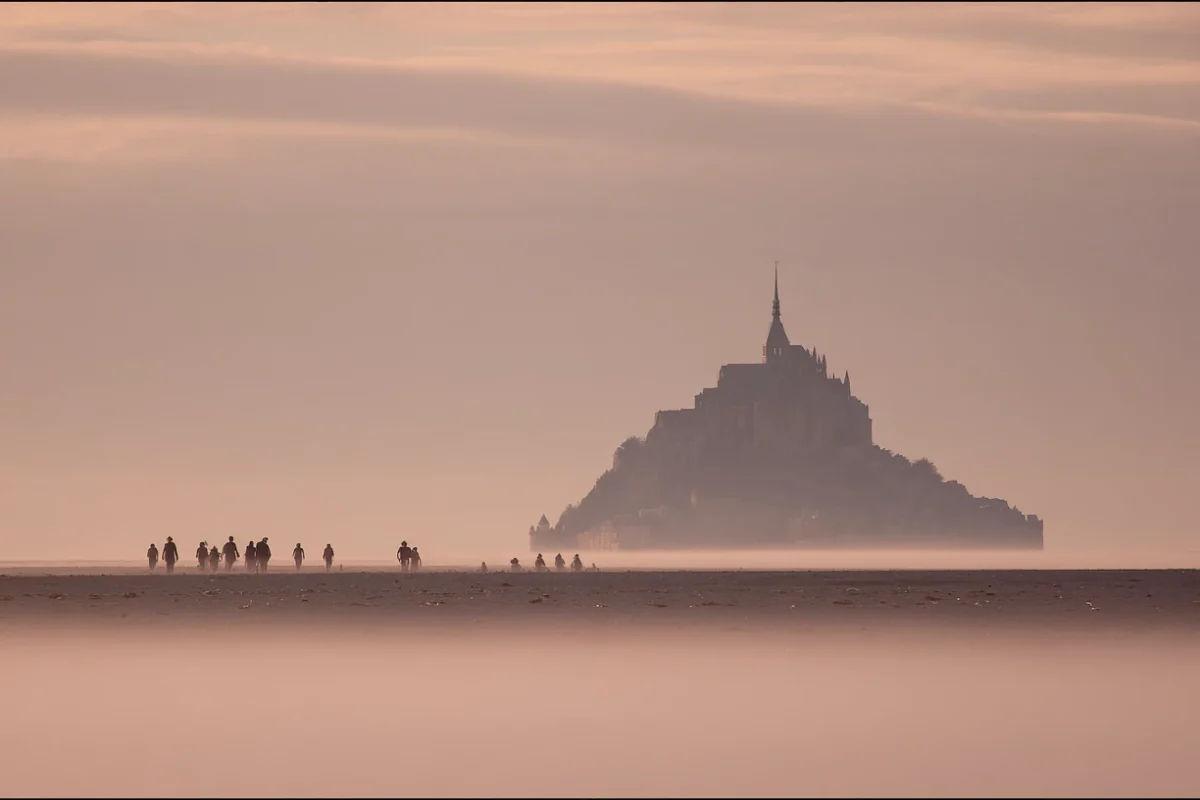
Mont Saint-Michel sits in a bay with the highest tidal range in continental Europe. The difference between low tide and high tide can reach around 14–15 meters on the biggest cycles, driven by the funnel shape of the bay and its very shallow, gently sloping seabed. During low tide, the sand flats surrounding the island are exposed and walkable. During high tide, water surrounds the island on all sides.
Modern infrastructure manages most of this for the ordinary visitor: the mainland road out to the parking areas stays passable even at high tide. But the footbridge connecting the parking area directly to the rock is a different story — during the most extreme spring tides, when the tidal coefficient climbs above about 110, the footbridge itself submerges and access to the island is genuinely cut off for roughly an hour and a half. This happens only a handful of days a year, almost always clustered around the March and September equinoxes, so it’s not something most visitors need to plan around — but it’s worth knowing it’s a real phenomenon, not just a metaphor.
The tides matter for two practical reasons:
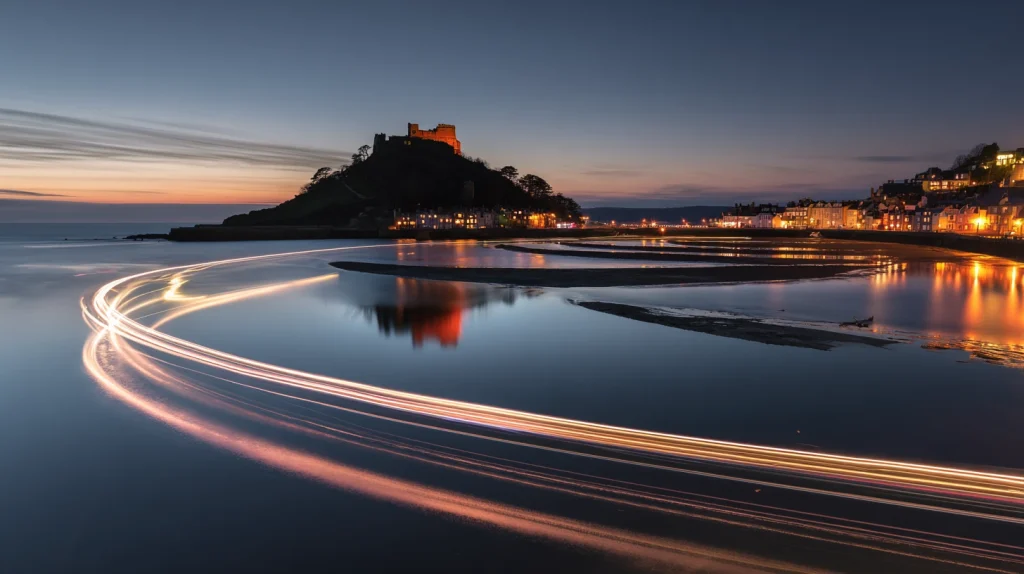
The photograph. The iconic image of Mont Saint-Michel — rock rising from water — only exists at high tide. At low tide, you’re looking at sand flats, which are atmospheric in their own way but less dramatic. If you want the postcard shot from the causeway approach, check the tide schedule before you go. The official tourism site publishes the full tidal calendar. Coefficients above 100 produce the most dramatic scenes.
The spring tides. A few times a year, exceptional tides (coefficient 110+) occur. The largest cluster around the March and September equinoxes — in 2026, the single highest tide of the year falls on March 14 (coefficient 119), with September 13 close behind at coefficient 118, the second-highest of the year. If you time your visit to one of these events, the water genuinely surrounds the island and the view is something different.
For the abbey visit itself, tide timing doesn’t change the interior experience. But it changes what you see from the terraces — which is reason enough to check before booking.
When to Go
May and September are the best months. Good weather, manageable crowds, and — in September especially, thanks to that mid-month equinox tide — some of the year’s most dramatic tides.
July and August are the most visited months. The main street runs at capacity. The abbey queues are long even with advance tickets. Arriving before 10am or after 5pm cuts the worst of it in summer, but you’ll still be sharing the cloister with a hundred people.
Weekdays are always quieter than weekends. Tuesday, Wednesday, and Thursday are your best options if you have flexibility.
Staying overnight on the island is the other solution. Rooms on the island are genuinely expensive — a simple double at the main hotels commonly runs somewhere in the €150–230 range in season, sometimes more. But you get the island at dawn and after 6pm, when the day visitors are gone. That early morning, when the light hits the abbey walls and you’re nearly alone on the main street, is worth more than any amount of extra preparation.
The island’s permanent population is tiny — around 20 people live there year-round. The atmosphere after the shuttles stop running in the evening is genuinely unlike anything you’ll encounter during the day.
The Honest Assessment
The abbey is worth it. The cloister and La Merveille are genuinely great medieval architecture that photographs can’t fully capture. The view from the top terraces is real and doesn’t disappoint.
The main street is not worth more than five minutes. Grand Rue is one of the more aggressively commercial medieval streets in France — every shop sells the same omelettes, the same crepes, the same stuffed-animal versions of Mont Saint-Michel. The famous soufflé omelette from La Mère Poulard restaurant is often discussed; it’s made in copper pans over open flames and runs around €34 for the plain version, with three-course menus built around it costing more. The experience of watching it made is genuinely theatrical. Whether it’s worth the price is a matter of perspective — plenty of visitors find it a memorable ritual, plenty of others find it steep for what’s essentially an omelette.
The crowds on the main street on a summer Saturday are genuinely difficult. Don’t go on a Saturday in July and August if you can avoid it.
FAQ
Do you need to book Mont Saint-Michel Abbey tickets in advance? Yes, especially in summer. Tickets sell out on peak days. Book through tickets.monuments-nationaux.fr — they’re released one month in advance. Advance booking also lets you skip the physical ticket queue at the entrance, which saves significant time in July and August.
How long does it take to visit the abbey? Allow 1.5 to 2.5 hours to see the abbey properly at a relaxed pace with the included guide booklet. If you’re moving quickly through the main rooms only, an hour is enough. Budget extra time if you want to sit in the cloister for more than a few minutes.
Can you see Mont Saint-Michel without going inside the abbey? Yes. The island village, rampart walks, and bay views are all free. The abbey costs €16 per adult from April through September, dropping to €13 the rest of the year. If your time is short or mobility is a concern, the island experience without the abbey is still worthwhile — but the interior is where the architecture rewards you most.
What’s the best time of day to visit Mont Saint-Michel? Before 10am or after 5pm to avoid peak crowds. An overnight stay gives you the most peaceful experience — dawn on the island with minimal crowds is significantly different from midday in summer. Tuesdays, Wednesdays, and Thursdays are quieter than weekends year-round.
Does the tide actually cut off Mont Saint-Michel? The mainland approach road stays accessible even at high tide, but the pedestrian footbridge connecting the parking area to the rock genuinely does submerge and cut off access for around 90 minutes during the year’s most extreme spring tides, when the coefficient climbs above roughly 110. This happens only a handful of days a year, mostly around the March and September equinoxes. Check the tide schedule before your visit if this matters to you — the timing shifts daily.