Provence on a budget sounds like a contradiction to a lot of travelers — hotels in Gordes in July, rosé on a terrace, the mas farmhouse with the pool and the lavender view. All of it real, all of it not cheap.
But the reputation does the region a disservice. Provence is large, and prices swing wildly depending on where and how you travel within it. The same morning can cost €7 (a coffee and a pastry, a walk through a village market, a hilltop viewpoint with no ticket) or €50 (breakfast at a hotel, entry to a major monument, lunch at a Luberon restaurant). Both are genuinely available. What you spend comes down almost entirely to the choices you make, not to some inherent expensiveness baked into the destination.
Here’s what it actually costs, broken into the things that move the needle most.
The numbers first
Based on aggregated spending data from recent travelers to the wider Provence-Alpes-Côte d’Azur region, the average daily spend runs around €190 per person per day — a figure that includes a share of a mid-range hotel, meals, local transport, and some sightseeing, for travelers who are staying in comfortable hotels and eating at sit-down restaurants regularly. It’s not a budget figure; it’s a blended average across all types of travelers.
For a couple sharing a room, a realistic one-week trip at that same average level runs somewhere around €2,500 to €2,700 total, covering accommodation, food, transport, and entry fees, but not flights or car rental.
A deliberately budget-minded approach can bring the daily figure down to roughly €80 to €100 per person. A comfortable but not luxury approach lands closer to €130 to €160 per day. The average above is a midpoint across all traveler types, not a floor.
Accommodation: where the real gap is
Accommodation is where the biggest differences live, and where the biggest mistakes get made.
Budget tier (€40–€75/night, double room): Hostels in Avignon and Aix-en-Provence have private rooms in this range. A gîte (self-catered rural rental) shared between two or three people can also land here outside of peak season. Don’t expect a village view or a pool at this price point, but clean and functional is genuinely available.
Mid-range tier (€90–€150/night): This is where most hotel options land in Avignon, Aix-en-Provence, and the smaller towns — a reliable 3-star hotel with an en-suite room, breakfast optional. In July and August, this same room can climb to €150–€200.
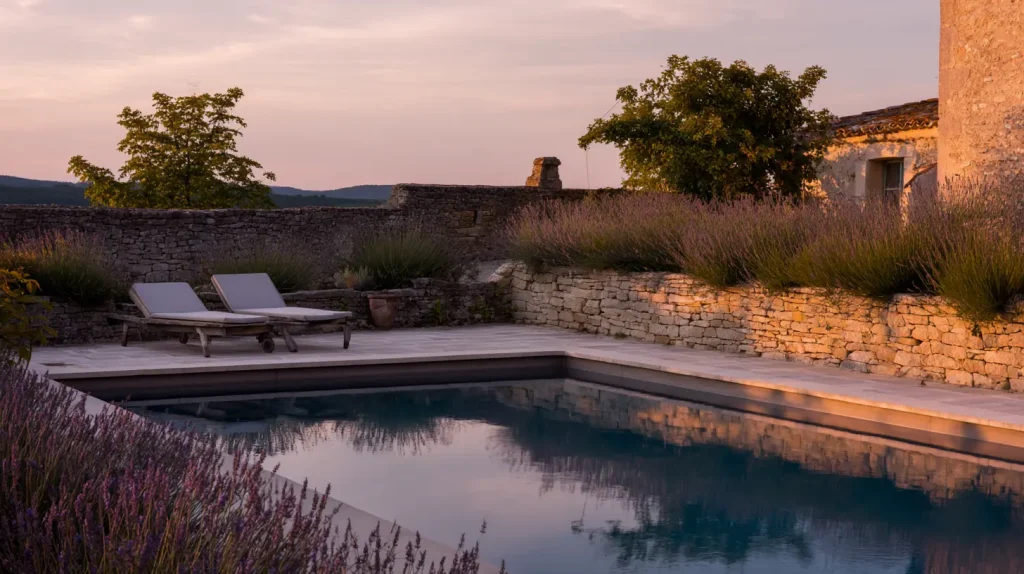
Luberon village accommodation: This is where prices get genuinely steep. A stone mas farmhouse in the Luberon in July commonly runs €200 to €400 or more per night for a private room or self-catered cottage, with the same property often dropping to somewhere around €120 to €200 in May or September. This is where the seasonal timing decision alone is worth €80 to €100 a night.
The single most effective accommodation saving in Provence: choose Avignon as a base instead of a Luberon village. A mid-range Avignon hotel runs roughly €90 to €130 a night in peak season, while a Luberon boutique property often starts around €200 — and you’re typically 50 to 60 minutes from the same villages either way.
The second most effective saving: travel in June or early September instead of July or August. Accommodation prices commonly drop somewhere in the 20 to 40 percent range.
Food: the formule déjeuner is your best tool
Restaurants in Provence, like everywhere in France, offer a formule déjeuner — a fixed-price lunch menu, typically two courses for somewhere around €14 to €18, or three courses for roughly €18 to €24. The same dishes from the same kitchen at dinner commonly cost €25 to €40 per person, sometimes more.
If you eat your main meal at lunch and keep dinner simple — cheese, charcuterie, bread, and olives from a market — your daily food spend can realistically stay under €30 per person while still eating well.
A few reference prices to calibrate against:
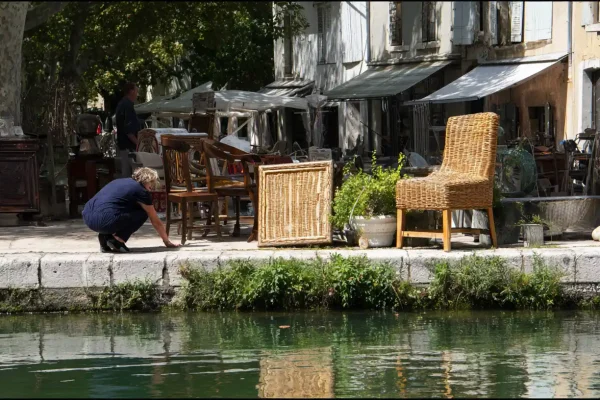
A proper market lunch — baguette sandwich, a chunk of cheese, a tomato, some olives, and fruit — generally runs €8 to €12 total. The markets in Apt, Lourmarin, Carpentras, and L’Isle-sur-la-Sorgue all support this approach easily, and the produce is genuinely excellent, not a compromise.
A café coffee (un café) runs roughly €1.50 to €2.50, depending on whether you’re standing at the counter or sitting at a terrace with a view.
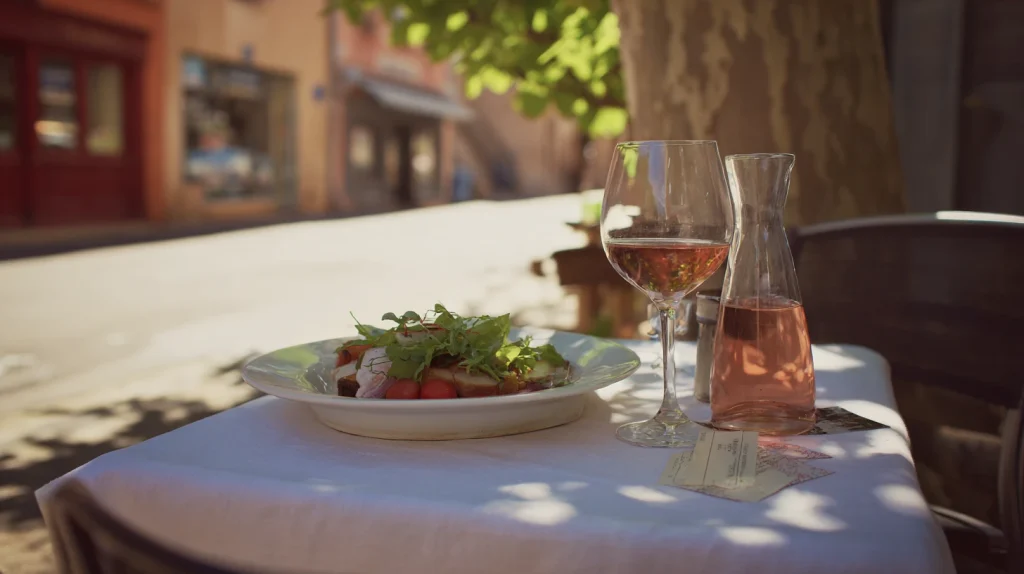
A glass of house rosé at a restaurant generally costs €5 to €8. A bottle of decent Luberon or Côtes de Provence rosé from a supermarket generally runs somewhere around €5 to €12.
A full dinner at a Luberon restaurant, without wine, commonly runs €30 to €50 per person. In July and August, popular village restaurants often need reservations a week or two in advance.
Getting around: the car cost nobody budgets for
Almost everyone visiting Provence rents a car. Very few people budget for it accurately.
Car rental itself: a compact car for a week generally runs somewhere around €200 to €400 total, depending on the company, season, and how far ahead you book. Full coverage insurance — genuinely worth having for narrow Luberon lanes — adds meaningful cost on top of budget-tier rental rates.
Fuel: unleaded petrol (SP95) in France has generally run somewhere in the €1.70 to €1.90 per liter range recently, though it’s worth checking current prices before you go since fuel costs shift with global markets. Budget roughly €10 to €15 per day of driving in the Luberon circuit — the village-to-village distances are short, but the roads are winding and slow.
Tolls: if you’re arriving by autoroute from Marseille, Lyon, or the coast, toll costs add up — the A7 from Lyon to Avignon and the A8 along the coast near Nice both carry tolls. If you’re renting a car at Marseille-Provence airport and driving to Avignon, budget roughly €10 to €15 in tolls one-way, though it’s worth checking current rates since toll pricing is adjusted periodically.
Parking in Avignon: the inner city has limited parking on a paid zone system. Budget roughly €10 to €15 a day for a central garage if you’re based inside the walls.
For budget travelers, the car decision matters: if you’re based in Avignon and doing day trips into the Luberon, you can manage some routes with buses and taxis for a few days without a car, but it limits you significantly. For most Provence itineraries, the car isn’t really optional — planning its full cost honestly, not just the rental fee, avoids an unpleasant surprise partway through the trip.
Free and low-cost things to do
Provence has a meaningful amount of genuinely free or nearly-free activity, and a lot of it counts among the best things the region offers.
Free: Walking the hilltop villages costs nothing — the viewpoint above Gordes, the village streets in Roussillon, the old town in Les Baux-de-Provence, and market squares everywhere all charge no entry. You can spend an entire day moving between villages and spend nothing on sightseeing.
The hiking trails in the Luberon Regional Natural Park are free, and the GR trails through the Luberon are well-marked enough to walk village to village at no cost.
Village markets are free to browse and cheap to buy from — a bag of tomatoes, a wedge of cheese, and a baguette runs around €8 to €12 total.
The lavender field approach road at Sénanque Abbey is free to walk and photograph from outside the abbey itself — the scene that appears in essentially every Provence lavender photo doesn’t require an entry ticket to see, just a trip in late June or early July when the fields are at peak.
Paid, but worth knowing the price: The Roussillon ochre trail costs €3.50 per person. The Palais des Papes in Avignon runs roughly €12 for the palace alone, or around €14.50 combined with the Pont d’Avignon bridge. At the Pont du Gard, walking across the ancient aqueduct itself is free — the fee, generally somewhere around €8 to €9.50 per adult, is specifically for the museum and discovery areas on-site, with parking charged separately at a few euros on top. The Luberon Museum in Apt runs a modest few euros as well.
Most entry fees in the region are low enough that seeing two or three paid attractions per trip doesn’t seriously move the budget. The big spend categories are accommodation, the car, and restaurants — not tickets.
The three daily budget tiers
Budget: roughly €70–€90/day per person. Base in Avignon or a mid-range town. Hostel or budget hotel around €35–€45 per person per night. Market lunches plus one sit-down meal daily. No car — occasional bus, taxi, or a one-day rental for specific trips. Skip the Luberon mas. Travel in May or September.
This is achievable with some planning, and it means missing some of the most atmospheric accommodation — but you see the same landscapes and villages everyone else does.
Mid-range: roughly €120–€160/day per person. Mid-range hotel or gîte around €90–€130/night shared. Formule déjeuner most days, occasional dinner at a proper restaurant (€35–€45/person). Rental car for the trip. All the main sites. Travel in late June or September.
This is the comfortable Provence trip most visitors actually end up having.
Comfortable: €200+/day per person. Boutique Luberon hotel or mas farmhouse at €200–€350/night. Dinner reservations at the places worth reserving. Wine with most meals. No trade-offs.
This is roughly what the Provence of travel magazines actually costs. The gap between mid-range and comfortable is mostly accommodation and dinners — not sightseeing.
The mistakes that cost most people extra money
Booking Luberon accommodation in June for a July stay. The best properties — mas farmhouses, boutique village hotels — fill months ahead. Book late and you end up in worse accommodation at the same price; book early and you get the property you actually wanted.
Eating dinner at the wrong places. A restaurant with a good terrace view in a Luberon village can charge €50 to €60 per person for dinner without being particularly good. The formule déjeuner at the same restaurant, or its equivalent around the corner, often delivers similar quality at roughly half the price. Lunch is where the value is in France.
Underestimating the car. People budget for the rental and forget fuel, tolls, and parking. Add at least €100 to €150 to your car budget beyond the base rental rate for a week.
Going in July or August without a reservation strategy. Everything costs more, everything needs booking further ahead, and you end up spending time and money navigating crowding logistics that simply don’t exist in June.
Buying wine at restaurant prices. Provence rosé from a supermarket or local cave coopérative generally runs €5 to €12 for something genuinely good. The same bottle at a restaurant terrace often runs €25 to €40. Buy it at the supermarket and drink it at a hilltop viewpoint at sunset instead — it’s not a lesser experience.
Timing for lower prices
May and early June bring mild temperatures, no real crowds, fully open restaurants and markets, and hotel prices commonly 20 to 35 percent below peak. The one thing missing is lavender.
Late September brings grape harvest, prices somewhat lower than August, good weather, and noticeably fewer crowds than the summer peak.
February, if you can manage it, brings truffle markets in Carpentras and Richerenches, very few other tourists, and accommodation prices at their yearly low. It’s cold, sometimes windy from the Mistral, and many smaller village properties are closed for the season — but Avignon and Aix stay open and genuinely quiet.
Frequently asked questions
Is Provence expensive compared to the rest of France? Provence runs roughly comparable to Paris for accommodation at the top end in peak season, but mid-range and budget options are generally more affordable than Paris equivalents. A typical mid-range hotel here runs around €90 to €130 a night. Food and attractions are reasonably priced by Western European standards.
What’s the cheapest way to get around Provence? Base yourself in Avignon and combine TGV trains, local buses, and one-day car rentals for specific trips — this avoids the daily cost of a full-length rental. For a genuine circuit of the Luberon villages, though, a car is really the only practical option, since buses don’t serve the hilltop villages well and run infrequently.
How much does a week in Provence cost for two people? A realistic mid-range week for two — car included, mid-range hotel, a mix of market lunches and restaurant dinners — typically runs somewhere around €1,800 to €2,500 total, excluding flights, or roughly €130 to €180 per person per day. A budget approach can bring the total closer to €1,000 to €1,200 for two; comfortable or upscale travel runs €3,000 to €5,000 or more.
What are the biggest free things to do in Provence? Walking the hilltop villages, hiking the Luberon’s GR trails, browsing the village markets, taking in the viewpoints above Gordes and Roussillon, and photographing the lavender from the approach road at Sénanque Abbey are all free. Several of the most memorable Provence experiences cost nothing beyond getting yourself there.
Can you do Provence without a car? You can manage a limited version of it. Avignon and Aix-en-Provence are reachable by TGV from Paris, and a handful of Luberon villages have occasional bus connections. But the classic village circuit — Gordes, Roussillon, Bonnieux, Sénanque, Lourmarin — isn’t realistically doable without a car unless you’re booking expensive taxis for each leg. For most visitors, the car isn’t really optional.