The mistake most first-time visitors make when deciding where to stay in Provence is choosing a base the same way they’d pick a hotel in Paris — finding something in a place that looks good on a map and hoping the rest falls into place.
Provence doesn’t work like that. The region is large. The famous sites spread across distinct zones: the Luberon to the east, the Alpilles to the west, the Rhône plain through the center, the coast an hour south. Your base isn’t just where you sleep. It’s the anchor that either makes the driving efficient or turns every day into an hour and a half of getting somewhere before you can start enjoying it.
I’ve seen this go wrong for people who stayed in Aix-en-Provence because they’d heard it was beautiful — it is — while spending most of their trip driving nearly an hour north into the Luberon and back. And I’ve seen people stay deep in the Luberon hills and spend three days barely leaving the terrace. Neither is entirely wrong. But both could have been better.
The question is what you came for. Start there.
Avignon: The Strategist’s Base
If your trip is car-based and you want to cover the most ground in the least time, Avignon is your most efficient home.
It sits at the geographic center of Provence’s main tourist circuit. From Avignon, the Luberon villages (Gordes, Roussillon, Bonnieux) are roughly 45 to 55 minutes away. Pont du Gard is about 25 minutes. Saint-Rémy and the Alpilles are about 30 minutes. Châteauneuf-du-Pape wine country is around 20 minutes north. Arles is about 45 minutes southwest. No other base in Provence gets you to all five of those zones within an hour.
Avignon itself is a proper medieval city with the Palais des Papes, ramparts that still stand entirely intact, and a restaurant scene that’s genuinely good rather than tourist-trap good. It stays open year-round, unlike many Luberon village hotels and restaurants that close from November through March.
The honest downsides: Avignon’s inner city parking is a genuine problem. Traffic through the narrow streets inside the walls is slow and maddening if you have a car. Most visitors park on the city perimeter and walk in. The city also hosts the famous Avignon Theatre Festival through most of July, which is either a reason to be there or a reason to have booked months ahead, depending on whether you can still find a restaurant table.
One thing Avignon doesn’t give you is the feeling of actually sleeping in Provence. The hilltop village, the stone walls, the view over lavender at 7am — that’s not the Avignon experience. It’s more France-in-general than Provence-specifically. If the atmosphere matters to you as much as the logistics, look elsewhere.
If you’re not renting a car, Avignon is also your best option. It has a TGV station with direct trains from Paris in under three hours. From there you can reach parts of the Luberon by bus and local taxi, slowly, with planning, which makes it the only genuinely practical car-free base in the region.
Saint-Rémy-de-Provence: The First-Timer Sweet Spot
Saint-Rémy sits in the Alpilles, a compact limestone mountain range that looks like something from a folklore illustration. It’s smaller and far less touristy than Avignon, with a real village center and a Wednesday morning market that turns the streets into something worth waking up early for.
From Saint-Rémy, you’re within about 30 minutes of Avignon, Arles, and the western Luberon villages. The Alpilles natural park is right there. Les Baux-de-Provence, the most dramatic hilltop ruin in the region, is roughly 20 minutes away.
What makes Saint-Rémy work for first-timers is that it avoids the extremes. Avignon can feel like a city when you’ve come expecting villages. The deep Luberon feels wonderfully rural but thin on good restaurants if you’re staying far inside it. Saint-Rémy is the middle ground — a real place with real facilities that still looks and feels like Provence. You can walk to dinner without planning it two weeks in advance.
There’s also a Van Gogh dimension that doesn’t come with a brochure attached. He spent just over a year at the Saint-Paul-de-Mausole asylum on the edge of town, where he painted The Starry Night and roughly 150 other works. It’s still a working psychiatric facility today, but the garden and the cloister are open to visit, and the context is affecting in a way that most art tourism is not.
The Luberon Villages: When Atmosphere Is the Actual Point
If you want to sleep inside Provence’s most iconic landscape, the one in every photograph, you want a base inside the Luberon itself. That means towns like Gordes, Goult, Bonnieux, Lourmarin, or Ménerbes.
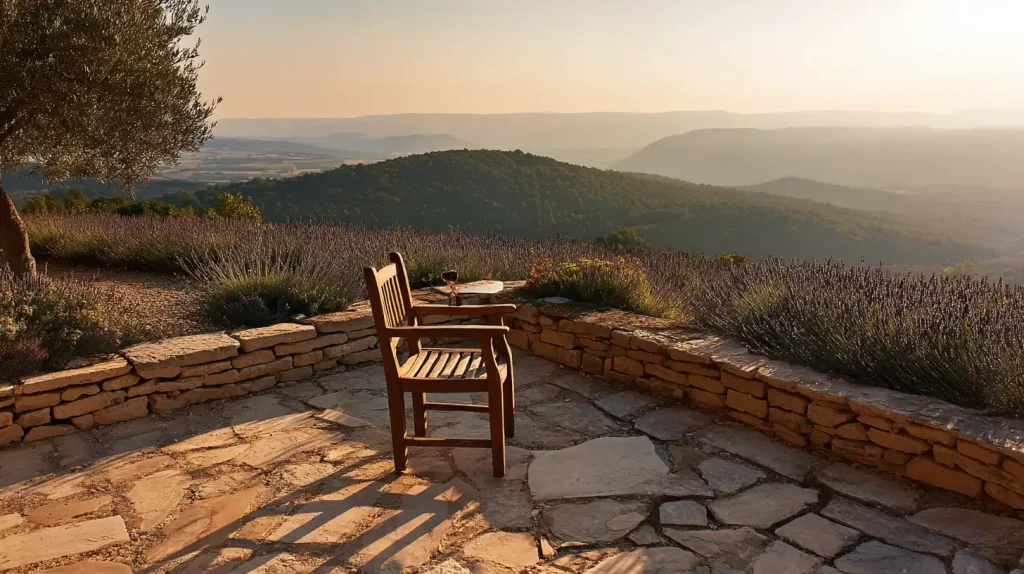
The upside is obvious. You walk out your door and the view is already there. You can reach Sénanque Abbey before the first tour bus arrives. You don’t spend an hour in the car every morning before the day begins.
The trade-offs are real and nobody mentions them:
Accommodation books out fast. The best stone mas farmhouses and boutique village hotels fill months in advance for summer. If you’re going in July or August and haven’t booked by April, you’re working with what’s left, and what’s left is often disappointing.
The driving is also less convenient than it looks. The Luberon circuit works well as a set of loops within the hills, but reaching Avignon, Arles, or the coast takes real time. From Gordes, Avignon is around 45 to 50 minutes. Cassis, for a day at the calanques, is closer to an hour and a half. If your trip includes a day at Pont du Gard and a day on the coast, a Luberon base adds a lot of windshield time.
Village life also closes down. Many smaller Luberon restaurants have limited evening hours, close one or two nights a week, and shut entirely from November through March. If you’re renting a gîte deep in the hills, dinner requires actual planning — you can’t just walk until something looks good.
That said, if you have five nights or more and the Luberon is the reason you made the trip, staying inside it is the better choice. A week based in Goult or Lourmarin is a genuinely different experience from the same week based in Avignon with daily drives in. Slower, more settled, more like the real place.
Goult in particular is worth knowing about. It sits between Gordes and Bonnieux without being either of them — less photographed, less visited, with a village center that still feels lived in by people who actually live there. Accommodation options are limited, but a week based there is one of the quieter good things you can do in the south of France.
Lourmarin is the other one worth pushing. It’s in the southern Luberon, which means slightly better access to Aix and the coast, and it has a genuinely good restaurant scene for a village its size. The Friday market draws local producers rather than souvenir stalls. There are two well-regarded hotels here from the same small operator, Le Moulin and Le Galinier, if you want something taken care of rather than self-catered.
L’Isle-sur-la-Sorgue: For Market Obsessives
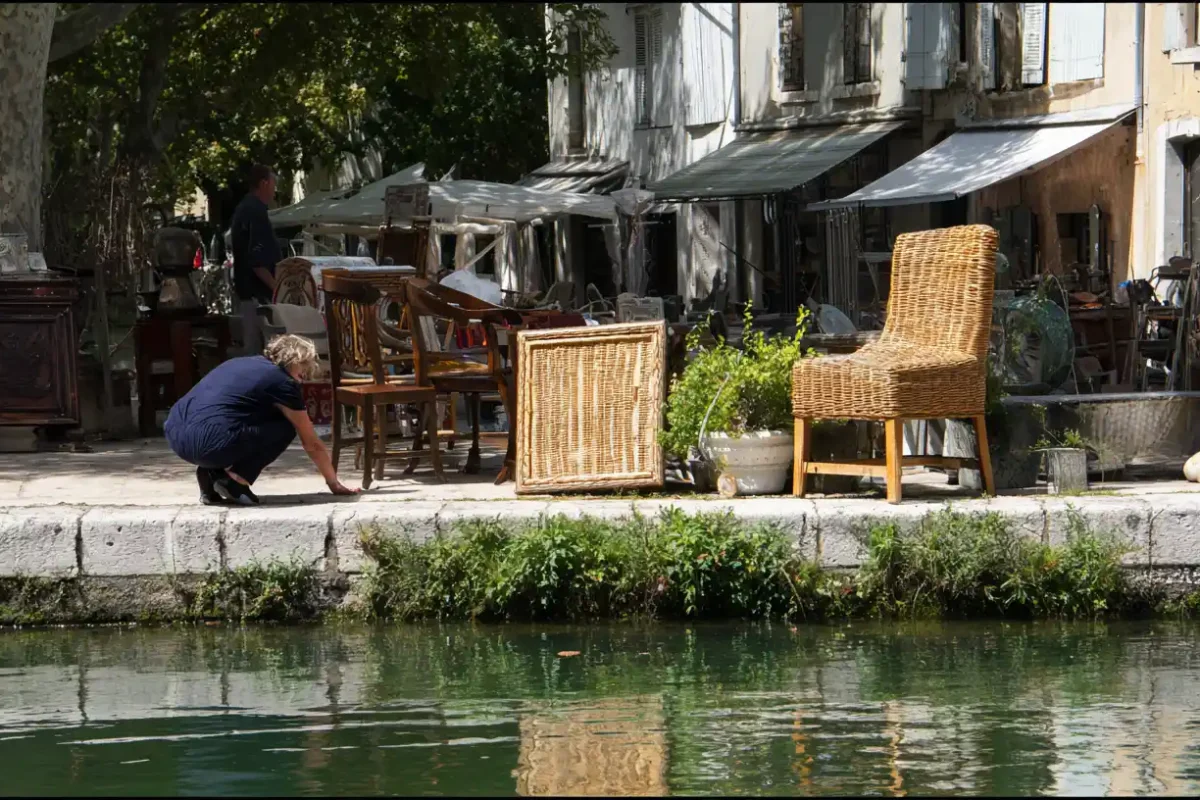
L’Isle-sur-la-Sorgue sits on canals — waterways genuinely run through the center — which gives it a different character from the stone-and-hilltop template of the Luberon. It’s about 30 minutes east of Avignon and 25 minutes north of the Luberon circuit.
The town is known for its Sunday market, one of the largest antique markets in France. Hundreds of dealers set up along the canal banks with furniture, ceramics, art, textiles, and objects from across Europe. These are real dealers with real prices, not a flea market, and people come specifically from Paris and beyond to buy. If antiques or vintage interiors are your thing, this is a full morning and possibly longer.
The specific reason to stay here rather than treating it as a day trip: if you want to be on the canal at 7am on Sunday before the crowds arrive, you need to be staying there the night before.
Beyond that, L’Isle-sur-la-Sorgue is a pleasant town with good restaurants and easy Luberon access. If Sunday antiques aren’t your draw, it works better as a day trip from a base in Avignon or Saint-Rémy than as the home base itself.
Aix-en-Provence: Honest Assessment
Aix is beautiful. Cours Mirabeau is one of the best main streets in France — wide, tree-lined, full of cafés that are good at being cafés and not just places to put tourists with coffee. The old town has 17th- and 18th-century limestone architecture. The Saturday market fills multiple squares. It’s a real city with a university and year-round energy that the Luberon villages don’t have.
But here’s what nobody says in these guides: Aix is a poor base if the Luberon circuit is your main goal.
Aix sits toward the southern end of Provence, roughly equidistant between Marseille and the Luberon hills. From Aix, Gordes is close to an hour’s drive. Avignon is about the same. Most of what defines the classic Provence experience sits an hour’s drive away in any direction.
Where Aix works well is as a gateway to the south. Cassis and the calanques are about 30 minutes. Marseille is about 30 minutes. The Sainte-Victoire mountain, which Cézanne painted obsessively from every angle, is right outside town. If your trip deliberately combines inland Provence with a day or two at the coast, Aix is a reasonable anchor for that version of the trip.
My honest take: most people stay in Aix because it sounds like the right kind of place to stay — upscale, beautiful, French in a way that feels correct. It is all of those things. But it will add close to an hour of driving to every Luberon day trip, and after three days that math starts feeling heavy. Which, honestly, is the thing nobody tells you before you book.
What You Sleep In Matters Too
The base decision is about location. The accommodation type is about how Provence actually feels while you’re in it.
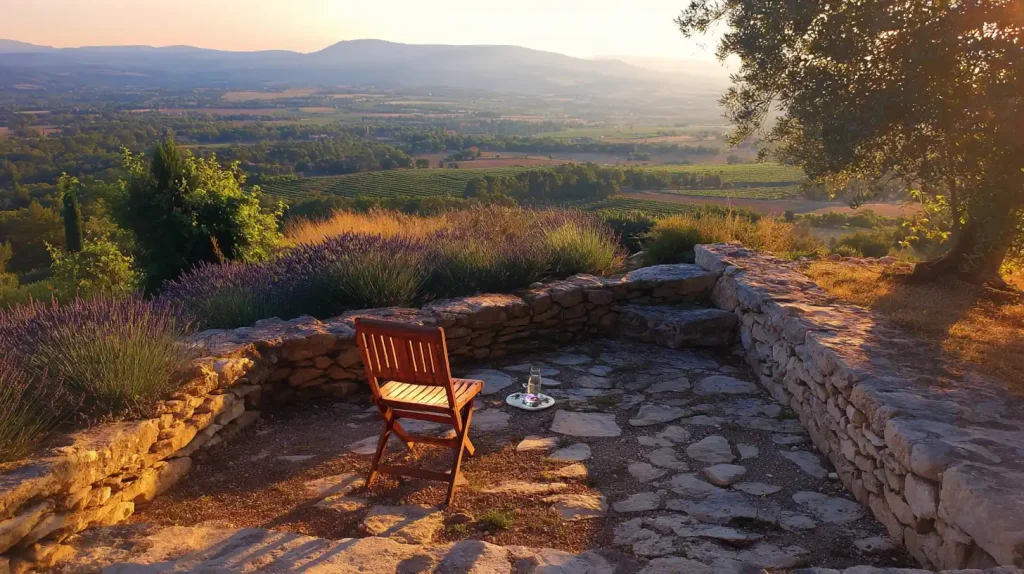
Stone mas farmhouses are the signature experience of the Luberon. Old Provençal stone farmsteads, some converted to boutique hotels, many available as gîtes (self-catered rentals), set in the hills with views over lavender, vines, and olive trees. A private terrace. A pool that nobody else is using at 7am. Silence except for cicadas. They are not cheap. A good mas in July costs more than most Paris hotels. But the experience of that morning — coffee, no one around, the valley going gold below you — is the thing people come back from talking about.
Village hotels vary more than you’d expect. In Gordes, Airelles La Bastide de Gordes is a luxury operation in a historic 16th-century village building with prices to match. In Lourmarin, Le Moulin is a converted 18th-century mill, more modest, more personal. In L’Isle-sur-la-Sorgue, La Maison sur la Sorgue is small, canal-side, and books out fast. These are all specific to their village in a way a standard chain hotel is not.
City hotels in Avignon and Aix cover the full spectrum from budget to luxury, with far better last-minute availability than anything in the Luberon. Hôtel La Mirande in Avignon is genuinely special — a historic building dating to 1309, a serious restaurant, one of the most considered hotels in the south of France, open year-round. For a more straightforward stay, Avignon’s ring outside the old walls has a range of reliable mid-range options.
The Split Base Option
If you have seven or more nights, the most effective Provence trip often splits across two bases rather than committing to one.
Three or four nights inside the Luberon followed by three nights in Avignon or Saint-Rémy covers more ground without the daily long-distance driving. The Luberon stretch gives you the immersive village experience at its own pace. The Avignon or Saint-Rémy stretch gives you the range to reach Pont du Gard, Arles, the wine estates, and the coast.
The order matters. Go Luberon first, when you’re freshest for the winding country roads and village walking. Finish in the more accessible base, where evening restaurant options are wider and you’re not planning every dinner in advance.
Frequently Asked Questions
Which town is the best base in Provence for first-time visitors? Saint-Rémy-de-Provence for most people. It’s central enough to reach both the Luberon and Avignon within 30 to 45 minutes, has a real restaurant and market scene, and looks and feels like Provence rather than a logistical hub. If covering maximum ground efficiently is the priority, Avignon edges ahead.
Is Aix-en-Provence a good base for visiting the Luberon? Not if the Luberon is your main focus. Aix is close to an hour from Gordes, which adds meaningful drive time to every Luberon day. It works better as a base if you’re combining inland Provence with days near Cassis and Marseille — for that version of the trip, Aix is well placed.
Do I need a car to stay in Provence? For anything outside Avignon and Aix, yes. The Luberon villages have no practical public transport. Saint-Rémy is walkable within town but requires a car for day trips. Avignon is the only base where car-free travel is genuinely feasible, using a combination of TGV from Paris plus local buses and taxis.
When should I book Provence accommodation? For July and August in the Luberon, book by April, earlier still for stone mas properties. For June and September, May bookings are usually fine for most places. For October through May, last-minute availability is generally reasonable outside of specific event weekends.
What is a gîte and is it different from a mas? A mas is a traditional Provençal stone farmhouse — a type of building. A gîte is a self-catered rental property — a type of accommodation. Many of the best Luberon rentals are described as gîtes inside old mas farmhouses. When searching, use both terms. The word “gîte” on its own can mean anything from a converted mas to a village apartment, so read the property description rather than the label.