The first time someone hands you a small plastic cup of freshly pressed olive oil and tells you to drink it straight, you’ll probably do it wrong. You’ll sip it like tea. What you should actually do is pour the whole thing into your palm, warm it slightly with your other hand, then tip it into your mouth and breathe in through your nose while swallowing.
That’s when it actually tastes like something. Grass. Artichoke. A clean bitterness at the back of the throat that makes you want more. Not a condiment. A thing in itself.
You can do this at several working mills across Provence, most of them free to visit, most of them open year-round without reservations. The olive oil trail through the Alpilles and the Luberon isn’t especially well known as a travel experience — most visitors drive past the mills on their way to the hilltop villages without stopping. That’s a mistake worth correcting.
What Makes Provençal Olive Oil Different
Provence is France’s most important olive oil region, and the oils here taste different from Italian or Spanish oils in ways that aren’t subtle. The climate is the starting point: hot, dry summers and limestone-rich soils that stress the trees in a way that concentrates flavor. Several of the varieties grown here don’t really exist anywhere else.
The key varieties in the Alpilles region — the ridge of white limestone hills running east of Arles — include Salonenque and Grossane, alongside Béruguette and Verdale des Bouches-du-Rhône. Together they produce oils with an intense, fresh quality: cut grass, green tomato, raw artichoke, and a pronounced peppery finish at the back of the throat. That peppery bite comes from polyphenol content — antioxidant compounds — and its intensity is generally treated as a quality indicator rather than a flaw.
In the Luberon, the dominant variety is Aglandau, which tends to produce lighter, rounder oils with less aggressive bitterness. Smoother, and a good entry point if you’re new to tasting seriously.
The Two Styles You’ll Encounter
Provence olive oil comes in two distinct styles, and understanding the difference makes tasting make a lot more sense.
Fruité vert — green fruity — is pressed from olives harvested early, while still green or just beginning to turn. The flavor is fresh, grassy, and pungent, with a stronger bitterness and peppery finish. This is the style most closely associated with the AOP Vallée des Baux-de-Provence, and it’s the style olive oil professionals tend to admire most. It also carries the highest polyphenol content, which is part of why it stings slightly on the way down.
Fruité noir — mature fruity — is pressed from riper olives that go through a gentle, controlled fermentation before pressing. The flavor profile shifts completely: black olive, cocoa, sourdough bread, cooked artichoke. Velvety where the green fruity is sharp. Moulin Jean-Marie Cornille in Maussane-les-Alpilles, which has been producing oil on this site since 1685, is one of the best places to understand this style — it’s particularly known for its mature, “fruité noir” oil.
Neither style is objectively better. They’re suited to different uses. Fruité vert works well on a salad, drizzled over fresh tomatoes with sea salt, or used to finish a dish just before serving. Fruité noir is better for bread dipping, for cooking beans, or for savory preparations where you want depth rather than brightness.
The Vallée des Baux: Where to Start
The Alpilles region, particularly the area around Maussane-les-Alpilles and Les Baux, has the highest concentration of working mills with visitor access anywhere in Provence. The AOP Vallée des Baux-de-Provence designation covers roughly 1,700 hectares of olive groves across sixteen surrounding communes — a protected appellation requiring specific varieties, careful harvesting, and minimum polyphenol standards, and it gives this valley the highest density of olive trees anywhere in southern France.
Moulin Jean-Marie Cornille (Maussane-les-Alpilles) has operated on this site since 1685, making it one of the oldest continuously working mills in the region; it became a cooperative in 1924. The mill presses olives from member growers across the valley and produces seven different oils, including both PDO fruité vert and PDO fruité noir styles.
Self-guided visits run Monday through Friday, 9:30am–12:30pm and 1:30–6pm, and Saturday 10am–12:30pm and 1:30–6pm. Self-guided admission is €4 per person, free for children under 10. Guided tours run Monday through Friday at 10:30am and 2pm for €6.50 per person and take you through the pressing equipment, the storage areas, and the small permanent exhibition explaining PDO production methods. Worth confirming current hours on the mill’s own site before you go, since seasonal adjustments do happen.
Address: 22 Rue Charloun Rieu, 13520 Maussane-les-Alpilles.
Moulin Castelas sits just outside Les Baux-de-Provence itself, in the limestone hills that give the AOP its name. Unlike Cornille’s cooperative model, the Hugues family who run Castelas grow their own olives and press exclusively on their own property — a genuine estate oil, and a comparatively young one, with the family having built their own mill starting in 1997. Visits and tastings are free, run daily without a reservation, and typically last around 30 minutes for the mill tour plus another 30 for the guided tasting, with an additional 45-minute self-guided walk through the olive groves if you want it.
The Castelas oils are known for their mineral quality — a fairly direct expression of the limestone terroir. If you want to taste what makes Baux-de-Provence olive oil specifically taste like Baux-de-Provence, this is a strong place to do it.
The two mills sit close enough together to combine easily in one morning. Start at Castelas when it’s quieter, then head into Maussane for lunch and the Cornille mill in the afternoon.
In the Luberon: A Different Oil, a Different Landscape
The Luberon olive oil experience is quieter and more scattered than the Alpilles. The dominant variety is Aglandau, and the oils here tend toward the lighter, smoother end of the spectrum.
Moulin du Clos des Jeannons, a family-run mill near Gordes on the road toward Saint-Pantaléon, offers free self-guided visits (with explanatory panels) roughly March through early October, and tastings throughout the day without a reservation required. The Horard family, who founded the operation in the early 2000s, farm around 27 hectares and roughly 6,000 trees, mostly Aglandau. It’s a much smaller-scale operation than Cornille — the kind of place where you may well be shown around by a member of the family. A signposted walking trail through nearby olive groves and dry-stone bories starts right at the mill, if you want to extend the visit into a short walk.
For a broader view of Luberon olive oil producers, the Saturday morning market in Apt regularly has olive oil vendors from the surrounding area, including small producers who don’t run their own mill-visit operations but sell their oil directly.
What to Actually Taste (and How)
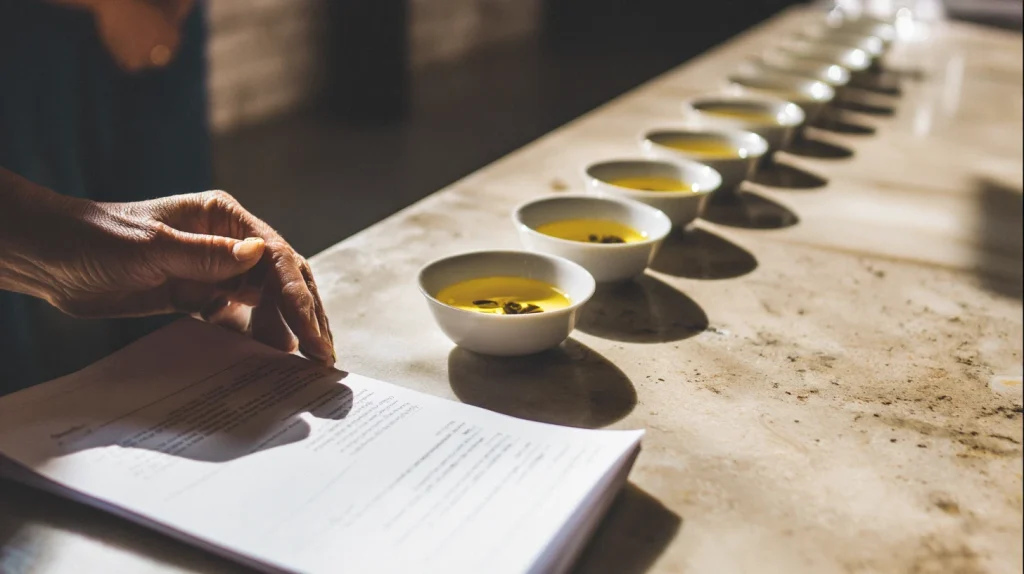
Most mill tastings offer four to six oils at a time. Here’s how to approach it without overwhelming your palate:
Start with water between samples to clear your mouth. When you taste, let the oil coat your entire mouth — don’t just touch the tip of your tongue. Breathe in while the oil is still in your mouth, since most of what you’re actually tasting comes from aroma compounds picked up through the nose rather than the tongue alone.
What you’re evaluating: fruitiness (the positive olive character), bitterness (from polyphenols — a positive quality indicator), and pungency (that peppery throat catch — also positive, also polyphenols). Defects to watch for include rancidity (flat, stale, a bit like old walnuts), mustiness, or signs of excessive fermentation.
A fresh, high-quality fruité vert will often make you cough slightly on the finish. Among people who taste seriously, that’s generally read as a mark of quality, not a flaw.
Tapenade and What Else to Look For
At any mill shop worth visiting, you’ll find tapenade made from the producer’s own olives, and it’s worth taking seriously. Tapenade is black olives, capers, anchovies, and olive oil, pounded rather than blended into mush — the texture should have some bite left in it, and the color should be dark, close to black.
Artisan tapenade from a working mill is not the same product as the version in a jar at a supermarket. The olive quality matters, the oil matters, and the ratio of anchovies and capers to olives matters. Good tapenade has a clean saltiness and an olive flavor that doesn’t disappear into a generic paste.
Other products worth looking for at mill shops:
- Olive purée (sometimes labeled “olivade” or Grossane purée) — made from a single variety, pressed with fewer capers and anchovies than tapenade. More subtle, good on bread.
- Olive oil soap — Provence has a long tradition of making savon de Marseille and related soaps from olive oil. Not a gimmick; the lather quality is genuinely different from synthetic soap.
- Flavored oils — lemon, thyme, basil, and similar. These are usually infused rather than co-pressed, so the quality still depends heavily on the base oil. At a good mill, even the flavored oils start from decent stock.
When to Go (and Why November Is the Best Month)
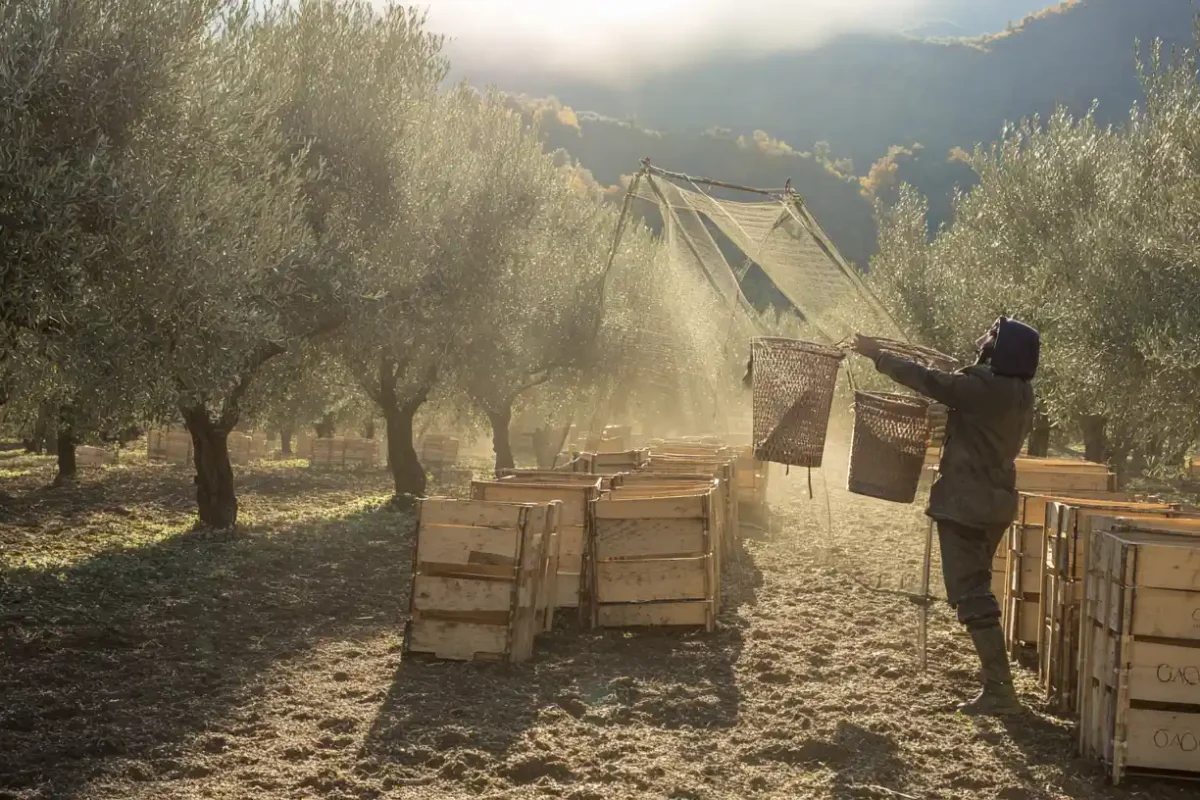
The olive harvest in Provence generally runs from late October through December, with most mills pressing actively in November. This is when:
- The mills are running at full capacity and you can actually watch pressing happen
- New-season oil is available immediately after pressing — the freshest version you’ll ever taste
- The Alpilles countryside at harvest feels like a working landscape rather than a tourist stop
- Mill shops tend to have the widest range of current-year oil, often at the best prices of the year
Outside harvest season, the mills are still open and tastings still happen — you’ll just be tasting oil from the previous harvest, which is entirely fine quality-wise. November simply gives you the fuller experience of seeing production in motion.
July and August are workable for visiting, but the Alpilles get hot, and the mills are often busier with general tourism than with production at that time of year. September and October make a reasonable middle ground if November doesn’t fit your schedule.
Buying It and Getting It Home
Olive oil is one of the best souvenirs you can bring back from Provence, and also one of the easiest to ruin in transit.
What to buy: a 500ml bottle of PDO Vallée des Baux fruité vert from Cornille or Castelas is a meaningful purchase. Good olive oil generally keeps well for a good while past harvest if stored correctly — look for the harvest year on the label rather than relying solely on a generic “best before” date, since freshness relative to harvest is what actually matters for flavor.
How to transport it: carry it in your carry-on luggage rather than checked baggage. Checked luggage swings between cold and warm temperatures and gets thrown around, both of which accelerate oxidation. A 500ml bottle generally falls within standard airline carry-on liquid limits if it’s sealed and wrapped well — check your specific airline’s rules before you fly, since allowances vary.
Storage at home: cool, dark, away from heat sources. Not the cabinet above the stove. Not on a windowsill that gets afternoon sun. Treat an opened bottle as something to use within a year or so of bottling for the best flavor. If the oil at the back of your pantry has been sitting for years, it’s likely gone rancid, and you may simply be used to that flavor without realizing it.
One honest caveat: the best Provençal olive oils aren’t cheap. A 500ml bottle of PDO fruité vert from a quality mill commonly runs somewhere in the €12–20 range, more than supermarket olive oil costs by a good margin. The difference in flavor is significant enough to justify it at least once — taste them side by side with a supermarket bottle, and the comparison tends to be almost embarrassing.
FAQ
Do you need to book in advance to visit an olive oil mill in Provence? Most mills with visitor access — including Moulin Cornille and Moulin Castelas — don’t require reservations for self-guided visits or standard tastings. Guided tours at Cornille do need advance booking. It’s worth calling ahead if you’re visiting in July or August, when mills can get busy with general tourism. During harvest in November, some mills have limited capacity for visitors while pressing is actively underway.
Is Provence olive oil really better than Italian or Spanish oil? Different, not necessarily better. The terroir in the Alpilles produces a distinctive mineral, intensely herbaceous style that doesn’t exist in quite the same form elsewhere. Whether you prefer that to a Tuscan or Andalusian oil depends on what you’re using it for and which flavors you like. The PDO designation guarantees specific production methods and minimum quality standards, so what’s in the bottle is genuinely different from generic imported oil, even if “better” is a matter of taste.
What is the Vallée des Baux-de-Provence AOP? It’s a French Protected Designation of Origin for olive oil produced from specific varieties — primarily Salonenque, Grossane, Béruguette, and Verdale des Bouches-du-Rhône — grown across communes around Maussane-les-Alpilles and Les Baux. The designation requires careful harvesting and processing within the production zone, and the oils must meet defined polyphenol and acidity standards. AOP is the EU-wide equivalent of the French AOC designation.
Can I visit the mills in winter? Yes, and November and December are generally the best months to visit if you want to see mills actually pressing. Harvest season typically runs from late October through December, with Alpilles mills usually at full production in November. Being able to taste oil straight from that season’s press is something worth planning a visit around.
What’s the difference between tapenade and anchoïade? Tapenade is olive-forward — black olives, capers, anchovies, and olive oil, with the olives as the main ingredient and the anchovies adding background salt and depth. Anchoïade flips that ratio, putting anchovies front and center alongside garlic and oil. Both are common across Provence as spreads and dips, but tapenade is the one you’ll find at most market stalls and mill shops.