By 10am in August, the main square at Gordes has a parking problem. Cars circle the lower lot, tour buses idle, and the village’s famously narrow lanes are doing their best to handle a volume of foot traffic they were built for horses and donkeys, not tour groups. Nobody warns you about this in the posts about “the most beautiful villages of Provence.”
Here’s the truth about the Luberon hilltop villages: they are real. The stone, the light, the way a terrace of pale houses clings to a limestone ridge above a valley of lavender and oak — that’s all genuine and worth a detour from almost anywhere in Provence. But the experience depends entirely on when you show up, which villages you prioritize, and how you sequence the day. Get the order wrong and you’ll spend the morning in gridlock, the afternoon in a queue, and the evening wondering why the photos looked better than the reality.
You Will Need a Car
Let’s get this out of the way early. The Luberon villages are scattered across a regional natural park — one of seven in Provence-Alpes-Côte d’Azur and a UNESCO Biosphere Reserve — that covers a large stretch of countryside. There’s no practical train service to any of the hilltop villages. Buses exist but run on schedules that bear no relationship to how a traveler actually wants to move through the day.
Rent a car. Full stop. The roads here are genuinely lovely to drive — winding through garrigue scrubland, past terraced vineyards, with views opening up unexpectedly around corners. Signage is good, and parking exists in every village, though in peak summer you’ll want to arrive before the crowds to have any reasonable shot at a space.
The closest major airport is Marseille, about 1.5 hours from the Luberon. Avignon is the easiest train connection from Paris — a direct TGV in around 2 hours 40 minutes — with a rental car pickup available there. Aix-en-Provence also works well as an arrival point.
Start With the Abbey, Not Gordes
A few kilometers outside Gordes, down a narrow single-lane road through a cool valley, sits the Abbaye Notre-Dame de Sénanque. The lavender that grows in the field in front of it has become one of the most reproduced images in all of Provence photography, and it earns that reputation completely.
The abbey is still an active Cistercian monastery, founded in 1148 by monks who arrived from Mazan in the Ardèche — it was the fourth Cistercian abbey established in Provence. Monks live here year-round. The abbey offers both guided tours and self-guided visits using a digital HistoPad tablet, on a schedule that varies through the year and closes for a handful of specific dates each winter, so it’s worth checking senanque.fr for the exact current visiting windows before you go. Adult tickets run €8, students aged 18–25 pay €6, and children aged 6–17 pay €4; under-6 is free.
Come here first on a Luberon day, arriving as close to opening as you can manage. The single-lane road down to the abbey becomes a slow-motion standoff once tour groups arrive mid-morning, so getting there early and leaving before the rush is the difference between a calm visit and a long wait.
The lavender typically blooms in late June and early July. Outside that window, the abbey is still worth it — the interior, spare and cool, with Romanesque stone arches and no decoration beyond the proportions themselves, is the real draw either way.
Gordes: Worth Every Minute If You Arrive Right
After the abbey, drive up to Gordes. But before you park, do this: pull off at the small lay-by on the D15 road that approaches from below the village. This is where the iconic view lives — the entire village stacked on its white rock face, the château looming at the top, walls and towers and pale stone all rising together against the sky. Take the photo here; you won’t get a better angle from inside the village.
Then park and walk up. The lanes are narrow and uneven. Stone houses date back centuries, and you’ll find art galleries, a few café terraces, and the occasional restaurant tucked into the hillside. The village takes about 45 minutes to walk properly, an hour if you stop for coffee. Don’t feel obligated to stay for lunch — the point of Gordes is the architecture and the setting, not the souvenir shops.
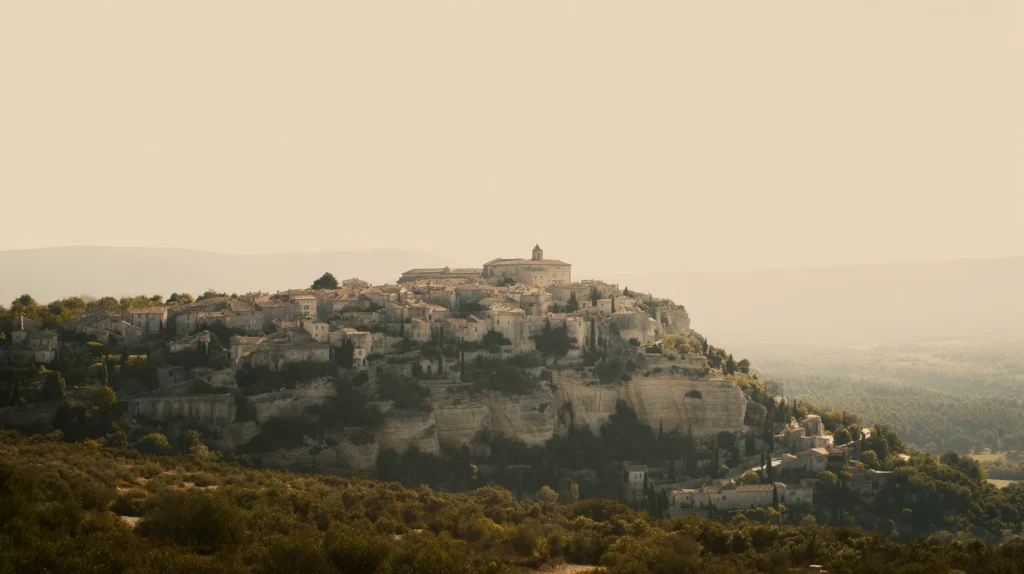
Gordes changes character completely depending on when you show up. At midday in high summer, the square gets genuinely crowded and the lanes slow to a shuffle. Early morning or early evening, once the day-trippers have thinned out, is when the light on the limestone and the relative quiet make it obvious why the village has the reputation it does. Arriving before 9am in summer, or after 5pm once the tour buses clear out, is the reliable way to get that version of it.
Village des Bories: The One People Skip
A few kilometers from Gordes, slightly off the road toward Apt, is the Village des Bories — a cluster of dry-stone huts built using the same ancient technique you’ll notice all across the Luberon landscape. Stacked limestone, no mortar, surprisingly solid, some of them two stories tall with corbelled roofs built entirely by hand from stone cleared out of the surrounding fields.
This particular hamlet dates mainly to the 17th and 18th centuries, when population growth pushed farmers to cultivate new land and clear the stone from their fields into exactly this kind of structure — seasonal agricultural shelters that were eventually abandoned and left to decay before being restored in the 1970s. UNESCO recognizes dry-stone construction as intangible cultural heritage, and the Bories are one of the best places in the region to understand why.
Admission is €8 for adults, €4 for children aged 12–17, and free for children under 12. The site is quiet — far quieter than Gordes itself — and takes about 45 minutes to walk properly.
This is the kind of place that doesn’t appear in everyone’s highlight reel. That usually means it’s worth your time.
Roussillon: The Color Shock
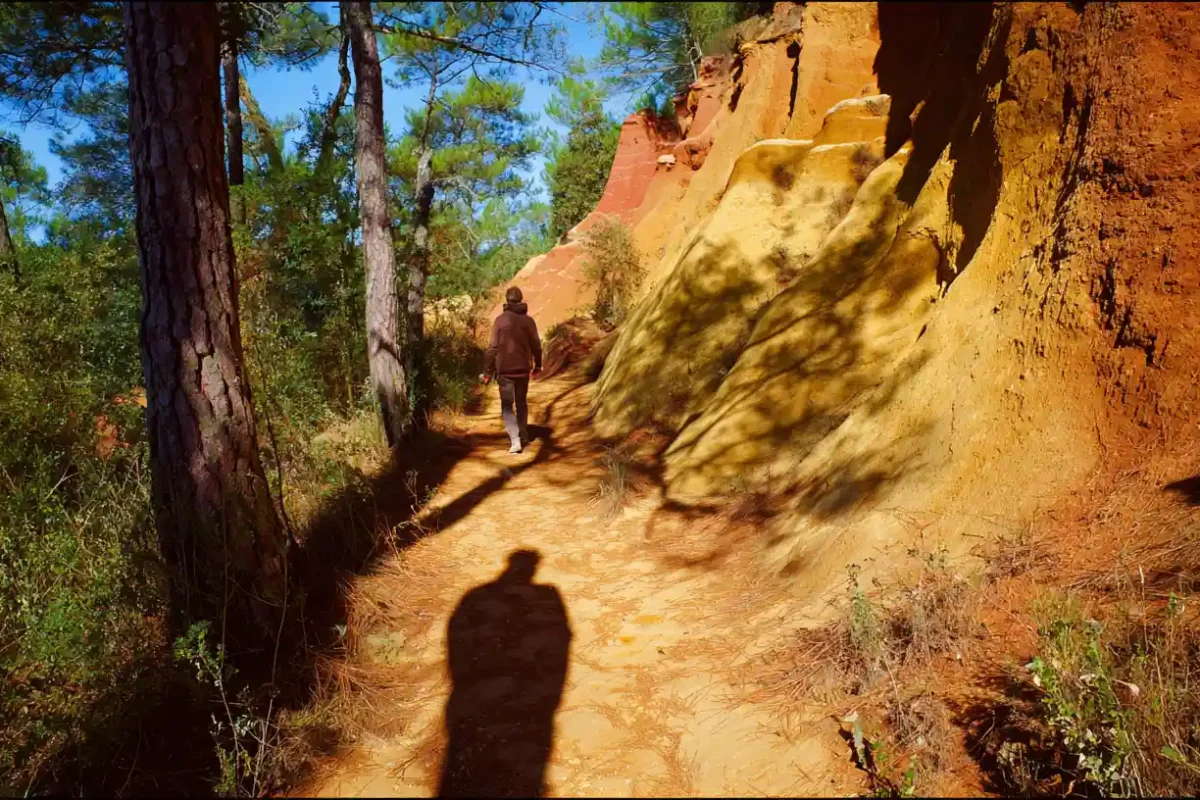
Roussillon sits roughly 20 minutes’ drive east of Gordes, and the contrast between the two villages is total. Where Gordes is grey-white limestone and formal architecture, Roussillon glows — deep rust, orange-gold, pale yellow, burnt sienna — because everything here is built from or painted in local ochre.
A local regulation requires facades to be coated in ochre-toned paints. This isn’t nostalgia for its own sake — the village sits on what was once one of the largest ochre deposits known. Mining peaked in the late 19th century after the railway reached nearby Apt, enabling industrial-scale extraction. Artificial pigments arrived in the 20th century, the ochre market collapsed, and large-scale mining all but disappeared. The color stayed, written into the building code.
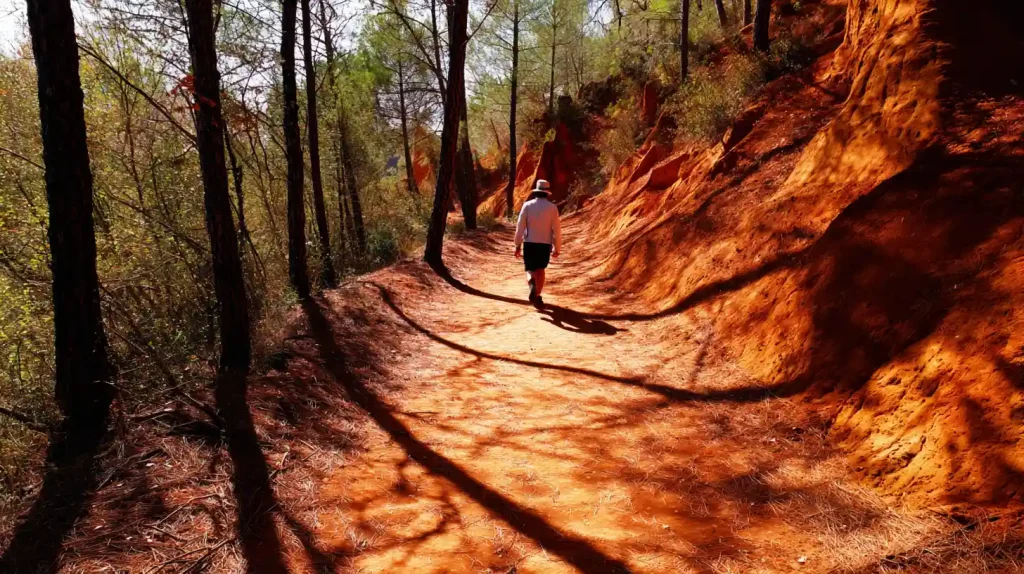
The Sentier des Ocres — the Ochre Trail — is the main draw beyond the village itself. Tickets cost €3.50 per adult and are free for children under 10. The trail is generally open daily outside of January (when it closes for maintenance), with hours that stretch to around 7:30pm in July and August and shrink considerably in winter — check current hours before visiting, since the site can also close temporarily for heavy rain or fire risk. You can choose between a roughly 30-minute loop and a longer 50-to-60-minute route; both are worth taking seriously. The ochre cliffs rise several meters above the path, and in afternoon light the colors are almost unreal — all that warm-spectrum geology under a blue Provence sky.
One practical note: wear shoes you don’t love. The ochre dust genuinely stains, and dark, closed shoes are strongly recommended over sandals or anything pale.
The village itself takes about an hour to walk. The main square has good cafés, the Okhra eco-museum covers the history of pigment extraction and offers workshops, and the views out across the valley go on for a long time.
Ménerbes: Lunch, Wine, and a Good Sunset
Ménerbes sits on a long, narrow ridge — the village stretches from the medieval citadel at one end to a 13th-century church at the other, about a 20-minute walk end to end. Peter Mayle lived and wrote here, and his memoir A Year in Provence did more for the village’s global name recognition than any tourism campaign.
The views from the terrace below the church are wide, with two valleys opening up simultaneously — the Luberon ridge behind you, farmland rolling south toward the Alpilles. This is a good village for a long lunch, or for arriving in late afternoon when the light goes amber and the day-trippers have moved on.
One quirky stop worth 30 minutes: the Musée du Tire-Bouchon, a corkscrew museum that makes a surprising amount of sense once you’re standing in a landscape covered in vines — the Luberon produces AOC Côtes du Luberon wines. There are thousands of corkscrews inside, from medieval to modernist, simple to baroque. It’s more interesting than it sounds.
The Other Villages: Honest Rankings
Goult is a small village of just over 1,000 people, with no famous literary associations and no official prestige label — just a weekly market, good stone streets, and the ordinary rhythm of village life. Worth putting on the list for a second day if you’re staying overnight in the Luberon; it’s the kind of place that stays appealing precisely because relatively few tourists bother to stop.
Bonnieux has a terraced hillside layout and an old church at the top reached by a long staircase, delivering one of the better views in the Luberon — the whole ridge visible, Mont Ventoux to the north on clear days, the Lourmarin valley below. A Friday morning market brings both locals and visitors. Worth the stop.
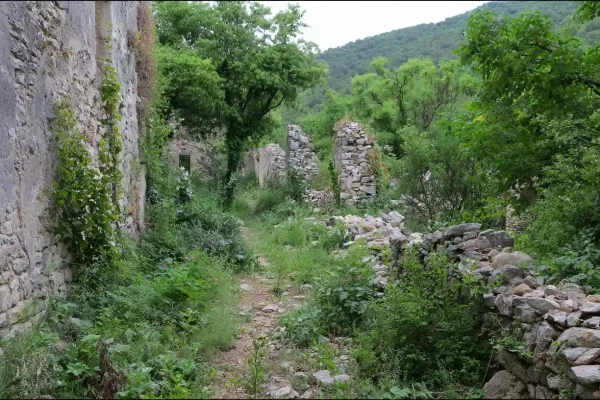
Oppède le Vieux was largely abandoned during the 20th century and only partly restored, so you’re walking through a village that still feels half-reclaimed by time. The medieval castle ruins require a decent uphill walk; the whole visit takes about 30 minutes. The atmosphere is unlike anywhere else in the Luberon — somewhere between ghost town and archaeological site, genuinely strange in a good way.
Lourmarin, further south than the main cluster, is probably the most livable of the Luberon villages. It has proper restaurants, a Friday market, a Renaissance château open to visitors, and a pace that doesn’t feel like it’s performing for anyone. Albert Camus lived in Lourmarin and is buried in the village cemetery, on the edge of town — a modest, easy-to-miss grave marker that draws a steady trickle of literary pilgrims. Lourmarin is generally less crowded than the northern villages, partly because it sits roughly 30 minutes further away.
Lacoste has dramatic castle ruins once belonging to the Marquis de Sade and a small artistic community. Worth a 20-minute stop if you’re passing through between Bonnieux and Ménerbes, but not a village to build your whole day around.
How to Route the Day
If you have one full day in the Luberon, this sequence makes practical sense:
Start at Abbaye de Sénanque as close to its opening time as possible. Drive up to Gordes while it’s still manageable, ideally before 11am. Then drive to Village des Bories, a few kilometers away, for about an hour. Have lunch somewhere — Gordes has options, or push on to Roussillon.
After lunch, walk the Ochre Trail at Roussillon; afternoon light on those cliffs is the best light of the day. Then drive west to Ménerbes for late afternoon — the ridge views at sunset are genuinely one of the best ways to end a Luberon day.
That’s five sites in one day, which is probably the ceiling if you want to feel each one rather than just photograph them. A more photography-focused version would skip Village des Bories, add Bonnieux’s hilltop church, and end at Ménerbes just before sunset.
Two days in the Luberon? Add Goult, Bonnieux, and Oppède le Vieux on day two, and try to time it around a morning market if one happens to be running.
Where to Stay
Staying inside Gordes or just outside it gives you the best access to the village before anyone arrives, plus proximity to Sénanque. The hotels here tend toward the higher end — bastide-style properties with pools and good breakfasts.
The area between Gordes and Goult is a solid base for the northern Luberon cluster. Goult itself has quieter, more affordable rental options. Bonnieux works well if you want to be central to both the northern and southern villages.
Lourmarin is the right base if you’re also planning to hike in the Grand Luberon or explore the southern side of the park.
FAQ
How many Luberon hilltop villages can you realistically visit in one day? Three to five is the honest answer, if you have a car and start early. Trying to cover eight or nine major villages in a single day means 20-minute stops that leave you feeling like you saw nothing. Pick three to four you actually care about, slow down, and have a real lunch somewhere.
Do you need to buy tickets for the Luberon villages? The villages themselves are free to walk through. Individual sites have separate admission: the Sentier des Ocres at Roussillon is €3.50 for adults (free for children under 10), the Village des Bories near Gordes is €8 for adults, and Abbaye de Sénanque is €8 for adults. Check current opening hours before visiting — sites like Sénanque and the Ochre Trail both run seasonal schedules that shift throughout the year.
When is the worst time to visit the Luberon? The second half of July and all of August. Parking lots fill fast, popular sites can have real queues, and Gordes at noon feels considerably busier than a quiet medieval village. If you’re visiting in summer, go early morning and try to be done with the main villages by 11am. Late September tends to be noticeably better — softer light, thinner crowds, and the landscape still holds its color.
Can you visit the Luberon without a car? Technically, yes — there are organized tours from Avignon and Aix-en-Provence that visit two or three villages in a half-day. But the experience is constrained by the group’s schedule, and you’ll skip the smaller villages entirely. A rental car is genuinely the right tool for this region.
Is the Luberon worth visiting outside lavender season? Completely. The lavender in front of Abbaye de Sénanque is dramatic if you time it right, but it only grows in that one spot and for a few weeks a year. The villages themselves have nothing to do with lavender — Roussillon’s ochre is there in January, Gordes looks good in October morning light, and Ménerbes’ ridge views don’t really change by season. The Luberon is a year-round destination that just happens to get photographed most in June and July.