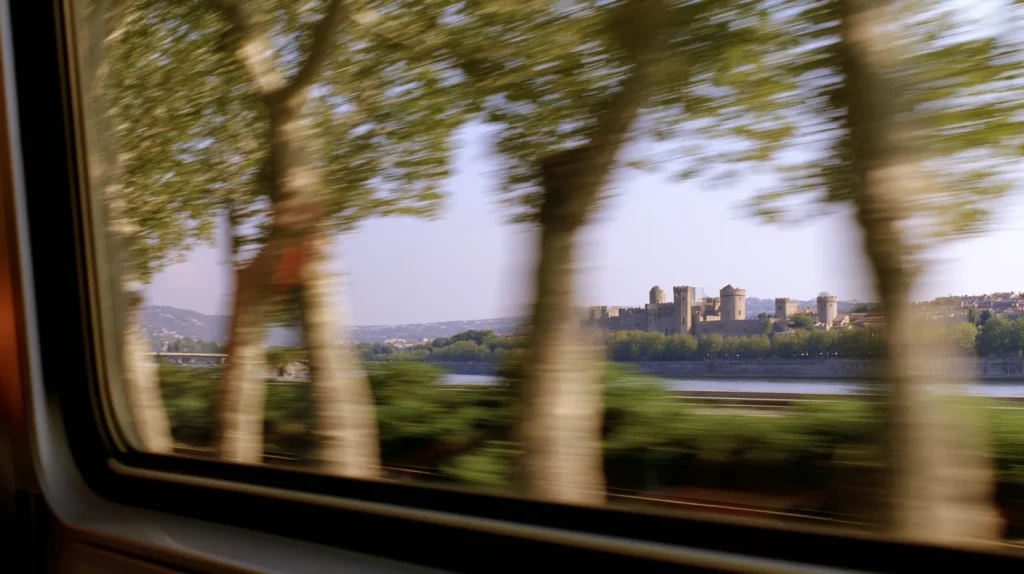
The first impression of the Palais des Papes is scale. You walk through a gate in the city walls, turn a corner, and find yourself standing in front of something that looks less like a palace and more like a fortress that got confused about which century it belongs to. Towers, battlements, walls several meters thick — all honey-colored stone rising three stories in every direction around a courtyard the size of a city block.
This is widely described as the largest Gothic palace in the world. Nine Catholic popes lived and ruled from this building between 1309 and 1376. Pope Clement V relocated the Church’s headquarters to Avignon when Rome was deemed too politically dangerous — what followed was one of the most turbulent periods in Church history, with rival popes in Avignon and Rome and eventually three men simultaneously claiming to be pope at once.
Avignon got this building from all of that.
The city that surrounds it is compact, walkable, and feels genuinely lived-in for a UNESCO destination. Roughly 90,000 people live here, ringed by medieval ramparts. It’s a real city with an excellent food market, a river island, streets worth getting lost in, and a theater festival that turns the whole place upside down every July.
The Palais des Papes: What to Expect Inside
The palace interior surprises most visitors. Not because it’s lavish — it isn’t. Because it’s empty.
The furnishings, tapestries, and most of the decorative detail were stripped out during the French Revolution, when the palace was converted into military barracks and later a prison. What remains are vast Gothic halls, stone floors, and soaring vaulted ceilings — nearly monastic in their austerity, which is a little ironic given the political theater that played out here.
A few rooms survive with original frescoes. The Chambre du Cerf (Stag Room) has hunting scenes painted for Pope Clement VI in the 1340s — detailed, well-preserved, and one of the better examples of 14th-century secular painting in France. The papal bedchamber and the Chapel of St. John give you fragments of what the palace felt like furnished and decorated. But most of the time, you’re moving through bare stone.
This isn’t a problem once you accept it. The power is in the architecture — the scale of the Grand Tinel banquet hall, the height of the Consistory where cardinals met to elect popes, the way light falls through narrow windows into cavernous rooms. Give it at least 1.5 to 2 hours.
The palace provides a free tablet (the Histopad) at the entrance, available in several languages. It shows augmented reality reconstructions of the rooms as they appeared in the 14th century — furnishings materialize over empty floors, faces appear on bare stone walls. Worth using, especially in the rooms with no original decoration.
Tickets and hours: as of August 2026, the palace and gardens alone run €16 for adults (this rose from €14.50 on August 1, 2026, so pricing does shift through the year — worth double-checking on the official site before you go), with free entry for children under 10. A combined Palace + Pont d’Avignon ticket runs somewhat higher than the palace alone; check current rates, since these were also revised as of August 1. The palace is open every day, all year, from 9am to 7pm in the main season (roughly March through early November, with reduced hours in winter), with last admission one hour before closing.
New in 2026: Rooms Never Previously Shown to the Public
Since May 1, 2026, the palace has been opening sections that were previously closed, as part of a renovation project continuing through spring 2027. New guided interpretation, interactive models, and documentary films accompany the new areas. A smartphone WebApp called “Les Clefs du Palais” (Keys of the Palace) provides content in several languages, including English. Worth knowing if you visited a few years ago — the experience has changed noticeably.
The Pont d’Avignon: The Bridge That Never Finished
The Pont Saint-Bénézet — the Pont d’Avignon — originally stretched across the Rhône on 22 arches. Today, four remain. First built in the 12th century, it was repeatedly battered by floods over the centuries and never fully repaired after the 1600s. The result is a dramatic bridge stub jutting halfway across the river and stopping abruptly above the water.
The song everyone knows — “Sur le Pont d’Avignon” — is slightly ironic in practice. The bridge was apparently too narrow for the kind of dancing the song describes; the more commonly told version is that locals actually gathered and danced on the riverbanks below the bridge, or on an island beneath one of its arches, rather than on the structure itself. The song became more famous than the actual history behind it.
The combined ticket with the Palace includes bridge access with an audio guide. On its own, standalone bridge entry runs around €6 for adults as of August 2026 (it was €5 through July). The walk out to the end takes about ten minutes. The view back to the ramparts and the Palace towers is worth the trip on its own.
Avignon’s Streets: Beyond the Two Big Monuments
The old city inside the ramparts is genuinely good for aimless walking.
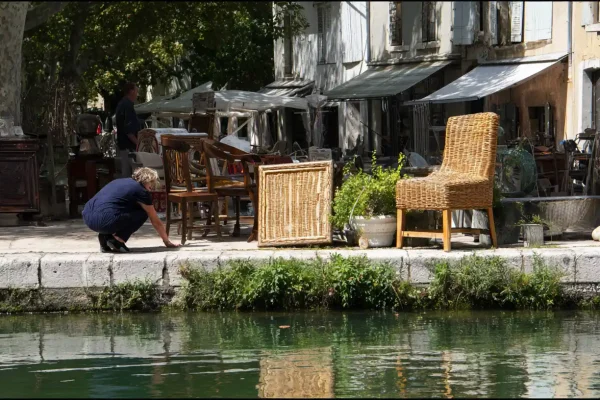
Rue des Teinturiers (Dyers’ Street) runs along a narrow canal with working waterwheels still turning — this was once the heart of the city’s textile industry. Now it’s lined with cafés, restaurants, and small bookshops that spill books onto the cobblestones. Come here for lunch. You’ll probably stay longer than planned.
Les Halles, the covered market on Place Pie, opens Tuesday through Sunday mornings. Saturday morning tends to be the liveliest, with cooking demonstrations by local chefs running alongside the stalls. Avignon sits in Côtes du Rhône wine country, and the market stalls reflect that: Provençal produce, local oils, cheeses, and herbs that smell exactly like Provence should.
Place de l’Horloge, the main square below the Gothic clock tower, fills with café tables in summer. The streets north and west of the Palace have the better restaurants and tend to be quieter than the square itself.
The Rocher des Doms — a garden on a rocky bluff directly behind the Cathédrale Notre-Dame des Doms — gives the best views of the Rhône and the bridge from above. Free to enter, with shaded seating, a duck pond, a small café, and on clear days a view across to the Luberon hills. A worthwhile 30-minute detour that most visitors miss because it’s up a small slope.
The Île de la Barthelasse, reachable by a free ferry from behind the Palace walls, is a large river island with a municipal pool, campsites, small organic farms, and a cycle path. This is where locals go to escape the crowds. If you’re spending two nights in Avignon, it’s worth an afternoon.
The Avignon Festival: If Your Dates Align
The Festival d’Avignon runs across July and is one of the world’s largest theater festivals. Hundreds of shows — in the official program and the sprawling “off” festival — fill theaters, courtyards, and available spaces all over the city, with official-program tickets typically running somewhere between €15 and €38 depending on the show and seating category. The city transforms entirely during it.
If you’re visiting during the festival, book accommodation well in advance and accept that Avignon will be at full capacity. If theater isn’t your priority, the festival period also means maximum prices, maximum crowds, and reduced availability at restaurants — worth factoring into your timing either way.
Pont du Gard: Why It Deserves Its Own Half-Day
About 20–25 kilometers northeast of Avignon, roughly 30 to 40 minutes by car, the Pont du Gard is a Roman aqueduct built in the 1st century AD. It’s one of the best-preserved Roman structures in Europe, and most day-trip itineraries give it far too little time.
The structure: three tiers of stone arches, standing roughly 49 meters high and stretching about 275 meters across at its longest tier, built to carry water from springs near Uzès to the Roman city of Nîmes — a roughly 50-kilometer route that the water completed by gravity alone, dropping only around 17 meters across the entire length. No mortar was used; the stones were cut and fitted together with an accuracy that has kept the structure standing for two thousand years.
The approach from the parking area across the river gives you the aqueduct framed against the valley. Then you walk closer and the scale changes — the individual stones are enormous, and the second tier is wide enough to walk across. Looking down from any elevated vantage point onto the river and the arches, you understand why this is a UNESCO World Heritage Site without anyone having to explain it.
Entry to the bridge area itself is free. You only pay for parking (€9 per vehicle, regardless of size or visit length) and for the discovery areas — museum, cinema, games room, and temporary exhibitions — which cost €8 for adults and are free for anyone under 18. Guided tours cost €15 per adult and €6 for children aged 4–17. The museum gives the engineering story proper context and is worth the extra €8.
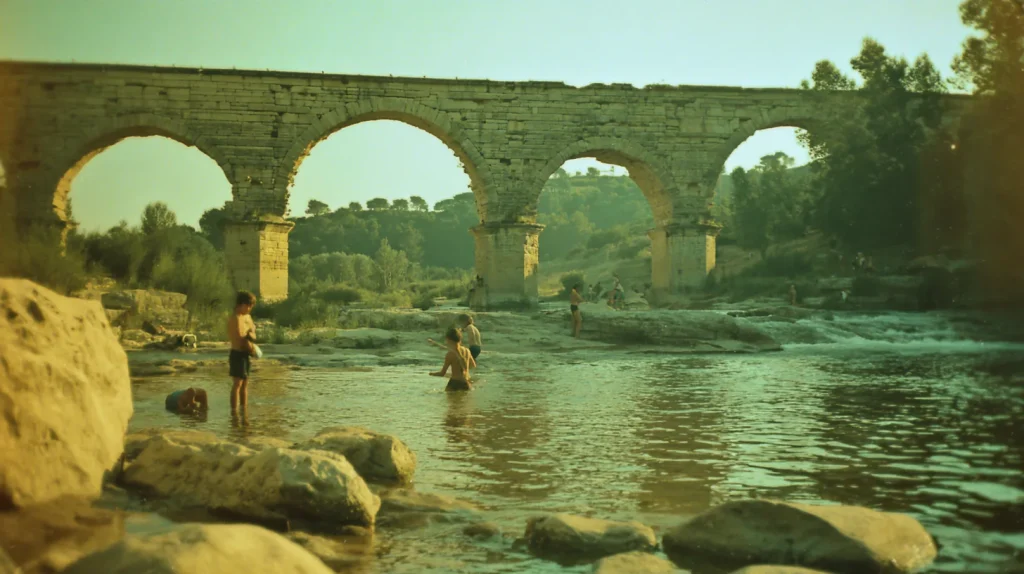
Swimming is permitted in the river at the base of the monument in summer. The water runs clear and cold even in July, and this is where families spend entire days. Watching people swim in a river beneath a two-thousand-year-old structure is one of those small moments that stays with you.
Budget 2 to 3 hours. Don’t try this as a quick stop — it deserves the time.
Getting to Avignon
Avignon TGV station sits about 4km outside the city center and is served by high-speed trains from Paris Gare de Lyon in roughly 2 hours 40 minutes on the fastest services. From Marseille, the fastest trains take around 30 minutes; from Lyon, closer to 1 hour 45 minutes on a direct TGV. The city center station (Avignon Centre) handles regional trains and sits a short walk from the old city.
Getting to Pont du Gard is most comfortable with a car or an organized tour, but it isn’t entirely without a public transport option: the liO regional bus line 115 runs directly between Avignon and the Pont du Gard, taking roughly 35–40 minutes. It’s a real option if you don’t have a car, though it runs on a limited schedule of only a few departures a day, so check current times carefully before relying on it. Most visitors still find it easier to combine both sites in one day with a rental car picked up at Avignon TGV.
How to Split Your Time Between the Two
One day in Avignon is the minimum. Two is better.
If you have one full day: go to Pont du Gard first thing (before the car park fills up), spend 2–3 hours there including a swim, then drive back to Avignon for a late afternoon Palace visit (open until 7pm in the main season) and an evening walk through the old streets. Skip the Pont d’Avignon bridge itself and come back for it if you have another day.
If you have two days: use day one for the Palace properly, the Rocher des Doms, lunch on Rue des Teinturiers, and the market. Use day two for Pont du Gard in the morning and the Île de la Barthelasse or wine country in the afternoon.
The Avignon City Pass — roughly €24 for 24 hours, €32 for 48 hours — covers reduced entry to Pont du Gard and several museums, and is worth calculating against your planned visits.
FAQs
Is the Pont du Gard free to visit? Viewing the aqueduct from the riverside costs nothing. You only pay for parking (€9 per vehicle) and for the museum and discovery areas (€8 adults, free under 18). Guided tours cost €15 adults, €6 for children.
How long does the Palais des Papes take? Plan on 1.5 to 2 hours minimum. The free Histopad AR tablet included with your ticket significantly changes the experience. Last admission is one hour before closing.
What is the Avignon Festival? One of the world’s largest theater festivals, held throughout July, with hundreds of performances across the entire city. Worth timing your visit around if theater interests you; otherwise, it means bigger crowds and higher prices during that window.
Do I need a car to visit Avignon? Not for Avignon itself — the TGV connects it to Paris, Lyon, and Marseille, and the old city is fully walkable. Pont du Gard does have a direct bus (line 115) from Avignon, but it runs infrequently, so most visitors find a car or a day tour more practical for that leg.
Can I see both Avignon and Pont du Gard in one day? Yes, if you’re efficient. Pont du Gard in the morning, the Avignon Palace in the afternoon — the palace stays open until 7pm in the main season, so the timing works. Budget the full day; don’t try to rush both into five hours.