The first thing that surprises you isn’t the purple — it’s the smell. Before you even pull over and park, the windows-down drive across the Valensole plateau hits you with something you weren’t quite prepared for: lavender in full bloom smells sweeter and sharper than anything you’ve ever bought in a bottle.
The plateau itself is massive, spanning roughly 800 square kilometers. This isn’t one photogenic field you’ll reach in ten minutes. It’s a working agricultural landscape that shifts and changes as you drive through it. Some plots bloom purple. Others are already harvested by the time you arrive. A few are planted with wheat or sunflowers that year instead. This is farmland, not a theme park.
Which is exactly what makes it worth planning properly.
When the Lavender Fields of Valensole Actually Bloom
Most guides give you a range — “late June to mid-July” — and leave it there. That range is broadly accurate but not especially useful when you’re actually booking flights.
Here’s how it tends to play out. Lavender on the plateau typically starts opening in mid-to-late June, but early on you’ll find patchy color rather than a solid wall of purple. The fields usually fill in through the first half of July, and the window straddling late June and the first two weeks of July is historically the safest bet for catching the plateau at or near peak.
Harvest generally begins in mid-to-late July, though the exact timing depends heavily on that year’s weather — hot, dry stretches pull the harvest forward, sometimes dramatically, while a cooler or wetter spring can push everything later. Once harvest starts in a given field, it’s done: those rows go from purple to grey stubble within days, not weeks. Recent hot summers across Provence have made the schedule noticeably less predictable, and some farms have adjusted their planting mix in response to prolonged drought conditions.
Valensole’s own lavender festival is traditionally held on the third Sunday of July each year, but treat that as a cultural date, not a bloom guarantee — in a hot year, a meaningful share of the surrounding fields can already be cut by the time the festival happens. If your travel dates are fixed, arriving in late June to early July gives you the best odds of seeing real bloom; traveling closer to the festival date is more of a gamble depending on that summer’s weather. The only reliable way to check close to your trip is to follow the regional Route de la Lavande channels or contact the Valensole tourism office directly in the week or two before you travel.
What the Plateau Actually Looks Like When You Arrive
Not every field is purple. That’s the first reality check.
Lavender is rotated with other crops across the plateau — wheat, sunflowers, clary sage, helichrysum. Farmers don’t plant the same plots every year. This means driving through in early July might give you long stretches of purple, then a field of ripe wheat, then another sweep of lavender. Patchwork, not uniform.
That’s not a disappointment once you accept it going in. The variety is part of what makes the landscape feel like a real working place rather than a curated set piece.
The fields that are in bloom are extraordinary. Rows run in long parallel lines, and when the light hits at the right angle — early morning or the hour before sunset — the shadows between rows deepen the purple into something that looks almost unreal. Bees work the flowers constantly; the hum is loud enough to hear over the wind.
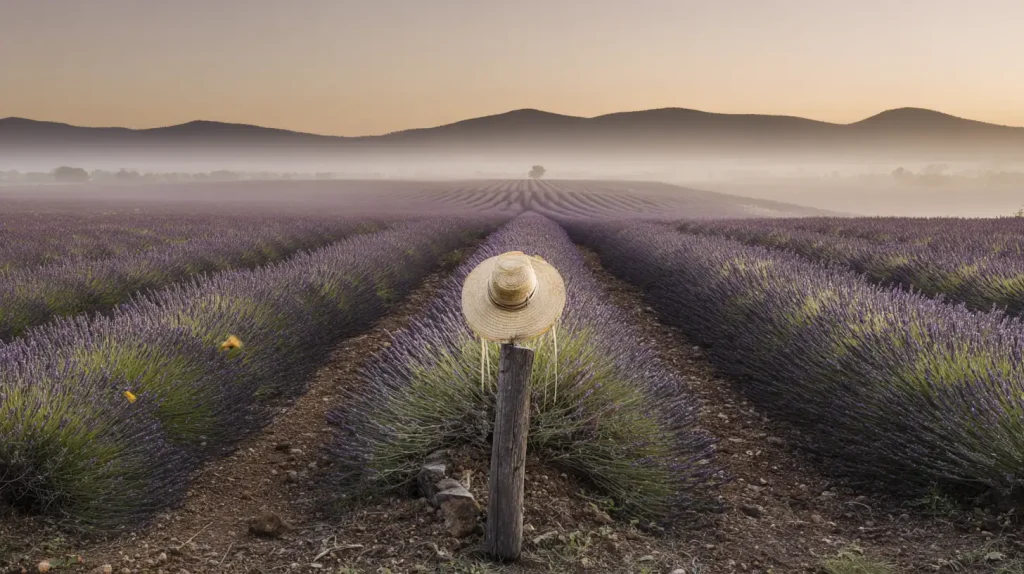
Nearly all of the fields are private working farms. You cannot walk into them without permission. Photographs taken from the road are perfectly fine — most of the famous lavender views you’ve seen from Provence are shot from road shoulders and dirt tracks bordering the fields. If you want to stand in the rows for a photo, ask the farmer first. Some welcome it, especially outside peak hours. Many don’t, particularly during the busiest weeks of the season, when they’re managing hundreds of visitors on top of running an active farm.
Getting There Without a Car Is Not Really an Option
The nearest major city with good rail connections is Aix-en-Provence. From there, plan on roughly an hour’s drive to reach the plateau under normal conditions, though it can stretch closer to 90 minutes depending on your exact route and the time of year — traffic and seasonal detours around the plateau add up in July. There’s also a regional train station at Manosque, about 20 kilometers from Valensole village, but getting from there onward to the fields themselves without a car still leaves you fairly stuck, since local bus service is limited and infrequent.
Public transport across the plateau itself doesn’t really exist in any useful form during lavender season. Guided bus tours from Aix or Marseille follow fixed routes and fixed stops — you’ll see lavender, but you won’t be able to pull over, linger, or detour when something catches your eye.
Renting a car is the right move here. Drive the plateau at your own pace. Pull over along the D8 between Valensole village and Riez. Take the D50 south toward Puimoisson. These smaller roads cut through the heart of the plateau and give you the stop-and-start flexibility that makes the experience feel real rather than rushed.
One of the most rewarding approaches: come from the south via the D49, rounding the southern end of Lac de Sainte-Croix before climbing onto the plateau. The lake views on the way up are stunning in their own right, and the transition from turquoise water to purple fields over the space of half an hour is one of those drives that makes you go quiet.
Photography: What Actually Works Here
Golden hour is real here, not just an Instagram cliché.
The lavender plateau at 7am or in the hour before sunset looks entirely different from the same field at noon. Midday light is flat and harsh — it washes the purple out and makes the rows look grey-green. The same field two hours earlier, and you’re shooting with warm, raking light that turns every shadow into a line of contrast.
Sunrise is particularly good because the plateau is genuinely empty then. No cars, no other photographers crowding the obvious spots — just you, the rows, bees not yet fully awake, and a cool morning that makes the lavender smell even sharper.
Wide-angle shots work well from slightly elevated positions — a gentle rise in the road is usually enough. Get low for the opposite effect: down near the base of the rows, shooting along the perspective lines toward a farmhouse or distant ridge. Both angles tell completely different stories, so it’s worth trying both if you have the time.
Don’t crop out the sky. When the morning light is right, the lavender and the pale blue above it together make up the whole composition.
If You Want Sunrise: Stay the Night Nearby
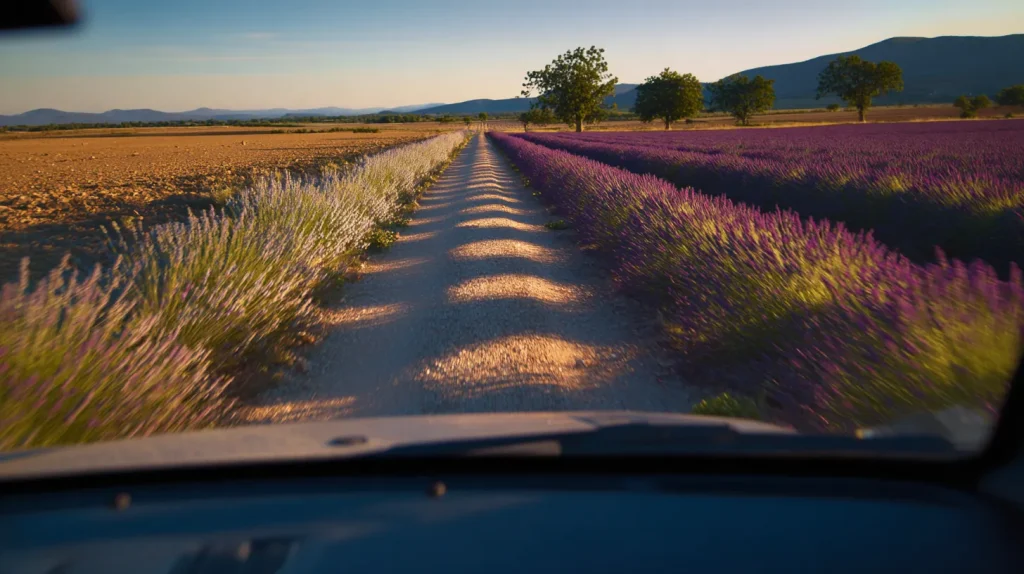
The best lavender photography happens before 8am. If you’re driving out from Aix-en-Provence or Marseille that morning, you’re looking at a 6am departure or earlier to catch sunrise on the plateau. Doable once. Exhausting twice.
For a more relaxed approach, staying one night near Valensole puts you on the plateau before the crowds arrive without the brutal alarm clock. Accommodation directly in Valensole village is limited — mostly gîtes and chambres d’hôtes, which book up well in advance for July — so it’s worth reserving early if you want to stay right there. Manosque, about 20 minutes north by car, has considerably more options and works well as a base if the village itself is full.
If you’re combining the trip with Moustiers and the Gorges du Verdon, the village of Moustiers-Sainte-Marie also has small hotels and B&Bs. Staying there puts you between the fields and the canyon — a good position for a relaxed two-day loop through this corner of Provence.
The Village and the Lavender Festival
Valensole village itself is small and unhurried. The main square has cafés, a few shops, and the kind of quiet that suggests the village existed long before tourists started arriving every July. It’s worth an hour of your time — the fields are the reason you’re here, but the village grounds you in where all of this actually comes from.
Local shops stock lavender products made on the plateau: oils, floral water, sachets, soaps, honey, and culinary lavender for cooking. Farmers sometimes sell directly from roadside stands near their fields — no middleman, no markup.
Valensole’s lavender festival typically falls on the third Sunday of July, with craft stalls, distillation demonstrations, and local food stands filling the village. As noted above, don’t assume the fields will still be in full bloom by then — check current conditions before building your whole trip around the festival date. If you’re buying lavender products to bring home, buying directly here, from the people who grow these fields, generally means better quality than what you’ll find in a tourist shop in Nice or Paris.
Lavender honey from the plateau deserves particular mention — it has a depth that generic honey doesn’t come close to matching. Worth buying by the jar.
Pair It With Moustiers-Sainte-Marie
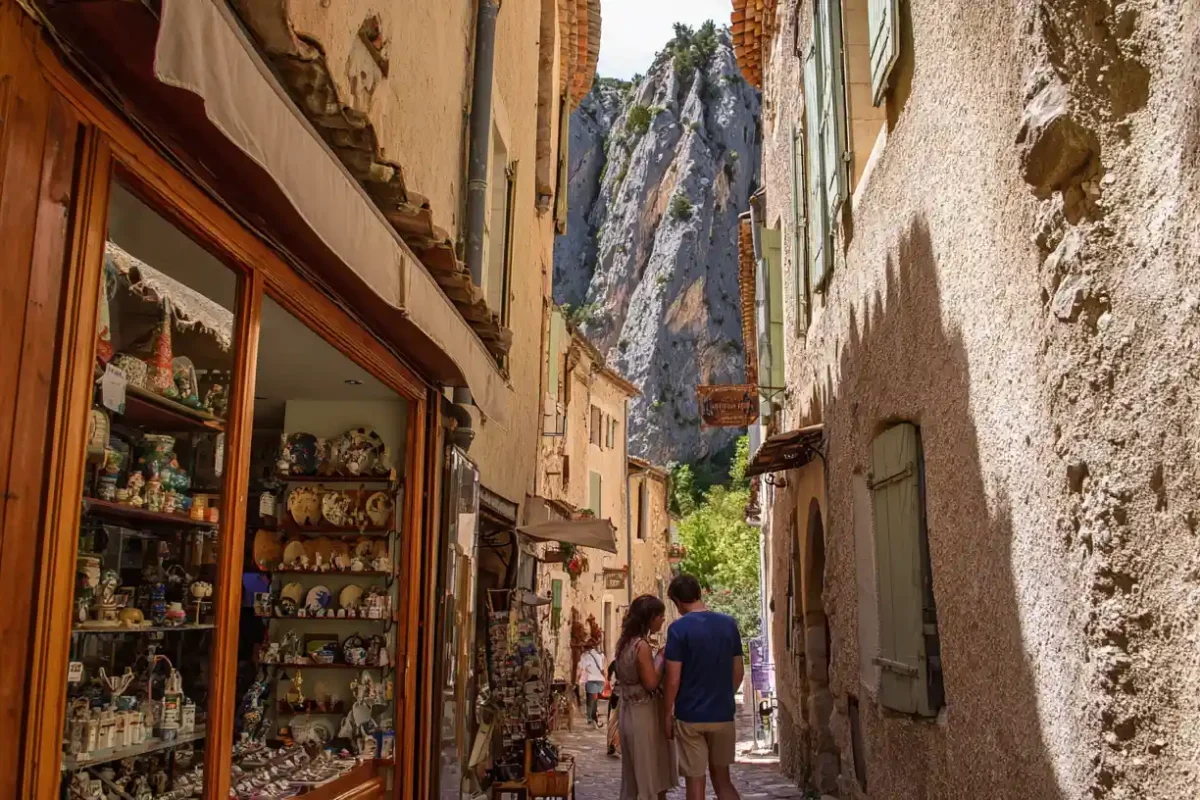
About 20 minutes from Valensole village by car, Moustiers-Sainte-Marie sits at the foot of a dramatic rocky cliff split by a gorge. High above the village, strung on a long chain between the two cliff faces, hangs a golden star — a local landmark with several competing legends attached to it. The most commonly told version involves a medieval knight of the Blacas family who was taken prisoner during the Crusades and vowed to hang a star above his village if he ever made it home. The star and its chain have been replaced many times over the centuries — most recently rehung by helicopter after the chain snapped in the early 2000s — and, legend aside, nobody actually knows for certain who first put it there or why.
The village is small. Pottery workshops line the main lanes — Moustiers has been known for its faience earthenware since the 17th century, and the tradition, after a period of decline, is still very much active today, with roughly a dozen working workshops. There are several good lunch spots before or after visiting the fields.
If you have the energy, a climb of a couple hundred steps up the Way of the Cross leads to the Notre-Dame de Beauvoir chapel, with views back across the plateau. Best done in the morning before the heat builds.
One honest note: Moustiers is popular in July, and its narrow lanes fill quickly. Aim to arrive before 10am, or plan to show up in the late afternoon once day-trippers have largely moved on.
The Gorges du Verdon: Worth Adding to the Same Day
The Gorges du Verdon is about an hour from Valensole, and it’s worth every minute of the drive.
The canyon cuts through limestone for roughly 25 kilometers between Castellane to the east and Moustiers-Sainte-Marie to the west. The water at the bottom is a shade of turquoise that looks edited until you’re standing above it — the color comes from fine limestone particles suspended in the glacier-fed river, and it shifts from pale blue to deep green depending on the angle and time of day.
Lac de Sainte-Croix, the large lake formed where the river exits the gorge, is where most visitors go to kayak or paddleboard. The easiest access point is the beach near the Pont du Galetas bridge, at the spot where the lake meets the canyon entrance. Several operators rent kayaks, canoes, pedal boats, and electric boats right at the water’s edge, with typical kayak rentals running somewhere in the €25–40 range depending on duration and whether you’re solo or in a tandem boat — prices and exact operators shift slightly year to year, so it’s worth checking current rates on site or with the tourist office. From the Galetas, you can paddle up into the lower gorge for about 2 kilometers, as far as marked buoys, before the current and shallower water end the route — genuinely one of the most memorable short outings in this part of Provence.
If driving the canyon rim appeals to you more than being on the water, the Route des Crêtes offers a series of viewpoints looking directly down into the gorge. The road is narrow and demands some patience, but the views down to the turquoise thread of river far below are unlike anything else in inland Provence.
Peak season in July means the lake area gets busy by midday, with the Galetas launch point in particular filling up fast. Arrive before 11am or after 4pm for a noticeably better experience.
The combination — Valensole fields in the morning, Moustiers for lunch, the Verdon and Lac de Sainte-Croix in the afternoon — makes for a full day in Provence done properly. Budget 10 to 12 hours if you’re doing all three in one go. It’s a lot, and it’s worth every minute.
FAQ
When is the best week to see the lavender fields of Valensole in bloom? Late June through the first two weeks of July are historically the safest bet. Early July tends to hit peak bloom in most years, while late July risks arriving after harvest has already started in some fields. Weather shifts the exact timing from year to year, so always check closer to your travel date with local tourism channels or the Route de la Lavande’s own updates.
Can I walk into the lavender fields for photos? Most lavender fields on the Valensole plateau are private working farms. Photographing from the road is always fine. If you want to stand in the rows, ask the farmer first — plenty say no during peak season, since they’re managing large numbers of visitors on top of running an active farm.
Do I need a car to visit Valensole? Yes, realistically. The nearest well-connected rail hub is Aix-en-Provence, roughly an hour’s drive away, sometimes closer to 90 minutes in heavier traffic. Guided bus tours exist from Marseille and Aix, but they run fixed routes and fixed stops. A rental car gives you the freedom to pull over whenever you want, explore the smaller roads across the plateau, and build your own day combining Valensole with Moustiers and the Gorges du Verdon.
Can I combine Valensole with the Gorges du Verdon in one day? Yes — and it makes for one of the best day itineraries in Provence. Lavender fields in the morning, Moustiers-Sainte-Marie for lunch, Lac de Sainte-Croix and the Gorges du Verdon in the afternoon. Budget at least 10 to 12 hours and don’t try to rush any part of it.
What lavender products are worth buying in Valensole? Lavender honey is the standout — buy it directly from farms or at the July festival market in the village. Lavender oils, floral water, and sachets are also good picks. Buying at the source generally means fresher, better-quality product than the same items sold in tourist shops elsewhere in Provence.