The most important thing to know about getting around Nice is this: the city center is entirely walkable, and the Riviera’s main towns are easily reached by regional train. For most visitors — even those planning day trips to Monaco, Antibes, and Villefranche — a car is a liability rather than an asset.
Nice’s streets are narrow, parking in the center is expensive and limited, and traffic in summer genuinely crawls. The regional TER train network runs frequently along the coast and connects Nice to Cannes, Monaco, Menton, and everything in between. Once you understand how the two main systems work — Lignes d’Azur for getting around Nice, and TER trains for getting along the coast — the logistics fall into place quickly.
The Lignes d’Azur network: trams and buses inside Nice
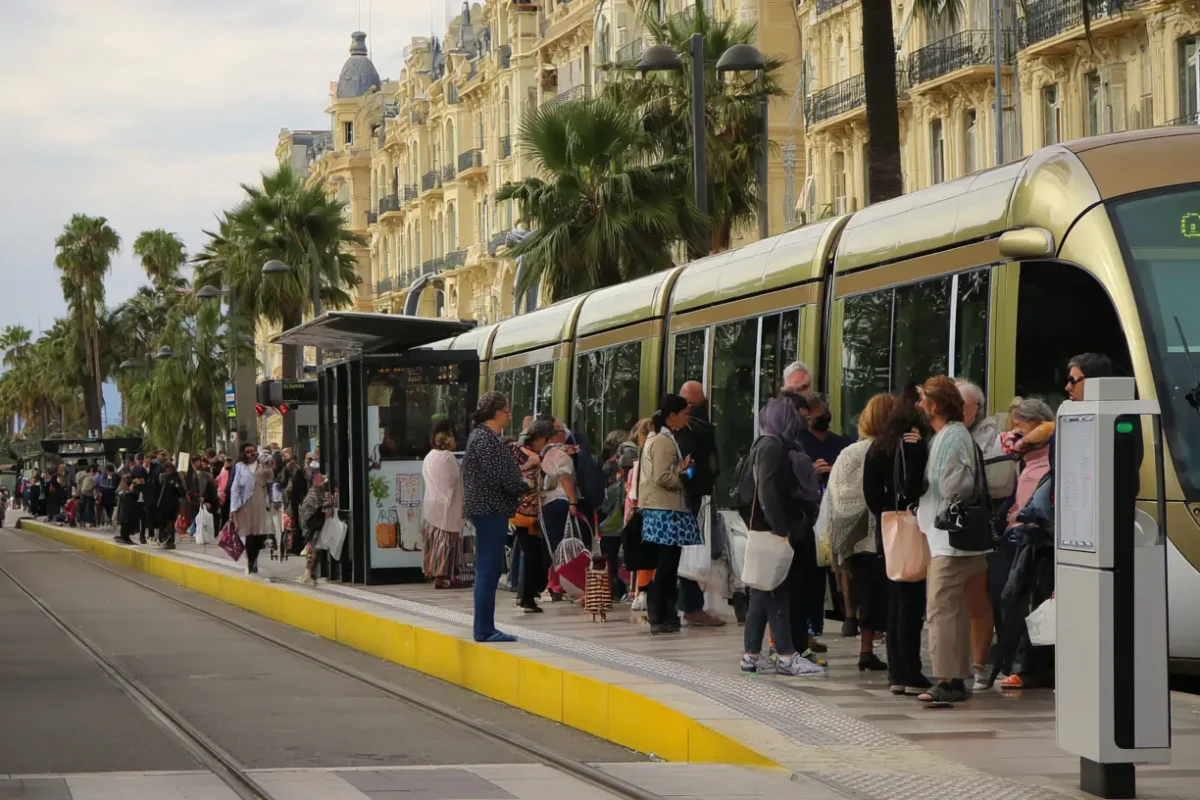
The Lignes d’Azur system runs three tram lines and well over a hundred bus routes across Nice and the surrounding metropolitan area. For visitors, the trams are the most practical option — faster than buses in traffic and straightforward to navigate.
Ticket pricing (current standard fares):
- Single ticket: around €1.70 per journey, valid for 74 minutes with unlimited transfers between bus and tram
- Day pass: around €7
- 7-day pass: around €20
- Airport return fare: around €10
Prices are adjusted periodically, so treat these as a solid working reference rather than a locked-in figure. Tickets can be bought at machines at every tram stop (card, contactless, or coins — no bills), at tabacs displaying the Lignes d’Azur logo, or through the Lignes d’Azur app. At street-level stops, validate your card or ticket on the reader as you board; at underground stations, tap to pass through the gate. Skipping validation is technically possible but inspectors do check, and the fines are real.
The three tram lines:
Tram Line 1 runs north–south through the city, connecting the northern residential neighborhoods to the center via Avenue Jean Médecin and Place Masséna, continuing into the old town area. This is the fastest line between Nice-Ville train station and the central tourist area.
Tram Line 2 runs east–west, from Nice Côte d’Azur Airport to Port Lympia, passing through the city center along the way. This is the airport line — the most important one for arriving and departing travelers, and also useful for reaching the port and the eastern parts of the city.
Tram Line 3 connects Port Lympia north to Saint-Isidore via the Allianz Riviera stadium — less relevant for most visitors, but useful if you’re heading to a football match.
Trams generally run from the very early morning until around 1:30am, with frequency ranging from about every 5 to 15 minutes depending on the time of day.
Getting from Nice airport to the city center
This is the first transport question most visitors have. Tram Line 2 connects both terminals of Nice Côte d’Azur Airport directly to the city center and Port Lympia, with a journey time to the center generally in the 25-to-30-minute range.
A regular Lignes d’Azur single ticket covers the trip, or you can buy a dedicated airport return fare (around €10) at the tram stop. If you’re only traveling one direction, a standard single ticket is the better value.
The tram is the default choice for most people. A taxi from the airport to the center generally runs somewhere in the €30 to €50 range depending on destination, time of day, and luggage, with night surcharges applying — worth confirming the current posted fixed rate at the taxi rank, since these are periodically adjusted.
Regional trains: the backbone of Riviera day trips
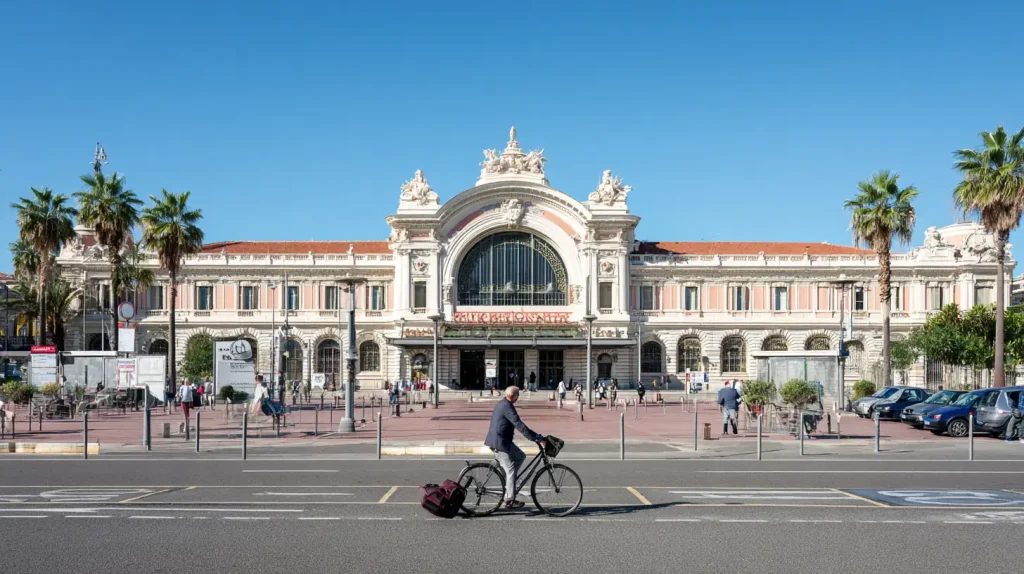
For traveling between towns along the coast, the TER regional train network (increasingly rebranded as Zou! in this region) is both the cheapest and most reliable option. Trains run frequently from Nice-Ville station, generally every 15 to 30 minutes in both directions along the coastal line.
Rough journey times and one-way fares from Nice, as a working reference (both shift with demand and how far ahead you book):
- Nice to Villefranche-sur-Mer: a few minutes, generally a couple of euros
- Nice to Èze-Bord-de-Mer (the coastal station, not the hilltop village): around 10 minutes, a few euros
- Nice to Monaco-Monte Carlo: roughly 20 to 25 minutes, generally in the €4 to €6 range
- Nice to Antibes: roughly 16 to 25 minutes depending on the service, generally in the €6 to €8 range
- Nice to Cannes: roughly 30 to 40 minutes, generally in the €7 to €10 range
- Nice to Menton: roughly 30 to 35 minutes, generally around €7 to €8
No advance booking is required for most journeys — buy a ticket at the station machines or counters on the day, or purchase ahead through the SNCF Connect app or the regional Zou! app. Buying online in advance can sometimes get you a cheaper fare than a same-day purchase.
One important note: the train station for Monaco is Monaco-Monte Carlo, inside the Principality itself, not a border stop. You step off the train and you’re there. There are no customs delays on this crossing for EU and Schengen-area travelers; non-Schengen visitors should keep their passport situation in mind.
The three Corniche roads: when driving makes sense
If you’re renting a car — or taking a taxi or organized tour — the stretch between Nice and Menton features three parallel roads at different altitudes, each with a different character. These are the Corniches.
Basse Corniche (D6098) — the lowest road, running near sea level along the coast, broadly following the route the train takes, with exits into each coastal town. Most practical for stopping in villages, least dramatic visually.
Moyenne Corniche (D6007) — the middle road, carved into the cliffs roughly halfway up the hillside. This is the route to the hilltop village of Èze (the village itself sits above the Moyenne Corniche; the coastal train station below is a separate stop). Views are excellent, and the road itself isn’t technically demanding.
Grande Corniche (D2564) — the highest road, rising to around 500 meters above the sea, originally built along an ancient Roman route. It offers the most dramatic panoramas of the coastline, but also the most demanding driving — narrow sections, limited passing points, fog that can roll in unpredictably, and a real accident history. Drive it in good weather, in daylight, and take it slowly.
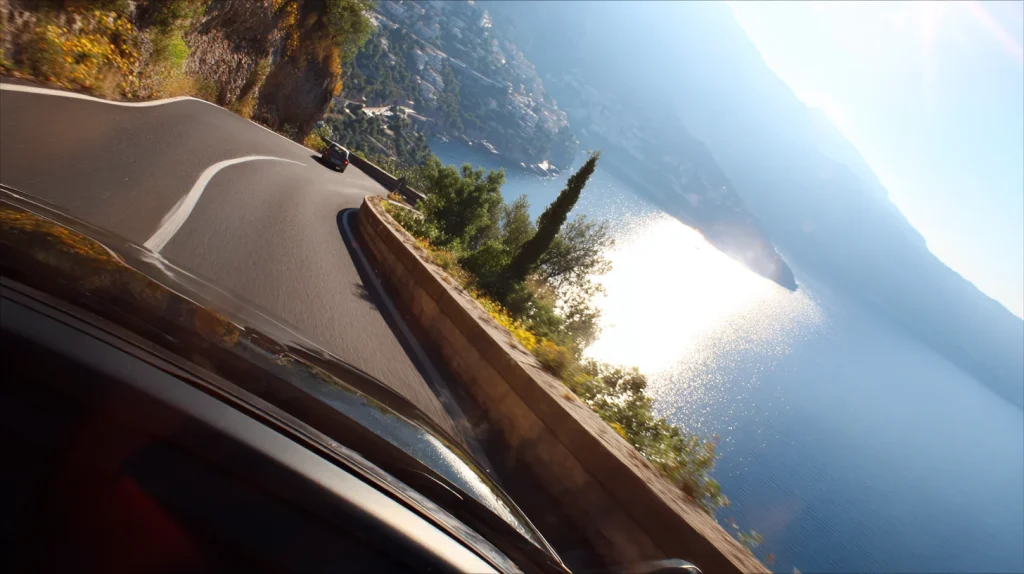
If you only drive one: the Moyenne gives the best balance of easy access and views, with the bonus of the Èze exit.
Taxis and rideshare
Taxis in Nice run on a metered system with a base rate plus per-kilometer charge. A trip from the center to the airport typically runs somewhere in the €30 to €45 range during the day, more at night, with an additional surcharge for pre-booking.
Uber operates in Nice and is generally a bit cheaper than a taxi stand, with the advantage of upfront pricing and card payment without a language barrier. Pickup can be slower in some parts of the city than in bigger metros, and surge pricing kicks in during peak hours and events. For in-city trips the tram doesn’t cover well, Uber is generally the more practical option over hailing a taxi.
Neither is really necessary for day-to-day travel within the city — the tram and walking cover most tourist needs at a fraction of the cost.
Cycling: Vélobleu and rental bikes
Nice has a functional bike-share scheme called Vélobleu, with around 175 stations across the city and nearby towns. Pricing has historically run cheap — commonly somewhere in the €1 to €3 range for a day pass — with the first 30 minutes of each ride free; if you dock the bike and take it back out, that free window resets, so short hops around the city can end up costing nothing beyond the base pass. It’s worth checking current Vélobleu pricing directly, since bike-share fee structures tend to shift more than transit fares do.
The Promenade des Anglais has a dedicated bike lane running its full length, making it one of the better cycling routes in any French city. The coastal path toward Port Lympia and east toward Villefranche is also rideable. Hills inland get steep quickly — e-bikes make areas like Cimiez and the northern neighborhoods far more manageable.
Third-party bike rental shops also operate in Nice for full-day or multi-day rentals, generally starting somewhere around €15 a day for a standard bike.
Do you actually need a car in Nice?
For most visitors: no. Here’s the practical breakdown.
You don’t need a car if you’re based in Nice and doing day trips along the coast. The train covers Monaco, Cannes, Antibes, Villefranche, and Menton in well under 40 minutes each and runs frequently enough that you can plan loosely and adjust as you go. The city itself is walkable between major landmarks, and the tram handles anything a bit further out. Returning to Nice by train also means skipping the parking scramble that hits every Riviera town in July and August.
A car makes sense if you specifically want to drive the Corniches, reach inland hill villages not served by trains (Peillon, La Turbie, and similar), explore Provence more broadly, or you’re traveling as a family with significant luggage moving between several accommodation stops across the region.
Car rental practicalities: rates vary a lot by size, season, and how far ahead you book, but expect a wide range depending on those factors — worth comparing a few booking platforms rather than assuming a fixed number. Parking in the old town isn’t possible at all, since the streets are pedestrianized; parking in the wider center is metered and competitive. If you do rent a car, plan to park it at your hotel or in a paid underground garage and use it mainly for leaving the city — walking from the garage to your actual destination is nearly always the better plan once you’ve arrived somewhere.
Getting to Nice airport for departure
Tram Line 2 to the airport is the default choice. Buy your ticket (or use an existing pass) and allow around 30 to 35 minutes from the city center, including the walk to the tram stop. The tram serves both terminals.
If you have a very early flight — before the trams start running around 4:30am — or heavy luggage that makes the tram impractical, Uber or a pre-booked airport transfer is the fallback. Pre-book the night before if you need a guaranteed early-morning departure.
Frequently asked questions
What’s the best way to get around Nice city center? Walking and the tram. The Lignes d’Azur tram network covers the main tourist areas efficiently — Tram Line 1 runs through Jean Médecin and Place Masséna, and Tram Line 2 connects the airport to the port. A single ticket costs around €1.70 and is valid for 74 minutes with unlimited transfers.
How do I get from Nice airport to the city center? Tram Line 2 connects both airport terminals directly to the city center in roughly 25 to 30 minutes. A standard Lignes d’Azur ticket or the dedicated airport fare covers the trip. A taxi or Uber is faster but generally costs somewhere in the €30 to €50 range.
Can you visit Monaco from Nice by train? Yes. Regional TER trains from Nice-Ville reach Monaco-Monte Carlo in roughly 20 to 25 minutes. Trains run frequently throughout the day, tickets generally run somewhere in the €4 to €6 range one way, and no advance booking is required.
What are the three Corniche roads in Nice? The Basse, Moyenne, and Grande Corniche are three parallel roads running east from Nice toward Menton at different altitudes. The Basse follows the coast closely; the Moyenne gives access to Èze village with excellent sea views; the Grande is the highest and most dramatic, with narrow sections and some fog risk. The Moyenne is generally the best choice for most visitors.
Do I need a car to visit the French Riviera? Not for most itineraries. The regional TER train connects Nice to all the major coastal towns. A car adds real value for reaching inland villages, driving the Corniches, or for flexibility exploring Provence more broadly — but for the coast itself, the train is faster, cheaper, and considerably less stressful than driving and parking in summer.