Where you sleep in Nice shapes everything else. It affects how far you walk to the beach in wet sandals, whether late-night bar noise seeps through your window at 2am, what you pay for the room itself, and how easy it is to catch a train or bus to Èze or Monaco when you want to get out of the city for a day.
Most “where to stay” guides will tell you Vieux Nice is atmospheric and the Promenade des Anglais has great sea views. True enough. But they don’t tell you that Vieux Nice’s narrow streets mean no car access, that the Promenade’s best hotels can charge close to double what equally good hotels two blocks back charge, or that the Port area — overlooked by most first-timers — is arguably the best base for anyone using Nice as a launching pad for Riviera day trips.
This guide gives you the real picture, neighborhood by neighborhood.
The Quick Decision
Before going deep, here’s the short version:
Best for first-timers: Vieux Nice or Carré d’Or Best for families: Carré d’Or (close to beach, walkable, spacious hotels) Best for budget: Gambetta–Fleurs or Musicians Quarter Best local vibe: Port Lympia Best for culture: Cimiez Best for day trips by train: Jean Médecin / New Town (walking distance to Nice-Ville station) Best for day trips by boat: Port Lympia (ferries to Corsica and Sardinia)
Now the detail.
Vieux Nice: The Soul of the City
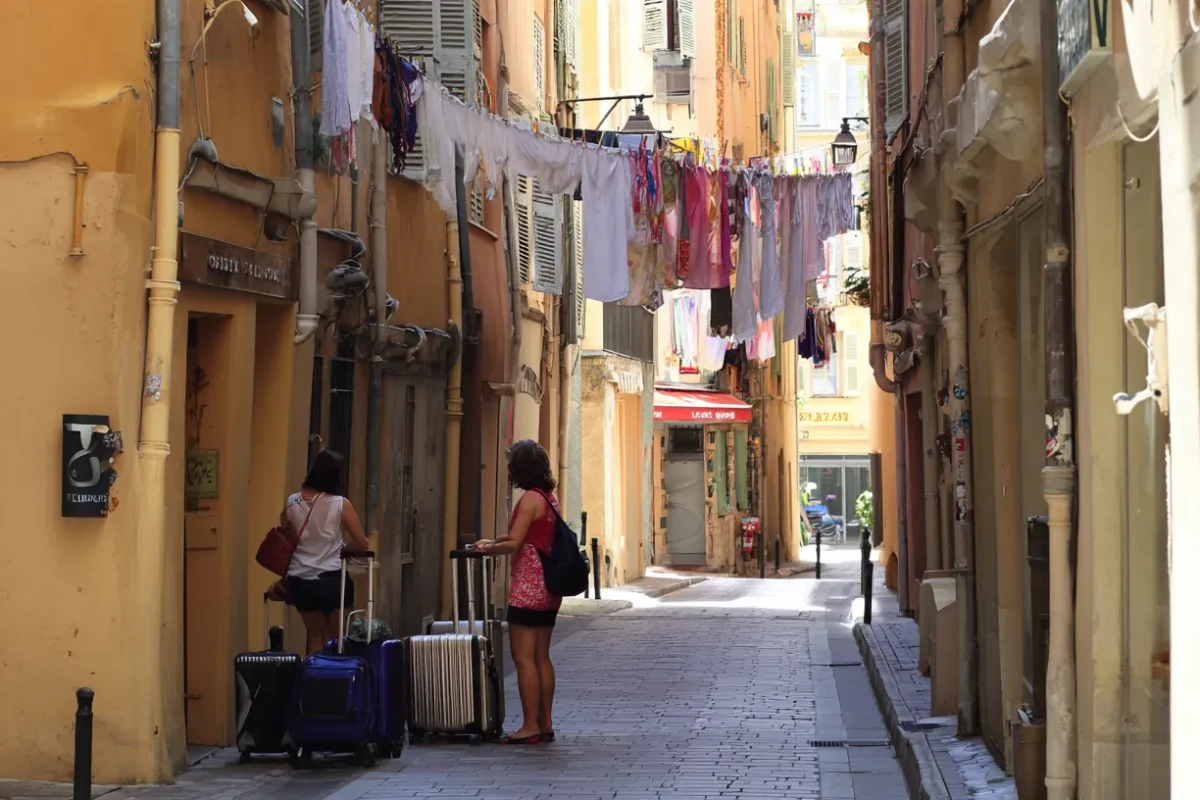
Vieux Nice — the Old Town — is what most people picture when they imagine Nice: narrow Baroque streets, buildings painted in shades of ochre, sienna, and faded yellow, arched doorways, and a general sense that you could get genuinely lost and not particularly mind.
Cours Saleya hosts a produce and flower market every morning except Monday, when it converts to an antiques market. Summer evenings bring an artisan night market. It’s the visual and social center of the city, and staying inside it puts you within about five minutes of the sea on one side and Castle Hill on the other.
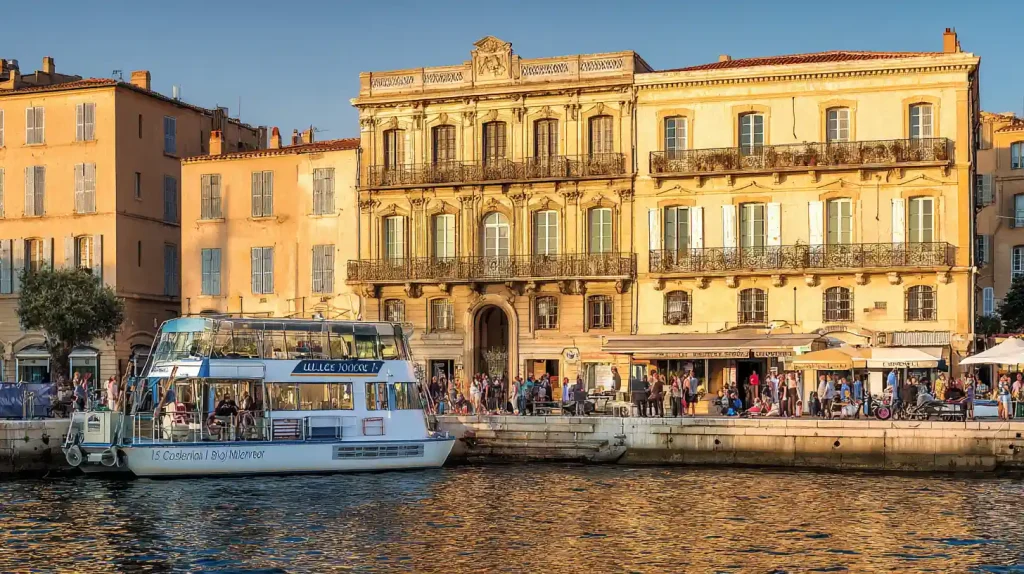
The hotels in Vieux Nice run from guesthouse-level to genuinely exceptional. La Pérouse, perched on the flank of Castle Hill, is one of the more quietly impressive places to sleep on the whole Riviera — terraced gardens, Mediterranean views, and rooms that feel peaceful despite the location. Hôtel du Couvent, a former 17th-century Visitation convent restored into a five-star property, has a panoramic outdoor pool alongside a Roman-style bath circuit built as a tribute to the ancient Roman baths in nearby Cimiez. Neither comes cheap, but neither feels overpriced for what it offers.
One practical note: Vieux Nice’s streets are pedestrianized and tight. If you’re arriving with large luggage, you’ll be wheeling it across cobblestones, and there’s no car access through most of the old town. Bar and restaurant noise from the Cours Saleya area also carries at night — ask for rooms facing the interior if quiet sleep matters to you.
Best for: First-timers, couples, anyone who wants to be in the middle of Nice’s historic atmosphere Consider before booking: Street noise at night, no car access, cobblestones with luggage
Carré d’Or and the Promenade des Anglais: Luxury and Beach Territory
The Carré d’Or — “Golden Square” — sits just west of Vieux Nice and is technically where the Promenade des Anglais begins. It’s Nice’s most prestigious address: wide Haussmann-style boulevards, Belle Époque architecture, stately buildings converted into boutique hotels, and a density of good restaurants and shops that makes it easy to spend an entire trip without moving far.
The Promenade des Anglais runs along the seafront and is where Nice’s most iconic hotels sit. Le Negresco, the Belle Époque landmark with its distinctive pink dome, has anchored the Promenade since it opened in January 1913 and remains one of the most recognizable hotel facades on the Riviera. The Hyatt Regency Palais de la Méditerranée occupies a grand Art Deco building nearby. Anantara Plaza Nice, reborn after a multi-year renovation, sits in a Belle Époque building close to the Promenade with a well-regarded rooftop restaurant and bar, though it’s worth noting it doesn’t have its own pool — guests instead get access to a private beach nearby. Maison Albar Le Victoria is a newer, more recently renovated boutique property with its own rooftop pool and restaurant, and it draws consistently strong reviews.
Here’s the honest trade-off on the Promenade: a sea-view room in a beachfront hotel costs noticeably more than an equivalent room two to three streets back in the Carré d’Or, while the difference in beach access is under five minutes of walking. If you’re on a tighter budget, staying in the Carré d’Or rather than directly on the Promenade makes good sense — you lose very little in practice and gain meaningfully on price.
The Carré d’Or is also the most practical area for families. The streets are wide and walkable, it’s directly adjacent to the beach, and the hotel stock includes several properties with family rooms and pools.
Best for: Families, luxury seekers, anyone prioritizing beach access, couples who want a classic Riviera experience Consider before booking: The most expensive area in Nice; book early for summer
Port Lympia: The Local’s Pick
The Port area is the neighborhood most first-time visitors overlook and most repeat visitors end up preferring.
Port Lympia sits just east of Castle Hill at the base of the Mont Boron headland. The port itself handles ferries to Corsica and Sardinia, along with cruise ships and a fleet of private yachts. The neighborhood around it — Place Garibaldi, Rue Bonaparte, the antique shops along the quayside — has become one of the liveliest and most genuine parts of the city.
The building stock is impressive: neoclassical ochre houses with ornate wrought-iron balconies around Place de l’Île de Beauté, which frames the Church of Notre-Dame-du-Port. Les Puces de Nice, the city’s flea market, draws locals on weekends. The bar scene around Place du Pin feels genuinely local rather than tourist-oriented, and you can eat well here without paying a tourist markup. Rue Bonaparte is notably LGBTQ-friendly.
Hotels in the Port area tend to be mid-range and represent better value than equivalent options in the Carré d’Or. Palais Ségurane is a boutique hotel with apartment-style rooms and an art gallery on the ground floor, with spacious, individually decorated rooms. Mama Shelter Nice brings its trademark playful design to the neighborhood. Ibis Styles Nice Vieux Port is a solid, modern mid-range option in a central Port location.
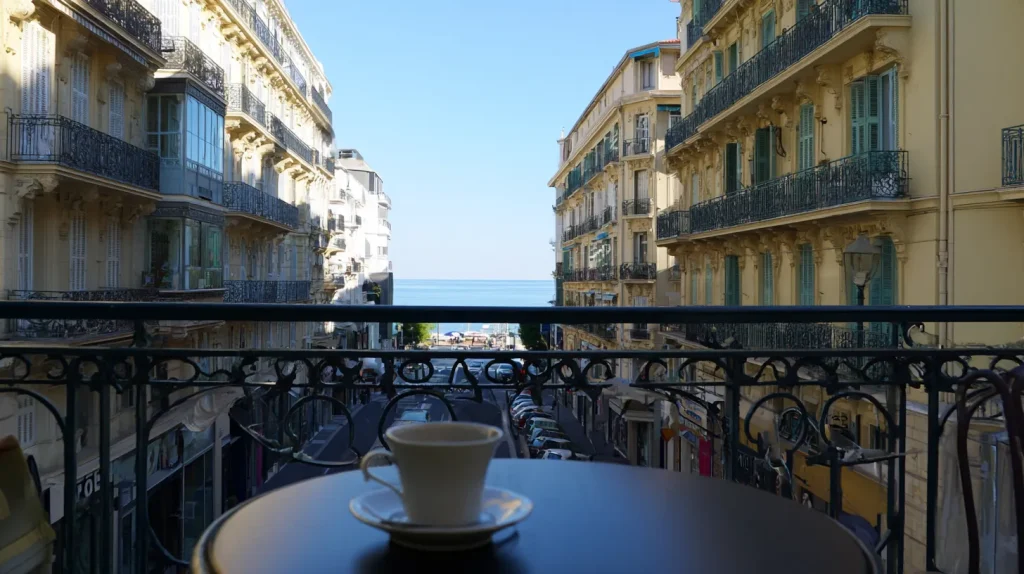
The main practical advantage of the Port for day-trippers: ferries to Corsica and Sardinia depart from here, and bike paths heading east toward Villefranche-sur-Mer and Saint-Jean-Cap-Ferrat start nearby. Several Lignes d’Azur bus lines connect the area to the rest of the city without needing to walk far. The downside is noise — the Port area gets loud at night around certain streets, so it’s worth specifically requesting quieter rooms or checking reviews that mention noise before booking.
Best for: Repeat visitors, anyone using Nice as a day-trip base, local dining and nightlife enthusiasts Consider before booking: Noise at night in busy parts; roughly a 15-minute walk to the Promenade
Jean Médecin & New Town: Practical Central
Jean Médecin is Nice’s main commercial street, running north from Place Masséna to the Nice-Ville railway station. It’s not the most beautiful part of the city, but it’s the most functional: good supermarkets, serious shopping, direct tram access, and hotel prices that reflect a lack of sea views rather than a lack of quality.
If you’re making multiple train day trips — to Monaco, Cannes, Antibes, Menton — staying within walking distance of Nice-Ville station removes one layer of logistics every single morning, which is worth something if you’re on a packed itinerary.
The neighborhood around Jean Médecin also includes Place Masséna, Nice’s main civic square with its geometric paving and fountains, and the MAMAC contemporary art museum is nearby. There are good mid-range hotel options here, though the area lacks the character of Vieux Nice or the beach access of the Carré d’Or.
Best for: Train-dependent day-trippers, travelers who prioritize logistics over atmosphere, anyone on a tight budget who still wants a central position Consider before booking: Less scenic than other areas; beach is roughly a 15-minute walk
Gambetta–Fleurs & Musicians Quarter: Budget Done Right
These two neighborhoods are something of Nice’s best-kept secret for value accommodation. Both sit west of the Carré d’Or, slightly inland, in what is primarily a residential neighborhood of Belle Époque apartments and tree-lined streets.
The Gambetta–Fleurs area is named for the Boulevard Gambetta that forms its eastern edge and the Fleurs neighborhood to the west. The Musicians Quarter (Quartier des Musiciens), named because its streets carry the names of famous composers, sits a bit further north. Both are within roughly 10 to 20 minutes’ walk of the beach and the old town, and prices here are meaningfully lower than in the Carré d’Or or Vieux Nice.
These areas are residential and quiet, which is a genuine plus if you’re sleeping in rather than joining the Vieux Nice late-night crowd. The tram runs through here, connecting you to Place Masséna in minutes. Self-catering apartments in these neighborhoods often offer the best cost-per-night value in Nice proper, with the kind of kitchen access that lets you skip restaurant meals when you’d rather spend that budget on a day trip instead.
Best for: Budget travelers, longer stays, self-catering, couples who want quiet without sacrificing a central location Consider before booking: No immediate beach or major attraction access; fine on foot or tram
Cimiez: Culture and Calm
Cimiez occupies a hillside north of the city center and offers a different kind of Nice experience. It’s mostly residential, with wide avenues, mature trees, and the kind of ambient quiet that feels far removed from the Promenade des Anglais hustle — even though it’s only a few kilometers away.
The main draws are cultural: the Musée Matisse is here, housed in a 17th-century Genoese villa surrounded by Roman ruins and an olive grove, and the Musée National Marc Chagall sits between Cimiez and the center. The Fête des Mai folklore festival runs every Sunday in May (plus May 1st itself) in the Cimiez Arena gardens, among century-old olive trees — free, local, and genuinely lovely, with traditional music, dancing, and Niçois food specialties.
For accommodation, Cimiez generally means guesthouses, small hotels, and apartments rather than the hotel chains and luxury flagships of the waterfront. The trade-off is clear: more serenity and residential context, but less convenience for beach days or evening restaurant access without a bus or tram ride.
Cimiez tends to work best for art-focused travelers, those who find urban noise genuinely disruptive to their trip, or anyone who has already done Nice’s center on a previous visit and wants a different pace this time. For first-timers, it’s a bit too far from the action to be the obvious base.
Best for: Art and history enthusiasts, repeat visitors, anyone prioritizing quiet over convenience Consider before booking: Requires tram or bus for most central activities; fewer dining options nearby
On the Promenade vs. Two Streets Back
This is worth spelling out clearly because it’s the decision where the most money gets spent — or saved — unnecessarily.
The Promenade des Anglais itself commands a price premium at every hotel along it, in rough proportion to whether you can see the sea from your room. A room facing the Promenade can cost noticeably more than a room facing the interior courtyard of the same hotel. A comparable hotel two blocks back in the Carré d’Or can cost meaningfully less than a beachfront equivalent while still offering the same three-to-five-minute walk to the sea.
Unless a sea-view breakfast is a specific priority for you, staying one to two streets back from the Promenade and putting that savings toward better meals, a day trip, or an extra night is a trade most people would make if they thought about it in advance.
How to Choose
The neighborhood question usually resolves quickly once you know what matters most to you:
If atmosphere and walking streets are the point — Vieux Nice. If beach and family space — Carré d’Or. If local restaurants and day-trip access by boat — Port Lympia. If train logistics and shopping — Jean Médecin. If budget and quiet residential calm — Gambetta–Fleurs or the Musicians Quarter. If art and silence — Cimiez.
Nice is compact enough that none of these are really the wrong answer. The right one depends entirely on how you plan to spend your days.
FAQs
What is the best area to stay in Nice for first-timers? Vieux Nice or the Carré d’Or. Vieux Nice puts you inside the historic atmosphere with easy beach access. The Carré d’Or is more polished, better for families, and sits directly beside the Promenade des Anglais.
Where should I stay in Nice on a budget? The Gambetta–Fleurs neighborhood or the Musicians Quarter offer the best value without sacrificing a central location. Both are within tram distance of Place Masséna and a 10–20 minute walk to the beach.
Is it worth staying on the Promenade des Anglais? Only if a sea view from your room or direct beach access matters enough to justify the price premium. Hotels two to three streets back in the Carré d’Or offer comparable quality at meaningfully lower rates, with essentially the same walk to the beach.
Which Nice neighborhood is best for day trips? Port Lympia if you’re doing coastal day trips by boat, since ferries to Corsica and Sardinia depart from there. Jean Médecin or New Town if you’re doing train-based day trips to Monaco, Antibes, and Menton — Nice-Ville station is walkable from there.
Is Cimiez worth staying in as a tourist? It depends on your priorities. Cimiez is quiet, cultural, and residential — excellent for art lovers visiting the Musée Matisse and Chagall museums, but it requires a bus or tram for beach days and most restaurant dinners. It works best for repeat visitors or anyone who specifically wants a slower pace.