Three days in Nice feels like just enough time to mismanage it completely. The coast is so beautiful that you want to be everywhere at once — Monaco on Tuesday, Cannes on Wednesday, Èze on the way back, Vieux Nice whenever — and you end up sitting on trains between places you barely saw.
The Riviera rewards a different approach. Slow mornings. One destination done properly per day. Long lunches that don’t feel rushed. This itinerary is built around that logic, not a checklist. You’ll leave with a real sense of the place rather than a collection of glimpses.
Before You Go — A Few Things Worth Knowing
Nice has a cheap, efficient regional train that runs east and west along the coast. Trains to Monaco take about 23 minutes. Villefranche-sur-Mer is 10 minutes. Antibes is around 20 to 25 minutes, Cannes about 35 to 40. Trains run frequently — often every 20 minutes or so. You don’t need to book these short hops in advance. Buy a ticket at the station or through the SNCF Connect app and go.
The Promenade des Anglais, Vieux Nice, Cours Saleya, and Colline du Château are all walkable from each other. You don’t need a car in Nice itself.
The old town area is noisy in the evenings. If you need quiet sleep, stay near the Carré d’Or or near the train station. If you want to walk to the market before breakfast, stay in Vieux Nice.
One honest note: three days is enough to do Nice well and add two good day trips. It’s not enough to do everything. This itinerary makes choices.
Day 1 — Nice Itself
Morning: Cours Saleya and Vieux Nice
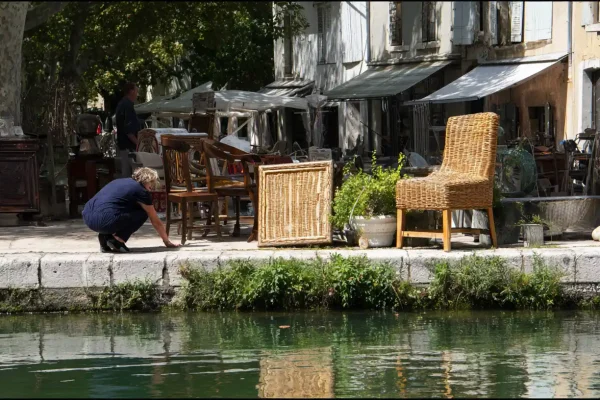
Start at the Cours Saleya market before 9am. Tuesday through Sunday this is the flower and food market — arrive early for the best energy, before the tour groups. Pick up a socca from one of the market carts, buy flowers if you want them, and eat standing up. Monday is the antique and flea market instead, running roughly 7am to 6pm — a different but equally good experience.
After the market, walk into the lanes of Vieux Nice behind Cours Saleya: Rue Droite, Rue de la Poissonnerie, the side streets. Look for the 16th-century fresco of Adam and Eve on Rue de la Poissonnerie — easy to walk past, worth finding. Duck into the Chapelle de la Miséricorde at Place Pierre-Gautier if the doors are open; it’s regarded as one of the finest Baroque chapels in Europe, and admission is free.
Give yourself two to three hours in the old town. Don’t try to complete a route — wander and let it slow you down.
Afternoon: Colline du Château
Walk to the eastern end of Vieux Nice and take the free elevator near the Bellanda Tower up to Colline du Château — Castle Hill. Entry is free. The park itself is open from roughly 8:30am to 8pm from April through October, and 8:30am to 6pm from November through March; the elevator generally runs shorter hours within that window, so don’t count on it right at opening or closing.
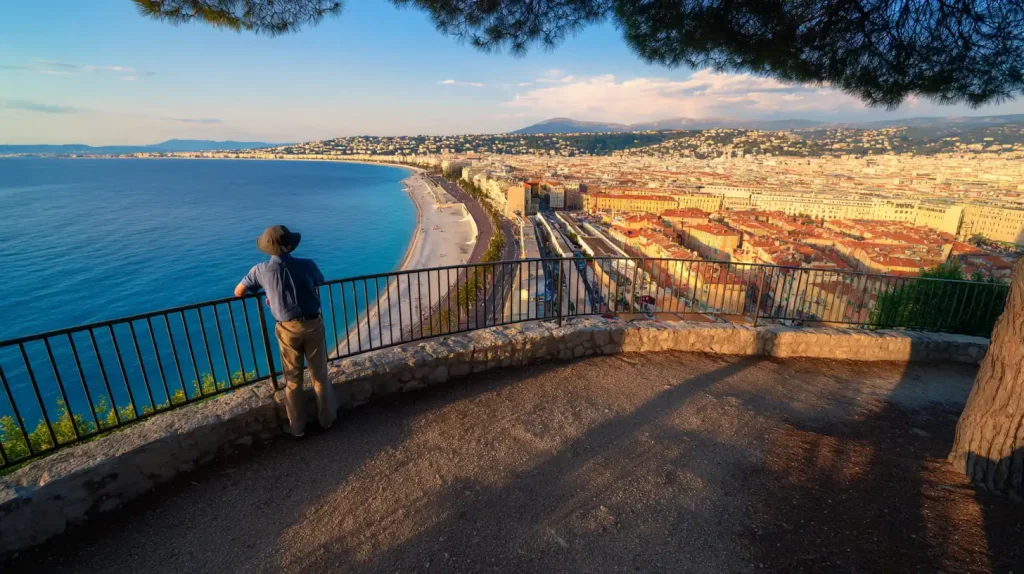
At the top: the best view of Nice. The Baie des Anges and the Promenade des Anglais sweep west, the port lies below to the east, and the old town rooftops press against the hill below you. There’s a waterfall, shaded paths, benches. Give it an hour. Walk down rather than taking the elevator back — the descent through the old town side adds a few quiet streets worth seeing.
Late Afternoon: Promenade des Anglais
Walk the Promenade des Anglais westward from the old town. The full length is about 7 kilometers, but you don’t need to walk all of it. The first kilometer or two, from the Quai des États-Unis past the landmark Hôtel Negresco, is the heart of it. The famous blue iron chairs line the edge — sit in one, watch the sea, and let the afternoon go by. That’s the promenade done right.
The pebble beaches below the promenade are free to use. If you want a sunbed and umbrella, private beach clubs run along the promenade, generally charging somewhere in the range of €20 to €30 per person per day — worth checking the specific club’s current rate before you settle in, since it varies by location and season.
Evening: Place Rossetti
End the day at Place Rossetti for ice cream from one of the well-known gelaterias on the square, and a drink at one of the cafés framing the cathedral. If you want dinner in Vieux Nice, look for one of the small, well-regarded local bistros tucked into the side streets rather than the restaurants right on the Cours Saleya terrace — the food is generally better and the prices more reasonable a block or two off the main square.
Day 2 — Villefranche-sur-Mer and Èze Village
Morning: Villefranche-sur-Mer
Take the train from Nice-Ville station toward Ventimiglia. Villefranche-sur-Mer is 10 minutes east. Get off and walk down to the harbor.
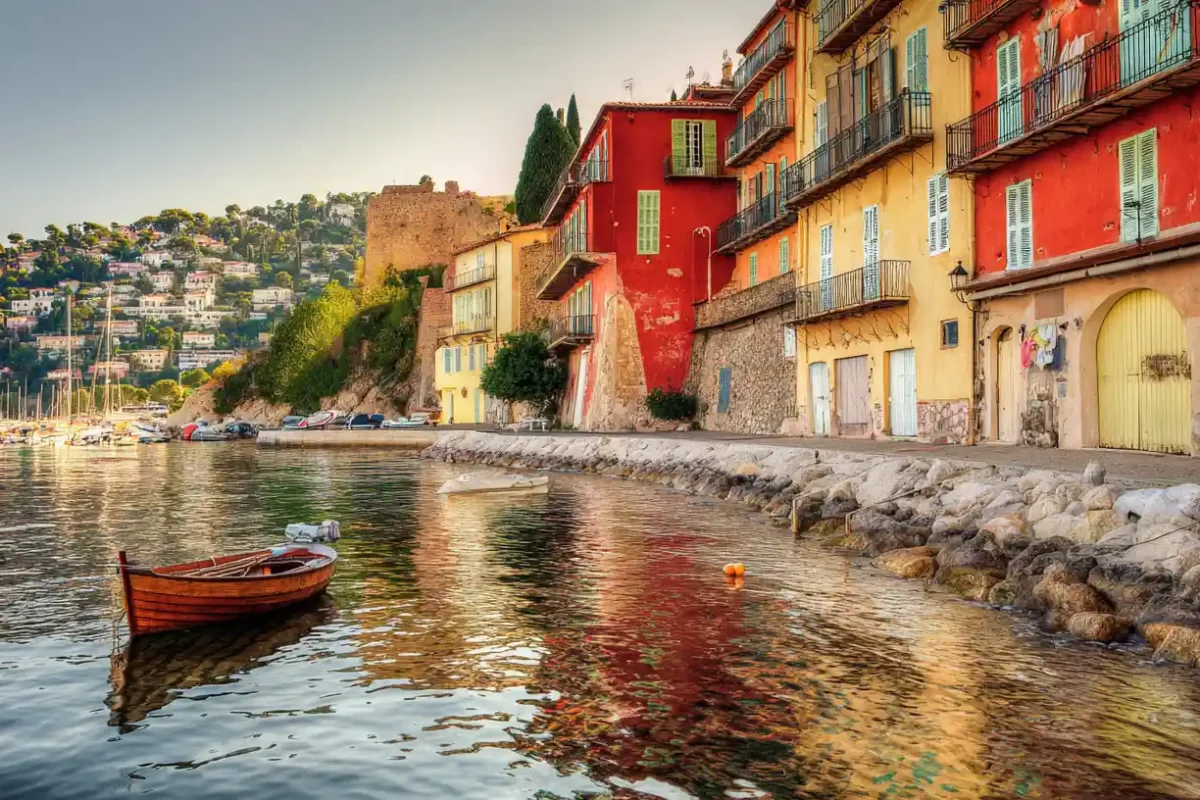
Villefranche is a small, colorful fishing port with a citadel, a deep natural harbor, and streets that drop steeply down to the water. It’s compact and genuinely beautiful. The Rue Obscure is a vaulted medieval street running under the buildings parallel to the waterfront — one of the oldest covered streets on the Riviera, worth walking through slowly. The citadel on the hillside houses a handful of small museums with free entry, though it’s worth confirming current hours locally, since they can shift by season.
Two to three hours in Villefranche is about right. Have a coffee at the port, walk the old streets, then head back to the station.
Afternoon: Èze Village
From Villefranche, take the train one more stop east to Èze-sur-Mer station, about 5 minutes from Villefranche. From the station it’s a steep uphill walk to Èze Village, roughly 45 minutes on foot, or you can take a taxi from the station. A local bus also connects the station to the village — check the current schedule locally, since bus frequency on this route varies by season and isn’t something to rely on without a quick look beforehand.
Èze Village sits some 400 meters above the Mediterranean on a rocky peak, with views that reach Monaco to the east and Cap Ferrat to the west. The medieval village itself is really just a single loop of narrow stone streets, with former houses now turned into craft shops and galleries — give it 90 minutes to two hours.
The Jardin Exotique at the top of the village charges somewhere in the €8 to €10 range for adults and has cactus and succulent gardens with the best views in the village. Worth it.
You’re realistically done with Èze by mid-afternoon. Take a local bus back down to Nice, roughly 40 minutes, or return to Èze-sur-Mer station for the train.
Day 3 — Monaco (or Antibes/Cannes)
Option A: Monaco
Monaco is a sovereign city-state — its own country — that takes about 23 minutes by train from Nice. Trains run roughly every 20 minutes.
Monaco is worth a full day if you’re doing it properly. The key stops:
Le Rocher (the Rock), the old town of Monaco on the promontory where the Princely Palace sits. The palace square hosts a changing of the guard ceremony every single day, year-round, at 11:55am sharp, free to watch. The Oceanographic Museum, also on the Rock, is a legitimate world-class institution founded by Prince Albert I in 1910, with a large aquarium and marine research collection. Standard adult admission runs around €22.50, with reduced rates for students and children.
Monte-Carlo Casino: the famous casino dates to the 1860s and still operates. Entry to the gaming rooms requires a passport or ID and a dress code. The ornate entrance halls can be visited for free without gambling. The exterior and the surrounding square are as photogenic as the interior.
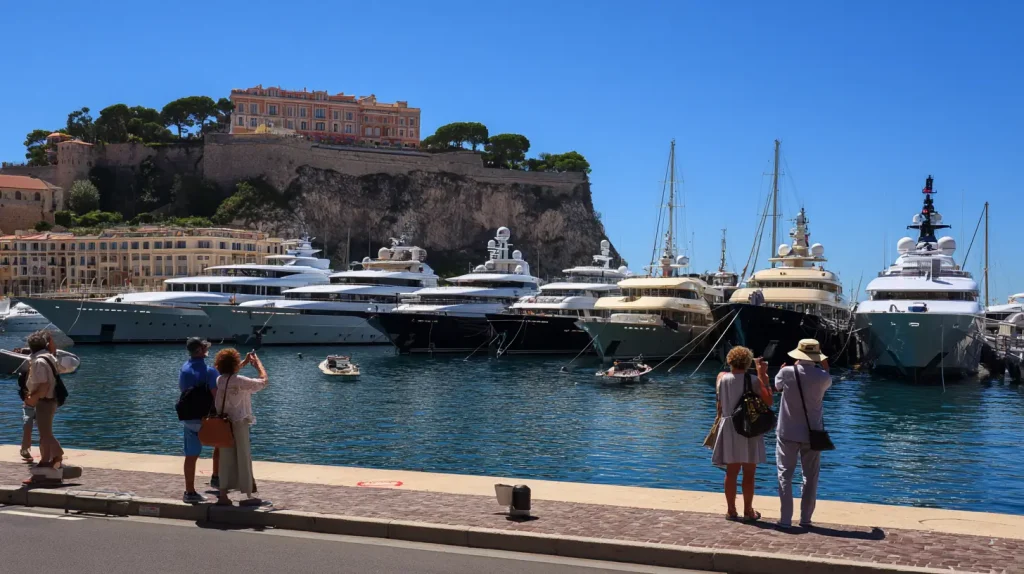
Port Hercule: Monaco’s main harbor, where superyachts berth year-round. Worth 20 minutes to walk around, more if you want to eat at one of the port-side cafés.
Monaco is genuinely expensive — the casino café charges what you’d expect, and most restaurants near the port are tourist-facing at premium prices. Eat in the La Condamine neighborhood, the flatter area between the Rock and Monte-Carlo, for more reasonable options.
One thing worth knowing before you go: Monaco has no border control. You walk off the train and you’re there. No passport check, no customs. It’s a separate country that functions, from a travel logistics perspective, exactly like a French coastal town. The train ride back to Nice takes about 23 minutes, and trains run frequently into the evening.
Option B: Antibes and Juan-les-Pins
If you’ve already done Monaco or want something lower-key, Antibes is around 20 to 25 minutes west of Nice by train. The old town, Vieil Antibes, has a covered market on Cours Masséna running Tuesday through Sunday mornings, the Musée Picasso in the château overlooking the sea (admission runs roughly €8 to €10), and the Cap d’Antibes coastal path, which is free and runs along the water for several kilometers.
Juan-les-Pins, the beach town directly south of Antibes old town, has better sandy beaches than Nice and a more relaxed atmosphere than Cannes. Add it to the Antibes day if the weather is good.
What to Skip (Honest Take)
Cannes with only one day to spare is a good call only if the beaches are your priority. The old town, Le Suquet, is genuinely lovely, but Cannes’s reputation rests more on film festival mythology than on what it offers a first-time visitor with limited days.
Grasse, the perfume capital, is an interesting half-day if you have a specific interest in perfume history. Otherwise it’s a fairly ordinary Provençal town reached by a roughly 45-minute bus ride. A nice addition for a longer stay, not a must for three days.
The French-Italian border towns, Menton and Ventimiglia, are worth a day trip on a longer visit but add transport time for a smaller payoff than Villefranche or Monaco on a short trip.
Practical Notes
The Nice tram (Line 1) connects the train station to Place Masséna in about 8 minutes and runs until midnight. A single ticket costs €1.70 and covers both trams and buses, with free transfers within a 74-minute window in the same direction. If you’re taking multiple tram or bus journeys across your stay, a multi-day pass works out cheaper than paying per trip.
The weather on the Riviera in summer runs hot, typically 28 to 34°C in July and August. Morning activities are always more comfortable than midday. Take water on the Castle Hill climb and on any walk through Vieux Nice’s narrow streets, which trap heat in summer.
The Nice-Ville train station is about a 15-minute walk, or one tram stop, from the center of the old town. Tram Line 1 runs frequently between the station and Place Masséna.
All the day-trip trains covered here run on standard TER regional tickets. No high-speed rail, no seat reservations needed. Buy on the SNCF Connect app or at ticket machines in the station.
Budget travelers can eat well for €10 to €15 per person at lunch — socca, pan bagnat, a glass of wine at a simple bistro. Restaurant dinners in Vieux Nice average roughly €25 to €40 per person. Monaco runs noticeably higher across the board.
Frequently Asked Questions
Is three days enough for Nice and the French Riviera? Three days covers Nice itself and two solid day trips. It’s enough to leave with a real sense of the Riviera rather than just photographs of famous spots. A week would let you slow down further and add Cannes, Saint-Paul-de-Vence, and the Provençal hinterland.
Do I need to book day trips in advance? Not for train-based day trips to Monaco, Villefranche, or Antibes. Just buy a regional TER ticket at the station or on SNCF Connect and go. For the Oceanographic Museum in Monaco or the Musée Picasso in Antibes, booking online the night before helps you avoid queues.
What’s the best neighborhood to stay in for this itinerary? Vieux Nice gives you the shortest walk to Day 1’s highlights and the market. The Promenade des Anglais area is more comfortable at night and still walkable to everything. Avoid hotels directly on Cours Saleya itself — the market starts early and the nightlife runs late.
Can I do the Day 2 itinerary in reverse — Èze first, then Villefranche? Yes. Take the train to Èze-sur-Mer in the morning, when it’s cooler for the uphill walk, spend the morning in Èze village, then come back down and take the train one stop west to Villefranche for lunch and the harbor. Works equally well either direction.
Is Monaco worth a full day or just a half-day? A full day is better if you want to see the Oceanographic Museum, the old town, Monte-Carlo, and the port without rushing. A half-day from Nice works if you’ve seen Monaco before or only want the highlights. Factor in the roughly 23-minute train ride each way.