Nice food doesn’t taste like the rest of France, and there’s a good reason for that. You’ll usually smell it before you find it — something hot and savory, with a slight char, drifting from a direction that makes no sense until you turn a corner in the old town and see a line of locals holding paper cones.
That’s most people’s first encounter with socca, and it’s usually the first stop on a much longer list. Nice food covers a lot of ground beyond the chickpea pancake everyone’s heard of — a whole regional cuisine built around a handful of core dishes, from street-food staples to slow-cooked winter classics to a couple of distinctive local sweets. This guide walks through what to eat, where the good versions actually come from, and what’s worth skipping.
Here’s what most food guides skip: Niçoise cuisine isn’t really French food, at least not by origin. It didn’t develop as part of the French culinary tradition. Nice belonged to the Kingdom of Sardinia until 1860, and for centuries before that its food was shaped by Ligurian, Italian, and broader Mediterranean influences. That history shows up on the plate — chickpea dishes with roots in Genoa, Italian-style stuffed vegetables, olive oil on nearly everything, anchovies used as a base flavor rather than a garnish. France annexed Nice 165 years ago, but the kitchen wasn’t French for much longer than that.
This matters when you’re deciding where to eat. Restaurants that understand and honor that heritage produce something genuinely different from places that put “Niçoise” on the menu because it’s a useful word for tourists.
What Makes Niçoise Cuisine Different
The formal name for this culinary tradition is Cuisine Nissarde — “Niçoise” in the local Niçois dialect. Since 1998, Nice’s tourist office has maintained an official Cuisine Nissarde label, created at the initiative of the local tourism board and the Niçoise heritage association La Capelina d’Or, awarded each year (or every two years, depending on the cycle) to restaurants that prepare traditional dishes to a set standard: respecting traditional recipes, using quality regional ingredients, offering genuine hospitality and information to guests, and meeting hygiene and safety requirements. Restaurants in the main “Restaurant” category must offer at least five validated local specialties; smaller snack-and-takeaway spots in the “Merenda & Goustaroun” category need at least three. A technical committee of chefs, teachers, and food historians reviews applicants, and anonymous “mystery diners” return later to confirm standards are being maintained — restaurants that slip can lose the label. Somewhere between fifteen and thirty-odd establishments across greater Nice hold it in a given year, depending on the cycle. It’s not an absolute guarantee of a great meal, but a restaurant displaying the plaque is a far safer bet than one that isn’t.
The cuisine itself is built on a small core of ingredients handled with real skill: chickpea flour, olive oil, anchovies, locally grown tomatoes and zucchini, small black Niçois olives (cured differently from the larger Provençal varieties), Swiss chard in both savory and sweet preparations, and fresh herbs. Little to no cream, minimal butter — almost everything Mediterranean in character rather than heavy or rich in the way people sometimes associate with French cooking.
The Italian connection is direct rather than incidental. Socca is a close cousin of Genoese farinata. The flavors in pan bagnat — garlic-rubbed bread, olive oil, anchovies — could just as easily belong to a Ligurian seaside lunch. That’s not a coincidence: for much of its history, the population of Nice traded, married, and cooked across what’s now the Italian border, and the food crossed with the people.
Socca — The Dish You Have to Try
Socca is four ingredients: chickpea flour, water, olive oil, and sea salt. The batter is poured into a large copper pan and cooked in a wood-fired oven at very high heat until the surface is charred in spots while the center stays slightly custardy. It’s served in paper cones, eaten with your fingers, and almost always finished with a scatter of coarsely ground black pepper.
The contrast in texture is the whole point — crispy and even a little burnt at the edges, soft and creamy toward the middle. A poor version comes out either too thick and gluey or too thin and dry. The best socca is thin enough to stay light while still having real give in the center.
Socca is traditionally a morning and early-afternoon food at market stalls, though several dedicated socca restaurants now serve it through lunch and into the evening as well. If you’re relying on a market stall specifically, treat the morning as your best window, since those vendors tend to wind down by mid-afternoon.
Chez Thérésa, at 28 Rue Droite in Vieux Nice, is the most frequently cited address and has been serving Niçoise specialties since 1925. Its wood-fired oven dates back to 1867, from when the building was a bakery. Beyond the restaurant, Chez Thérésa also runs a stall at the Cours Saleya market, delivered by moped from the main kitchen every fifteen minutes or so to keep it fresh. Expect a short wait in the morning; it moves quickly once you’re in line.
Chez Pipo, at 13 Rue Bavastro near the old port, has been in business since 1923 and is built around a wood-fired oven that’s been in continuous use for the same span. Its socca tends to run particularly crispy — if that’s your preferred texture, this is the spot. Unlike some of the market-hours-only stalls, Chez Pipo serves through the day into the evening.
Chez René Socca, at 2 Rue Miralheti in Vieux Nice, serves socca alongside most of the other classic Niçoise dishes at communal wooden tables. It’s a self-service, order-at-the-counter kind of place, open year-round, and a glass of Provençal rosé pairs with the socca better than you’d expect. Note that if you want to sit at the tables rather than take away, you’re generally expected to order a drink.
Lou Pilha Leva, at 10 Rue du Collet, has fed the old town since the 1970s in a similar counter-and-bench style — order at the counter, grab a tray, sit outside at the shared tables. It’s a solid, fast option if you want to eat quickly and keep exploring, though quality here has drawn more mixed reviews in recent years than the other three, so it’s worth going in with modest expectations.
Prices generally run somewhere between €3 and €6 for a portion, depending on the spot and size. The Cours Saleya market stall is comparable in price to the sit-down places — the energy of eating it market-side is its own reward.
Pan Bagnat — The Sandwich That Has No Equal
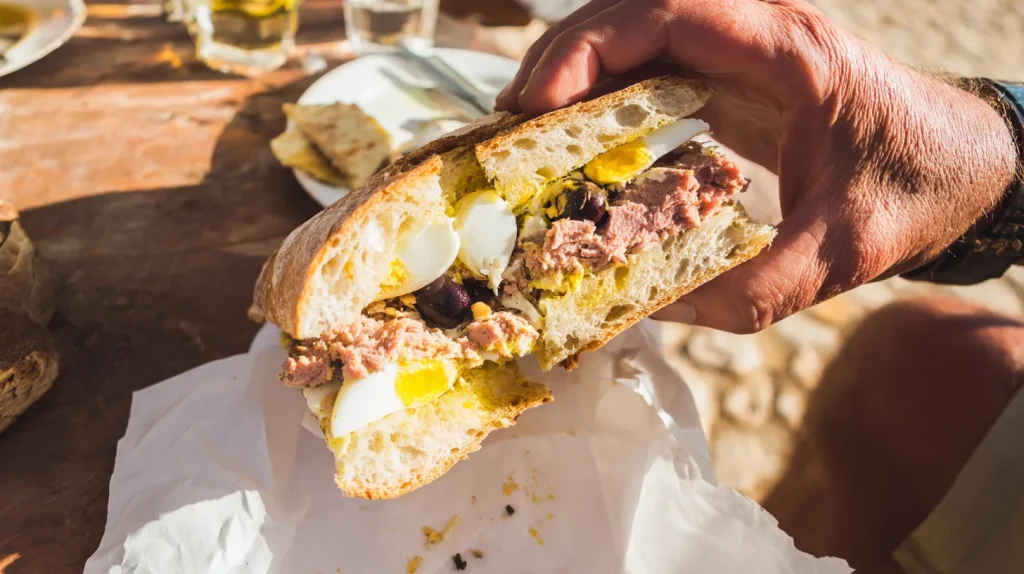
Pan bagnat means “bathed bread” in Niçois. A round, crusty roll is rubbed with garlic and drenched in good olive oil, then filled with tuna or anchovies, hard-boiled egg, tomatoes, green beans, Niçois olives, artichoke hearts, radish, celery, basil, and bell pepper. The bread soaks everything up, turning soft at the cut face while staying crusty on the outside.
This is the traditional street food of the beach and the working lunch — what fishermen and laborers grabbed when there wasn’t time to sit down. It still works exactly that way today: buy one, walk to the waterfront, sit somewhere, eat it.
The original salade Niçoise — the salad version of the same ingredients — is a related but separate dish, worth knowing about on its own terms. A traditional Salade Niçoise uses raw vegetables rather than cooked green beans, and is dressed with olive oil only, never mayonnaise. The cooked, mayo-adjacent version that shows up widely in restaurants elsewhere is a later adaptation, and you’ll occasionally see menus that clearly note the distinction because they care about getting it right.
For pan bagnat specifically, Lou Balico, a family-run institution carrying the Cuisine Nissarde label, is frequently cited for getting the bread-to-filling ratio right.
Pissaladière — The Pizza That Isn’t
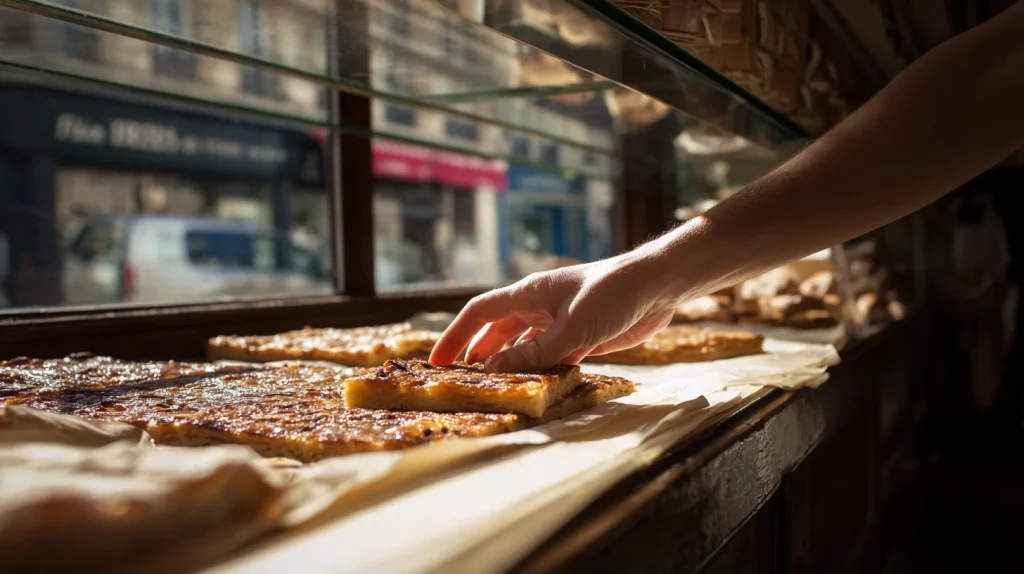
Pissaladière looks like pizza and is sold in similar contexts — bakeries, market stalls, café windows by the slice — but it’s a different thing entirely. The base is a thicker, more bread-like dough rather than a crisp pizza crust. On top: caramelized onions cooked slowly until fully soft and sweet, black olives, and anchovies arranged in a lattice, traditionally over a base of pissalat, a pounded purée of salted small fish that gives the dish its name.
The anchovies are the part that divides people, at least until they try it. People who don’t normally like anchovies often find pissaladière wins them over, because the fish dissolves into the onion layer rather than staying overtly fishy — the sweetness of the onions carries the dish.
You’ll find it at Cours Saleya in the morning, at Chez René Socca, and at most bakeries throughout Vieux Nice. A slice usually runs around €3 to €4 — a good market snack, warm, filling, and easy to eat standing up.
Petits Farcis — The Vegetable Dish Worth Ordering
Petits farcis are stuffed vegetables, typically tomatoes, zucchini, bell peppers, and sometimes round squash, filled with seasoned ground meat mixed with rice, garlic, and herbs, then baked until the tops turn golden.
Every family has its own version, and in restaurants the quality swings from excellent to forgettable. At their best, the vegetables are soft enough to have given up some of their flavor to the filling without collapsing entirely, and the filling carries enough herbs and pepper to taste intentional rather than like leftovers repurposed.
They’re generally a main course at a sit-down meal, served with a green salad or bread. Chez Acchiardo, a family-run Cuisine Nissarde–labeled restaurant in Vieux Nice run by the same family since 1927, comes up consistently as a reliable place to order them.
Daube Niçoise and Stockfish — The Winter Dishes
Daube Niçoise is a slow-cooked beef stew made with red wine, garlic, herbs, and — distinctively — porcini mushrooms, which sets it apart from Provençal daube elsewhere in the region. The beef, typically cheek or shank, is marinated overnight before cooking, resulting in something rich, deeply flavored, and very tender. It’s usually served with polenta, fresh pasta, or bread, and reads as a winter dish in character even if you encounter it in July.
Stockfish Niçois is for the more adventurous eater. Dried cod is rehydrated and cooked in tomato sauce with garlic, olive oil, and herbs. The flavor is intense — dried fish carries a concentration of taste fresh fish doesn’t have, and it stays pronounced even after the long cooking. Worth trying once; it won’t be everyone’s favorite.
The Sweet Side: Tourte de Blettes and Panisse
Tourte de blettes tends to catch visitors off guard. It’s a pastry, usually dusted with powdered sugar, made with Swiss chard, raisins, and pine nuts. Sweet and savory in a way that sounds strange on paper and works better in practice than the description suggests — the chard adds an earthy undertone that keeps the sweetness from becoming cloying. You’ll find it at patisseries throughout the old town, and it’s worth trying at least a slice.
Panisse is socca’s quieter sibling: the same chickpea flour, but the batter is cooked, set in a mold, sliced thick, and fried rather than baked in a wide pan. The result is golden and crunchy outside, soft inside — closer to a thick, fried polenta than a pancake. It’s usually served as a snack alongside socca at the same stalls, including at Chez René Socca.
If you want a taste of Nice’s other sweet tradition, it’s worth stopping into Maison Auer on Rue Saint-François-de-Paule, a chocolate and confectionery house that’s been making candied fruit, chocolates, and other sweets by hand since 1820, in a beautifully preserved 19th-century interior across from the opera house. It’s more a candied-fruit-and-chocolate institution than a bakery for savory Niçois specialties, but it’s a genuine piece of the city’s culinary history and worth a visit on its own terms.
The Markets for Food, Not Just the Flowers
Most visitors head to Cours Saleya for the flowers and leave it at that. The food side of the market deserves more attention — the socca cart, pissaladière by the slice, fresh vegetables, local olive oil, tapenade, and seasonal produce are all there, generally at a higher standard than what you’d get at a restaurant on the same square.
Marché de la Libération, near the Nice-Ville train station and easily reached by tram, is where Nice residents actually do their shopping. It’s less tourist-facing than Cours Saleya, with noticeably better prices on produce and seafood, and the pan bagnat from the small sandwich stalls around the square tends to be a more honest version than what’s sold to tourists in the old town. It runs Tuesday through Sunday, generally from early morning until early-to-mid afternoon, and is closed Mondays.
What to Skip (Honest Take)
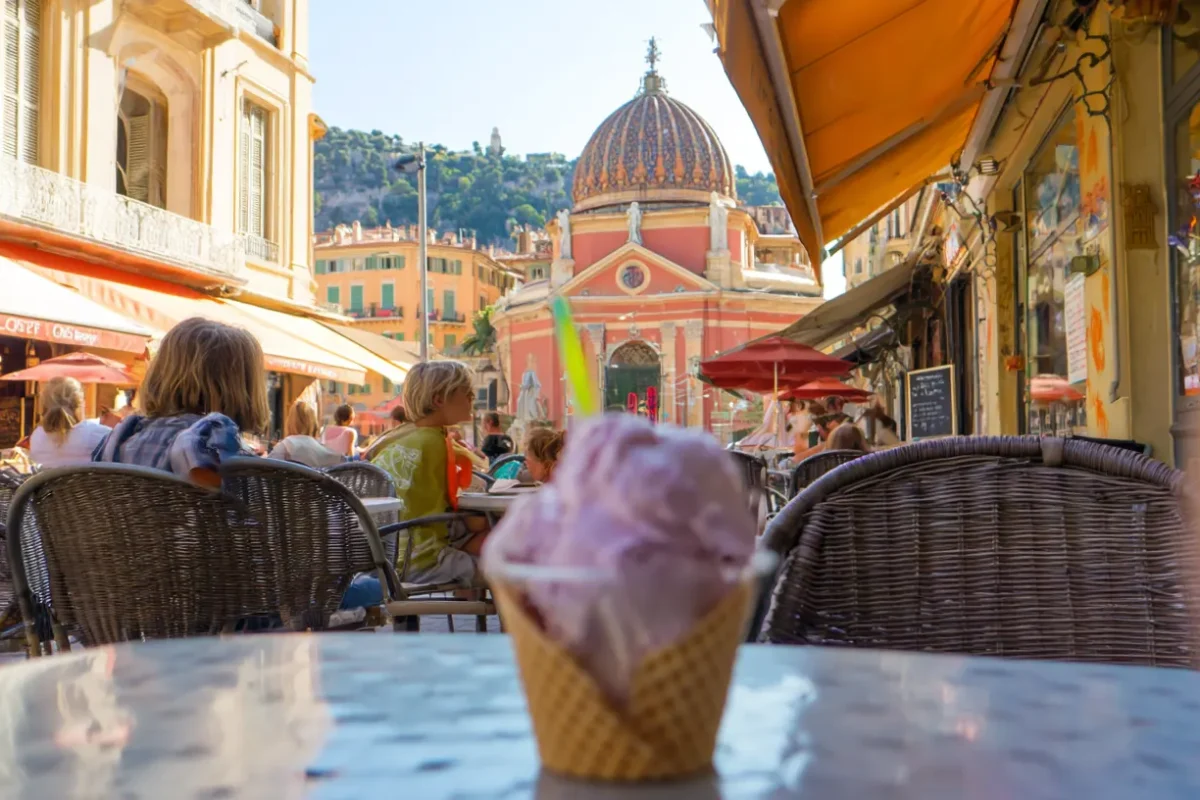
The tourist restaurants lining Cours Saleya are, with few exceptions, not where you want to eat. The setting is beautiful, the prices are high, and the kitchens are mostly built to serve volume rather than quality — it’s entirely possible to pay €18 to €22 for a salade Niçoise made with supermarket tuna and industrial olive oil.
The same caution applies to any restaurant leaning hard on a street-facing terrace in Vieux Nice. The better signals to look for are the Cuisine Nissarde label displayed in the window, a handwritten daily menu, or a line made up of people who clearly know what they’re ordering. None of these guarantee a great meal on their own, but they’re far more reliable than a laminated photo menu showing a picture of every dish.
FAQ
What is socca, and what does it taste like? Socca is a thin chickpea flour pancake cooked in a wood-fired oven. The outside is crispy and slightly charred, the inside soft and custardy. It’s salty and savory, usually finished with black pepper — something like a chickpea crêpe, lighter than bread but more filling than a typical snack.
Is there a difference between pan bagnat and salade Niçoise? Yes, though they share the same core ingredients. Salade Niçoise is the salad version; pan bagnat puts those same ingredients into a round, garlic-rubbed roll drenched in olive oil. Pan bagnat is the portable option, better suited to eating on the go or on the beach.
What is the Cuisine Nissarde label? It’s an official designation, created in 1998 and awarded periodically by Nice’s metropolitan tourist office, given to restaurants that prepare traditional Niçoise dishes to an established standard — respecting traditional recipes, ingredient quality, and genuine knowledge of local culinary history. It’s one of the more reliable signals that a restaurant is cooking authentically rather than just marketing the name.
Is Niçoise food spicy or heavy? Neither. It’s Mediterranean in character — light, olive oil–based, herb-forward, with anchovies typically providing depth rather than heat. The flavors are bold without being heavy, and even the slow-cooked dishes like daube read as earthy and rich rather than dense.
When can I eat socca in Nice? It depends on where you go. Market stalls like Chez Thérésa’s Cours Saleya cart tend to wind down by mid-afternoon, so arriving by 9am gives you the best shot at it fresh from the oven. Dedicated socca restaurants like Chez Pipo and Lou Pilha Leva, on the other hand, generally serve it through lunch and into the evening.