The first thing to know about the Promenade des Anglais is that it costs nothing to walk. No ticket, no timed entry, no reservation. You show up, turn left or right, and start moving along one of the most famous seafronts in the world.
The second thing to know is that the beach is made entirely of pebbles.
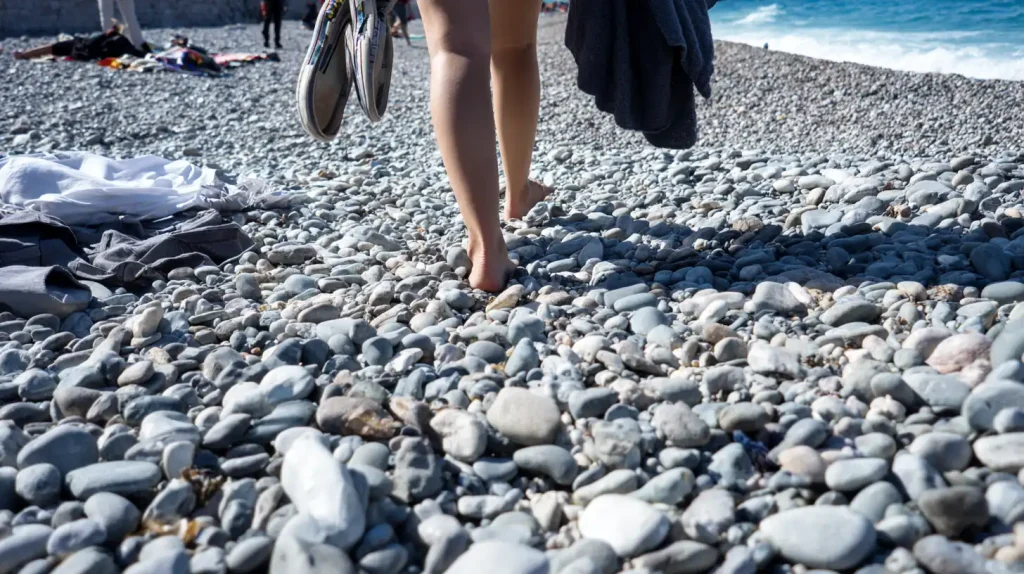
This catches a lot of people off guard, especially anyone picturing the French Riviera as a white-sand Mediterranean fantasy. The Baie des Anges really is an extraordinary shade of blue, and the light in Nice genuinely feels different from the rest of France. But the beach surface is smooth grey stones, not sand, and walking on them barefoot down to the water is the kind of thing you’ll wish you’d packed water shoes for. Nobody puts that part in the brochure.
What the promenade actually is
The Promenade des Anglais runs for roughly 7 kilometers along the Baie des Anges — the Bay of Angels — tracing the curve of the Nice coastline from the airport in the west to the Quai des États-Unis near the old town in the east.
It dates to the 1820s, when English aristocrats wintering in Nice to escape the cold funded a proper walking path above the beach. Hence the name: the English Walk. By the late 19th century it had become one of the grandest seaside boulevards in Europe, lined with hotels, casinos, and architecture that all but announces unlimited money and mild winters.
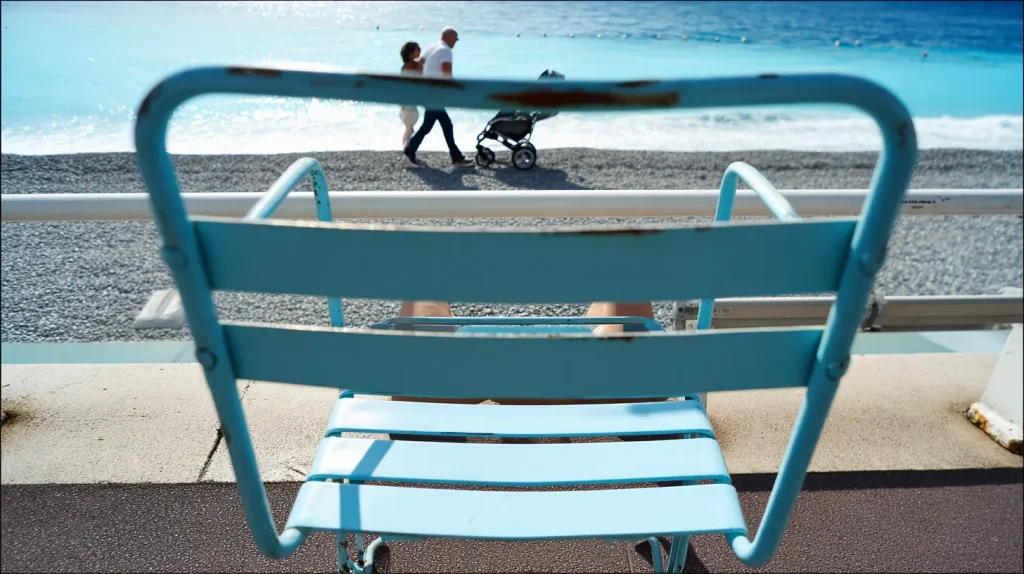
Today it’s shared ground. Cyclists, joggers, families with strollers, older men in linen, tourists in sandals — everyone uses the wide walkway at once. On one side: the Mediterranean. On the other: the facades of Nice, including the iconic Hôtel Negresco with its pink dome, one of the last grand Belle Époque hotels on the Riviera still operating as one.
The Negresco itself is worth a slow look even without any intention of staying there. The pink cupola is visible from most of the western promenade, and the lobby is open to walk into — the interior is genuinely striking — though staff will let you know fairly quickly if you’re not there for a purpose. Having a drink at the bar is the most affordable way to see more of the inside.
The promenade is free and open 24 hours a day, year-round. Nothing to book, no guide required. You just show up and let the pace of the day set your own.
Along the seafront edge of the walkway, you’ll see rows of the famous blue chairs — the chaises bleues. These are public, available to anyone, and sitting in one to watch the sea for an hour costs nothing. It might be the best free activity in Nice, and it requires zero planning.
The beach: public vs. private
The pebble beaches lining the promenade come in two forms that operate very differently.
Public beaches — marked with a blue flag, no entrance charge — are free to use. You walk down from the promenade, find a spot, and settle onto the stones. There are no loungers or umbrellas provided, and facilities are limited. The water is clean and access is easy. Bring your own towel and water.
Private beach concessions — the ones with rows of padded loungers, restaurant service, and beach bars — charge for access. A basic lounger-and-umbrella setup generally runs somewhere around €25 to €45 per person at the more accessible spots along the promenade, climbing higher at premium establishments and during the July–August peak, when rates often rise on top of the base price. You typically can’t bring your own food or drinks into these areas, and reservations are advisable in high summer.
Both have their logic. On a scorching July afternoon with a few hours to fill, a private beach with shade and table service earns its price. On a mild May morning with lighter crowds, the public beach is perfectly pleasant and free.
Worth knowing: water quality in the Baie des Anges is regularly tested and generally good, and Nice’s beaches carry Blue Flag status, reflecting water quality, safety, and environmental standards. That said, water quality anywhere on the Mediterranean coast can dip temporarily after heavy rain — check posted notices from the local beach authority if you’re visiting shortly after a storm.
The public beach directly below the Negresco and the Palais de la Méditerranée gets genuinely crowded in summer. Walking fifteen minutes east or west of the busiest access points usually turns up quieter public stretches.
Two rules tourists break constantly
Nice has a couple of local rules along the promenade that catch a lot of visitors off guard.
Rule one: no smoking on public beaches. Since May 2024, Nice has banned smoking (including vaping) across all of its public beaches, as part of a wider outdoor smoking ban that also covers the city’s parks. Enforcement is inconsistent, but the rule is real, and most private beach concessions follow a similar no-smoking policy in practice.
Rule two: cover up once you leave the beach itself. A Nice municipal ordinance, first passed in 1999 and renewed annually, bans walking around shirtless or in swimwear alone away from designated swimming and beach areas — mainly the streets of the city center and old town. The fine is around €35, though in practice it’s rarely issued unless someone refuses to cover up after being asked. Right along the seafront strip of the promenade itself, this tends to be tolerated in practice, since locals generally treat that stretch as an extension of the beach — but the moment you step off the seafront and into the surrounding streets or shops, cover up. It’s a minor thing, but it’s a genuinely enforced local norm rather than an urban legend.
Neither rule will ruin a beach day. Both are real enough that it’s worth knowing about them before an awkward exchange with a municipal police officer.
There’s also an informal third rule worth knowing: don’t leave your things unattended on a public beach. Bag theft from towels left unwatched is a recurring seasonal problem in Nice. A small waterproof pouch to keep valuables on you while swimming is a cheap, sensible investment.
Best time to visit
The promenade is walkable year-round — the real question is what kind of experience you’re after.
April and May are excellent. It’s warm enough to enjoy the promenade and beach, the water is still too cold for most people to swim in but pleasant to sit near, and the summer crowds haven’t arrived yet. The light in late May is genuinely striking.
June through August is peak season. The promenade gets busy, private beaches fill up and often require advance booking, and hotel prices climb. Water temperatures are at their best for swimming. If a summer beach day is on the itinerary, book your private beach spot ahead of time.
September and October offer some of the best conditions on the Riviera — warm, quieter than summer, with the sea still holding heat from the season. Many experienced Riviera travelers consider September the sweet spot.
November through March is quiet. The promenade is never empty — locals use it for morning runs year-round — but tourist activity drops off sharply. The light stays attractive and the weather is mild compared to the rest of France; Nice sees a genuinely high number of sunny days annually, so even a winter afternoon can surprise you with warmth and clarity. Some beach concessions close entirely for the off-season, and the private lounger market largely shuts down until spring, but the public beach and the promenade walk stay open and free throughout. For flexible travelers who’d rather skip summer crowds, December through February in Nice is genuinely underrated.
What’s nearby
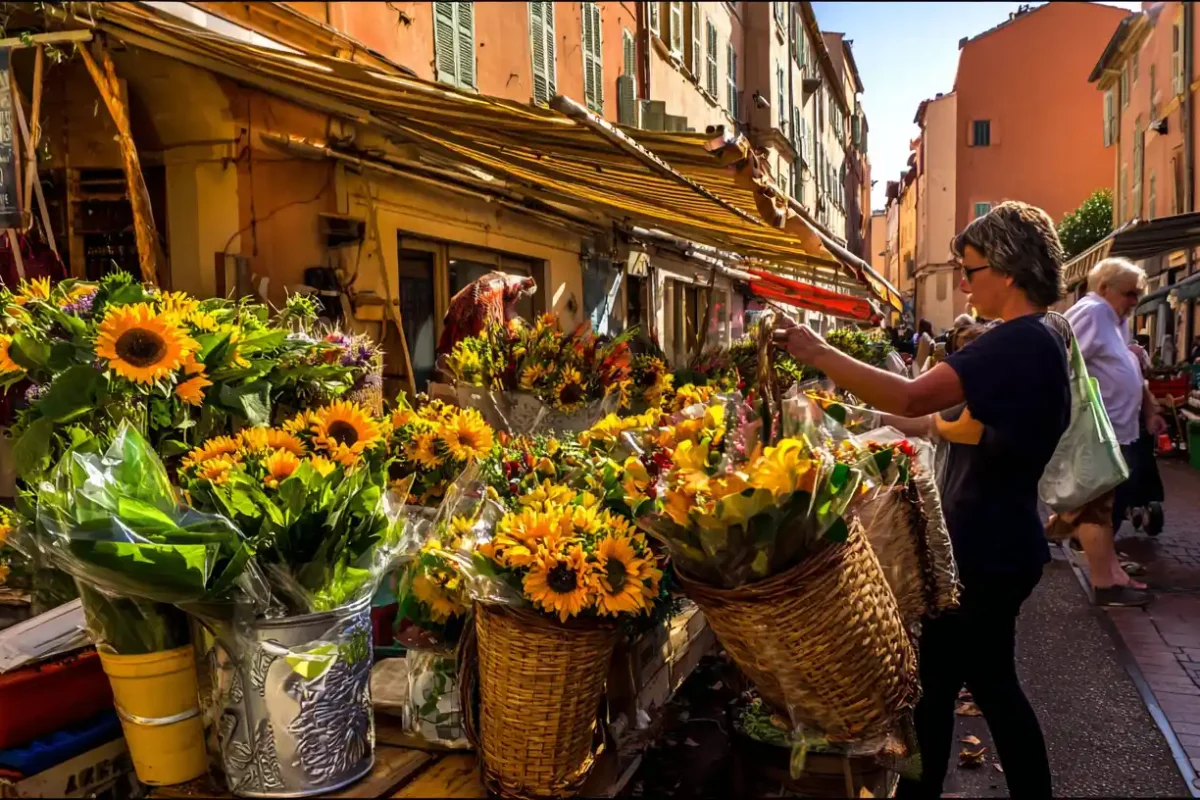
The promenade’s eastern end connects directly into Vieux Nice, the old town — a dense tangle of narrow ochre streets, Baroque churches, and the Cours Saleya market. The market runs Tuesday through Sunday mornings, selling flowers, produce, and regional specialties, and it’s one of the better markets in the south of France.
A five-minute walk from the promenade’s eastern end brings you to the base of Colline du Château — Castle Hill — which offers the best panoramic view over the bay and the promenade from above. Once the site of Nice’s medieval fortress, long since demolished, the hill is now a terraced park with waterfalls, ruins, and a viewpoint that makes sense of the promenade’s scale in one glance — you can actually see how tightly it follows the curve of the bay for those seven kilometers. The elevator up is free, or the walk takes about twenty minutes each way. Either way, budget roughly an hour including the climb.
Place Masséna, the central square of Nice, sits at the eastern end of the promenade. The gardens just behind it, Jardin Albert 1er, are free and a good place to sit with something from the old town market before heading back toward the water.
Getting there
The promenade runs through the center of Nice, and most hotels in the city put you within fifteen to thirty minutes on foot. Nice’s tram network reaches the seafront directly: Tram Line 2 connects Nice Côte d’Azur Airport to the city center in roughly 25 to 30 minutes, with a single ticket costing around €1.70 (a return airport fare of about €10 is also sold at the airport tram stop). Several bus lines also run along or parallel to the promenade.
From the airport, a fixed-rate taxi to the city center generally runs somewhere in the low-to-mid €30s, taking about 15 to 25 minutes depending on traffic — worth confirming the current posted rate at the taxi rank, since fixed fares are adjusted periodically.
If you’re arriving by train from Paris, Cannes, or Menton, Gare Nice-Ville is about a fifteen-minute walk from the eastern end of the promenade, or a short tram ride away.
Parking along the promenade itself is limited and expensive in summer. If you’re arriving by car from elsewhere on the Riviera, it’s generally easier to park at a structure on the edge of the city center and walk in.
Frequently asked questions
Is there an entrance fee for the Promenade des Anglais? No. The promenade itself is completely free and open at all hours, and the public beaches along it are also free. Private beach concessions charge for loungers and umbrellas, generally starting somewhere around €25 per person for a basic setup and rising from there.
Is the beach in Nice sandy or rocky? Rocky — specifically smooth pebbles. It’s beautiful to look at, but walking barefoot on it is uncomfortable. Water shoes are the practical fix and are sold in most shops near the promenade; flat sandals help for the walk down as well.
Can I swim at the Promenade des Anglais? Yes. The water in the Baie des Anges is clean, and swimming is allowed from the public beaches. It stays cold until around June, becomes comfortable through July and August, and generally stays warm into September and sometimes October.
What’s the best time of day to visit? Early morning for a peaceful walk, cooler temperatures, and good light. Sunset for atmosphere — the sky over the bay can turn spectacular on clear evenings. Midday in July is the busiest and hottest stretch.
What should I wear on the promenade? Comfortable walking shoes and normal clothes for the boulevard itself. Swimwear belongs on the beach below rather than the walkway above — Nice has a real, if inconsistently enforced, local rule against walking around shirtless or in swimwear alone once you’re off the immediate seafront and into the surrounding streets, so it’s worth throwing a shirt on before wandering into town.