You land at Charles de Gaulle, drag your suitcase onto the RER B, and forty-five minutes later you’re rolling past grey rooftops with a sliver of the Eiffel Tower flashing by in the distance. That tower is why most people come. It’s also why so many first-timers book a hotel in the 7th arrondissement to be close to it — and then spend half their trip on the Métro wondering why everything else feels so far away.
Where you sleep is arguably the single most consequential decision you’ll make before a Paris trip. Get it right and you’re walking to dinner, stumbling into a Sunday market on the way back, and feeling like you actually live here for a week. Get it wrong and you’re commuting across the city for everything, burning money on Métro tickets, and missing the street-level texture that makes Paris worth the flight in the first place.
Here’s an honest breakdown of which neighborhoods actually work for first-time visitors, and which ones look better on Instagram than they feel at 9pm when you’re hungry and don’t want to get back on the train.
The one rule that should drive your decision
Before getting into specific neighborhoods, it’s worth understanding this: Paris is not quite as walkable as its reputation suggests. The center is genuinely walkable. The outer arrondissements are not. A hotel in Montmartre sounds romantic right up until you realize it’s a 40-minute walk, or two Métro changes, from the Louvre.
For a first visit, stick to arrondissements 1 through 9, ideally within a five-minute walk of a Métro station served by more than one line. That single rule will save you more time than any other piece of planning advice in this guide.
Le Marais (3rd and 4th arrondissements)
Le Marais is the best all-around neighborhood for first-time visitors. Full stop.
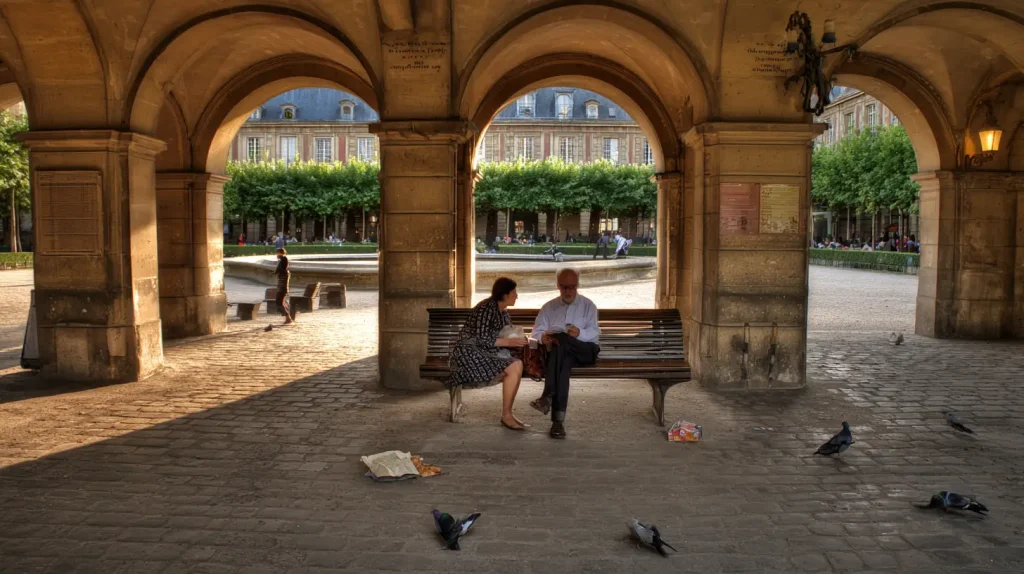
It sits close to the geographic center of Paris, within walking distance of Notre-Dame, the Centre Pompidou, and Place des Vosges — most of it reachable on foot in eight to ten minutes. You can reach the Île de la Cité in about fifteen minutes on foot, or the Louvre in roughly twenty-five. The 4th arrondissement side is a little more convenient for sightseeing and has denser restaurant coverage; the 3rd is calmer and feels closer to the Paris that locals actually use day to day.
What makes the Marais work is variety packed into a small footprint. One block might have a Michelin-recommended table; two blocks over you’re eating a falafel sandwich from L’As du Fallafel on Rue des Rosiers, which generally runs somewhere in the €9 to €14 range depending on whether you eat in or take away. BHV department store is a short walk away for anything you forgot to pack. The Marché des Enfants Rouges, the oldest covered market in Paris, is open most days of the week and pulls food from half a dozen vendors under one glass roof — a genuine neighborhood institution rather than something built for tourists.
Hotels here skew toward the pricier end. A reasonable working range for the Marais is somewhere around €120 to €250 a night in a typical mid-range hotel, climbing well beyond that for boutique properties in high season — treat that as a starting reference rather than a quote, since Paris hotel pricing moves constantly with season and demand. The upside is that the neighborhood’s walkability offsets some of that cost, since you’re not spending as much getting around.
The honest downside: it gets genuinely crowded on weekends. Rue de Bretagne and the main food streets are close to shoulder-to-shoulder on Saturday afternoons. If crowds wear you down, aim for weekday visits, or pick a hotel on a quieter side street and dip into the busy arteries only when you actually want them.
Saint-Germain-des-Prés (6th arrondissement)
If the Marais is the best practical choice, Saint-Germain is the most romantic one. The 6th arrondissement has a quality other neighborhoods don’t quite replicate — the sense that the city has looked like this for centuries and isn’t in any rush to change.
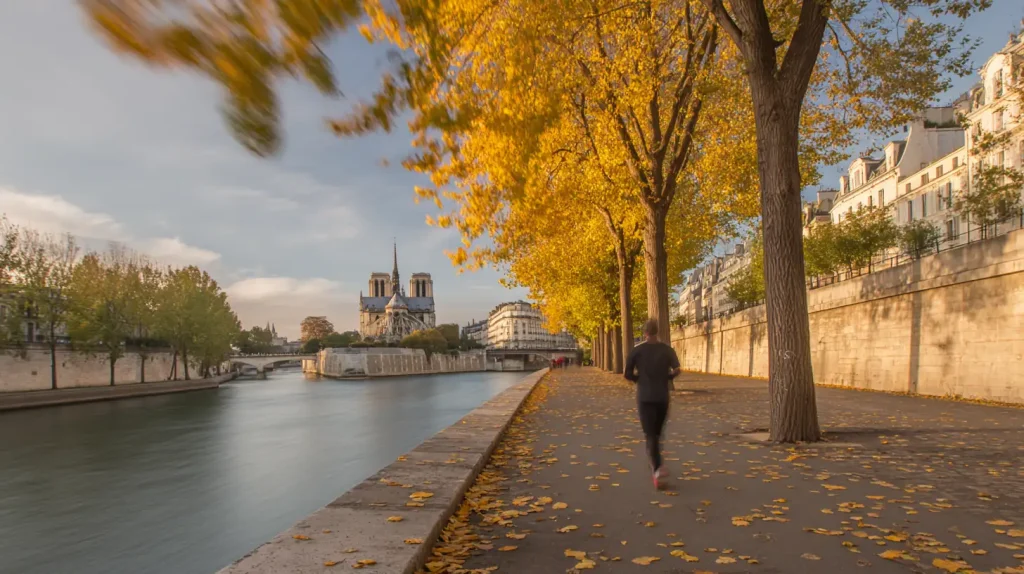
Café de Flore and Les Deux Magots are here — overpriced, full of tourists, and still worth one coffee on a quiet Tuesday morning before the tour groups arrive. The Luxembourg Gardens are a five-minute walk away. The Seine is right there. And the stretch around Boulevard Saint-Germain and Rue de Rennes gives you access to some of the best bookshops and specialty food shops in the city.
The catch is budget. This is one of the most expensive parts of Paris to sleep in — real estate prices here are among the highest in the city, and hotel rates follow suit, commonly running from around €180 up to €400 or more a night in peak season, with well-known boutique properties pushing higher still. That’s not automatically a dealbreaker, but it shapes the rest of your trip’s math.
For couples on a splurge trip, or anyone who values atmosphere over strict value, Saint-Germain is hard to beat. For more budget-conscious travelers, it’s a wonderful place to spend an afternoon and a much easier place to sleep somewhere else.
The 7th arrondissement: beautiful but isolated
Here’s the take most guides won’t give you straight: the 7th is a lovely arrondissement to visit and a genuinely frustrating one to base yourself in on a first trip.
The draw is obvious. The Eiffel Tower is here. The Musée d’Orsay is here. The Rodin Museum is here. Rue Cler, a lively market street, is here. The wide, leafy boulevards and formal architecture feel unmistakably Parisian.
But the 7th is residential in a way that shows after dark. By 9pm, a lot of the streets go quiet. Restaurant options immediately around the Tower skew mediocre and tourist-priced. And once you want to see any other part of the city, you’re on the Métro, every time. The Eiffel Tower is spectacular the first time you see it up close. After that first evening, it becomes a backdrop you’ve already checked off, and the location itself stops earning its keep.
Stay in the 7th if the Eiffel Tower is genuinely the emotional center of your trip and you’re fine commuting to everything else. Otherwise, base yourself in the Marais or Saint-Germain and visit the tower in the evening, when it’s more beautiful anyway thanks to the lighting.
Latin Quarter (5th arrondissement)
The Latin Quarter sits on the Left Bank, just southeast of Saint-Germain, and it’s a genuinely strong option that doesn’t get enough credit in first-timer roundups.
It’s affordable by Paris standards, with mid-range hotels commonly running somewhere in the €80 to €200 range — meaningfully cheaper than the Marais or the 6th, though as always, exact rates shift with season and how far out you book. The neighborhood is walkable to Notre-Dame, the Jardin des Plantes, and the Institut du Monde Arabe, and the Panthéon sits right in the middle of it.
The Latin Quarter is student-heavy, which keeps everyday prices — cafés, casual meals — lower than you’d expect this close to the center. The Rue Mouffetard market area is one of the better food streets in Paris: good cheese, good wine, market stalls, and enough cafés to fill a morning without any real planning. It’s not the most glamorous arrondissement, but it’s lively in the right ways and central enough that almost nothing important is more than twenty minutes away on foot.
If you’re traveling with kids or watching your budget, the 5th deserves serious consideration. One underrated bonus: it sits within walking distance of both banks of the Seine, so you can cross into the Marais on foot or head west toward Saint-Germain without ever touching the Métro. That kind of geographic flexibility matters more on your first few disoriented days in a new city than it sounds like it should.
Montmartre (18th arrondissement): resist the pull
Almost everyone romanticizes Montmartre before they’ve been. The hilltop. The old vineyard. The artists’ history. The Sacré-Cœur gleaming white above the rooftops.
Here’s what actually happens if you stay there: you spend more time than you budgeted for just getting down to the rest of the city. Montmartre sits on the northern edge of Paris, on a hill, with Métro connections that often require more changes than you’d like. The tourist strip around Place du Tertre is one of the more aggressively souvenir-heavy pockets of the city, and the approach up to Sacré-Cœur has a well-documented pickpocket risk worth being alert to, same as any other major tourist choke point in a big European city.
Visiting Montmartre for an afternoon is genuinely worth doing on any first trip — walk up early before the crowds arrive, find a café on one of the quieter side streets, take in the view over the rooftops. A few hours here earns its place on the itinerary easily.
Sleeping there is a different calculation. The charm rarely compensates for the daily inconvenience. Base yourself somewhere more central and treat Montmartre as a half-day excursion instead.
Opéra and Grands Boulevards (9th arrondissement): the underrated pick
The 9th arrondissement is probably the most underrated first-timer base in Paris, and it almost never gets the credit it deserves in roundup guides.
It sits just north of the 1st and 2nd, within walking distance of the Louvre, the Palais Royal, and the covered passages — those glass-roofed 19th-century shopping arcades that somehow survived intact into the present. The Palais Garnier opera house anchors the neighborhood, and the department stores Galeries Lafayette and Printemps are a few streets over if you want them.
Hotel prices here generally run lower than the Marais or the 6th, with reasonable mid-range options commonly available somewhere in the €130 to €200 range — again, treat that as a rough band rather than a fixed figure, since it moves with the calendar. The neighborhood also has strong Métro access across several lines, so wherever you’re headed, you can usually get there without much fuss.
One thing that tends to surprise first-timers about the 9th: it has some of the best covered passages in Paris. Passage Jouffroy and Passage Verdeau sit right here — glass-vaulted arcades full of antique dealers, secondhand booksellers, and old-fashioned cafés that feel completely removed from the main tourist circuit. A slow morning drifting through them can feel like you’ve found something the guidebooks underplay.
It’s not as instantly atmospheric as the Marais or Saint-Germain — you won’t get that “movie Paris” jolt the second you step outside your hotel. But it’s convenient, reasonably priced, and central enough that it doesn’t cost your first trip anything meaningful. Which, for a first visit, is more or less the whole point.
Where to avoid on a first trip
Two areas come up repeatedly as poor fits for first-time visitors: the immediate area around Gare du Nord, Paris’s main international train station, and the far edges of the 10th and 19th arrondissements. None of this is about danger in any dramatic sense — these aren’t unsafe by the standards of a major European capital. They’re simply less polished, less convenient, and don’t deliver the version of Paris most first-timers are hoping for. They’re worth reconsidering on a return trip, once you already know the city a little.
A quick note on budget
Paris hotels are expensive, and that’s just the baseline reality of visiting one of the most-visited cities in the world. As a rough sense of the landscape: budget hotels tend to fall somewhere around €80 to €130 a night, with mid-range options generally landing between €150 and €300, and both bands stretching well beyond that depending on season, star rating, and how far in advance you book. Booking directly through a hotel’s own website or a well-known platform lets you compare like for like. If your dates are flexible, mid-week stays in March, November, or early December tend to run noticeably cheaper than the summer peak.
Short-term rental apartments can make sense for stays of five nights or longer, particularly for groups, and often work out cheaper per person than the equivalent hotel category once you’re past two guests. The one thing worth double-checking is the actual neighborhood — a listing described as “central Paris” is worth confirming on a map before you book, since that phrase gets used loosely.
Frequently asked questions
Is Le Marais safe for tourists? Yes. It’s one of the safest and most tourist-friendly neighborhoods in Paris. Standard urban precautions apply — keep your phone out of your back pocket on busy streets, keep your passport secure — but it’s a well-trafficked, well-policed area with no particular safety concerns beyond ordinary city awareness.
What’s the cheapest area to stay in Paris that’s still central? The 9th arrondissement (Opéra/Grands Boulevards) and the Latin Quarter (5th) generally offer the best value for the location, with solid Métro access and reasonable dining, without the premium pricing of the Marais or Saint-Germain.
Is it worth staying near the Eiffel Tower? For most first-time visitors, not really. The 7th arrondissement is quiet and residential, with thinner dining options after dark and a Métro-dependent relationship to the rest of the city. Visit the Eiffel Tower in the evening, when it’s genuinely at its best, and base yourself somewhere with better all-around walkability.
How far in advance should I book a Paris hotel? For summer travel (June through August) or major events, three to six months ahead is a reasonable target. For spring or autumn trips, six to eight weeks is usually enough. Rooms do turn up at the last minute even in high season, but prices tend to spike noticeably within two weeks of arrival.
Can I stay in Montmartre and still see everything easily? You can, but it takes more planning than a more central base would. Two Métro changes to reach the Louvre is a real drag when you’re jet-lagged and hauling a day bag. Montmartre works well as a half-day trip from somewhere more central, but choosing it as your base makes the logistics of a packed first visit harder than they need to be.