Rue des Rosiers runs about 380 meters through the 4th arrondissement, and in that short stretch you can eat your way through two centuries of Jewish Paris. On one end of the timeline: Ashkenazi delis serving strudel and chopped liver from recipes that predate the Second World War. On the other: falafel stands that arrived with North African Jewish immigrants in the 1950s and 60s. Both are still open. Both are still busy. And walking the street with an appetite is one of the more interesting ways to spend an afternoon in Paris.
Most guides reduce this street to a single question: which falafel stand has the shorter line? That’s worth knowing, and we’ll get to it. But it’s not really the point of Rue des Rosiers, and treating it that way misses most of what makes the street worth visiting in the first place.
The history behind the street
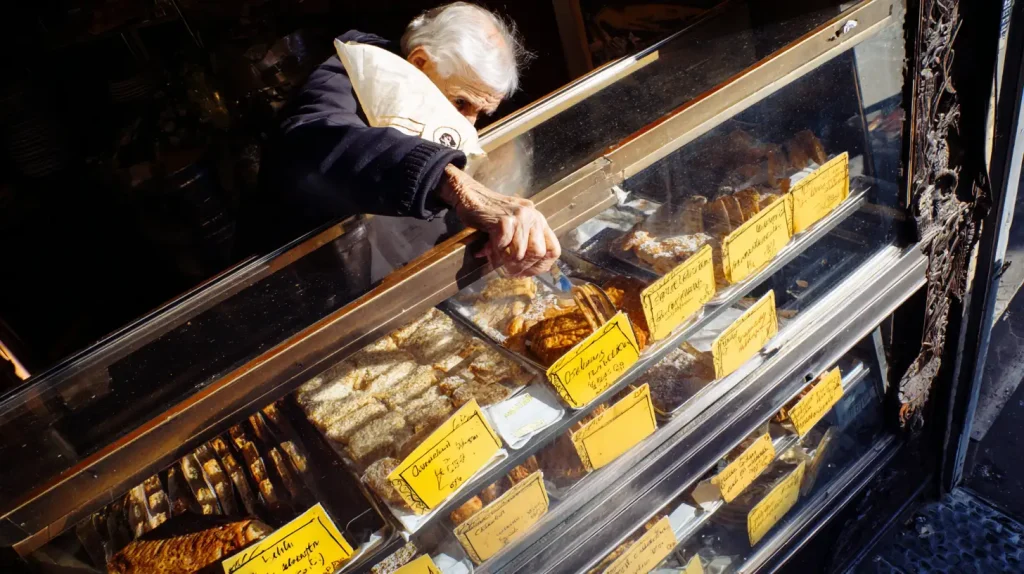
Rue des Rosiers sits at the heart of what was historically called the Pletzl — Yiddish for “little place.” From the late 19th century through the mid-20th century, this was where Ashkenazi Jews from Russia, Poland, and Eastern Europe settled after fleeing pogroms and, later, Nazi persecution. The neighborhood filled up with delicatessens, Yiddish-language newspapers, synagogues, and the food of Central European Jewish life — challah, chopped liver, rugelach, strudel.
World War II devastated the community. More than 13,000 Jews from the Marais were arrested in the Vel’ d’Hiv roundup of 1942, carried out by French police under German orders. Most were murdered. The Pletzl never recovered its prewar population.
What grew in its place was, in part, Sephardic. North African and Middle Eastern Jews arrived in Paris after Algerian independence in the early 1960s, bringing the food of Tunisia, Morocco, and the Levant with them — falafel, hummus, shawarma. The falafel stands on Rue des Rosiers today are that community’s contribution to the street, and they represent a genuinely different culinary tradition from the older delis a few doors down. Ashkenazi cooking, shaped by Russian and Polish winters, leans on pickles, rye bread, beef, and cabbage. Sephardic cooking, shaped by the Mediterranean, leans on chickpeas, tahini, lamb, and eggplant. The two traditions ended up on the same 380 meters of pavement largely because of geography: the Marais was historically an affordable district with existing Jewish infrastructure — synagogues, community organizations, kosher butchers — so new arrivals gravitated to where that infrastructure already existed. The food followed the people.
You don’t need to know any of this to enjoy a falafel sandwich. But it changes what you’re eating. This isn’t a theme-park version of Jewish food assembled for tourists — it’s the layered, sometimes uneasy record of a community’s survival, displacement, and reinvention, and you can still taste both halves of that story on the same walk.
Worth knowing before you go: the Ashkenazi delis on the street are mostly run by an older generation, and not every strudel recipe has a confirmed successor. The falafel stands, by contrast, are busier and have adapted more easily to a tourist economy. The street you’re walking today may look different in a decade. Right now, both traditions are still standing.
The falafel walk
L’As du Fallafel — 34 Rue des Rosiers
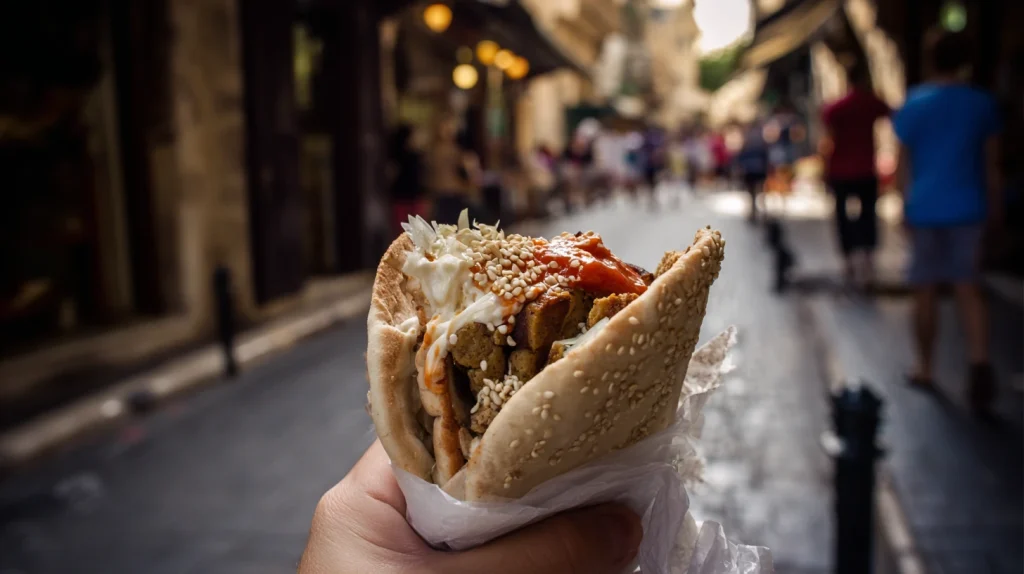
This is the most famous falafel stand in Paris, and arguably the reason the street became a destination at all. Founded in 1979, L’As (French for “the ace”) built its reputation on one specific combination: fresh chickpea falafel, served in warm pita with fried eggplant, cabbage, hummus, hot sauce, and tahini. The eggplant is the real differentiator — soft, faintly caramelized, and consistently underrated by first-timers who show up expecting the falafel alone to carry the sandwich.
A takeaway sandwich generally runs somewhere in the €9 to €14 range, with eat-in prices running a bit higher since you’re paying for table service rather than a paper wrapper. Treat that as a ballpark rather than a fixed number — menu prices shift, and eating in versus taking away changes the total noticeably.
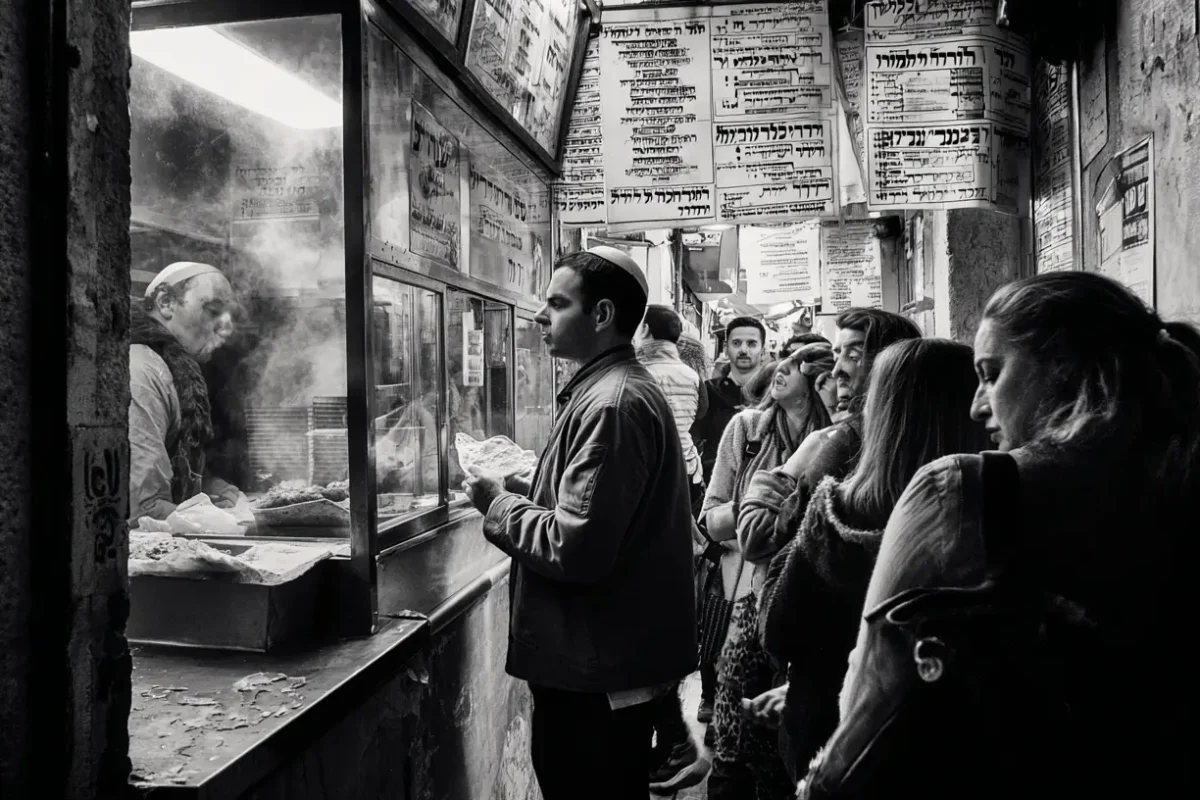
L’As is kosher under the supervision of the Beth Din of Paris, which means it’s closed all day Saturday for Shabbat and closes early on Friday afternoon — sources list Friday closing times anywhere from mid-afternoon to early evening, so if you’re planning a Friday visit, check the posted hours that day rather than assuming. Sunday through Thursday, it’s open long hours into the evening. The ordering system is part of the experience: a street-side seller takes your order and payment outside, hands you a ticket, and you bring that ticket to the service window. Don’t try to walk in and order from inside — that’s not how the line works.
Expect a queue, especially between 1pm and 3pm and on Sunday afternoons, when it feels like half of Paris shows up at once. The line moves faster than it looks from the back of it.
Chez Hanna — 54 Rue des Rosiers
Thirty meters up the street sits L’As’s longtime rival. Chez Hanna is open every day of the week — including Saturday, which immediately sets it apart from L’As — with hours that generally run from late morning into midnight. Locals will tell you the falafel here is crispier, the queue is shorter, and the value is better if you want to actually sit down. All three claims hold up reasonably well in practice. The flavor is a touch spicier than L’As’s version, with a crisper fried exterior, and the eggplant preparation is excellent here too.
The L’As-versus-Chez Hanna debate has been running for decades and doesn’t really have a correct answer. Both are good. The honest advice is: whichever line is shorter when you arrive is the right choice. The bigger difference is atmosphere — L’As is loud and theatrical, with the street vendor performing for the crowd; Chez Hanna is calmer and easier to actually sit down in.
Beyond falafel: the rest of the street
Florence Kahn, on the corner of Rue des Rosiers and Rue des Écouffes, is the Ashkenazi counterpoint to the falafel stands — a bakery and deli behind a striking blue mosaic facade dating to 1932, now a protected historic monument. It’s known for pastrami sandwiches, chopped liver, strudel, and rugelach. It’s generally closed Monday and Tuesday, open the rest of the week from roughly mid-morning to early evening, and it has outdoor seating in warmer months. If you want to understand the older half of Rue des Rosiers’s history, this is the counter-order to L’As du Fallafel.
Sacha Finkelsztajn, known locally as “the yellow bakery,” sits at 27 Rue des Rosiers and has been serving Eastern European Jewish specialties since 1946 — kugel, babka, poppy-seed pastries, and a pastrami sandwich with real devotees. It’s also generally closed Monday and Tuesday, open the rest of the week from mid-morning into the early evening. Neither this shop nor Florence Kahn requires a big order to be worth stopping at — a single rugelach or a slice of strudel is enough to understand what the fuss is about.
Miznon, just around the corner at 22 Rue des Écouffes, is a different register entirely — modern Israeli street food from chef Eyal Shani, who built the concept in Tel Aviv before expanding internationally. The signature dish is a whole roasted cauliflower, caramelized and slightly charred, served with tahini. There’s also spiced fish, shakshuka, and lamb pita. It’s closed Saturday and keeps shortened hours on Friday afternoon, similar to the kosher spots nearby, with longer hours the rest of the week. This isn’t the same culinary tradition as L’As or Chez Hanna, but it fits naturally into the street’s Sephardic and Israeli thread.
Practical notes for the walk
When to go. Weekday lunch, roughly between noon and 1pm, tends to hit the sweet spot — busy enough to feel alive, not so packed that the line spills into the street. Sunday afternoons are the most crowded time on the street by a wide margin. Friday afternoons are quieter, but remember that the kosher spots close early ahead of Shabbat, so don’t plan a late Friday falafel run.
What to skip. The Marais has gentrified heavily over the past two decades, and a lot of the shopfronts now lining Rue des Rosiers and its side streets have nothing to do with the neighborhood’s Jewish history — fashion boutiques, lifestyle brands, chain cafés among them. If you want to see the parts of the quarter that haven’t been smoothed over, wander the adjoining streets — Rue des Écouffes and Rue des Juifs in particular.
Eating on the street. You’ll likely eat standing up or perched on whatever surface is available — some people sit on the bollards across from L’As, and that’s completely normal here. The falafel is messy enough that eating while walking isn’t really an option.
On price. Marais falafel is not the cheapest falafel in Paris, and it’s worth going in with the right expectations. This is an expensive, high-traffic tourist neighborhood, and the prices at L’As and Chez Hanna reflect that — you’re paying partly for location, partly for the volume of visitors the street pulls in, and partly for food that’s genuinely well made. All three factors are real. It’s worth the price for most people, but don’t expect Rue des Rosiers to be a budget street-food experience.
Friday afternoons specifically. As Shabbat approaches, the street visibly changes gear. L’As closes early. The Ashkenazi delis slow down and start closing up. There’s a specific, quieter quality to the light and pace of the Marais on a Friday afternoon that’s different from any other day of the week — worth noticing if you happen to be there for it.
Getting there and around
Rue des Rosiers sits in the 4th arrondissement. The closest metro stop is Saint-Paul (line 1), about a three-minute walk away. Hôtel de Ville (lines 1 and 11) is a bit further but useful if you’re combining the visit with a walk along the Seine.
The Marais as a whole rewards walking — it’s compact, dense with good food, and has a higher concentration of interesting eating per block than almost anywhere else in the city. Place des Vosges is about a 15-minute walk from Rue des Rosiers and pairs naturally with a post-falafel wander.
The broader Marais food walk
Rue des Rosiers itself takes about 45 minutes to eat through properly. If you’ve got more time, the wider Marais has hours more worth exploring.
Marché des Enfants Rouges, on Rue de Bretagne in the northern Marais (3rd arrondissement), is the oldest covered market in Paris, dating to the early 17th century. It’s generally closed Monday, and on the days it’s open, the market itself runs roughly from mid-morning into the evening, with somewhat shorter hours on Sunday — individual stalls inside keep their own schedules, and some close well before the market as a whole does. Inside, you’ll find a rotating mix of permanent stalls and vendors: cheese, oysters, charcuterie, natural wine, and a cluster of small international food counters — Italian, Japanese, Lebanese, Moroccan. Because it’s covered, you can eat comfortably regardless of weather, and this is genuinely where people who live in the Marais do their weekend shopping and grab lunch, rather than a spot built for visitors.
Rue de Bretagne itself is worth a slow walk even if you skip the market — it has some of the better independent food shops in the neighborhood, from cheesemongers to butchers, without the tourist density you’ll find closer to Rue des Rosiers.
Marais cafés are a mixed bag. Many of the spots closest to Place des Vosges are competent but forgettable. The better coffee tends to be one or two streets back from the main square, in the parts of the neighborhood where the clientele skews local rather than touristic — look for a small independent roaster or a café where the barista clearly cares about how the shot pulls.
If you’re pairing the food walk with some sightseeing, Place des Vosges — Paris’s oldest planned square, dating to 1612 — is about a 10-minute walk from Rue des Rosiers. The Maison de Victor Hugo, the writer’s former apartment, sits on the square’s southeastern corner. Permanent-collection admission is normally free, though the museum runs paid temporary exhibitions on top of that, so it’s worth checking current admission terms before you go. It’s generally closed Monday and open the rest of the week from mid-morning into the early evening.
Strung together — falafel and deli on Rue des Rosiers, the covered market on Rue de Bretagne, and a stop at Place des Vosges — the full loop takes about three hours at an unhurried pace and gives you a genuinely representative slice of what the Marais actually is, beyond the postcard version.
Frequently asked questions
Is L’As du Fallafel worth the queue? For most people, yes — the falafel is genuinely excellent, and there’s something to the street theater of ordering outside that adds to the experience. That said, Chez Hanna, thirty meters up the street, tends to have shorter lines and a slightly crispier falafel. If the L’As queue is running down the block, going to Chez Hanna instead isn’t a downgrade.
When is L’As du Fallafel open? It’s closed all day Saturday for Shabbat, open long hours Sunday through Thursday, and keeps shortened hours on Friday afternoon ahead of Shabbat. Exact opening and closing times can shift, including around Jewish holidays, so it’s worth double-checking hours the day you plan to go rather than relying on a single source.
What makes Marais falafel different from falafel elsewhere? The fried eggplant folded into the pita is the signature move, particularly at L’As, where it’s paired with cabbage, hummus, and tahini in a combination that’s been refined over decades. Freshness matters too — the falafel is fried continuously through service rather than sitting around, which is part of why the texture holds up.
Is the Marais still a Jewish neighborhood? It’s gentrified significantly, and the resident Jewish population is smaller than it was in the mid-20th century. The synagogues, delis, and falafel stands are still there and still active, but much of the surrounding retail is now fashion-driven rather than community-driven. Rue des Rosiers itself has held onto its character better than most of the streets around it.
What else should I eat in Le Marais besides falafel? Florence Kahn and Sacha Finkelsztajn cover the Ashkenazi side — pastrami, strudel, and Eastern European pastries you won’t easily find elsewhere in Paris. Miznon offers a modern Israeli take a block over. And if you have a few extra hours, the Marché des Enfants Rouges and the food shops along Rue de Bretagne round out a fuller picture of how the neighborhood actually eats.