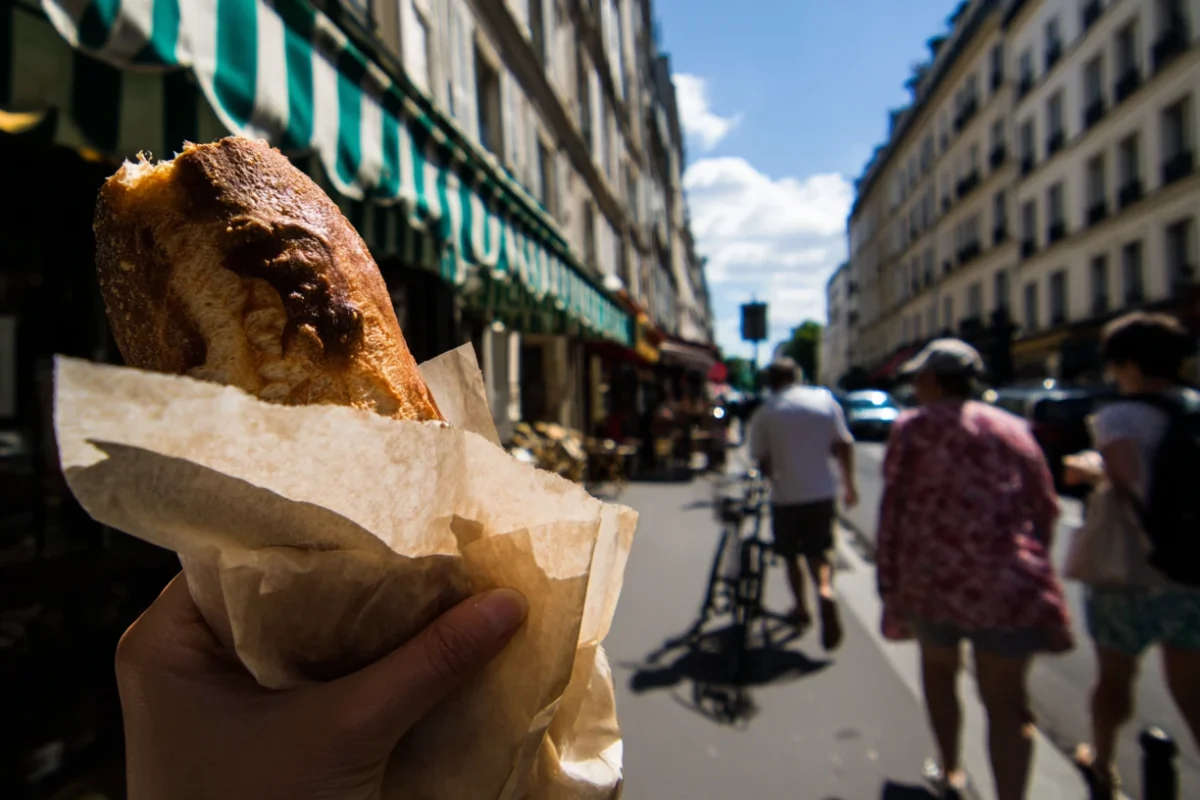
A good baguette does three things. It crackles when you squeeze it. It smells faintly of yeast and toasted grain when you hold it up to your face. And when you tear it open, the inside isn’t a uniform white foam — it’s got irregular holes, little air pockets of different sizes, gaps where actual slow fermentation happened.
Most baguettes sold in Paris don’t manage all three. The good ones do, and the gap between a mediocre baguette from a chain bakery and a properly made baguette de tradition from a serious boulangerie isn’t subtle. It’s the difference between bread you eat without thinking about it and bread you’re still thinking about an hour later.
Every year, the city of Paris runs a blind competition to find the best one. The winner gets a cash prize, a medal, and — the part that actually matters for bragging rights — a one-year contract to supply the Élysée Palace, meaning the President of France eats that bakery’s bread every day for a year. In February 2026, a 43-year-old baker named Sithamparappillai Jegatheepan won the Grand Prix de la baguette de tradition française on his very first attempt, beating out more than a hundred other competitors. His bakery, Fournil Didot, is a real, ordinary neighborhood shop you can walk into and buy the exact baguette that won.
That’s a good place to start a Paris bakery crawl. But first, it helps to understand what you’re actually looking for, because the word “baguette” covers two genuinely different products — and most visitors have no idea which one they’re eating.
Tradition vs. Ordinaire: The One Thing Worth Knowing
This is the single most useful piece of vocabulary before you buy bread in Paris.
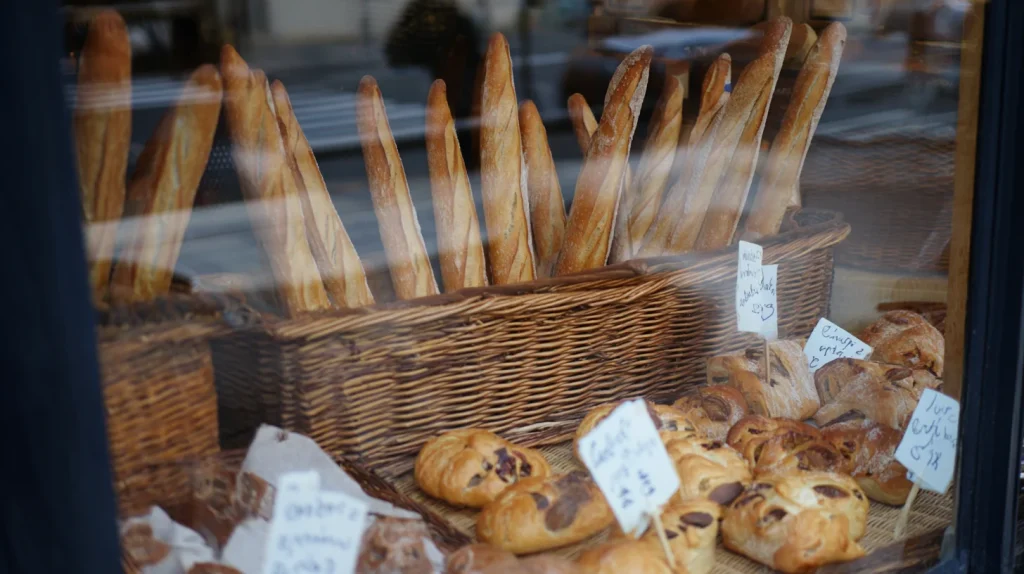
A baguette ordinaire (sometimes called baguette classique or just “baguette” on the menu board) can legally contain additives and dough conditioners that speed up production and make the result more consistent. The dough is sometimes frozen and thawed. It’s soft, pale, quick to make, and perfectly fine as bread goes. It’s just not memorable.
A baguette de tradition is a different, legally protected category, defined by a French government decree from 1993. It can only contain four ingredients: flour, water, salt, and yeast or natural leaven. No additives are permitted, the dough can’t be frozen at any point in the process, and it has to be made on-site with a long fermentation — typically somewhere in the range of 15 to 20 hours. That slow fermentation is where the flavor actually comes from. It’s also why a tradition baguette has a craggier, less uniform crust and an irregular crumb, instead of the smooth, machine-made look of an ordinaire.
The price gap between the two is small. Recent nationwide pricing surveys put the average baguette de tradition from an independent boulangerie somewhere around €1.25, with most bakeries falling between roughly €1.20 and €1.40 — only a bit more than a standard baguette, which averages closer to €1. Paris has historically run slightly above the national average. Given how small that gap is, there’s really no reason to order anything but the tradition.
Look for the word “tradition” on the sign, the price list, or the paper bag. Most serious boulangeries display it clearly, because they’re proud of it. If you’re not sure, you can just ask: “C’est une tradition?” You’ll get a clear yes or no.
How to Judge a Baguette Without Being an Expert
You don’t need any special knowledge to evaluate a baguette on the spot. You need four senses and about thirty seconds.
Look at it. The crust should be a deep, uneven gold rather than pale yellow. Small blisters scattered across the surface are actually a good sign — they usually mean the bread was properly steam-baked and fermented slowly. A crust that’s smooth, pale, and blister-free is a warning sign that it was made fast.
Squeeze it, gently. A good crust makes noise — a genuine crackle — and springs back a little after you press it. A baguette that compresses silently and doesn’t resist much was probably underproofed, or made with dough conditioners standing in for real fermentation time.
Smell it. Hold it near your face. You’re looking for yeast, toasted grain, maybe a hint of caramelized crust. A properly fermented tradition baguette has a real, distinct wheaty aroma. If it smells like not much of anything, it’ll probably taste like not much of anything too.
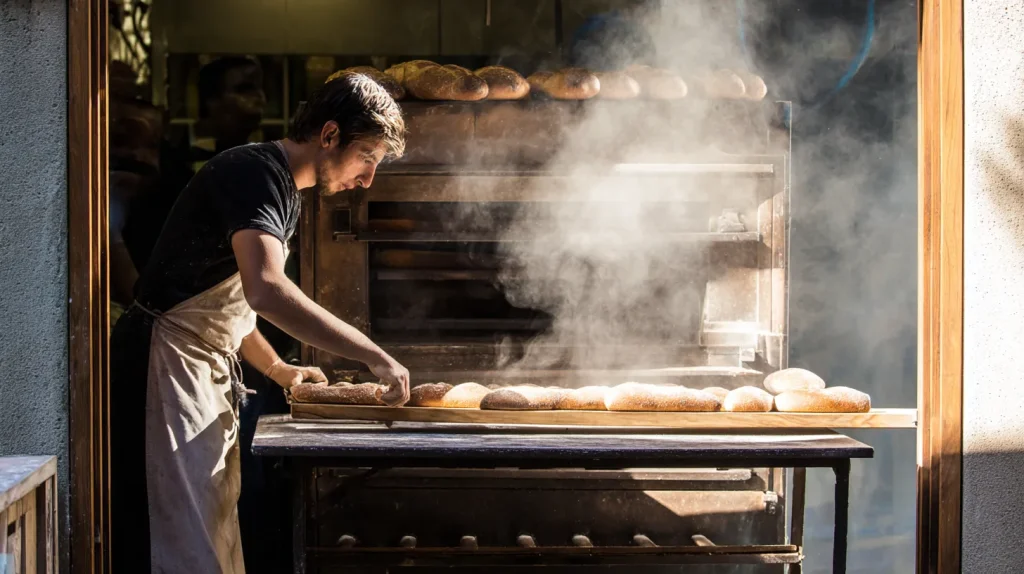
Break it open. This is the real test. The inside should show irregular air pockets of different sizes — an uneven, almost honeycomb structure that only comes from a slow rise. A tight, uniform crumb with small, evenly spaced holes usually means the bread was made on a fast schedule. Not necessarily bad, just not the thing you’re crossing Paris for.
The Grand Prix de la Baguette: Paris’s Annual Bread Championship
Each year, the City of Paris runs a genuinely serious competition — the Grand Prix de la baguette de tradition française de la Ville de Paris — to determine the best traditional baguette made in the city. Bakers submit loaves that are judged blind by a panel that typically includes past winners, working bakers, food journalists, and a handful of members of the public. Judging criteria cover appearance, bake, crumb structure, aroma, and taste, and the baguettes have to meet strict size and weight rules (roughly 55 to 65 centimeters and 250 to 300 grams) or they’re disqualified before tasting even starts.
The winner takes home a modest cash prize and a medal, but the real prize is the contract to supply fresh bread to the Élysée Palace — the French President’s official residence — for the following year.
The 2026 edition, held in late February, was won by Sithamparappillai Jegatheepan of Fournil Didot, at 103 Rue Didot in the 14th arrondissement, in the bakery’s first-ever year entering the competition. It was also notable as the fourth time in the competition’s history that a bakery from the 14th arrondissement has taken the top spot, part of a broader shift in recent years toward the city’s southern neighborhoods, away from the northern areas around Montmartre that dominated the competition’s earlier years.
Winning once doesn’t guarantee a bakery stays at the top — the judging happens fresh every year, and fermentation is sensitive enough that a bakery’s form can genuinely vary day to day. But some addresses show up again and again. Boulangerie Guyot Ferreira, at 28 Rue Monge in the 5th arrondissement, has placed in the competition’s top ten five separate times since 2020, including a second-place finish and a more recent third-place result — an unusually consistent record for a contest that rewards conditions that shift daily.
How to Actually Do a Baguette Crawl
The idea is simple: pick three to five bakeries, buy a baguette (or a half, if they’ll cut one) at each, eat as you go, and compare. It costs well under €10 total and takes two to three hours including the walking between stops. It’s a genuinely good way to spend a morning in Paris, and it requires no reservations, no tickets, and almost no planning beyond picking a neighborhood.
A few things make the difference between a good crawl and a mediocre one.
Start early. Most serious boulangeries have their ovens going by 7am, and the best tradition baguettes of the day are often out by 8am. Popular spots can sell out of their best batches by midday, and by mid-afternoon whatever’s left has usually been sitting out for hours, with the crust starting to soften.
Go hungry. This sounds obvious, but it matters more than people expect. You’re tasting plain bread with nothing to mask or enhance it — your appetite is doing a lot of the work of noticing the difference between a proper slow fermentation and an average one. A coffee and croissant beforehand will dull that.
Buy small amounts at each stop. The point is comparison, not a full lunch at the first bakery. A half-baguette per stop — most boulangeries will cut one for you if you ask — works better than a full loaf.
Eat outside, standing or walking. This isn’t a tourist habit, it’s just how bread is eaten in Paris. Standing in front of the shop, sitting on the nearest bench, or tearing pieces off as you walk to the next stop is completely normal.
Compare like with like. Order the tradition at every stop. Comparing a tradition at one bakery to a standard baguette at another isn’t actually comparing anything — they’re different products with different goals.
Where to Start
Fournil Didot — 103 Rue Didot, 14th arrondissement. The 2026 Grand Prix winner, and a genuine neighborhood bakery rather than a tourist destination, which is part of the appeal. It gives you a good excuse to explore the 14th, an area most visitors skip entirely. Go early, since demand has understandably picked up since the win — call ahead or check current hours before making a special trip.
Boulangerie Guyot Ferreira — 28 Rue Monge, 5th arrondissement. A small, tile-fronted, takeaway-only shop near the Panthéon with one of the most consistent competition records in Paris. Its location in the Latin Quarter makes it an easy stop if you’re already exploring the Left Bank.
Maison Thevenin — 6 Rue de Buci, 6th arrondissement. A family-run bakery operating since 1963, on one of the best market streets in the Saint-Germain-des-Prés area. It pairs naturally with a morning walk through the 6th, and it’s open daily.
Here’s the honest caveat, though: plenty of Paris’s best baguettes are made by bakers who’ve never entered the competition and never will. The neighborhoods where ordinary Parisians actually live and shop — the 11th, 13th, 19th, 20th arrondissements — are full of excellent local boulangeries that show up on no lists at all, simply because no food writer happened to walk in that week. If you see a line of people leaving a shop with baguettes tucked under their arms at 8am, that’s usually worth joining, competition medal or not.
What Else Is Worth Buying
A boulangerie visit doesn’t have to stop at baguettes.
Most serious bakeries also sell pain au levain — a denser, more acidic sourdough made with natural leaven instead of commercial yeast. It’s a different eating experience: more sour, chewier, and it actually holds up for a day or two, where a fresh tradition baguette is really at its best within about four hours of coming out of the oven.
Fougasse, a flatbread from Provence often studded with olives, herbs, or anchovies, shows up in a lot of the better Paris boulangeries and is worth grabbing warm if you see it.
And since most boulangeries double as pâtisseries, it’s worth glancing at the viennoiserie case while you’re there. The croissants, pain aux raisins, and chaussons aux pommes (apple turnovers) are made using the same quality butter the bakers use for everything else — a good boulangerie’s croissant is often just as good as a dedicated pâtisserie’s down the street.
What to Eat With Your Baguette
A fresh baguette doesn’t need a kitchen to become a real meal.
The simplest option is cheese, bought from any nearby fromagerie or market stall at the same time. Comté, brie de Meaux, or a soft chèvre all pair well with the slight tang of a properly fermented tradition baguette. Most cheese shops will slice or wrap small portions specifically for this kind of picnic eating. Add a piece of fruit from a street market, and you’ve got one of the more satisfying cheap lunches in the city, for a few euros total.
The next option is a filled baguette sandwich, which most boulangeries make fresh and sell pre-wrapped. The classic is jambon-beurre — ham and butter, nothing else — which sounds unremarkable until you have a genuinely good one. When the bread is fresh, the butter is real and salted, and the ham is from a decent supplier, there’s nowhere for mediocrity to hide. It’s a simple sandwich that tells you a lot about the quality of everything that went into it.
Or you can just eat the baguette plain, tearing pieces off as you walk. That’s not a tourist habit either — it’s genuinely how the bread is meant to be eaten, and nobody in Paris is going to look twice at someone eating bread on the pavement at nine in the morning. They’re probably doing the same thing.
A Bit of Context
In 2022, UNESCO added the “artisanal know-how and culture of baguette bread” to its Representative List of the Intangible Cultural Heritage of Humanity — recognizing not just the bread itself, but the daily practices around it: the visits to the bakery, the specific display racks built for the loaf’s shape, the whole rhythm of buying bread fresh, often more than once a day.
Whether the designation was necessary is something French commentators still debate. What’s not really in dispute is the role the baguette plays in daily life: the early-morning queue, the loaf carried home under an arm, torn pieces eaten with cheese at midday, yesterday’s slightly stale end turned into breadcrumbs for dinner. Little of it goes to waste, and the tradition baguette — protected by a decree that’s now over three decades old, contested every year by a fresh batch of competing bakers — is the clearest expression of how seriously that culture takes its bread.
You don’t need to know any of this history to enjoy a good baguette. But knowing that a government decree protects the fermentation process, and that there’s a genuine annual contest to decide who does it best, adds a little to the experience of eating one.
FAQ
What is the best baguette in Paris right now? The most recent Grand Prix de la baguette de tradition française, held in February 2026, was won by Sithamparappillai Jegatheepan of Fournil Didot, at 103 Rue Didot in the 14th arrondissement. It was his first year entering the competition, and the win comes with a one-year contract to supply the Élysée Palace. That said, “best” is a snapshot of one judging day — plenty of other bakeries, including repeat top-ten finishers like Boulangerie Guyot Ferreira in the 5th, are just as worth seeking out.
What’s the difference between a baguette tradition and a regular baguette? A baguette de tradition is legally limited to four ingredients — flour, water, salt, and yeast or leaven — with no additives and no frozen dough, and it must ferment for around 15 to 20 hours on-site. A standard baguette (ordinaire or classique) can include dough conditioners and move through production much faster. The tradition has more flavor and a craggier crust; the price difference is usually only a few cents.
How much does a baguette cost in Paris? Prices vary by bakery and neighborhood, but a standard baguette from an independent boulangerie typically runs around €1, while a baguette de tradition usually falls somewhere between €1.20 and €1.40. Given how small that gap is, it’s almost always worth paying the little extra for the tradition.
When’s the best time to buy a baguette in Paris? As early as you can manage — 8am is a good target at most serious boulangeries. Tradition baguettes are at their best within a few hours of baking, and popular bakeries can sell out of their best batches by midday.
How can I tell if a baguette is actually good? Squeeze it gently — it should crackle and spring back slightly. Smell it — you’re looking for yeast and toasted grain. Break it open — the inside should have irregular air pockets, not a uniform, tight crumb. And the crust should be a deep, uneven gold with small blisters rather than smooth and pale. Those four checks tell you more, faster, than any list of “best” bakeries.