If you’ve spent any time looking at restaurant awnings in Paris, you’ve probably noticed the same handful of words repeating across the city: bistro, brasserie, bouillon, café. They get thrown around almost interchangeably in English-language guides, but they don’t mean the same thing — and knowing the difference changes both where you should eat and what you should order once you sit down.
The second thing that trips people up is the menu itself. In France, “entrée” means starter, not main course. The main dish is “le plat” or “plat principal.” Order an “entrée” expecting a full dinner and you’ll get a small salad or a bowl of soup, followed by a slightly confused waiter coming back to ask what you’d actually like to eat.
Get those two things straight and the rest of eating in Paris gets a lot easier.
Bistro, Brasserie, Bouillon: The Actual Difference
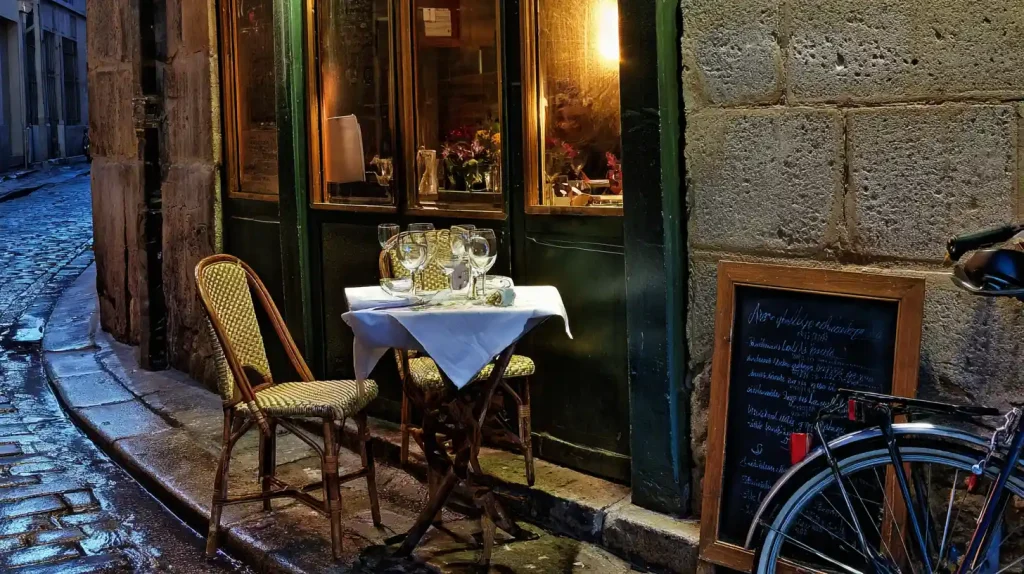
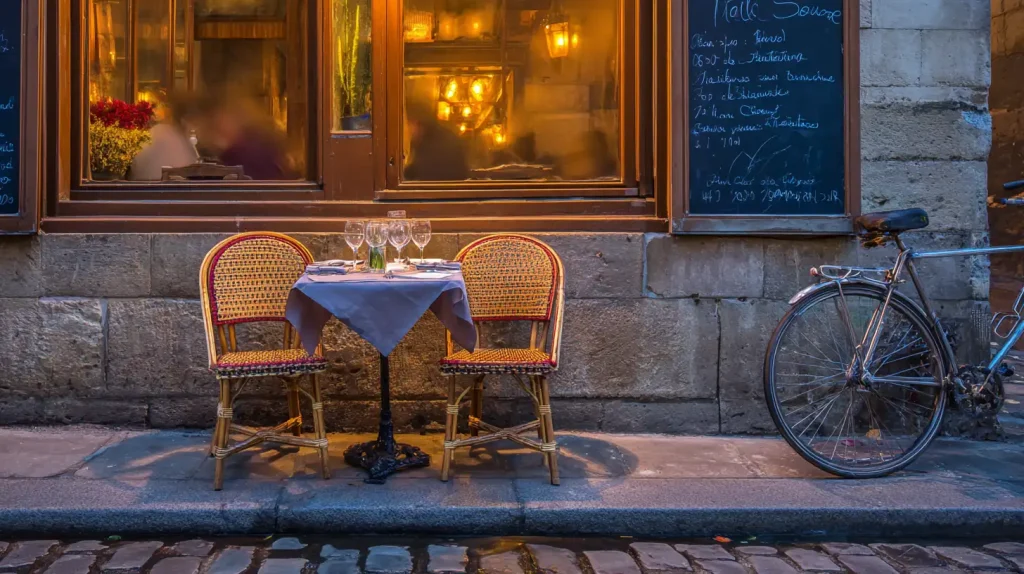
Bistro. A small, neighborhood restaurant serving simple, traditional food at moderate prices. The menu is short, often handwritten on a chalkboard, and changes with the seasons. Bistros generally open only at mealtimes — lunch from around noon to 2:30pm, dinner from around 7pm to 11pm — so if you show up at 3pm hungry, you’re out of luck. The rooms tend to be warm, a little cramped, and tables sit close together. That’s by design, not a limitation.
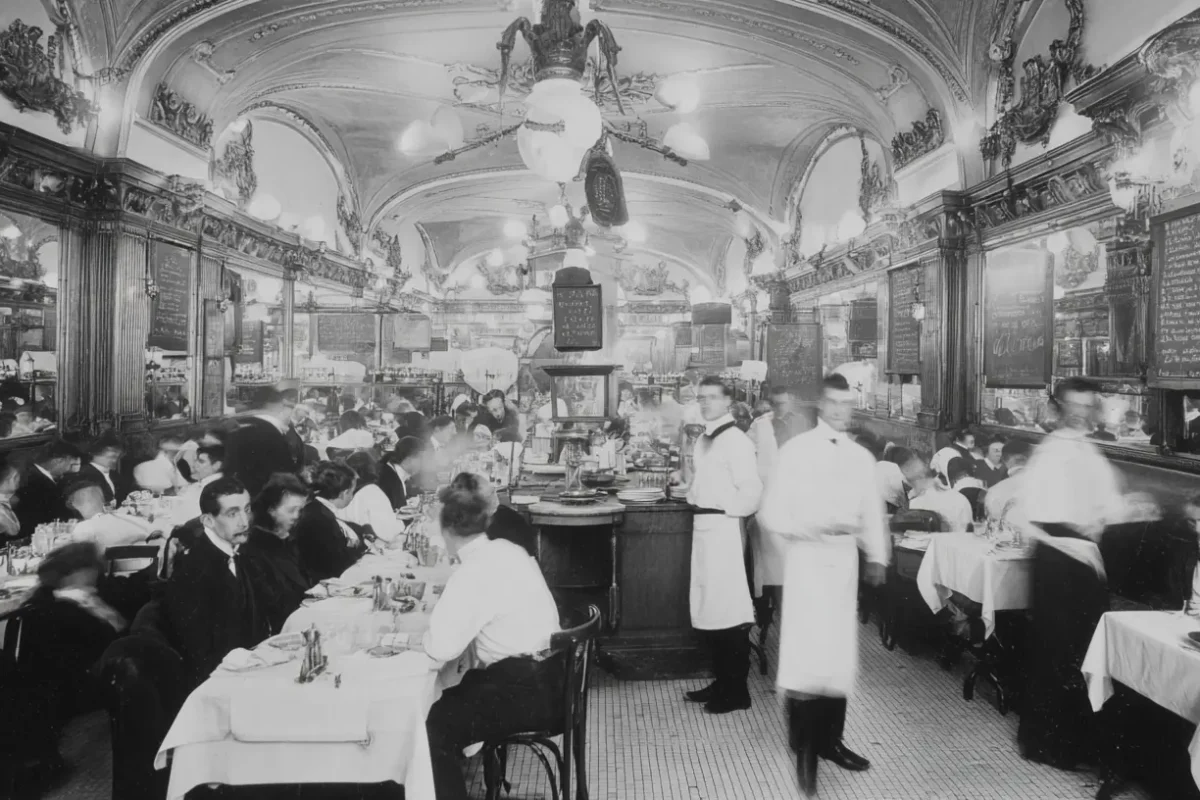
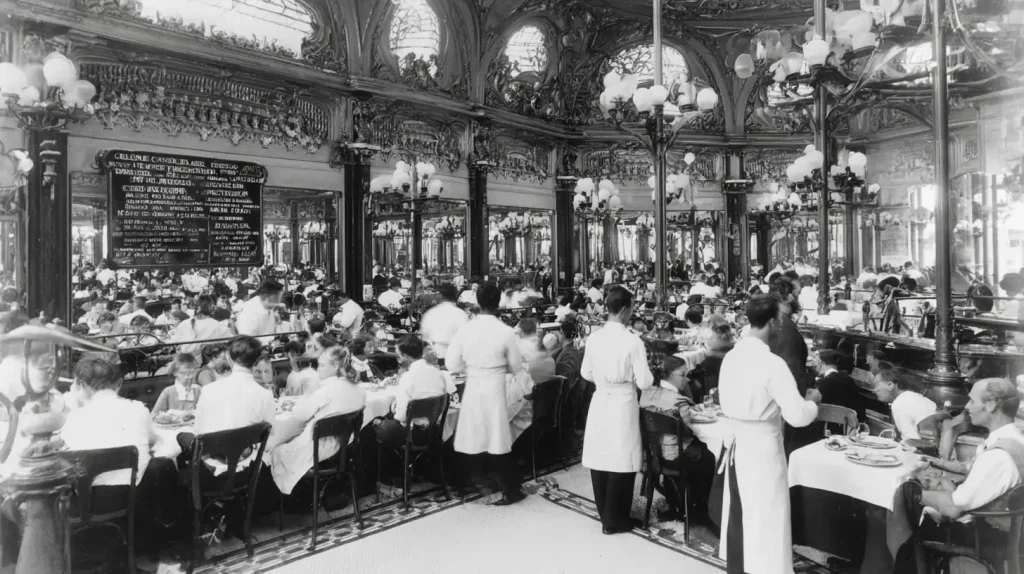
Brasserie. Bigger, louder, and open all day. The word originally meant “brewery” — many Alsatian brasseries started out serving food alongside beer. Classic brasseries lean into Belle Époque or Art Deco decor: mosaic floors, brass fixtures, leather banquettes, waiters in long white aprons. The menu is broader and the kitchen moves faster. Good for solo diners, late meals, or anyone who doesn’t want to wait for a table.
Bouillon. The most democratic of the three. Bouillons emerged in the late 19th century to feed Parisian workers a hot, affordable meal, and the concept still runs on that logic today: open long hours, prices that have barely moved with the times, and rooms built to seat hundreds. The food overlaps heavily with bistro classics — steak-frites, onion soup, escargot — just cheaper, faster, and served at scale. The most famous ones have become tourist landmarks in their own right, which changes the experience somewhat, but not the basic value proposition.
The practical shortcut: if you’re short on time and budget, go to a bouillon. If you’ve got a couple of hours and want something that feels more like a neighborhood meal, look for a bistro without an English menu taped to the window.
What Makes a Bistro Worth Your Time
The single most reliable signal of a good bistro is the chalkboard.
A handwritten menu that changes daily means the kitchen is buying what’s fresh that morning and cooking in small batches — when a dish sells out, it comes off the board. A laminated menu with glossy photos is telling you something different: that the food is designed to be reproduced identically, day after day, regardless of what’s actually good at the market that week.
Other signs worth watching for: a menu in French only, or French with minimal English notes rather than a full parallel translation; locals eating there at normal mealtimes; a short wait for a table around 12:30pm; a compact wine list with carafe options; and a “plat du jour” — dish of the day — priced a bit below the rest of the menu because the kitchen made a large batch of it that morning.
Red flags run the other way: someone standing outside trying to pull you in off the street, menus with photographs of the food, a page printed in five languages, a “tourist menu” advertised in the window, or a chalkboard that somehow never seems to change.
The Formule: How the Lunch Deal Works
Most Paris bistros offer a “formule” at lunch — a fixed-price menu that bundles two or three courses together. The structure is usually:
- Entrée + Plat (starter + main): typically in the mid-teens to low twenties in euros
- Entrée + Plat + Dessert (three courses): typically a few euros more on top of that
Exact pricing varies quite a bit by neighborhood, kitchen reputation, and what’s currently in the market, so treat any specific figure as a starting point rather than a promise — but as a rule, the formule is almost always the best value on the menu. The kitchen preps those dishes in batches ahead of service, which keeps both the price and the wait time down compared to ordering à la carte.
Formule service generally runs from around noon to 2:30pm. After that window closes, you’re ordering à la carte, and dinner tends to cost noticeably more across the board.
Classic Bistro Dishes Worth Ordering
Steak-frites. The bistro standard. You’ll be asked how you want it cooked — “saignant” is rare, “à point” is medium, “bien cuit” is well-done. À point is a safe default if you’re unsure. The best version usually comes as bavette (flank steak) with béarnaise sauce, a tarragon-forward cousin of hollandaise that pairs with beef better than almost anything else on a bistro menu.
Soupe à l’oignon gratinée. French onion soup, finished with a thick layer of Gruyère or Comté browned under the grill until it forms a crust you have to break through with your spoon. A properly made version takes real time to prepare; shortcut versions are usually obvious the moment you taste them.
Escargots. Snails cooked in garlic butter and parsley, served in ceramic dishes with individual wells. The snail itself has a mild, slightly chewy texture — the garlic butter is really the point. Order bread on the side so you can mop the dish clean once the snails are gone.
Confit de canard. A duck leg slow-cooked in its own fat until the meat falls off the bone, usually served with lentils or potatoes. It’s a genuinely rich dish, exactly as indulgent as it sounds — order it when you’re not planning much else for the rest of the day.
Tartare de boeuf. Raw minced beef seasoned with capers, cornichons, shallot, and egg yolk, either mixed at the table or served pre-mixed. Popular with locals and sometimes misread by visitors who don’t clock that “tartare” means raw. Worth trying if you’re comfortable with the concept.
Crème brûlée or tarte tatin. The two desserts that show up on nearly every bistro menu in the city. Tarte tatin is an upside-down caramelized apple tart, served warm — genuinely one of the better ways to end a meal here.
Where to Eat: Three Honest Recommendations
Bouillon Chartier (9th arrondissement, 7 Rue du Faubourg Montmartre) is worth doing once — but go for the room, not the cooking. Opened in 1896, it’s still operating in the same Belle Époque dining hall: high ceilings, brass luggage racks above the tables, a floor plan that hasn’t changed in over a century, and waiters who write your order directly on the paper tablecloth. Pricing runs on a genuinely rare model for Paris — starters from around €1, mains starting around €7, desserts from around €2 — with the house promising a full meal for under €20. Expect a queue, sometimes up to an hour at busy times, and no reservations. The food is solid and traditional rather than exceptional. Go for the atmosphere and the price, not expecting the best version of any given dish you’ll have in Paris.
Le Baratin (20th arrondissement, 3 Rue Jouye-Rouve, in Belleville) is where a lot of Paris chefs eat on their own time. Argentine-born chef Raquel Carena has run the kitchen here for decades, and the cooking is genuinely serious — simple in presentation, precise in execution, built around whatever’s good that day. The natural wine list, curated by her partner, is one of the more respected ones in the city. Reservations are essential; the restaurant is closed Sundays and Mondays, with lunch service Wednesday through Saturday and dinner Tuesday through Saturday. Expect to spend somewhere in the €40-per-person range for the food, before wine. This is the opposite experience from Chartier in almost every way — small, unpolished-looking, quietly excellent, and largely frequented by people who already know about it rather than tourists passing through.
Bistrot des Vosges (4th arrondissement, 31 Boulevard Beaumarchais, near Place des Vosges) draws a mix of locals and visitors without tipping over into tourist-trap territory. It specializes in food from the Aveyron region of southwest France — tripoux, stuffed cabbage, sausage with aligot (a stretchy, cheese-laced mashed potato) — alongside bistro standards like onion soup and steak tartare, and the onion soup in particular gets singled out repeatedly as one of the better versions in the city. It’s open daily, which is unusual for a genuine neighborhood bistro, and its location just off Place des Vosges makes it an easy stop between sights in the Marais. Reservations are a good idea, especially in the evening, since it fills up.
One Honest Warning
A lot of the “classic Parisian bistros” clustered in the most-visited areas — around the Eiffel Tower, along the main tourist streets in the Marais, anywhere within a couple of blocks of Notre-Dame — serve mass-produced food at inflated prices inside a room that’s been styled to look the part. The chalkboard is decorative. The boeuf bourguignon likely came pre-made from a supplier. The wine is unremarkable.
This isn’t a secret — Paris food critics and locals write about it constantly. The genuinely good bistros are usually a five-minute walk off the main tourist route, on a block that still has a working pharmacy and a dry cleaner rather than a row of souvenir shops. That’s generally where the neighborhood is actually eating.
How a Bistro Meal Actually Flows
This is the part most guides skip, and it’s the part that trips people up the most.
You arrive and get seated. A server comes fairly quickly to take your drinks order. This is a good moment to order wine — by the glass (“un verre”), by the half-carafe (“une demi-carafe,” roughly two glasses), or by the full carafe (“une carafe,” roughly four). A house red at a bistro is almost always a safe, solid choice; these places tend to have long-standing relationships with small producers rather than a sprawling, over-curated wine list.
Bread arrives without being asked for. It’s free, and it’s meant to be eaten with everything, including used to mop up sauce.
Your entrée (starter) arrives, you finish it, the plate gets cleared, and then some real time passes before the main course shows up — sometimes ten minutes, sometimes closer to twenty. That gap isn’t the kitchen forgetting about you. It’s just the pace of the meal.
Once the main is cleared, someone will usually ask if you’d like dessert, cheese, or both. Order if you want it, skip it if you don’t — nobody’s going to rush you either way.
The check doesn’t arrive automatically; you have to ask for it. Catch a server’s eye and mime signing something in the air, or say “l’addition, s’il vous plaît.” Because a 15% service charge is legally required to be built into every French restaurant bill — the “service compris” you’ll sometimes see printed at the bottom — no additional tip is required. Rounding up or leaving a couple of euros in cash for genuinely good service is a nice gesture, not an obligation.
Budget at least 90 minutes for a three-course lunch, and closer to two hours is more typical. This is not a culture built around getting in and out quickly, and trying to rush the meal tends to just create friction with the kitchen and the room.
Practical Notes
Most bistros don’t take reservations for parties smaller than four, which means the two easiest ways in are showing up right at opening (noon for lunch) or arriving around 12:45pm once the initial rush has been seated. Weekend lunches are harder to walk into without a wait — arrive early if you can, or be ready to hang around the bar for a few minutes.
Tipping is genuinely optional in France, since service is built into the price by law — a few coins or rounding up is appreciated but never expected the way it can feel in North America. Leaving a tip on a card is often not even possible, since many French payment terminals don’t have a line for it; if you want to leave something extra, do it in cash.
Tap water is free and should be offered without much fuss. If it isn’t, ask for “une carafe d’eau, s’il vous plaît” — a jug of tap water, which is perfectly safe to drink and comes out quickly. There’s no need to order bottled water unless you specifically prefer it; the price difference is small per meal, but it adds up over a week of eating out.
Above all, expect the meal to move slower than you might be used to. Courses arrive at whatever pace the kitchen sets, the bill won’t show up until you ask for it, and none of that is a sign of bad service. It’s just how a proper French bistro meal is meant to unfold.
FAQ
What is a French bistro? A bistro is a small, neighborhood restaurant serving simple, traditional French food at moderate prices. Menus change seasonally and are often written on a chalkboard. Bistros typically open only at mealtimes — roughly noon to 2:30pm for lunch, and 7pm to 11pm for dinner — and tend to be smaller and more personal than brasseries.
What’s the difference between a bistro and a brasserie in Paris? A bistro is small, serves only at set mealtimes, and runs a short, seasonal menu. A brasserie is larger, often decorated in an Art Deco or Belle Époque style, and stays open all day with a broader menu. Bouillons are similar to brasseries in scale and hours, but built around especially affordable pricing, historically aimed at feeding workers a hot meal cheaply.
What should I order at a French bistro? Steak-frites with béarnaise, soupe à l’oignon gratinée, confit de canard, and tartare de boeuf are the classics worth trying. For dessert, tarte tatin or crème brûlée are safe, reliably good choices. At lunch, the formule — a fixed two- or three-course set menu — is almost always the best value on offer.
Is Bouillon Chartier worth the wait? For the historic room and the price, yes. For the food alone, it’s more solid than exceptional. The Belle Époque dining hall is genuinely striking, and a full meal comes in well under €20. Expect a queue at busy times, sometimes up to an hour, since reservations aren’t taken. Go for the atmosphere and value rather than expecting food that will impress someone who grew up eating this cuisine.
What does “entrée” mean in France? In France, “entrée” means starter, not main course — the main dish is “le plat” or “plat principal.” This trips up a lot of English-speaking visitors, since “entrée” refers to the main course in North American usage. In French, the entrée is simply what comes in first, before the plat.