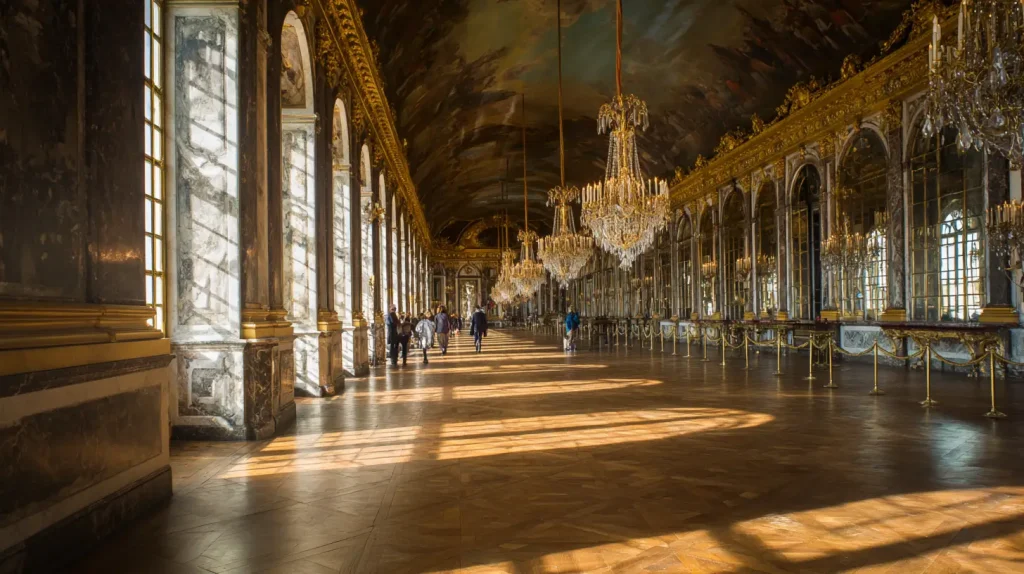
The Hall of Mirrors is spectacular for about ten minutes. Then you’ve seen it — 357 mirrors, 20,000 candles in chandeliers, a ceiling that documents Louis XIV’s military campaigns in paint. It’s one of the most famous rooms in the world. And yet what people remember most about Versailles isn’t the mirrors or the palace — it’s the gardens. The fountains running on a Saturday afternoon, the geometry of the parterres stretching toward the horizon, the hour they spent getting completely lost in the bocage forest section and didn’t mind at all.
Plan your Versailles day trip around the gardens, not the palace. The palace is the reason you came. The gardens are why you’ll remember it.
The First Decision: Half-Day or Full Day?
This is the question nobody asks before you arrive and everyone asks after.
The Palace of Versailles estate is enormous. The palace itself, walked quickly, takes 2–3 hours. The gardens run over 800 hectares — you could walk for four hours and not see all of them. The Trianon estate (the smaller palaces where royalty retreated from court life) adds another 1–2 hours. Combine all three and you need a full day — at least 7–8 hours — to do it without feeling rushed.
If you have half a day (4–5 hours): Take the first entry slot (9am), see the State Apartments and the Hall of Mirrors, then spend an hour in the gardens near the palace. Leave the Trianon for a future visit. This is a valid plan and leaves you back in Paris by 3pm.
If you have a full day (7–8 hours): This is the better version. Palace in the morning, gardens and Grand Canal after lunch, Trianon estate in the afternoon. Stay until closing. This is the visit where Versailles earns its reputation rather than just meeting it.
Make this decision before you book your train, because it determines how early you need to leave Paris.
Getting There from Paris
The RER C train is the standard route, and it’s worth being precise about which train, since this trips people up. Board a train with the four-letter mission code VICK on the departure board — this is the branch that terminates at Versailles Château–Rive Gauche, the station closest to the palace (about a 10-minute walk from the gates down Avenue de Paris). Other RER C codes on the same platforms (VERI, VIRE, and others) branch off to completely different suburbs — don’t board on the strength of seeing “Versailles” in the name alone; confirm VICK specifically.
Journey time: approximately 35–45 minutes from central Paris, depending on which station you board at (closer to 35-40 minutes from Left Bank stations like Invalides or Musée d’Orsay, slightly longer from Saint-Michel Notre-Dame).
Cost: a single point-to-point RER C ticket from central Paris to Versailles Rive Gauche runs a few euros — commonly cited around €4.40 for this specific zone crossing, which is a bit more than a standard single Paris metro fare since Versailles sits in an outer zone. If you have a Navigo week pass covering the relevant zones, Versailles is included at no extra cost. Paris Museum Pass holders get free entry to Versailles itself but still need to pay for the train separately.
The RER C caveat: The RER C is subject to more service disruptions and weekend maintenance than other Paris metro/RER lines. In summer especially, check for planned works before you travel. If the RER C is disrupted, Line L to Versailles-Rive Droite (about a 17-minute walk from the palace) or Line N from Gare Montparnasse to Versailles-Chantiers (about 20 minutes’ walk) are the backup options — both add meaningfully more walking than Rive Gauche.
Tickets: What You’re Paying For
Passport ticket (full estate access — palace, gardens, Trianon): €25 in low season (November–March), rising to €32-35 in high season (April–October) and on Musical Fountains days, for non-EEA visitors — EEA nationals and residents get a €3 discount off each tier. This pricing structure is relatively new: Versailles introduced seasonal, tiered pricing in January 2026, replacing the flat year-round rate that applied previously, so if you’ve seen an older single price quoted elsewhere, it’s out of date.
Gardens-only access: The gardens are free to enter from November through March. From April through October, entry is charged specifically on days when the fountain shows are running — full price starting around €12, reduced around €11, free for under-6s. On non-show weekdays in season (the “Musical Gardens” days, generally Tuesday-Friday, with ambient Baroque music but not the full fountain choreography), access is typically included or lower-cost — check the specific date’s designation before you go, since “gardens are free” isn’t a blanket rule in high season the way it is in winter.
Free entry for: all visitors under 18, EU/EEA residents under 26, with documentation.
Book in advance. Seriously. Walk-up tickets exist, but the ticketing queue on peak days (Tuesday–Sunday in summer) runs 45–90 minutes before you’ve even entered the palace. Online booking gets you a timed entry slot and a skip of the ticketing queue. On crowded days, this is a difference of an hour of your life.
Opening Hours
The Palace is open Tuesday to Sunday, generally 9am to 6:30pm in high season and slightly shorter hours in low season — closed every Monday, plus January 1, May 1, and December 25.
The Gardens open daily from around 8am — this means on Mondays you can visit the gardens even when the palace is closed. Worth knowing if your only available day falls on a Monday.
The Trianon Estate (Grand Trianon, Petit Trianon, Marie Antoinette’s Hamlet) opens Tuesday–Sunday from around noon. It doesn’t open in the morning, so structure your day with the palace first, gardens after, then Trianon in the afternoon.
What to Expect on Arrival
The town of Versailles sits around the palace gates, and the approach from the RER C station walks you down Avenue de Paris — a wide, formal boulevard that gives you a sense of scale before you even reach the gates. The palace complex fills the end of the street.
At the main entrance (the Cour Royale), you enter through the golden Gates of Honour — the original gates, restored and reinstalled with gold leaf in the 2000s. The forecourt opens up to the three wings of the palace, with the golden Marly Horses flanking the courtyard.
On busy days (weekends in summer especially), the security queue at the entrance moves steadily but takes time. Pre-booked tickets go through a dedicated lane. Even so, allow 20–30 minutes from arrival at the gate to actually being inside the palace.
The first thing you encounter inside is the Vestibule Dufour — a grand hall that was originally the guard room. It feeds into the main palace circuit. Pick up a map at the information desk. The palace does not have obvious internal signposting and the State Apartments connect to the Hall of Mirrors in a way that’s less intuitive than you’d expect.
One logistical note: the palace has limited facilities inside. Restrooms are in the vestibule area near the entrance and in the gardens — not scattered through the palace rooms. Sort this before you start the apartment circuit.
What to See Inside the Palace
The palace has many rooms, but you won’t see most of them on a standard visit. The public route through the State Apartments takes you through the Grand Apartments of the King and Queen, the Hall of Mirrors, and the Royal Chapel.
The Hall of Mirrors is the centerpiece and delivers exactly what photos suggest — a long gallery of arched windows alternating with mirrored panels, chandeliers overhead, the gardens visible through the windows. In high season, you’ll share it with a constant stream of visitors. Go in the morning at opening when it’s relatively clear. At midday, it’s a slow shuffle.
The King’s Grand Apartment — a series of rooms dedicated to planetary deities, each room named for a different celestial body. The ceiling paintings are worth stopping for properly, not just glancing up at while moving with the crowd.
The Queen’s Apartments — Marie Antoinette spent much of her Versailles life here. The bed chamber where several royal births took place (witnessed by crowds of courtiers, as protocol required) is specifically the room that makes most visitors stop and think about what court life actually involved.
One honest admission: the interior of the palace is grand but impersonal on a busy day. The furniture was sold during the Revolution and replaced with period pieces — the rooms are historically accurate but don’t feel inhabited. The emotional connection to Versailles happens in the gardens and the Trianon.
The Gardens: The Best Part
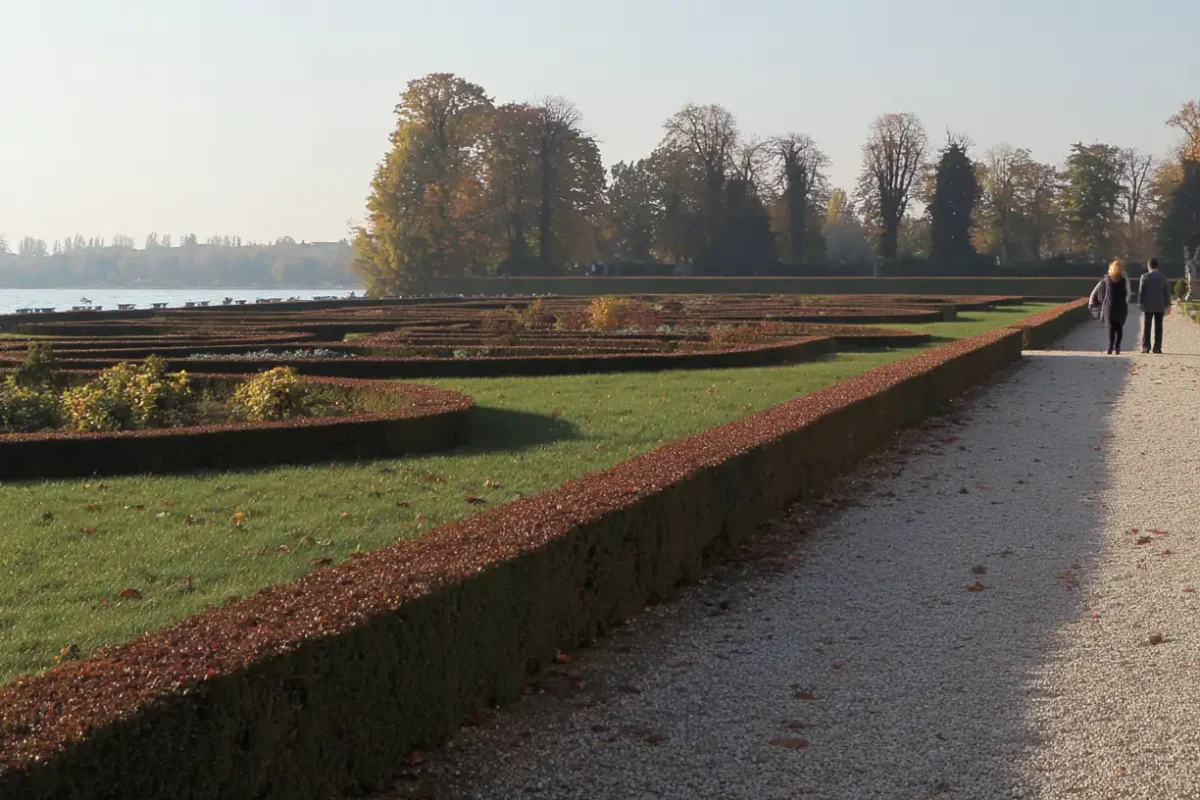
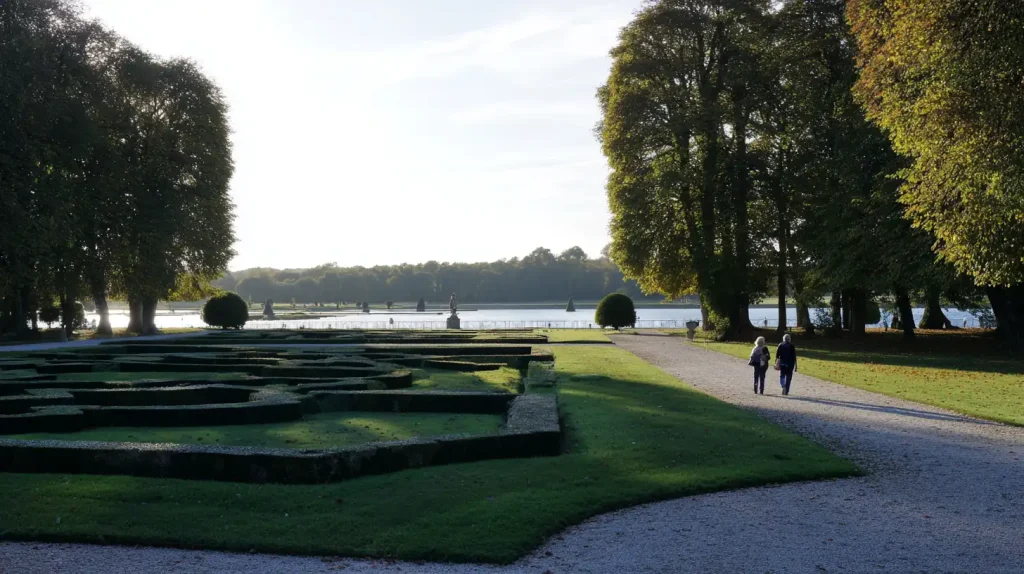
The formal gardens directly behind the palace were designed by André Le Nôtre under Louis XIV — an exercise in making nature behave. The geometric parterres (formal flowerbeds), the conical-clipped hornbeam trees, the fountains, the mile-long Grand Canal — all of it was designed to demonstrate that even nature obeyed the Sun King.
The Musical Fountains show (Grandes Eaux Musicales) runs on a fairly specific 2026 calendar worth knowing before you plan around it: every Saturday and Sunday from April 4 through November 1, plus every Tuesday from May 5 through June 30, and a handful of extra spring dates. On the Tuesday-through-Friday days it doesn’t run, there’s usually a quieter “Musical Gardens” version instead — ambient Baroque music and the groves open, but without the full choreographed fountain sequence. There’s also a separate evening event, the Grandes Eaux Nocturnes (Night Fountains Show), running Saturday evenings from early June to mid-September with a fireworks finale over the Grand Canal — this is ticketed separately from the daytime show and from the Passport ticket, typically starting around €33-38 for a standard adult ticket. The water for the daytime and evening shows synchronizes with Baroque-era music — Lully, Handel, and other composers of the court — genuinely moving if you catch it at the right hour.
Beyond the formal gardens, the park extends to the Grand Canal and the bocage forest beyond it. Rowboats and bikes can both be rented at the Grand Canal for exploring further afield — bikes aren’t permitted in the formal gardens themselves but are fine on the designated park routes beyond them. On a long summer afternoon, getting on the canal by boat and drifting along the cross-shaped water toward the Trianon groves is one of the more memorable things you can do in France.
The Trianon Estate: What Most Visitors Skip
This is my strongest recommendation: don’t leave Versailles without walking to the Trianon.
The Grand Trianon is a smaller palace of pink and white marble that Louis XIV built to escape the formality of the main court. Napoleon had it redecorated in Empire style and used it with his second wife, Marie-Louise. The interior is intimate in a way the main palace never is.
But the real reason to come here is Marie Antoinette’s Hamlet — a fantasy rustic village that the queen had built in the grounds of the Petit Trianon in the 1780s. It’s a collection of thatched farmhouses, a working mill, a dairy, a gardener’s cottage, all arranged around a small lake. The queen would come here to play at rural simplicity: she and her ladies dressed as milkmaids and actually worked the farm.
It sounds absurd. Standing in it, it’s oddly poignant. The Hamlet was built by a queen who was essentially a prisoner of her own status — a woman who had almost no private life from the moment she arrived at Versailles at age 14. The fake farm was her only approximation of one. Years after it was completed, she was arrested at Versailles. Not long after that, she was executed.
The Hamlet is a 15-minute walk from the palace, usually much less crowded, and one of the strangest and most affecting spaces in France.
Practical Tips
Go on a Tuesday or Thursday. Wednesdays and weekends are noticeably busier. Tuesday and Thursday mornings at 9am are among the quieter entry windows — though note that Tuesdays sometimes coincide with a Musical Fountains date in May-June specifically, so double-check the calendar if you’re deliberately trying to avoid the fountain-day crowds.
Eat before you arrive or pack food. The on-estate food options are overpriced and the queues in peak season are long. There’s a good bakery in the town of Versailles (10 minutes from the palace gates on foot) if you want to sort lunch before entering.
Wear comfortable shoes. The formal gardens alone require significant walking on gravel paths. If you’re doing the full estate including the Trianon, expect 5–8 km of walking on your feet for most of the day.
Leave early enough. The last RER C trains from Versailles back to Paris run until late evening, but the closing-time rush fills the station. Either leave 30 minutes before closing or stay in town for a post-visit meal and return on a less crowded train.
FAQ
How much does a Versailles day trip cost in 2026? Palace Passport ticket: €25 (low season) to €32-35 (high season), for non-EEA visitors, with a €3 discount for EEA residents; free for under-18s and EU residents under 26. Train to Versailles: around €4.40 each way on RER C from central Paris.
How do I get from Paris to Versailles by train? Take the RER C from central Paris stations (Saint-Michel, Invalides, Champ de Mars) — specifically a train coded VICK on the departure board — to Versailles Château–Rive Gauche. Journey time is 35–45 minutes. Trains run roughly every 15–30 minutes depending on time of day.
Is Versailles worth a full day? Yes, if you include the gardens and the Trianon estate. Doing only the palace interior is a half-day. The gardens in the afternoon and Marie Antoinette’s Hamlet are the experiences that make Versailles genuinely memorable rather than just box-ticking.
Is Versailles open on Mondays? The palace is closed on Mondays. The gardens are open from around 8am on Mondays. If Monday is your only available day, you can visit the gardens and walk to the Trianon (also closed Mondays) area for the exterior.
What’s the best time of year to visit Versailles? April to June and September to October: pleasant weather, gardens in bloom or turning, manageable crowds. July and August are peak and the most crowded. November to March is quieter and cheaper, but the Musical Fountains don’t run and the gardens are less spectacular — though also free to enter in that window.
RER C routing (the VICK mission code specifically), Versailles ticket pricing (including the January 2026 shift to seasonal/tiered pricing), and the 2026 Musical Fountains calendar verified August 2026 against the official Château de Versailles site (chateauversailles.fr) and current RER C routing guides. Exact fare amounts and showtimes can shift within a season — confirm specific dates against the official ticketing site if your visit is planned around a particular fountain show date.