Nobody tells you before you go that the Louvre is approximately the size of a small country. The museum has 380,000 objects across 72,735 square meters. You cannot see the Louvre. You can only visit a piece of it, and the visitors who accept this enjoy themselves considerably more than the ones who spend three hours speed-walking through wing after wing trying to tick every famous painting.
Go in knowing what you want. Spend real time with three or four things. Leave feeling like you understood something. That’s the Louvre.
Here’s how to make that happen — including when to go, how to book, what to actually look at when you’re inside, and a few things specific to 2026 that are genuinely worth knowing before you plan around this museum specifically.
Important Context for 2026: What’s Been Going On
Before the practical guide, it’s worth being upfront about something most packaged travel advice glosses over: the Louvre has had a genuinely turbulent year, and the effects are still visible.
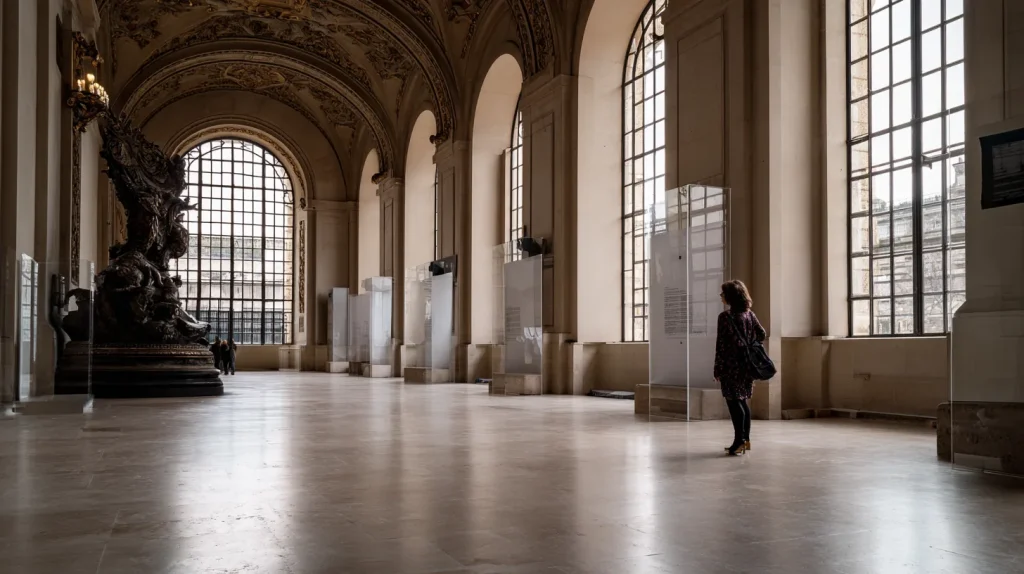
In October 2025, thieves broke into the Apollo Gallery in broad daylight and stole roughly €88-102 million worth of Napoleonic-era crown jewels in a matter of minutes. The jewels have not been recovered (except one crown, dropped and damaged during the getaway). The gallery closed for over nine months and reopened in late July 2026 — but it’s now on display largely empty, since the surviving, un-stolen pieces have been moved off-site pending a new high-security display space. If the crown jewels or the Apollo Gallery specifically were on your must-see list, temper expectations and check the museum’s current gallery status before you go.
The heist also triggered a wider reckoning: a separate gallery (the Campana Gallery, Greek ceramics in the Sully wing) was closed in late 2025 over structural concerns with the floor above it, and Louvre staff went on repeated strikes through the winter of 2025-2026 over understaffing, pay, and working conditions — at times closing the museum entirely or restricting access to only a handful of headline works (Mona Lisa, Venus de Milo, Winged Victory) on a “masterpiece route” while the rest of the museum stayed shut. The museum’s director came under sustained pressure and a senior official who led the Notre-Dame restoration was brought in to help reorganize operations.
By mid-2026, things had largely stabilized and the museum has been running close to normal — but given the pattern of recurring strikes over the past year, it’s genuinely worth checking the Louvre’s official social media or website the day before your visit, especially if your trip has no flexibility to shift days. A closure with little notice is a real, non-trivial possibility here in a way it wouldn’t have been a couple of years ago.
Separately, and on a longer timeline: France has approved a roughly €700-800 million renovation plan (branded “Louvre New Renaissance”), which is expected to eventually include a new dedicated entrance and a separate underground room for the Mona Lisa with its own timed ticket. This is a multi-year project and won’t be complete for years, but expect periodic gallery closures and construction activity somewhere in the building for the foreseeable future.
None of this should talk you out of visiting — the core collection is intact and the museum operates normally most days. But it’s a different risk profile than it was pre-2025, and worth factoring into how much flexibility you build into your Paris itinerary.
Ticket Prices in 2026
Since January 2026, the Louvre uses a two-tier pricing system:
- EEA residents (EU plus Iceland, Liechtenstein, Norway): €22 per adult.
- Non-EEA visitors (US, UK, Australia, Canada, and most of the world): €32 per adult.
Free entry for: all visitors under 18, EU residents under 26, and everyone on the first Friday of the month after 6pm — except July and August, when free Friday evenings are suspended.
The ticket covers the full permanent collection on the day of your visit (whatever is currently open and accessible — see the note above). Temporary exhibitions usually require a separate ticket.
Opening Hours
The Louvre is open 9am–6pm most days, with two important exceptions: it’s closed every Tuesday, and it stays open until 9:45pm on Wednesdays and Fridays for late-evening visits, with last entry around 9pm.
Closed Tuesdays is the most important thing to remember. Multiple visitors every week arrive at the Louvre on a Tuesday and find it shut. Don’t be one of them.
The late openings on Wednesday and Friday are genuinely worth planning around — more on that below.
How to Book (and Which Entrance to Use)
Book timed-entry tickets on the official Louvre website, louvre.fr. Pre-booked tickets cost the same as walk-up tickets — there’s no booking fee premium. The advantage is a timed entry window that lets you walk directly to the dedicated lane rather than queueing at the Pyramid to buy tickets.
Here’s the part most guides skip: the entrance you use matters as much as the ticket itself.
The glass Pyramid in the center of the Cour Napoleon is the most iconic entrance and the most crowded. In peak hours (11am–2pm), the queue to get in through the Pyramid — even with a pre-booked ticket — can run 30–45 minutes just for the security check.
The Carrousel du Louvre entrance is underground, accessed from the Rue de Rivoli shopping mall beneath the museum. It has its own security lane, is significantly less crowded, and deposits you directly into the ticketing area without the outdoor queue. If you have a pre-booked ticket, use this entrance.
The Richelieu passage (accessible from the Palais Royal side, through the archway off Place du Palais-Royal) is a third option and also calmer than the main Pyramid entrance.
The Louvre is currently mid-renovation, with some galleries periodically closed — as detailed above, this has been an unusually active year for closures specifically, so check the official site before your visit for current room status rather than assuming everything described in any guide (including this one) is currently open.
Best Time to Visit
This is where a little planning changes everything.
Best time by hour: First thing at 9am, when the doors open. Crowds haven’t yet arrived from hotels. You’ll have the Denon wing (the Mona Lisa, the Winged Victory) to yourself for about 45 minutes before the volume picks up. Alternatively, late on a Wednesday or Friday evening — after 6pm, visitor numbers drop dramatically, reportedly by around 60 percent compared to midday.
Best time by day of week: Monday or Thursday are the quietest weekdays. Avoid Sundays — all of Paris visits the Louvre on rainy Sundays. Wednesday and Friday are mid-range but the evening extension compensates.
Best time by month: February, March, October, and November see the lowest overall visitor numbers. July and August are peak season — the museum is extraordinarily crowded and the free Friday evenings are suspended.
Specific tip for the Mona Lisa: Friday evening around 7:30–8pm is the least crowded time to see her. If this sounds specific, it’s because every serious Louvre guide ends up at the same conclusion: the crowds in the Salle des États thin out significantly after 7pm on Friday evenings.
The Mona Lisa: What Nobody Prepares You For
The Mona Lisa is smaller than you expect. About 77 × 53 cm — roughly A2 paper. It sits behind a thick glass barrier, roped off at a distance, surrounded by a perpetual scrum of visitors holding phones over their heads trying to get a shot of it.
This is not the painting’s fault. It is an extraordinary work — the sfumato technique, the ambiguous expression, the impossible background. Up close (if you manage to get close), it’s more compelling than any reproduction. But the Mona Lisa room on a busy day is more about surviving the crowd than experiencing the art.
The underappreciated secret: turn around. Behind you in the same room is Veronese’s Wedding at Cana — a massive 10-by-7-meter painting covering the entire opposite wall. It’s one of the largest paintings in the Louvre. Almost no one looks at it properly because everyone’s facing the Mona Lisa. Spend five minutes with it.
Also in the Denon wing within walking distance: the Winged Victory of Samothrace, which stops people on the staircase mid-step. No head, no arms — just a figure of victory landing on the prow of a ship, marble drapery moving in frozen wind. It’s more affecting than the Mona Lisa for most people who see it without expectation.
A Two-Hour Plan for First-Timers
If you have two hours and no plan, you’ll spend most of it lost between wings. The Louvre has three wings — Denon, Richelieu, Sully — and connecting them without a clear route adds 30 minutes of corridor walking.
Here’s a focused first-timer route:
Enter through Carrousel du Louvre. Head immediately to the Denon wing.
The Winged Victory of Samothrace — Daru staircase, top of Denon. Stop here for 10 minutes. Let the scale register.
Mona Lisa and Salle des États — Continue through Denon. See the Mona Lisa. Turn around and look at Veronese. Move on — don’t get stuck here.
Italian paintings, Denon first floor — The rooms either side of the Salle des États contain Raphael, Caravaggio, Titian. These are world-class paintings in rooms that get a fraction of the Mona Lisa’s crowd. Spend 20 minutes here.
Venus de Milo — Head into the Sully wing. One of the most famous sculptures in the world, in a room large enough to see it properly. Ten minutes.
Egyptian Antiquities (optional) — If you have time remaining, the Sully and Richelieu wings have the Egyptian collection. This is where the museum’s scale becomes apparent — room after room of sarcophagi, statuary, artifacts. Even a 20-minute wander here is its own world.
Exit. You’ve seen the essentials. You haven’t seen a tenth of what’s there. That’s fine.
Room numbers have historically shifted with reorganizations and are more likely than usual to move again given the current renovation and closure activity — follow the museum’s live map/app on the day rather than a fixed room number from any guide, this one included.
What Most Visitors Get Wrong
Trying to see too much is the main mistake. Two or three hours spent properly in three or four rooms is a better experience than seven hours sprinting through fifteen.
Skipping the audio guide is a second mistake. The Louvre’s audio guide (available as an app on your phone or rented at the museum) adds enough context to make the difference between looking at a painting and understanding it. The room-by-room guide for the Italian paintings alone is worth the download.
Arriving at 11am is the third mistake. The period between 10am and 2pm is the most crowded window in the most crowded museum in the world. Don’t plan an 11am start.
Eating inside the museum is expensive and slow. The café on the lower ground level is convenient but pricey. If you want lunch, exit via the Carrousel du Louvre into the mall — there are better and cheaper options there. Or walk five minutes to the Palais Royal gardens and find a bench.
Not buying the audio guide is a fourth mistake that’s worth mentioning separately. The Louvre’s official app (free to download, paid guide within) walks you through the main works room by room. Even a 20-minute version for the Denon wing Italian paintings changes the experience. You’re no longer walking past a large canvas and reading a label. You understand what you’re looking at — when it was painted, for whom, what the artist was trying to do. A painting becomes a story. Download it before you go so you’re not fumbling with WiFi in the lobby.
Understanding the Three Wings (So You Don’t Get Lost)
The Louvre splits into three wings: Denon, Richelieu, and Sully. Each has a different character and it helps to know which one you’re heading into.
Denon wing is where most first-timers spend their entire visit. It contains the Italian paintings (Mona Lisa, Raphael, Caravaggio), the Winged Victory of Samothrace, and the large French paintings (Géricault’s Raft of the Medusa, Delacroix’s Liberty Leading the People). The crowds here are the densest of the three wings.
Richelieu wing is less visited and arguably more interesting if you want to escape the tourist rush. It holds Northern European paintings (Vermeer, Rembrandt, Rubens), French sculpture courts — two enormous glass-roofed rooms full of French royal sculpture — and decorative arts. The sculpture courts in particular are extraordinary and usually quiet.
Sully wing connects the other two and contains the Egyptian Antiquities, Greek and Roman antiquities (including Venus de Milo), and the medieval Louvre moat visible through glass floors in the basement. If you drop into the basement level, you can walk along the original 12th-century fortress foundations — an entirely different kind of history than the paintings upstairs. Note that part of Sully (the Campana Gallery of Greek ceramics) has been closed since late 2025 for structural investigation — check current status if this is a specific interest.
A practical tip: if you enter through the Carrousel du Louvre, follow the signs to Denon first, see the main highlights there, then cut across to Richelieu for the French sculpture courts. You avoid Sully until you’re ready to leave, which means you always know which direction exit is.
Practical Information
Address: Rue de Rivoli, 75001 Paris. Metro: Palais-Royal–Musée du Louvre (lines 1 and 7).
Closed: Every Tuesday, and on January 1, May 1, and December 25 — plus, as covered above, the real possibility of an unscheduled closure or partial closure given the pattern of strikes over the past year.
Late nights: Wednesdays and Fridays until 9:45pm. Last entry is around 9pm.
Bags: No large bags or luggage. There’s a bag check (vestiaire) if needed. Lockers are available. Expect security to be more visible and thorough than in past years following the 2025 heist.
Photography: Photography is permitted throughout the permanent collection. Flash is not. Tripods are not.
Children: Children under 18 are free. The museum is stroller-accessible via the elevator network, though some older areas have steps.
Paris Museum Pass: If you’re visiting multiple Paris museums, the Paris Museum Pass (covering the Louvre, Musée d’Orsay, Versailles, and others) may save money and includes timed entry — 2026 pricing runs roughly €55 for 2 days, €70 for 4 days, €85 for 6 days, worthwhile once you’re hitting 3+ paid sites across the pass’s validity window.
FAQ
How much are Louvre tickets in 2026? €22 for EEA residents, €32 for non-EEA visitors. Free for visitors under 18, EU residents under 26, and on the first Friday of the month after 6pm (except July–August).
Is the Louvre currently open normally, or affected by the 2025 closures? As of mid-2026, the museum is generally operating on a normal schedule, and the Apollo Gallery (site of the October 2025 jewel theft) reopened in late July 2026, though currently without the stolen pieces on display. Given a year of recurring staff strikes and gallery closures, it’s worth checking the museum’s official channels the day before your visit for any current disruptions, especially if your trip dates are fixed.
When is the Louvre least crowded? Wednesday or Friday evenings after 6pm — visitor numbers drop significantly. Weekday mornings at 9am are also quiet. Avoid Sundays and midday in any season.
How long does it take to visit the Louvre? Most visitors spend 2–4 hours. Seeing the highlights (Mona Lisa, Winged Victory, Venus de Milo, Italian paintings) takes about 2 hours with focus. Attempting to see more leads to diminishing returns and museum fatigue.
Is the Louvre worth it if I only have a few hours? Yes — with a plan. Choose your priorities in advance, use the early morning or late evening slots, and focus on two or three areas rather than the whole museum.
What’s the best way to see the Mona Lisa without crowds? Friday evenings after 7pm are the lowest-crowd window for the Salle des États. Book the late Friday session, arrive at 6pm when the museum gets quieter, and reach the Mona Lisa room by 7:30pm.
Ticket pricing (the January 2026 EEA/non-EEA tiers), hours, and entrance information verified August 2026 against the official louvre.fr site. The October 2025 Apollo Gallery heist, the Campana Gallery structural closure, the winter 2025-2026 staff strikes, and the “Louvre New Renaissance” renovation plan are all confirmed through multiple independent news sources current to July 2026 — this is a fast-moving situation for museum operations specifically, and readers should treat the closure/disruption risk as current rather than historical. Paris Museum Pass pricing verified against official Uffizi-style multi-site ticketing sources current to 2026.