The first time you see it in person, the Eiffel Tower is taller than you thought. Not in pictures — in pictures it looks like a postcard. But standing under it, looking up at 300 meters of iron lattice, it does the thing that only certain structures do: it makes you feel briefly insignificant. Then a group of tourists surrounds you taking selfies and the spell breaks. That’s the Eiffel Tower experience, in full.
Worth it? Yes. For most people, unambiguously yes. But what you’ll actually remember depends almost entirely on what you book, when you go, and whether you understand the difference between standing at the second floor and standing at the summit.
This guide covers all of it, without making you read the official website in three languages.
Ticket Types: What You’re Actually Choosing Between
There are four meaningful choices when booking Eiffel Tower tickets in 2026, and they’re not all created equal.
Stairs to the 2nd floor — Adults pay €14.80. You walk up approximately 674 steps to the second floor. No elevator. The crowd thins out because most people don’t want to walk. The views at the 2nd floor are excellent. This is the best value ticket if you’re reasonably fit and don’t mind stairs. Note that as of 2026, stair tickets only cover the climb to the 2nd floor — there’s no longer an all-stairs option all the way to the summit; from the 2nd floor, summit access requires the separate elevator.
Elevator to the 2nd floor — €23.50 for adults. You ride to the second floor. Same view as stairs, shorter legs required. This is what most families and groups book.
Stairs to 2nd floor + elevator to summit (combo) — €28.00 for adults. A relatively new middle option: walk the first stretch, then take the lift the rest of the way up. Slightly cheaper than going by elevator the whole way, if you don’t mind the climb for the first leg.
Elevator to the Summit — €36.70 for adults. You go from the 2nd floor up a separate, narrower elevator to the very top at 276 meters. The view from the summit is different in kind, not just degree — more exposed, more panoramic, and weather-dependent in a way the 2nd floor isn’t.
Youth (12–24) and children (4–11) pay reduced rates — roughly half the adult price on most tiers. Children under 4 enter free on every ticket type. EU residents under 26 also qualify for free entry with ID on some ticket categories — check the specific terms at booking, as this isn’t uniform across all tiers.
One thing the booking site doesn’t explain clearly: your ticket level is fixed at purchase. You cannot upgrade from 2nd floor to summit once you’re inside. If you think you might want the summit, book the summit.
Is the Summit Actually Worth the Extra Money?
This is the question nobody answers directly. I’ll try.
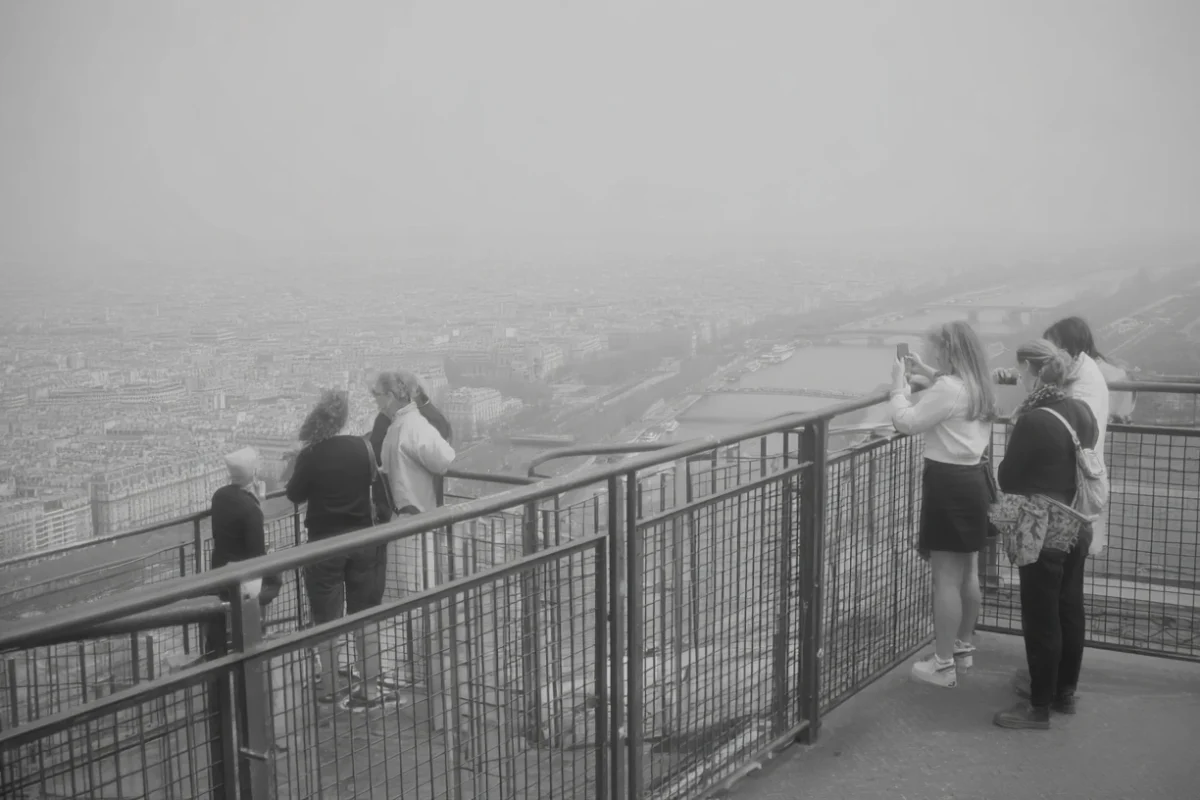
The 2nd floor at 115 meters gives you excellent 360-degree views over Paris. On a clear day, you can see for roughly 70 kilometers. You can make out the Seine, the Louvre, Sacré-Cœur, Notre-Dame, La Défense on the horizon. It’s genuinely impressive.
The summit at 276 meters adds roughly another 160 meters of height. What changes: the platform is much smaller, more exposed to wind, and the view opens out more dramatically. You can see further. The sense of being at the very top — nothing above you — is different from the 2nd floor in a way that’s hard to describe but real. There’s also a real practical trade-off worth naming honestly: at the summit, Paris starts to look more like a map than a city you’re standing above — some visitors find the 2nd floor is actually the more emotionally engaging vantage point precisely because you can still recognize individual streets and buildings.
Worth the extra ~€13 over the standard elevator ticket? For most first-time visitors, yes. For people who are at all nervous about heights, the 2nd floor is actually the better experience — you can walk around, take your time, lean over the railing at a comfortable height. The summit is more exposed and the crowd up there is smaller, which either feels great or feels nerve-wracking depending on you.
If you only have money for one level: book the summit on your first visit. You can always do the 2nd floor another time.
How to Book (and What Happens If You Can’t)
The official booking site is toureiffel.paris. Elevator tickets typically open around 60 days in advance; stair tickets can have a somewhat shorter booking horizon, closer to 40 days out — check the specific window for your ticket type when you go to book, as this has shifted in recent updates to the booking system. Summit slots at sunset sell out within hours of opening.
The process: you pick a date, pick a time slot, pick your level, pay. You receive a QR code confirmation. Your ticket will also specify which of the tower’s four entrance pillars (North, South, East, West) to use — these are spread out, so check this before you leave your hotel, since walking to the wrong pillar eats directly into your timed entry window. At the tower, there’s a dedicated entrance for ticket holders — you skip the queue to buy tickets. You still go through a security bag check, so arrive around 15 minutes before your slot.
What to do if all slots are sold out:
Check for cancellations. People cancel and the time slots reopen, sometimes just a day or two before your visit. Check the site morning and evening in the weeks before.
Go early in the morning. The first entry slots are less popular than midday or sunset and often available later. The light is different — softer, less harsh than midday — and the crowds at ground level are thinner.
Consider a third-party tour operator. Guided tours with access often have pre-purchased summit slots. These cost noticeably more than official tickets (often well over double, once you compare against the official €23.50-36.70 range) but include skip-the-security-queue access and a guide explaining the tower’s history. For groups or families, this can actually be worth it. Just be clear-eyed that you’re paying a real premium for the convenience and the guide, not for a better view.
Best Time of Day to Visit
Early morning (9–10am): The fewest people. Golden morning light on the structure. If you want the tower to yourself-ish and photographs without crowds, this is the slot. Not sunset-dramatic, but peaceful.
Midday (11am–3pm): The worst time. Maximum crowds, harsh overhead light, and the queue (even for pre-booked visitors going through security) is at its longest.
Late afternoon to sunset: The best light for photography, both on the tower and from it. Paris turns golden as the sun drops. This is when you want to be on the summit. Also when tickets are hardest to get — book these 4–6 weeks out.
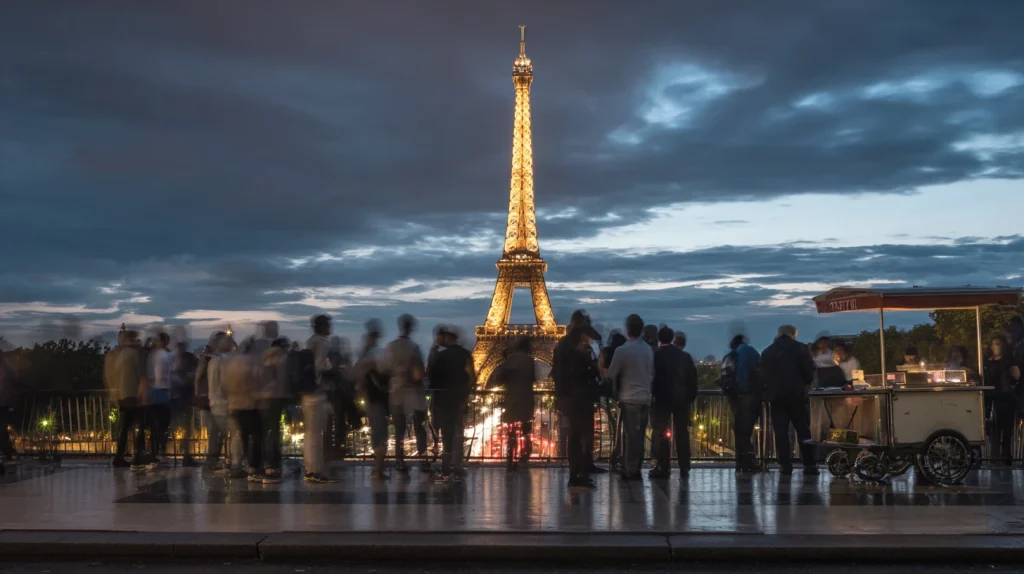
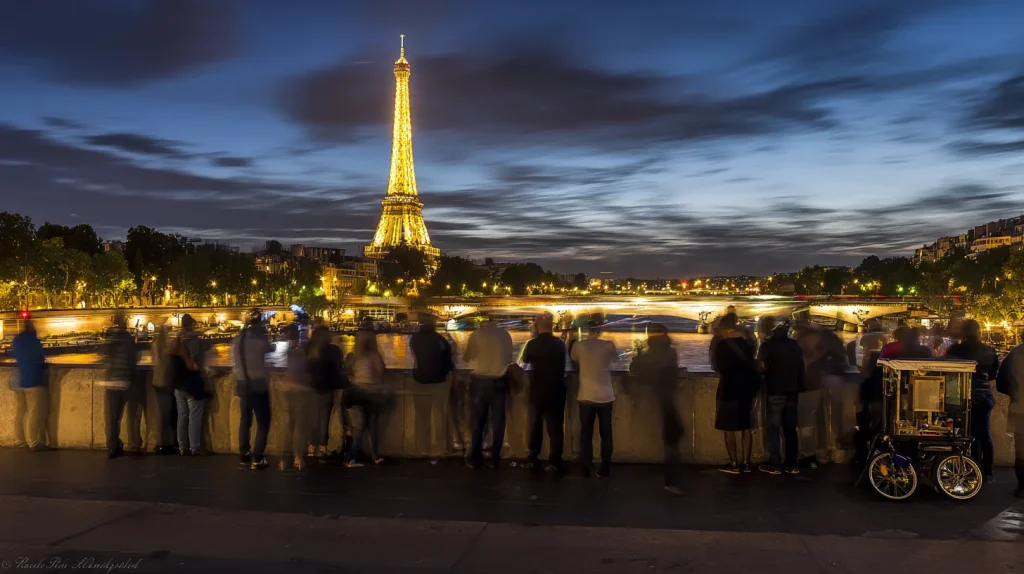
After dark (9pm onward): Every hour on the hour from dusk to midnight (until 1am in the closing hour), the tower does a light show — thousands of bulbs flickering and sparkling for five minutes. If you’re on the ground looking up, this is extraordinary. If you’re inside the tower when it starts, you’ll notice people suddenly leave the viewing platforms and look confused — you can’t see the sparkle from inside the tower, only from outside. Watch it from the Trocadéro plaza for the best angle.
Best Time of Year to Visit
Summer (July–August) is peak madness. The line for security, even with pre-booked tickets, runs long. The tower itself is hot and crowded. Book at least 4–6 weeks out for summer slots, and even then, you may find summit availability limited. The tower stays open later in this season, generally until midnight (last entry around 10:30-11pm), which is worth factoring into an evening plan.
Spring (April–June) is close to ideal. Weather is warm enough to enjoy the summit. Crowds are lower than summer. Tickets are easier to get 2–3 weeks out. The views over Paris include blooming chestnut trees along the Seine.
Autumn (September–October) is underrated. The light turns warm and golden. Crowds thin after early September. Temperatures on the summit can be cool but manageable. This is when Parisians start going back to the tower after avoiding it all summer.
Winter (November–February) brings its own version. The tower is less busy, and closing hours shift earlier (generally to around 11pm, with last entry 10:30pm, outside the June-September peak window). Cold on the summit — bring a proper jacket, not just a light layer. But on a clear winter day, the visibility is exceptional and the views are often sharper than summer’s hazy heat.
Practical Details You’ll Actually Need
Getting there: The Eiffel Tower is at Champ de Mars. Bir-Hakeim (metro line 6) is the closest station. From Bir-Hakeim, the tower is about a 5-minute walk. Trocadéro (line 6 or 9) gives you the classic frontal view as you descend the plaza steps — the better arrival for photography.
What to bring: Phone or printed ticket (QR code). No large bags — there’s a bag check with size restrictions. If you’re going to the summit, a light jacket even in summer because summit temperatures run 5–10°C cooler than ground level.
Accessibility: The tower is accessible by elevator to the 1st and 2nd floors for wheelchair users. Summit access and the stair-descent option are more limited — contact the tower directly if this is a specific concern, as arrangements can vary.
On-site food: There’s a restaurant on the 1st floor (Jules Verne, Michelin-starred) and a brasserie on the 2nd floor. Prices are high. The 2nd-floor brasserie is fine for a coffee or glass of champagne with the view — the experience is part of it. Don’t expect bargain dining.
Photography: The tower itself is free to photograph any time, day or night, for personal use. The nighttime sparkling light show specifically has been treated as a copyrighted artistic work in French law, which technically affects commercial reproduction/publication of images showing the light show in action — this doesn’t affect ordinary personal photos or social media posts, so don’t let this discourage a phone photo of the sparkle.
What the Experience Is Actually Like (Step by Step)
You arrive at the tower. If you’ve pre-booked, you go to the dedicated entrance lane for ticket holders — not the walk-up queue, and to the correct pillar as specified on your ticket. You’ll still go through a security check: bags on a conveyor belt, walk through a scanner. Allow 10–15 minutes for this.
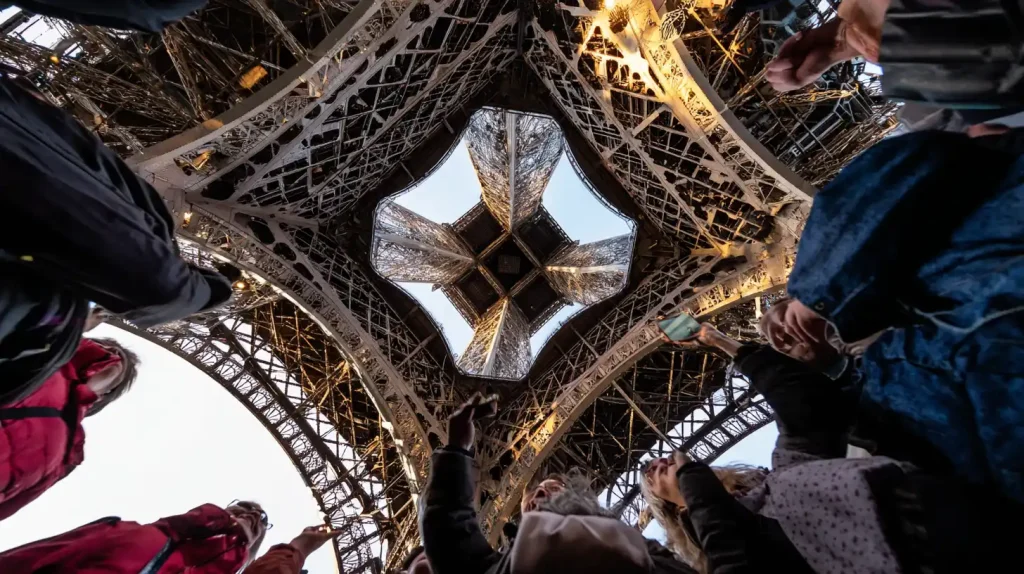
Once through, you’re at the base of the tower. Take a moment to look up. This is one of the more disorienting and satisfying views in Paris — four iron legs converging overhead into something that looks like it shouldn’t stand.
If you’re taking the elevator, you queue for the lift. The elevators travel inside the curved legs of the tower at an angle — this surprises people who’ve never read about it. The ride takes about a minute and is smooth.
At the 2nd floor, you step out onto the observation deck. The view opens up immediately. There are outdoor platforms with railings and glass barriers (renovated in recent years to be clearer and less obstructive), information panels showing what you’re looking at, a snack bar, and the entrance to the Jules Verne restaurant.
If you have a summit ticket, you re-queue for a second, smaller elevator that takes you the rest of the way. The summit platform is noticeably more exposed and more intimate — fewer people, more sky, more sense of height. Gustave Eiffel’s original private apartment is preserved here, with wax figures of him and Thomas Edison. It’s a small but worthwhile detail.
Coming down: you can take the elevator or walk the stairs for the 2nd floor to ground descent — allow up to about 10 minutes for the stair descent. Many people walk down. The staircase wraps around the outside of one of the tower’s legs and the views as you descend are excellent — a different perspective than the elevators, and less crowded. Note the stair descent is not accessible for visitors with reduced mobility.
The whole visit, from security queue to ground level exit, takes between 1.5 and 2.5 hours depending on how long you spend on each level.
What to Pack for France: Essentials & First-Timer Packing Tips
The Honest Take
The Eiffel Tower is not an overrated tourist trap. It is genuinely extraordinary — a 19th-century iron structure that was supposed to be temporary and became the most recognizable building in the world. Standing at the summit, looking out over Paris with the Seine threading through it, you understand something about the city that maps can’t tell you.
What it isn’t: a peaceful experience. The queues, the security, the crowds at ground level — these are real. That’s why the timing matters. Early morning or evening, pre-booked tickets, summit level on a clear day. Get those right and it delivers.
FAQ
How much do Eiffel Tower tickets cost in 2026? Stair access to the 2nd floor: €14.80. Elevator to the 2nd floor: €23.50. Stairs-to-2nd-floor-plus-summit-elevator combo: €28.00. Summit by elevator all the way: €36.70. Youth and child rates are lower; children under 4 are free.
How far in advance should I book Eiffel Tower tickets? For summer visits, 4–6 weeks minimum for sunset summit slots. For off-peak visits, 1–2 weeks is usually enough. Elevator tickets typically open around 60 days out; stair tickets on a somewhat shorter window. If you’re visiting in July or August, book as soon as the window opens.
Is the summit worth the extra cost over the 2nd floor? For most first-time visitors, yes. The summit at 276m feels meaningfully different from the 2nd floor at 115m — more exposed, more panoramic, more memorable, though also more abstract (Paris reads more as a map than a city from that height). If you’re visiting only once, book the summit.
What is the best time of day to visit the Eiffel Tower? Sunset for the best light and romance, but hardest to book. Early morning (9–10am) for the fewest crowds. Avoid midday — worst light and most people.
Can I visit without a pre-booked ticket? Technically yes — walk-up tickets are sometimes available on-site — but summit tickets especially sell out. In high season, showing up without a booking is a gamble that may cost you a very long wait for a 2nd-floor-only ticket. Pre-book.
Ticket prices (€14.80 stairs / €23.50 elevator to 2nd floor / €28.00 combo / €36.70 summit) verified August 2026 directly against the official toureiffel.paris pricing page — note this corrects an outdated 2nd-floor elevator figure that had been circulating at closer to €29. Opening hours (seasonal: until midnight June-September, until 11pm otherwise) and the stairs-to-2nd-floor-only policy also verified against the official site.