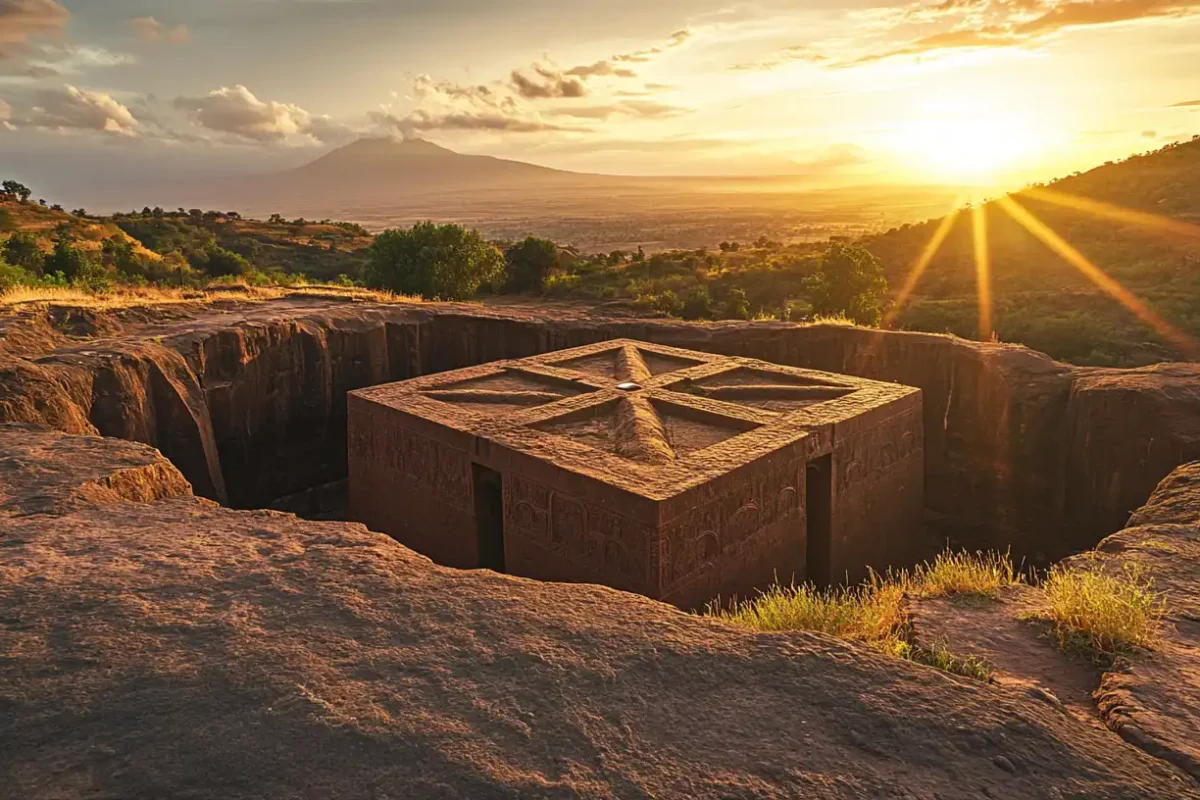
Lalibela is eleven churches carved directly out of red volcanic rock in the highlands of northern Ethiopia at 2,630 meters altitude, built during the reign of King Lalibela in the 12th and 13th centuries. Not built on top of rock — carved down into it, tunneled through it, sculpted out of living basalt until freestanding monolithic churches emerged from the earth as if the stone had always contained them. The Church of St. George, the most photographed, is a perfect Greek cross cut 12 meters below ground level, its carved walls descending like a shaft into the earth. Ethiopian Orthodox Christians consider this the New Jerusalem. On any given Sunday, barefoot pilgrims in white shawls press their foreheads against 800-year-old stone walls and pray. Incense fills the tunnels. Drums and chanting echo from multiple churches simultaneously. You will not see anything like it anywhere else on earth.
| Best time to visit | November–February (dry season); avoid July–August rains |
|---|---|
| Getting there | Fly Addis Ababa (ADD) to Lalibela (LLI) on Ethiopian Airlines, 45 min |
| Budget per day | $60–100 USD (modest once you’ve paid flights and entrance) |
| Visa for Americans | e-Visa required; apply at eta.gov.et ($82, 30 days) |
| Language | Amharic locally; English at guesthouses and with guides |
| Currency | Ethiopian Birr (ETB); USD accepted at most hotels; ATMs in town |
Is Lalibela Worth the Journey?
If you’re the kind of traveler who prioritizes genuinely singular experiences over comfort, yes — without hesitation. Lalibela requires effort: Ethiopia has real infrastructure gaps, the altitude hits you on arrival, and the dry-season dust is relentless. The churches themselves are active religious sites, not museums — you are a guest in a place of active worship, which requires appropriate behavior and appropriate clothing (shoes off at every church, shoulders and knees covered). In return, you encounter something that has no parallel anywhere. The Church of Bete Medhane Alem is the largest rock-hewn monolithic structure in the world. The Northern Cluster alone would justify the flight from Addis. The Sunday morning mass experience — attended long before other tourists have woken up — is among the most powerful things I have experienced in 20 years of travel.
The Ticket and the Clusters
The entrance pass for all of Lalibela’s churches costs $50 USD (as of 2025) and is valid for five consecutive days — there are no single-day or partial tickets. Buy it at the ticket office near the Northern Cluster entrance. Hold onto it; you’ll need it at every church gate. The pass covers all eleven churches across the Northern Cluster, Southern Cluster, and the standalone Bete Giyorgis.
The Northern Cluster contains seven churches and is the most architecturally coherent — tunnels and trenches link Bete Medhane Alem, Bete Maryam, Bete Golgotha (where King Lalibela himself is said to be buried, and where women may not enter), and four others. The Southern Cluster, 250 meters away, feels older and less ordered — the explanations are less certain, which creates more room for imagination. Bete Gabriel-Rufael is reached by crossing a sometimes-filled moat on a rickety bridge. Bete Emanuel has the most intricate carved exterior of any church in the complex.
Bete Giyorgis stands alone, about 300 meters from the clusters. This is the one in every photograph: a perfect cross pattern carved on its roof, visible from above before you see the depth below. The path down into the sunken courtyard is narrow and steep. The church was the last built — according to tradition, by King Lalibela himself on the instructions of St. George, patron saint of Ethiopia. Its interior is simple: an altar, a few paintings, a prayer hall. The exterior is the architecture.
Going to Sunday Mass
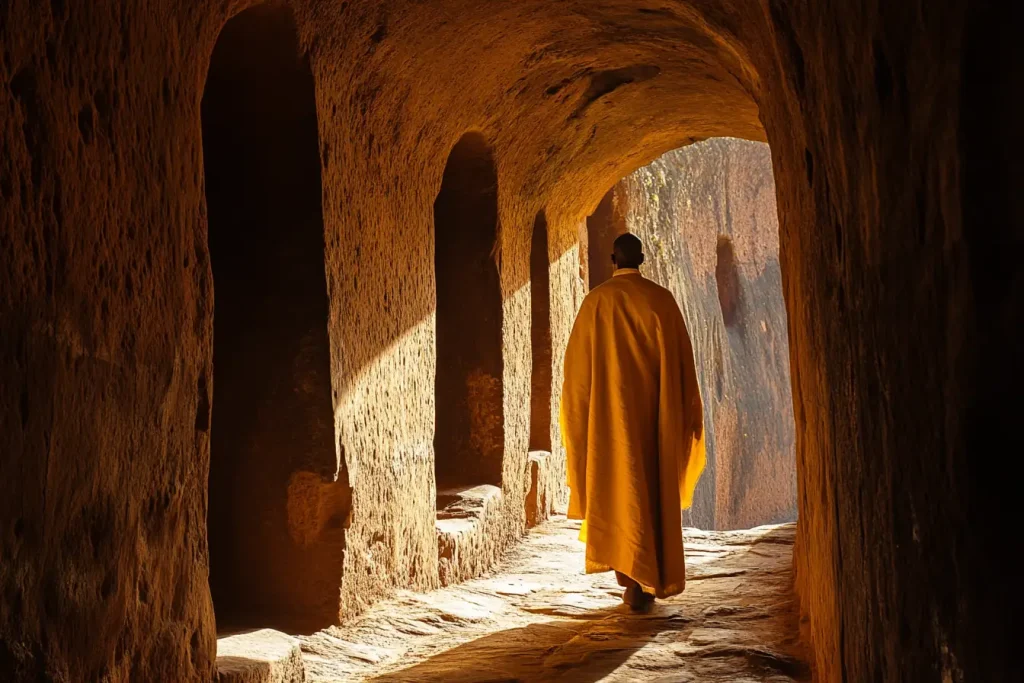
This is the single most powerful thing you can do in Lalibela. Wake up before dawn — 5:30am at the latest — and walk to one of the major churches (Bete Maryam or Bete Giyorgis). The Sunday mass begins in darkness. White-shawled worshippers arrive by the hundreds, some having walked hours from outlying villages. Priests in embroidered robes chant in Ge’ez — an ancient liturgical language that predates Amharic, still used in Ethiopian Orthodox services as Latin was once used in Catholic ones. Drums beat. Incense burns. The sound inside the rock corridors bounces and layered itself in a way that recording equipment cannot capture. You will be one of very few non-pilgrims. You are a witness, not a participant. Stand quietly at the back. This distinction matters.
Getting There from the US
Fly to Addis Ababa Bole International Airport (ADD) via Washington Dulles (United/Ethiopian Airlines direct), New York JFK, or via European hubs (Lufthansa via Frankfurt, Turkish via Istanbul). Round trips typically run $900–1,300 from East Coast cities. From Addis, Ethiopian Airlines flies to Lalibela Airport (LLI) daily in about 45 minutes — book well ahead in peak season, $80–150 one way. The Lalibela airport is 25km from town; arrange a guesthouse transfer or take a shared minibus for ~$3.
Where to Stay
Budget ($25–40/night): Alef Paradise Hotel, centrally located near all the churches, excellent reviews from travelers across budget levels, good breakfast. Tukul Village Hotel is similarly priced with beautiful traditional architecture — locally owned and a great source for guide recommendations.
Mid-range ($70–120/night): Mountain View Hotel — exactly what the name suggests, a terrace with the best view of the surrounding highlands, comfortable rooms, good restaurant.
Splurge ($200+/night): Lalibela Lodge or Hudad Lodge — the latter is a 45-minute hike above town with extraordinary panoramic views and a remote, off-grid atmosphere unlike anything in the town itself.
Practical Tips
Hire a local guide for your first day — they cost about $15–25 USD for a full day and make the historical and spiritual context of each church legible in a way that wandering alone cannot. The ticket office has a guide list; alternatively ask at your guesthouse. A good guide also navigates the protocol at each church — where to remove shoes, which areas are restricted, when services are happening.
The Saturday market in Lalibela town is one of the best in northern Ethiopia: traders from surrounding villages, traditional crafts, grain and spice sellers, donkeys and injera. Go on Saturday morning before the churches.
Frequently Asked Questions
How much does it cost to visit Lalibela churches?
The entrance pass costs $50 USD (2025 price) and covers all eleven churches across all clusters for five consecutive days. There are no single-day or partial tickets. The pass is sold at the ticket office near the Northern Cluster. Additional costs: guide ($15–25/day, strongly recommended), shoe rental at some churches if you forget, photography permit at a few sites.
How do I get from Addis Ababa to Lalibela?
Fly Ethiopian Airlines from Addis Ababa Bole Airport to Lalibela Airport (LLI) — about 45 minutes, $80–150 one way depending on advance booking. Flights are daily. The airport is 25km from Lalibela town; arrange a transfer through your guesthouse ($10–15) or take a shared minibus. Overland is possible but extremely long (12+ hours on rough roads) — only consider if you’re doing a full northern Ethiopia circuit by land.
What should I wear at Lalibela churches?
Shoes must be removed before entering every church — bring socks or be prepared to walk barefoot on carved stone. Shoulders and knees must be covered for both men and women. White clothing is appropriate for services (pilgrims wear it; visitors in white are received warmly). Modest dress throughout the visit is not optional — this is an active place of worship, not a museum.
When is the best time to visit Lalibela?
November through February for dry weather and clear skies. The major religious festivals — Genna (Ethiopian Christmas, January 7th) and Timkat (Epiphany, January 19th) — draw thousands of pilgrims and are extraordinary to witness but extremely crowded. March through June is warm and mostly dry. July and August bring heavy rain that floods some of the underground tunnel passageways. Avoid those months if possible.
Is Ethiopia safe to travel for Americans?
Lalibela and the northern historic circuit have been accessible to tourists throughout most recent periods, though Ethiopia has experienced regional conflicts in other parts of the country (particularly Tigray and Amhara regions). Always check current US State Department advisories before travel — the situation changes. Ethiopian Airlines connections through Addis Ababa to Lalibela avoid ground travel through any affected areas. Verify current security conditions at your time of booking.
