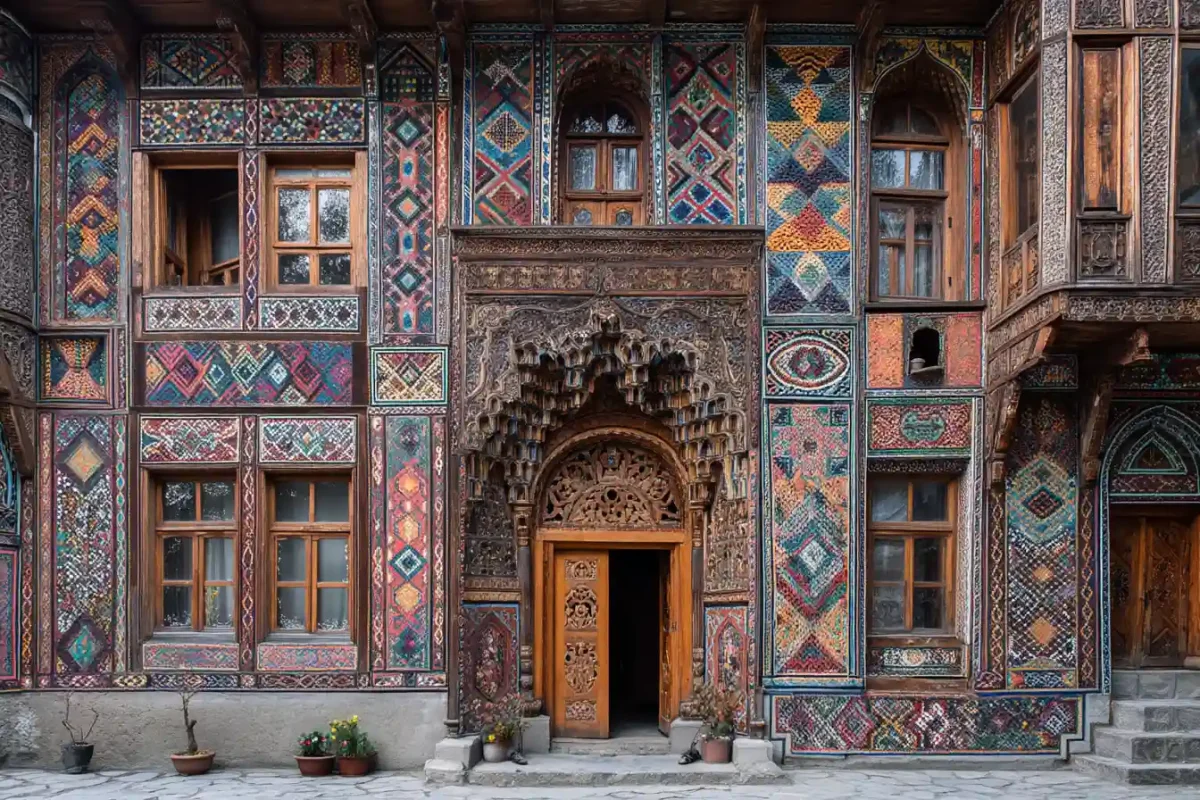
Most people visit Azerbaijan for Baku and leave. The flame towers, the old city, the insane oil money architecture — Baku is worth a few days. But the Azerbaijan that actually sticks with you is six hours northwest in the mountains, in a small city of about 60,000 people where the air smells like wood smoke and hazelnuts, the roads are cobblestone, and the main tourist attraction is a palace where the stained-glass windows were assembled without a single nail or drop of glue.
| Best time to visit | May–June and September–October |
|---|---|
| Getting there | Fly to Baku (GYD), then overnight train or 5-hr bus to Sheki |
| Budget per day | $30–50 USD (mid-range very comfortable) |
| Visa for Americans | eVisa required; apply at evisa.gov.az, $23 USD, issued in 3 days |
| Language | Azerbaijani; Russian useful; English limited outside Baku |
| Currency | Azerbaijani Manat (AZN); 1 AZN ≈ $0.59 USD. Cards at hotels; carry cash |
Is Sheki Worth the Trip?
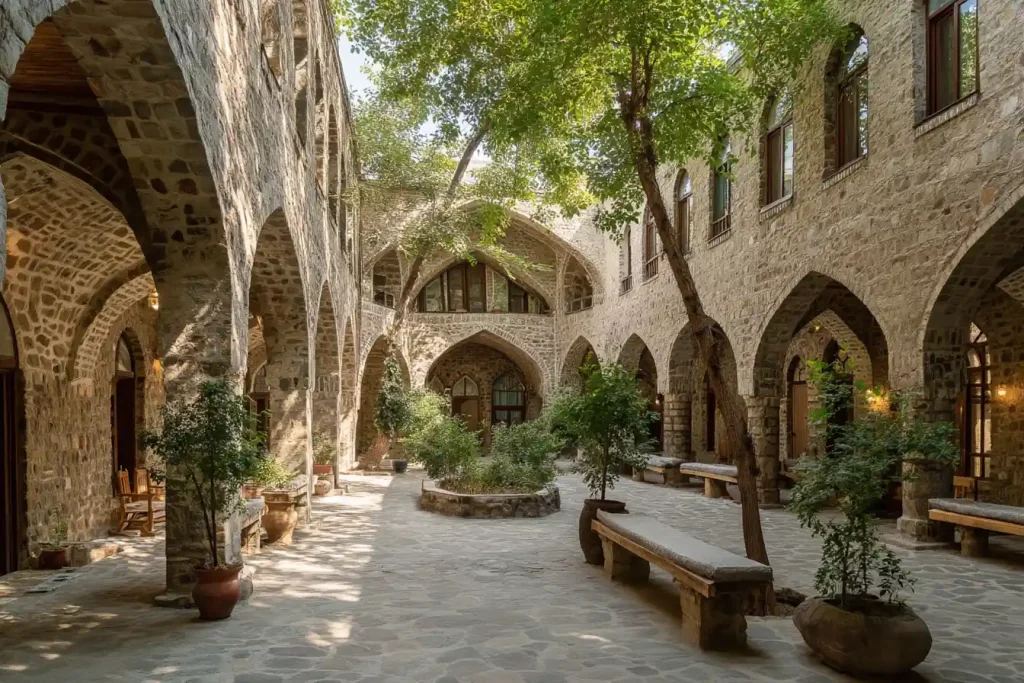
It is the most undervisited genuinely extraordinary place I have been in the Caucasus, and I have been to a lot of Caucasus destinations that claim that title. The Khan’s Palace is not the kind of building that photographs well — the images don’t capture the scale of the handmade shebeke windows, which are thousands of pieces of colored glass assembled into geometric patterns without any binding material. The color hits you when you step inside. That said, the palace itself is small. You’ll be through it in 45 minutes. Sheki earns its extra days from the surrounding streets, the bazaar, the mountain air, and the caravanserai where you can have tea in the same courtyard where Silk Road merchants rested their camels 300 years ago.
The Khan’s Palace
Built in 1762 for Khan Huseyn, the palace is a UNESCO World Heritage Site and the definitive reason to come to Sheki. Entry costs about 5 AZN ($3 USD). Opening hours are roughly 9am–6pm daily, though they can vary — arrive by 10am to beat any groups. Photography is not allowed inside the main hall, which is worth obeying not for the rules but because it forces you to just look at the frescoes rather than stare through a screen. The painted hunting scenes, battle compositions, and Islamic geometric patterns cover the walls floor-to-ceiling. The shebeke windows cast colored light across the tiled floors in a way that changes depending on the time of day. The effect is better in mid-morning light.
The Winter Palace is a separate building a short walk away, smaller and less visited, but worth 20 minutes. Most visitors don’t know it exists.
The Caravanserai
The Upper Caravanserai — Karvansaray in Azerbaijani — was built around 1750 as a roadside inn for Silk Road traders. Today it operates as a hotel and is one of the few places in the world where you can actually sleep where caravans slept. The courtyard is free to enter and wander. Stone archways ring the perimeter. Hooks where merchants tied their horses are still visible in the walls. The tea room at the far end of the courtyard serves excellent black tea in the traditional pear-shaped glass (armudu) for under $1 USD. Sitting there with a glass of tea and the Silk Road architecture around you is one of those travel experiences that actually delivers what it promises.
Rooms at the Karvansaray Hotel run 30–90 AZN ($18–53 USD) per night. Reservations cannot be made online — call or email directly, or book through a Baku travel agent. The rooms are modest by Western standards but completely functional. Staying here is a reasonable choice if the atmosphere matters to you; the mid-range Macara Sheki City Hotel is more comfortable if you prioritize that.
Food in Sheki
Sheki has the most distinctive regional cuisine in Azerbaijan. Two dishes matter most:
Piti is a slow-cooked lamb and chickpea soup served in individual clay pots. Eating it correctly requires instruction — your server will tell you to first break up the bread into the broth, then transfer the solids to a separate bowl and mash them with the fat. The correct place to try it is Buta Restaurant on the main road, where a full piti runs about 8 AZN ($4.70 USD). It’s heavier than it looks. Order one.
Sheki halva (locally called pakhlava) is nothing like the sticky Greek or Turkish versions. It’s a thin, layered crisp confection with walnuts and local honey, formed into diamond shapes. Buy it at Aliahmed sweet shop on the old town’s main pedestrian street — they’ve been making it for generations and it costs about 3–5 AZN per box ($2–3 USD). It survives the trip home in your luggage as a souvenir.
The bazaar near the old town is the best place for cheap food and local color. Grilled kebabs with fresh bread run about $2–3 USD. The walnut, hazelnut, and dried fruit stalls have better quality product than you’ll find in Baku at better prices.
Getting to Sheki from the US
Fly to Baku’s Heydar Aliyev Airport (GYD) — typically routing through Istanbul or Dubai from US cities. Turkish Airlines from New York or LA offers the most convenient connections, with fares around $700–1,100 round trip. From Baku, take the overnight train to Sheki (12 hours, departs late evening, arrives early morning) for about 16–35 AZN ($9–20 USD) depending on class — the modernized trains have proper sleeping berths and the journey itself is pleasant. Alternatively, shared taxis from Baku’s Avtovağzal bus station leave when full (about 5 hours, 20–25 AZN per seat).
Where to Stay
Budget ($18–35/night): Karvansaray Hotel — atmosphere over comfort, but genuinely historic and affordable. Book by phone.
Mid-range ($50–80/night): Macara Sheki City Hotel — modern, comfortable, well-reviewed, 30 minutes’ walk from the Khan’s Palace (or a short taxi ride).
Splurge ($100+/night): Marxal Resort and Spa — a few kilometers outside town in the mountains, views, spa, mountain air. Not historic but a comfortable base.
Best Time to Visit
May and June bring mild temperatures and lush green on the Caucasus foothills. September and October are equally good — the larches turn gold, the air is crisp, and the bazaar fills with autumn nuts and dried fruits. July and August are warm and more crowded with domestic Azerbaijani tourists. Winter is possible but some guesthouses close, and mountain roads can be icy. The overnight train from Baku runs year-round.
Practical Tips
Get your Azerbaijan eVisa before you leave home at evisa.gov.az. The $23 USD fee processes in 3 business days. Your US passport is fine — Americans don’t need anything beyond the standard eVisa.
English is genuinely limited in Sheki. Download Google Translate with Azerbaijani and Russian offline packs before you go. Most guesthouse owners have basic Russian, and a few have English — the Karvansaray Hotel staff can handle basic tourist communication.
Sheki is small. You don’t need more than 2–3 days. The thing most visitors get wrong is rushing it as a half-day trip from Baku — the journey time alone means you should sleep at least one night.
Frequently Asked Questions
How far is Sheki from Baku and how do I get there?
Sheki is about 300km from Baku — roughly 5 hours by shared taxi or 12 hours by overnight train. The train is the more comfortable and scenic option. Shared taxis from Baku’s Avtovağzal station cost 20–25 AZN ($12–15 USD) per seat. The overnight train runs 16–35 AZN ($9–20 USD) depending on berth class.
What is Sheki Khan’s Palace?
An 18th-century summer residence built for Khan Huseyn Mushtaq, famous for its shebeke stained-glass windows assembled without nails or glue, and its elaborate painted frescoes depicting hunting scenes and Islamic geometric patterns. A UNESCO World Heritage Site since 2019. Entry is about $3 USD.
Can you stay in the Sheki Caravanserai?
Yes. The Karvansaray Hotel operates inside the restored Upper Caravanserai. Rooms run 30–90 AZN ($18–53 USD) per night. Booking must be done by phone or email — no online booking system. It’s modest but genuinely atmospheric.
Do I need a visa for Azerbaijan as an American?
Yes. Apply for an eVisa at evisa.gov.az before traveling. Cost is $23 USD, approved within 3 business days. Single-entry, valid for stays up to 30 days. Do not try to get a visa on arrival — it’s not guaranteed and causes delays.
What food should I try in Sheki?
Piti (slow-cooked lamb soup in clay pots) at Buta Restaurant (~$5 USD per bowl) and Sheki pakhlava (thin layered pastry with walnuts and honey) from Aliahmed sweet shop (about $2–3 USD per box). Both are regional specialties you won’t find with the same quality elsewhere in Azerbaijan.
